
Last updated: May 16, 2026
In this article
- The Short Answer on Cats and Bok Choy Leaves
- What Is Bok Choy?
- Why Bok Choy Leaves Are Safer Than Stems
- Brassica Concerns: Goitrogens and Isothiocyanates
- Safe Serving Size and Preparation
- When to Skip Bok Choy Entirely
- How Bok Choy Compares to Other Greens for Cats
- Why Cats Don’t Need Vegetables at All
- Symptoms to Watch For After Bok Choy
- What to Avoid Completely
- Sharing Greens at Home — Practical Tips
- Frequently Asked Questions
The Short Answer on Cats and Bok Choy Leaves
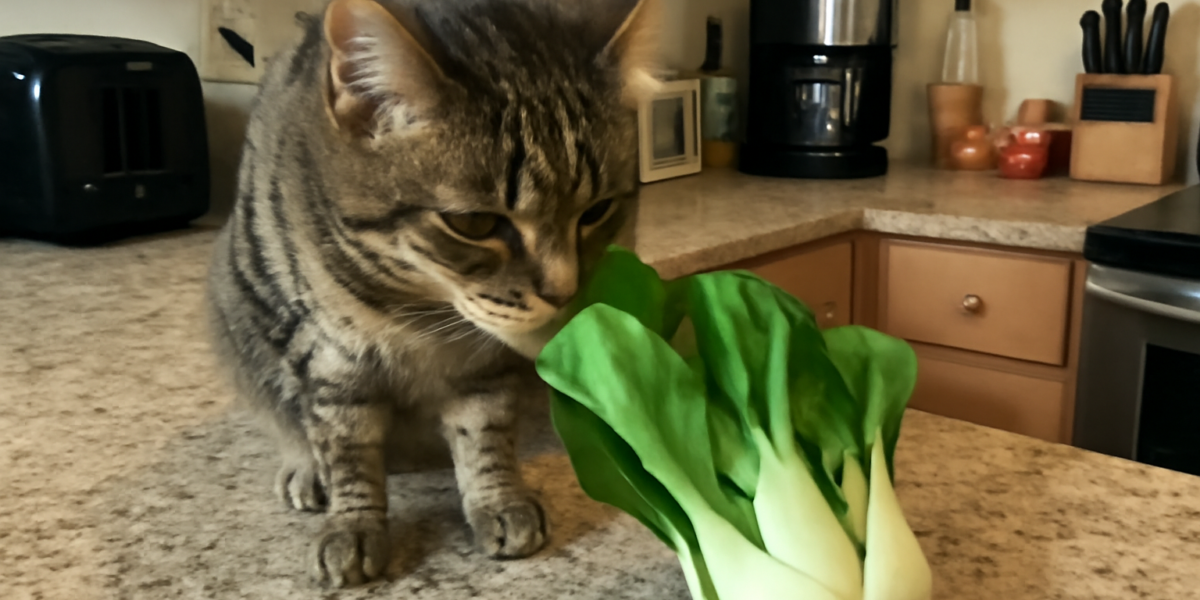
Cats can eat bok choy leaves in tiny amounts as an occasional treat, with the leaves cooked plain and unseasoned. Bok choy (Brassica rapa subsp. chinensis) is an Asian leafy brassica in the cabbage family. The dark-green leaves are softer and more digestible than the white stems, which are fibrous and harder for a small carnivore to break down. Plain steamed or boiled leaves, chopped finely and offered in pea-sized portions, are generally well tolerated by healthy adult cats.
That said, cats are obligate carnivores and do not need vegetables. The answer to “can cats eat bok choy leaves” is technically yes in moderation, but they offer no nutritional value your cat cannot get from a complete and balanced cat food. The main reason to share a tiny piece would be enrichment or a curious cat who shows interest while you cook. Skip bok choy entirely if your cat has thyroid issues, IBD, or a sensitive stomach.
What Is Bok Choy?
Bok choy, also spelled pak choi, is a leafy Chinese cabbage with white or pale green stems and dark green spoon-shaped leaves. It is a staple in Chinese, Korean, and broader East and Southeast Asian cooking, used in stir-fries, soups, dumpling fillings, and as a side vegetable. It is closely related to napa cabbage, mustard greens, kale, and broccoli — all members of the Brassica genus.
Nutritionally, bok choy is low in calories and high in vitamin A, vitamin C, vitamin K, calcium, folate, and beta-carotene. It also contains glucosinolates, sulfur-containing plant compounds that break down into isothiocyanates when chewed or cooked. Isothiocyanates are responsible for both the slight peppery taste of brassicas and most of the digestive concerns in pets.
Why Bok Choy Leaves Are Safer Than Stems
The white stems of bok choy are crunchy, fibrous, and water-rich — great for human stir-fries but a poor match for feline GI tracts. Cats have short digestive systems built for animal protein, not for breaking down crunchy plant fiber. Stems can cause chewing difficulty, partial obstruction in small cats, or simply pass through undigested and irritate the bowel.
The leaves are softer, especially when cooked. They wilt down to a manageable texture and are easier for a cat’s intestines to handle. If you decide to offer any bok choy to your cat, stick with the leafy portion only. Trim the white stem out and discard or save it for your own dish. Chop the leaves finely so your cat does not try to swallow a long ribbon.
Brassica Concerns: Goitrogens and Isothiocyanates
All brassicas contain goitrogens — compounds that, in large amounts, can interfere with thyroid hormone production by blocking iodine uptake. Hyperthyroidism is the more common feline thyroid problem (affecting roughly 10 percent of cats over age 10), but hypothyroidism does occur in cats with thyroid surgery or radioactive iodine treatment history. For these cats, regular brassica ingestion is a small additional stressor on an already unstable thyroid system.
Isothiocyanates are released when brassica plant tissue is damaged by chewing or cutting. In humans they have a peppery, mustardy flavor. In cats and dogs, large amounts can cause gas, bloating, and GI upset. Cooking deactivates a portion of these compounds, which is why steamed or boiled leaves are preferred over raw. Pickled or fermented bok choy (like the white-stem version of kimchi) is also off the table because of added salt, garlic, and chili peppers.
Safe Serving Size and Preparation
For a healthy adult cat with no thyroid, IBD, or GI history, here is the safest way to offer bok choy leaves.
- Wash one or two leaves thoroughly to remove dirt and any pesticide residue
- Trim out the white stem and use only the green leafy portion
- Steam or boil for 2 to 3 minutes until just wilted
- Cool completely and chop finely
- Offer a pea-sized to thumbnail-sized portion (no more than half a teaspoon)
- Plain only — no salt, oil, garlic, soy sauce, or other seasonings
- Limit to once a week or less
Avoid raw bok choy leaves — they are tougher and contain more active goitrogens and isothiocyanates. Avoid stir-fried bok choy because it is almost always cooked with garlic, onion, soy sauce, sesame oil, and salt. Garlic and onions are toxic to cats; see our garlic safety guide and onion guide for details.
When to Skip Bok Choy Entirely
Some cats should never have bok choy or any other brassica. These include cats with documented hyperthyroidism or hypothyroidism, cats with inflammatory bowel disease (IBD) or a history of vomiting and diarrhea after vegetables, cats with chronic kidney disease who are on a renal diet (the calcium and vitamin K content can interfere), kittens under 12 months whose digestive systems are still developing, and cats currently on warfarin or any anticoagulant due to vitamin K interference.
For cats with IBD specifically, see our feline IBD guide — fiber from any plant source can flare GI symptoms. Cats with kidney disease (about 30 to 50 percent of seniors) should follow the diet recommendations in our CKD guide rather than ad-hoc vegetable additions.
How Bok Choy Compares to Other Greens for Cats
Among leafy greens, bok choy leaves sit in the middle of the safety spectrum for cats. Spinach is high in oxalate and worse for cats with kidney or urinary stone history. Kale is more goitrogenic and tougher. Lettuce is mostly water and very mild. Cooked plain bok choy leaves are roughly equivalent to plain steamed napa cabbage or plain cooked broccoli florets — tolerable in tiny amounts, not nutritionally needed.
For cats specifically, our general bok choy guide covers the whole-vegetable picture (stems and leaves together). The leaf-only approach in this article is the more cat-friendly preparation. Other vegetable safety guides include okra and the parallel bitter melon discussion.
Why Cats Don’t Need Vegetables at All
It bears repeating because of how often cat owners are tempted to “round out” a cat’s diet with vegetables: cats are obligate carnivores. Their evolved physiology requires animal protein and animal-derived nutrients. Specifically, cats require dietary taurine (synthesized from animal sources only), arachidonic acid (animal-only), preformed vitamin A (cats cannot convert beta-carotene efficiently), and vitamin D from animal fat or supplemented food. None of these come from bok choy.
A complete and balanced commercial cat food provides everything your cat needs. Treats — including vegetables — should account for less than 10 percent of daily calories. If you want to add enrichment, food puzzles stretch out kibble or wet food in a way that is more rewarding to cats than vegetables. Indoor exercise routines are another way to engage indoor cats without altering diet.
Symptoms to Watch For After Bok Choy
Most cats tolerate a tiny amount of cooked bok choy leaves with no issue. Symptoms to watch for over the next 12 to 24 hours include the following.
- Vomiting, especially if leaves were eaten raw or in volume
- Diarrhea or unusually soft stool
- Excessive gas or bloating
- Lethargy or refusal to eat the next meal
- Pawing at the mouth or excessive drooling
Mild symptoms usually resolve on their own with bland food (plain boiled chicken) and water for 24 hours. Persistent vomiting, repeated diarrhea, or any sign of distress warrants a vet call. Cats with thyroid disease who eat brassicas regularly should have their thyroid panel rechecked.
What to Avoid Completely
Some bok choy preparations are never safe for cats and should be kept out of reach.
- Stir-fried bok choy with garlic, onion, soy sauce, or sesame oil
- Bok choy in dumpling fillings (often contain garlic, ginger, soy)
- Pickled bok choy or kimchi-style preparations (high salt, garlic, chili)
- Bok choy soup with bouillon or stock cubes (high sodium)
- Raw bok choy stems (fibrous, harder to digest)
- Bok choy with butter or oil (high fat, GI upset risk)
Cats are surprisingly drawn to greasy, savory smells from human stir-fries, so manage countertop access during cooking. A cat that grabs a piece of garlic-laden bok choy faces an allium-toxicity issue, not a bok choy issue.
Sharing Greens at Home — Practical Tips
Cats that show interest in your salad or stir-fry are often demonstrating curiosity rather than nutritional need. If you want to channel that interest into something safer than human-cooked vegetables, cat grass is the best option. Cat grass is typically oat, wheat, barley, or rye grown in shallow trays and sold at pet stores. It is purpose-grown for safe cat nibbling, contains some folate and chlorophyll, and gives cats a satisfying textural experience without the goitrogen, salt, or seasoning concerns of human leafy greens.
If you cook bok choy for the family and want to share a tiny taste with your cat, do it before adding seasonings. Set aside one or two leaves at the start of cooking, steam them plain in a small ramekin, and offer a chopped pea-sized portion. The rest of the bunch can be cooked normally with garlic, soy sauce, sesame oil, and salt for human consumption — just keep the human dish out of cat reach. This approach gives the cat the novelty without the toxins.
Watch your cat’s body condition over time. If you find yourself sharing several different vegetables with your cat each week, those calories add up and can shift the balance away from the species-appropriate cat food they need. Treats and extras should stay under 10 percent of total daily calories. For most cats, that means very small portions of any human food, no matter how “healthy” it seems for humans.
Frequently Asked Questions
How much bok choy can my cat have?
A pea-sized to thumbnail-sized piece of plain cooked leaves once a week or less. Treats overall should stay under 10 percent of daily calories.
Are raw bok choy leaves dangerous?
Not acutely toxic, but tougher to digest and higher in active goitrogens and isothiocyanates than cooked. Cooked is safer if you choose to share.
My cat keeps trying to eat my plant. Is bok choy a safe house plant?
Bok choy is not commonly grown indoors, but if you do, the leaves are non-toxic. Cats nibbling at house plants often need more enrichment — try cat grass (oat, wheat, or barley) instead, which is purpose-grown for safe nibbling.
Can kittens eat bok choy?
Kittens should stick to a complete kitten food and avoid all vegetable extras. See our kitten feeding guide for what to offer instead.
What if my cat has hyperthyroidism?
Skip all brassicas including bok choy. Goitrogens are not helpful for any thyroid disorder. Stick to your vet’s prescribed diet plan.


