
Last updated: May 16, 2026
In this article
- Boneset and Pets: The Honest Answer
- Boneset Versus Joe-Pye Weed — Critical Distinction
- The Pyrrolizidine Alkaloid Chemistry
- Severity Tier and Symptoms
- What To Do If Your Pet Chewed Boneset
- Boneset’s Folk-Medicine History (and Why It Matters Here)
- Where Boneset Grows in the Yard
- Removing Boneset From a Pet Yard
- Safe-for-Pets Native Alternatives
- Other Plants in the PA Category
- Frequently Asked Questions
Boneset and Pets: The Honest Answer
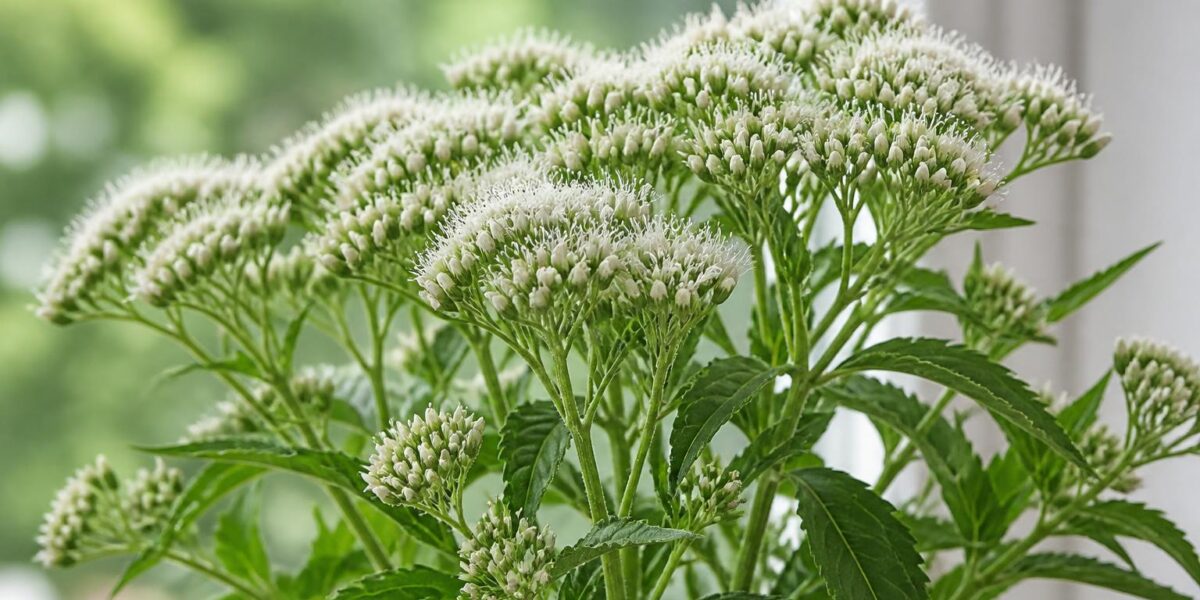
Boneset, the white-flowered native of wet meadows and ditch edges with leaves that appear pierced by the stem, is toxic to pets. Botanically known as Eupatorium perfoliatum, boneset contains pyrrolizidine alkaloids — a class of compounds that are hepatotoxic (liver-damaging) at sustained or significant exposures. The American Society for the Prevention of Cruelty to Animals (ASPCA) lists Eupatorium species as toxic, and the chemistry of boneset specifically supports that classification.
This article uses boneset plants toxic to pets as the focus phrase because that is what owners type when they identify the white-flowered plant in their meadow garden and start to wonder. Pyrrolizidine alkaloid (PA) toxicity is in a particular category — typically chronic rather than acute, and disproportionately damaging to the liver — which makes the framing slightly different from the cardiac-glycoside or calcium-oxalate toxicities that drive most pet-poisoning headlines.
If you are reading this because you grow boneset deliberately for its native-plant value or its herbal-medicine history, you are not alone. Boneset has a long and respected place in folk medicine. But the chemistry that drives its medicinal use also drives its pet-toxicity profile, and a pet in an unsupervised yard does not have the dosing guardrails that careful human use depends on. Treat boneset as a toxic plant in pet households.
Boneset Versus Joe-Pye Weed — Critical Distinction
The single most important pet-safety clarification for boneset is the distinction from Joe-Pye weed. Until the early 2000s, both plants were classified in the same genus — Eupatorium — and they have a long history of being confused with each other in older garden literature. The 2010 reclassification moved the Joe-Pye weeds into a new genus, Eutrochium, and left boneset and a few other plants behind in Eupatorium.
The pet-safety implications:
- Boneset (Eupatorium perfoliatum) — TOXIC. Pyrrolizidine alkaloids; hepatotoxic. ASPCA lists Eupatorium as toxic.
- Joe-Pye weed (Eutrochium purpureum, E. fistulosum, E. maculatum) — not on the ASPCA toxic list; generally considered safe. See are Joe-Pye weed safe for pets for the full safe-plant framing.
If you are reading older garden books or herbal references, both plants get called “Eupatorium” and the reader has to figure out from context which is which. Distinguishing features in the yard:
- Boneset: opposite leaves joined at the base around the stem (the “perfoliatum” feature — leaves look pierced by the stem); white flowers; flatter flowerheads; height 2 to 4 feet; prefers wet soils.
- Joe-Pye weed: whorled leaves in groups of 3 to 7; pink to mauve flowers; dome-shaped flowerheads; height 4 to 9 feet; prefers moist to wet soils.
If you have white flowers and pierced-stem leaves, you have boneset, and you have a toxic plant.
The Pyrrolizidine Alkaloid Chemistry
Pyrrolizidine alkaloids (PAs) are a class of plant-defense compounds produced by several genera of plants — Eupatorium, Senecio (groundsel, ragwort), Symphytum (comfrey), Crotalaria, Heliotropium, and others. The toxicity mechanism is hepatic: PAs are bioactivated in the liver into reactive metabolites called pyrroles, which bind covalently to liver proteins and DNA. The damage is cumulative.
This is what makes PA toxicity different from most acute pet poisonings. With cardiac glycosides or calcium oxalates, you are watching for an immediate-onset clinical event. With PAs, the toxicity tends to be sub-clinical at first — the liver absorbs damage that a pet-owner would not notice — and only declares itself once enough hepatic injury has accumulated to produce signs of liver dysfunction. Those late signs include weight loss, jaundice (yellowing of the gums or eyes), ascites (fluid in the abdomen), neurologic changes, and eventually liver failure.
The realistic-clinical-severity tier for boneset ingestion is moderate. A single mouthful of leaf material from a one-time exposure is unlikely to produce acute hepatic failure in a healthy adult dog or cat. But a pet who grazes boneset repeatedly over weeks — for example, a dog with daily yard access to a meadow where boneset grows wild — can accumulate hepatic damage over time, and the damage is not always reversible by the time clinical signs appear.
Severity Tier and Symptoms
Acute (single significant ingestion) symptoms typically include:
- Drooling, vomiting, diarrhea (often within hours).
- Loss of appetite.
- Lethargy.
Chronic / repeated-exposure symptoms (which may not declare for weeks or months) include:
- Progressive weight loss despite normal appetite.
- Jaundice — yellow tint to the gums, the whites of the eyes, the skin in lightly furred areas.
- Ascites — visible swelling of the belly with fluid.
- Neurologic signs from hepatic encephalopathy — disorientation, head pressing, circling, seizures.
- Coagulopathy — easy bruising, prolonged bleeding from minor cuts.
The cats-versus-dogs distinction matters. Cats are generally more susceptible to hepatic toxins than dogs because of their reduced glucuronidation capacity (a phase-2 detoxification pathway that mammals use to clear many xenobiotics). A cat exposed to PAs has fewer detox tools than a dog of equivalent size.
What To Do If Your Pet Chewed Boneset
For a known acute exposure, call your veterinarian or one of the 24-hour poison-control lines promptly. PA toxicity does not typically need the immediate emergency intervention that a cardiac-glycoside ingestion does — there is rarely an in-the-next-hour life-threatening situation — but a documented exposure benefits from documented baseline liver values and a follow-up plan. Recommended calls:
- Your own veterinarian or the nearest emergency veterinary hospital. They can run a baseline liver panel (ALT, AST, ALP, GGT, bilirubin, bile acids) so any later changes have a comparison point.
- The ASPCA Animal Poison Control Center at 888-426-4435 (per-call fee).
- The Pet Poison Helpline at 855-764-7661 (per-incident fee, 24 hours, staffed by veterinary toxicologists).
If you can do so safely, take a sample or a clear photo of the plant — leaf with the perfoliate stem-pierced arrangement, flowerhead, full-plant context. Bring an estimate of how much was eaten and approximately when. The PA category is one where the documentation pays off later.
Boneset’s Folk-Medicine History (and Why It Matters Here)
Boneset has been used for centuries in folk medicine, particularly in colonial-era American practice for fevers — the common name “boneset” reportedly comes from its use against “break-bone fever” (an old name for influenza or dengue, where joint pain felt like fractured bones). Native peoples of the eastern woodlands used boneset preparations medicinally, and 19th-century Eclectic physicians prescribed it widely.
Why this matters for pet safety: the herbal-medicine tradition is real, but it depends on careful preparation, dose control, and the fact that human users self-monitor for warning signs. None of those guardrails exist in a yard. A pet does not know the dose, cannot self-monitor, and may continue to graze if the plant is palatable.
Modern herbal practice has moved away from boneset for unsupervised internal use specifically because of the PA hepatotoxicity concern. Even careful adult human use is now generally short-term and topical rather than long-term internal. If trained herbalists have stepped back from chronic boneset use because of PA chemistry, that is a strong signal that an unsupervised pet should not be grazing it either.
Where Boneset Grows in the Yard
Boneset is a wet-meadow native. It tolerates damp soils, ditch edges, the margins of rain gardens, and naturalized wet areas. If you planted it deliberately, you probably know where it is. If it has volunteered on your property, it is most likely showing up in:
- Low spots where water collects.
- Drainage easements and ditches along property lines.
- Edges of ponds, streams, or wetland areas.
- Naturalized meadow areas you don’t mow.
Identification check, again: white flowers, pierced-stem leaves (you can almost slide a finger through where the stem appears to go through the leaf), 2 to 4 feet tall, blooming late summer through early fall. If you find this plant in an area your dog accesses unsupervised, removing or fencing the patch is the simpler management move than trying to teach a dog not to graze.
Removing Boneset From a Pet Yard
If you are not committed to keeping boneset for native-plant or pollinator reasons, removing it is straightforward. Pull young plants by hand in spring when soils are wet (the root system is fibrous but not deep). For mature established plants, dig out the crown and root mass; boneset does not regrow aggressively from root fragments the way some weeds do.
Bag and dispose of pulled plant material rather than leaving piles in the yard. A wilting heap of pulled boneset is a temptation for a curious dog and a hazard for a couple of weeks until it fully decomposes. The PAs do degrade over time but remain biologically active during decomposition.
Do not burn boneset on a backyard fire if you have pets or sensitive humans in the household — smoke from PA-containing plants can carry irritant compounds. Bagging for municipal yard-waste pickup is the cleaner option.
Safe-for-Pets Native Alternatives
If you wanted boneset for its late-summer white bloom and pollinator value, there are pet-safe native alternatives that fill a similar ecological niche. Joe-Pye weed is the obvious one — it bloomed at the same time, supports the same pollinator complex, and is the genus that boneset used to belong to. Ironweed blooms purple in the same season. Goldenrod blooms yellow in early fall.
For broader pet-safe pollinator-garden design, our coverage of coneflower, bee balm, liatris, and agastache covers the rest of the season. None of those plants are on the ASPCA toxic list.
Other Plants in the PA Category
Pyrrolizidine alkaloids show up in several plant genera you might encounter elsewhere on your property. Awareness of the broader category helps you not stack risk:
- Senecio species — common ragwort, groundsel. Some species are widespread weeds.
- Crotalaria species — rattlepods.
- Heliotropium species — heliotrope.
- Symphytum officinale — comfrey, sometimes grown as a herb. PA content varies; the modern herbal world has moved away from internal comfrey use.
- Echium species — viper’s bugloss / Patterson’s curse.
If your yard has any of these alongside boneset, the cumulative PA exposure for a grazing pet is higher than any one plant alone. This is one of those “manage the category, not just the individual plant” situations.
Frequently Asked Questions
My dog ate one leaf of boneset two weeks ago and seemed fine. Should I be worried?
A single small ingestion in a healthy adult dog is unlikely to produce clinical liver disease. The concern with PAs is repeated or large exposures. If the exposure was a one-time leaf and your dog has shown no symptoms, the realistic risk is low. If you want documentation, ask your vet to run a baseline liver panel — that gives you something to compare against if a future exposure happens or if any signs develop.
How is boneset different from Joe-Pye weed if they used to be the same genus?
They were reclassified in the early 2000s based on molecular phylogenetic work that showed the Joe-Pye weeds (now Eutrochium) are distinct from true Eupatorium. Boneset (Eupatorium perfoliatum) has the pyrrolizidine alkaloid chemistry that drives toxicity; Joe-Pye weed (Eutrochium) does not produce significant PAs and is not on the ASPCA toxic list. Visually: white flowers / pierced-stem leaves = boneset = toxic. Pink-mauve flowers / whorled leaves = Joe-Pye = safe. See are Joe-Pye weed safe for pets.
Can I keep my boneset if I fence it off from my dog?
Yes — that is a reasonable compromise if you value the plant for its pollinator and native-meadow contribution. Make sure the fencing is dog-proof (not just deer-fence) and that your pet does not have access during yard-cleanup or weeding. Remove and bag any debris that lands outside the fenced area.
What about cats and boneset specifically?
Cats are generally more susceptible to hepatotoxins than dogs because of reduced glucuronidation capacity, so cat exposures should be taken seriously even at smaller volumes. Indoor-only cats are not at risk; indoor-outdoor cats with access to a yard containing boneset should have the boneset removed or fenced.
Are pyrrolizidine alkaloids in honey from bees that visited boneset?
That is an active question in human food-safety research and not something pet owners typically need to act on directly. Honey from bees foraging on PA-rich plants can contain trace levels of PAs, but the levels in commercial honey are well below toxicity thresholds and are not a typical pet-poisoning route. If you have specific concerns about a known boneset-heavy honey, ask your vet — but this is not the boneset-toxicity pathway you need to manage. Manage the plant in the yard, where exposure routes are direct.


