
Last updated: May 16, 2026
In this article
- Ironweed and Pets: The Reassuring Answer
- Why Ironweed Is Not on the Toxic List
- Common Garden Vernonia Species
- Pollinator Value
- Planting and Garden Design
- What If My Pet Eats Some Ironweed?
- Mechanical and Practical Cautions
- Common Vernonia Misidentifications
- Pet-Safe Native Garden Design Template
- Frequently Asked Questions
Ironweed and Pets: The Reassuring Answer
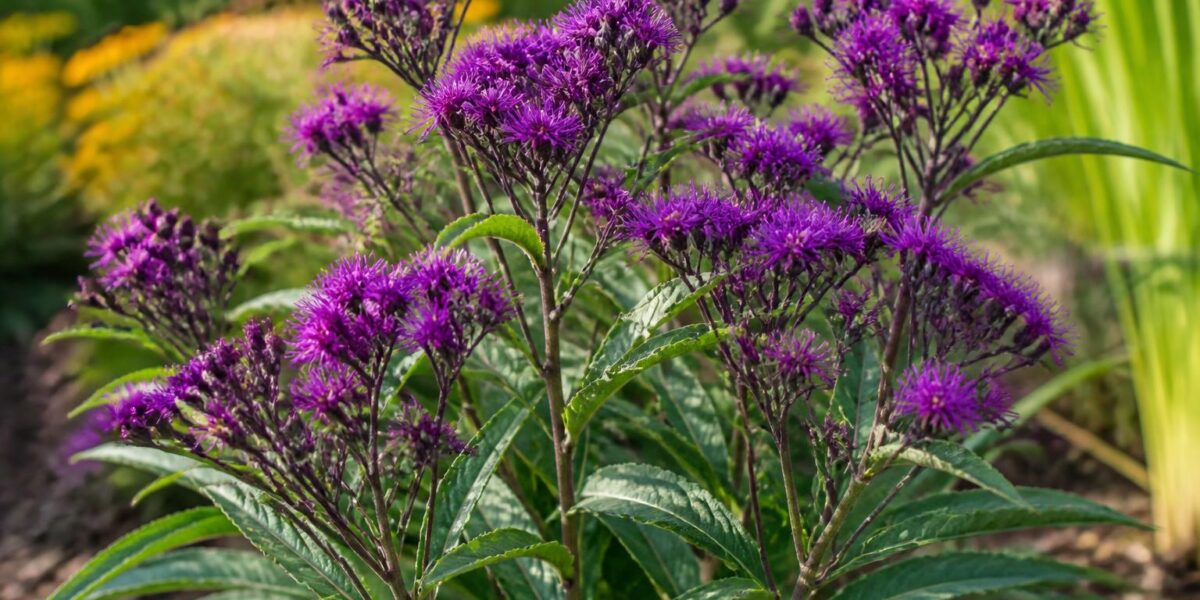
If the tall plumes of vivid magenta-purple flowers at the back of your late-summer perennial border are ironweed, here is the short version: ironweed is not listed by the American Society for the Prevention of Cruelty to Animals (ASPCA) as toxic to dogs or cats, and ironweed plants are generally considered safe for pets. The genus is Vernonia, the common garden species are V. noveboracensis (New York ironweed), V. fasciculata, V. baldwinii, V. lettermannii, and V. arkansana, and none of them carry a toxicity profile that warrants a database entry.
This article uses ironweed plants safe for pets as the focus phrase. Ironweed is one of those plants that fits cleanly into the safe-native-pollinator category — alongside Joe-Pye weed, goldenrod, coneflower, and bee balm — and it is one of the more visually striking choices in that group thanks to the deep saturated purple of its flowers.
As with any non-toxic plant, “safe for pets” means safe in the sense the ASPCA uses the term: not known to cause systemic poisoning in dogs or cats. It does not mean a pet can graze unlimited amounts as a snack. Bulk leaf material can produce mild GI upset (vomiting or soft stool) purely from volume, and that is the standard caveat that applies to almost any leafy ornamental.
Why Ironweed Is Not on the Toxic List
Ironweed (Vernonia) is in the Asteraceae family, the same broad family that contains both the safe-for-pets pollinator perennials (coneflower, helianthus, gaillardia, coreopsis) and the toxic ones (chrysanthemum, mums, Shasta daisy). What separates the safe from the toxic within Asteraceae is mostly whether the plant produces sesquiterpene lactones — the pyrethrin-related compounds that drive chrysanthemum toxicity.
Ironweed does produce some sesquiterpene-class compounds at low concentrations, and a few Vernonia species in tropical Africa are used in folk medicine for their bitter-principle chemistry. But the levels in the ornamental species commonly grown in North American gardens are not at concentrations that produce companion-animal toxicity, and ironweed has never made the ASPCA toxic-plant list.
For comparison, the genuinely toxic Asteraceae plants — see chrysanthemums and mums for cats — produce pyrethrin-related compounds at concentrations that cause vomiting, drooling, dermatitis, and in severe cases ataxia. Ironweed does not. It sits in the same family but in a different chemistry neighborhood.
Common Garden Vernonia Species
The species and cultivars you are most likely to encounter:
- Vernonia noveboracensis (New York ironweed) — the classic eastern tall ironweed, 5 to 7 feet, prefers moist soils, deep purple flowers in late summer.
- Vernonia fasciculata (prairie ironweed / common ironweed) — Midwestern native, slightly shorter, similar bloom and color.
- Vernonia baldwinii (Baldwin’s ironweed) — Great Plains and Ozark species, drought-tolerant.
- Vernonia lettermannii (Letterman’s ironweed) — fine-textured narrow leaves, more compact (3 to 4 feet), drought-tolerant. Cultivar “Iron Butterfly” is widely sold.
- Vernonia arkansana (Arkansas ironweed) — narrower leaves than V. noveboracensis, tall.
From a pet-safety standpoint, all Vernonia species fall under the same not-on-toxic-list framing. The species choice is a horticultural decision based on your soils, sun, and space, not a pet-management decision.
Pollinator Value
Ironweed is one of the highest-value late-summer pollinator perennials in eastern and midwestern North America. The deep-purple flowerheads attract:
- Native bees, particularly bumblebees and longhorned bees.
- Butterflies — swallowtails, monarchs (as nectar), painted ladies, fritillaries.
- Hummingbird moths.
- Honeybees.
The blooming overlaps with Joe-Pye weed, goldenrod, and milkweed seed-set, making ironweed a natural design partner for any of those plants. In a pet household, pairing ironweed with the other safe natives (Joe-Pye, goldenrod, coneflower, liatris) gives you a fully ASPCA-non-toxic late-summer pollinator bed.
If you also want to include a milkweed (Asclepias) for monarch larval support, see are Asclepias plants toxic to pets; milkweed is the toxic exception in this otherwise pet-safe planting palette and benefits from a fenced or back-of-bed station.
Planting and Garden Design
Ironweed is a tall back-of-border plant. New York ironweed at 5 to 7 feet, and V. fasciculata or V. baldwinii at 4 to 6 feet, anchor the deepest part of a perennial bed. The compact “Iron Butterfly” (V. lettermannii) at 3 to 4 feet works in mid-border. None of the species are aggressive spreaders in the way some goldenrods are; ironweed stays in clumps and increases gradually.
Planting partners that work well in pet households:
- Joe-Pye weed — same height, contrasting pink-mauve flower color.
- Helianthus (perennial sunflower) — bright yellow, similar height. See helianthus pet safety.
- Goldenrod — bright yellow, slightly shorter, prolific bloom.
- Switchgrass (Panicum virgatum) — gives airy textural contrast.
- Aster — late-fall purple/blue/white bloom that extends the season. (Note: there is no ironweed-aster cross-link on our site at present, so the recommendation stands as design advice without a hyperlink.)
For mid- and front-of-border pet-safe options to layer in front of ironweed: coneflower, liatris, coreopsis, gaillardia, and penstemon.
What If My Pet Eats Some Ironweed?
For a typical incidental graze, the realistic outcome is no symptoms or at most mild and self-limiting GI upset. The leaves are coarse and bitter; most pets find them disagreeable on first taste and don’t return. Some dogs will mouth a stem the way they mouth grass, and that is generally uneventful.
If your pet ate a substantial amount of ironweed leaves, you may see:
- One or two episodes of vomiting (volumetric, not chemical).
- Soft stool or one day of diarrhea.
- Brief loss of appetite.
This is the standard mild-mechanical-GI-upset profile that applies to almost any non-toxic leafy plant. Resolution is typically self-limiting within 24 hours.
Call your vet or a poison-control line if you see:
- Repeated vomiting (more than two or three episodes).
- Persistent diarrhea, or any blood in the stool.
- Lethargy, weakness, or refusal to eat or drink for more than a day.
- Any neurologic sign (wobbliness, tremors, dilated pupils) — these would NOT be expected from ironweed and would suggest your pet ate something else as well.
The 24-hour helplines available are: ASPCA Animal Poison Control Center at 888-426-4435 (per-call fee) and Pet Poison Helpline at 855-764-7661. Both are staffed by veterinary toxicologists.
Mechanical and Practical Cautions
A few practical considerations that apply to ironweed even though it is not chemically toxic:
Mature New York ironweed at 7 feet can lean and topple in storms. Stake or position to one side of high-traffic pet zones. The stems are not sharp or hazardous in themselves — “ironweed” refers to the toughness of the stems, not to spines or thorns — but a 7-foot plant falling on a small dog is a mechanical concern.
The flowers attract bees. Pets who chase or snap at insects can pick up stings near actively blooming ironweed, the same as with any pollinator-attractor. Supervise during peak bloom if your pet is a known bee-snapper.
The seedheads in late fall are messy and self-seed readily. Volunteers can show up in lawn or in nearby beds. Volunteers are not chemically dangerous to pets, just garden-management work.
Common Vernonia Misidentifications
A few plants people sometimes confuse with ironweed in the yard:
- Joe-Pye weed — different color (pink-mauve vs. ironweed’s deep purple), dome-shaped flowerheads vs. ironweed’s looser clusters, whorled leaves vs. ironweed’s alternate. Both safe-for-pets, so misidentification is low-stakes here. See are Joe-Pye weed safe for pets.
- Boneset — same height as some ironweeds, but white flowers and pierced-stem leaves rather than purple flowers and alternate leaves. Boneset IS toxic — see are boneset plants toxic to pets. The difference matters here.
- Asters — generally shorter, ray-flower daisy form vs. ironweed’s all-disk-flower fluffy heads. (We do not currently have an aster-specific article; the design context is non-binding.)
If you have a tall, deep-purple, late-summer plant with alternate willow-like leaves and clustered fluffy flowerheads (no ray flowers), it is almost certainly Vernonia (ironweed) and you are looking at a safe-for-pets plant.
Pet-Safe Native Garden Design Template
A complete late-summer pollinator garden built around ironweed and other safe natives:
- Back row (5 to 7 feet): New York ironweed, Joe-Pye weed, perennial sunflower.
- Middle row (3 to 5 feet): “Iron Butterfly” ironweed cultivar, goldenrod, coneflower, bee balm, agastache.
- Front row (1 to 3 feet): liatris, coreopsis, gaillardia, penstemon.
- Edge: yarrow if you want to mix in another low-spreader (note: yarrow is on the toxic list — see the article for context if you want to include it).
That stack covers continuous bloom from June through October, supports a full pollinator complex, and (with the noted yarrow caveat) contains nothing on the ASPCA toxic-plant list. For broader cat and dog plant guidance, see our cat-safe houseplants guide for the indoor companion to your outdoor planting.
Frequently Asked Questions
Is ironweed safe for cats specifically?
Yes — ironweed is not on the ASPCA cat-toxic list. A nibbling cat may vomit if she eats a substantial amount of leaf material (volumetric upset), but you do not have a chemical-poisoning concern.
My dog grazed on the ironweed clump and now has soft stool. Is this an emergency?
Almost certainly not. Mild self-limiting GI upset (one or two soft stools, possibly one episode of vomiting) is the normal response to a volumetric leaf-graze on any non-toxic plant. Watch for resolution within 24 hours, keep your pet hydrated, and call your vet if symptoms persist or worsen, or if you see anything beyond simple GI upset.
Are the cultivars (like “Iron Butterfly”) any different from the wild species in terms of pet safety?
No. Cultivars are bred for ornamental traits — flower color, plant size, foliage form — not for changes in chemistry that would affect pet safety. All Vernonia cultivars are not on the ASPCA toxic list.
Can I use ironweed in a rain garden where my dog plays?
Yes. Ironweed (especially V. noveboracensis and V. fasciculata) tolerates moist to wet soils and is a great rain-garden anchor. The plant is safe for pets to be near; the only caveats are mechanical (tall plants that can fall) and bee-attractor considerations during peak bloom.
Where should I call if I’m worried my pet ate something else in the garden, not just ironweed?
For any unsure plant ingestion, your own veterinarian is the first call. The ASPCA Animal Poison Control Center at 888-426-4435 (per-call fee) and the Pet Poison Helpline at 855-764-7661 are both 24-hour resources staffed by veterinary toxicologists; both lines can help you triage what your pet ate, in what quantity, and whether any in-clinic intervention is warranted.


