
Last updated: May 16, 2026
In this article
- The Reassuring Answer
- What “Perennial Sunflower” Means
- The ASPCA Position on Helianthus
- The Chemistry, Briefly
- The Sunflower Seedhead Question
- Differentiating Helianthus From Look-Alikes
- Mechanical and Practical Caveats
- Pet-Safe Pollinator Border Design
- Annual vs. Perennial Sunflower for Pet Owners
- What to Watch For (Realistic, Low-Probability)
- If You Need a Phone Number
- Frequently Asked Questions
The Reassuring Answer
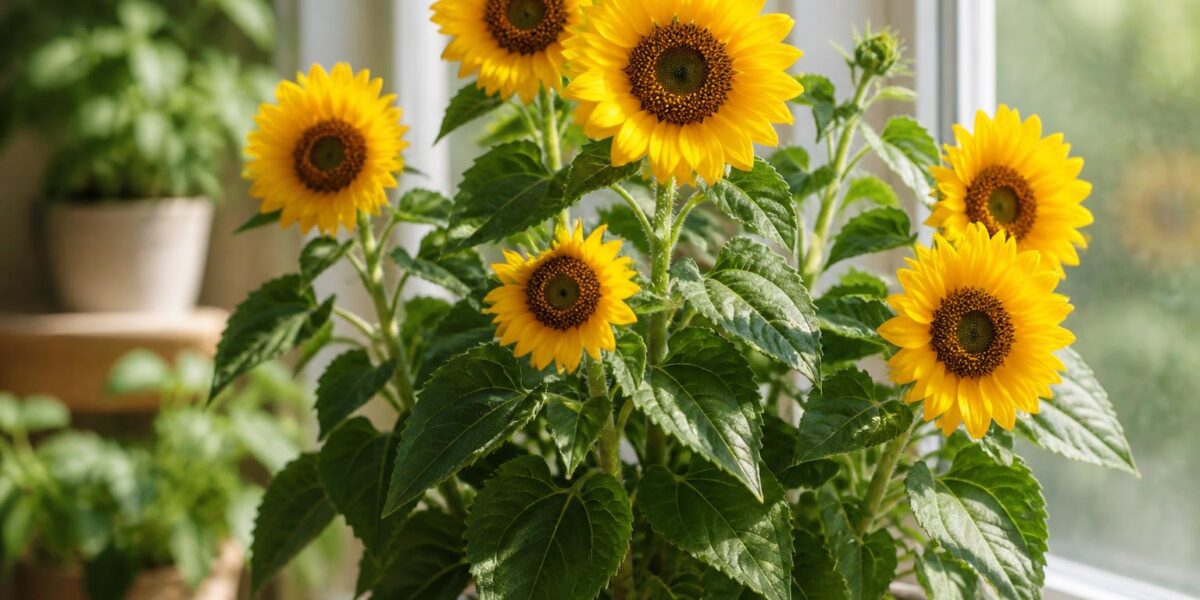
Helianthus perennial sunflowers are safe for pets in the everyday garden sense. The genus Helianthus — which includes the towering common annual sunflower most people picture, plus the perennial species commonly planted in backyard borders (H. tuberosus / Jerusalem artichoke, H. maximiliani, H. multiflorus, H. salicifolius, and the lemon-yellow false sunflower hybrids) — is not listed on the ASPCA’s toxic-plant database for dogs, cats, or horses. If your dog brushed past your Maximilian sunflowers chasing a squirrel, or your cat batted a falling petal across the patio, you are not facing a poisoning emergency.
Sunflowers are one of the friendliest plant choices a pet-owning gardener can make. They feed pollinators through their long bloom season, songbirds work the seedheads from late summer into winter, and the foliage is generally unappealing to pets. Our companion pillars on annual sunflowers (sunflowers and cats, sunflowers and dogs) cover the same family at species-level detail; the perennial Helianthus species in this guide share that same safe profile.
What “Perennial Sunflower” Means
Most people use “sunflower” as shorthand for Helianthus annuus — the giant annual that grows from a seed in spring to a 6-to-12-foot single-stalk tower by fall, and dies at the first frost. The perennial sunflowers are different. They live for many years, sprout from established crowns each spring, multiply by rhizomes or seed, and tend to form dense colonies. Common perennial Helianthus species in American gardens include:
- Helianthus tuberosus — Jerusalem artichoke or sunchoke, edible tubers, aggressive spreader
- Helianthus maximiliani — Maximilian sunflower, late-season tall prairie native
- Helianthus salicifolius — willow-leaved sunflower, narrow foliage, late bloomer
- Helianthus multiflorus or × multiflorus — perennial sunflower hybrids with double or semi-double blooms
- Helianthus angustifolius — swamp sunflower, fall bloom, wet sites
All share the same general safety profile: not on the ASPCA toxic list, low chemical risk to pets, mechanical caveats only. The bloom looks like a smaller version of the classic annual sunflower head, sometimes more daisy-like, with golden-yellow rays and a dark or brown central disc.
The ASPCA Position on Helianthus
The ASPCA does not list any Helianthus species as toxic to dogs, cats, or horses. Veterinary toxicology framing for unlisted plants is “not specifically listed by ASPCA as toxic — generally considered safe with mechanical or sap caveats.” Helianthus fits that framing well across both annual and perennial species. There are no published clinical patterns of Helianthus poisoning in pets, and the chemistry of the genus does not predict hidden toxicity.
This puts perennial Helianthus in good company on a pet-safe roster alongside other Asteraceae perennials we’ve covered as safe: coneflower, coreopsis tickseed, gaillardia blanket flower, and zinnia. The same daisy family includes some toxic members (chrysanthemum, Shasta daisy, Rudbeckia black-eyed Susan), so we cannot rely on family-level safety — but Helianthus itself is firmly on the safe side at the genus level.
The Chemistry, Briefly
Helianthus species contain a recognizable suite of secondary metabolites — sesquiterpene lactones in low concentrations, fatty acids in the seeds, small amounts of chlorogenic acid and other phenolics. None of these reach the threshold concentrations seen in chrysanthemum or Shasta daisy, which is why the family-level “Asteraceae caution” doesn’t apply to Helianthus. The seeds (sunflower seeds) are nutritionally rich in fats and protein and are eaten by humans, songbirds, and many pets without issue.
The closest thing to a pet-relevant chemical concern is the modest sap and small leaf-hair load that can produce mild contact irritation in pets with sensitive skin. This is the same mechanical caveat we describe for coneflower and gaillardia. It is not poisoning, and it is uncommon enough that most pets coexist with sunflower stands indefinitely without incident.
The Sunflower Seedhead Question
The big question owners actually have about sunflowers is the seed. Yes, sunflower seeds are safe for pets in moderation — they’re a common ingredient in commercial bird feed, in some commercial pet treats, and in human snacks. Sunflower-seed butter (without xylitol) is even sometimes recommended as a peanut-butter substitute for dogs with peanut allergies. The caveats are about hulls and quantity, not about toxicity.
Hulls are the rough fibrous cases around the seed kernel. A dog who eats hulled seeds is fine. A dog who eats a fistful of unhulled seeds straight off the bird feeder may have GI obstruction risk from the indigestible hull material, and salt content matters if the seeds are the salted human-snack kind. For a pet grazing a Helianthus stand in the yard, the practical risk is low: pets rarely eat enough whole seedheads to cause obstruction, and the unsalted in-shell seeds in a garden setting are about the same risk as any other fibrous plant material.
Differentiating Helianthus From Look-Alikes
Several Asteraceae perennials look broadly sunflower-like, and pet-owning gardeners benefit from knowing which is which. The two yellow-bloomed look-alikes most commonly confused with Helianthus are:
- Heliopsis (false sunflower) — also Asteraceae, also generally regarded as safe, blooms earlier in summer than Helianthus, smaller flowers
- Rudbeckia (black-eyed Susan) — Asteraceae, ASPCA-listed as toxic with mild GI effects, brown-black raised cone vs. flat or barely-raised disc on Helianthus
If you can confirm the plant is Helianthus or Heliopsis, you can relax. If it might be Rudbeckia, see our Rudbeckia black-eyed Susan toxicity guide for the full picture. Coneflower (Echinacea) is a more easily distinguished look-alike — purple-pink rays, bristly cone — and is also safe.
Mechanical and Practical Caveats
The two real-world caveats for Helianthus in a pet household are mechanical, not chemical:
- Tall plants attract bees. Maximilian and Jerusalem artichoke can reach 6-10 feet at peak. A sleeping dog who rolls into a bee-foraged stand can get a sting. Place tall sunflower stands away from primary nap zones.
- Aggressive spreading. Jerusalem artichoke (H. tuberosus) is famous for taking over a bed via tubers. This is a horticulture problem, not a pet problem, but it can mean Helianthus shows up where you didn’t plant it. Identify the plant before assuming it’s something more dangerous.
The seedheads, after birds have worked them, drop a fair amount of seed into surrounding soil. A vigorous stand of perennial sunflowers becomes a self-perpetuating colony, which is wonderful for songbirds and fine for pets but can crowd out smaller perennials.
Pet-Safe Pollinator Border Design
Perennial Helianthus belongs near the back of a border because of its height. Pair it with other safe Asteraceae perennials at decreasing heights: Helianthus at the back, coneflower mid-border, coreopsis or gaillardia toward the front. Lower-growing edge plants from the safe list — creeping phlox, sedum, low geraniums — finish the layering. Add a few mint-family pollinator plants (anise hyssop, bee balm, catmint) for vertical contrast and the border is essentially complete.
For owners specifically replacing a toxic plant in an existing border, perennial Helianthus is one of the easiest substitutes for tall structure. If you’ve decided to remove Baptisia or Russian sage, a clump of H. salicifolius or H. maximiliani gives you the late-season bloom and prairie-meadow feel without the alkaloid concern. The transition is straightforward.
Annual vs. Perennial Sunflower for Pet Owners
The annual common sunflower (H. annuus) — the one most people grow from a seed packet in spring — is also not listed by ASPCA as toxic and shares the same safe profile. The clinical and chemistry framing in our annual sunflower pillar pieces (are sunflowers toxic to cats and are sunflowers toxic to dogs) applies equally to perennial Helianthus species. The differences are horticultural — the annual is bigger and shorter-lived, the perennials are smaller, multi-stemmed, and come back every year — not safety-related.
If you’re choosing between the two for a pet household, both are fine. Annual sunflowers are dramatic for one season and don’t crowd a perennial bed. Perennial Helianthus offers reliable late-season bloom and seedhead value year after year. Many gardens use both: an annual H. annuus row at the back of the vegetable garden for cut flowers, plus a clump of H. maximiliani in the perennial border for a fall pollinator anchor.
What to Watch For (Realistic, Low-Probability)
Even with a safe plant, large ingestions of any non-food plant material can cause mild GI upset. Possible but uncommon outcomes include:
- One episode of vomiting after ingestion of a large amount of foliage
- Soft stool or mild diarrhea within 24 hours, resolving on its own
- Brief drooling from leaf-hair contact with the mouth
- Sneezing or watery eyes during peak pollen periods (uncommon, since Helianthus is insect-pollinated rather than wind-pollinated)
What you should not see are tremors, weakness, irregular heart rate, dilated pupils, or sustained vomiting. Any of those points to a different plant or a different cause and warrants a vet call. With a confirmed Helianthus exposure and only mild GI symptoms, monitoring at home is reasonable.
If You Need a Phone Number
For owners who want professional input on a Helianthus exposure, the path is the standard one: call your own veterinarian first, then the ASPCA Animal Poison Control Center at 888-426-4435 (per-call fee) or the Pet Poison Helpline at 855-764-7661 (per-call fee). Both lines have 24/7 veterinary toxicology coverage. A photo of the actual plant your pet ate goes a long way toward a fast, accurate consultation.
Identification matters because of the look-alike issue. If you call and tell a vet “my dog ate a sunflower,” and the actual plant was a Rudbeckia or a Shasta daisy, you and the vet are working with the wrong information. Confirm species before you confirm risk.
Frequently Asked Questions
Are perennial sunflowers toxic to dogs?
No. Helianthus species — including Maximilian sunflower, Jerusalem artichoke, willow-leaved sunflower, and perennial hybrids — are not on the ASPCA’s list of plants toxic to dogs. Mild GI upset is possible after large ingestions of foliage, but chemical poisoning is not a meaningful concern with the genus.
Are perennial sunflowers toxic to cats?
No, Helianthus is not listed by the ASPCA as toxic to cats. Cats typically show little interest in sunflower foliage. As with any non-food plant, large ingestions could cause brief mild GI upset, but the genus does not contain compounds known to cause significant feline poisoning.
Can my dog eat sunflower seeds from the garden?
In modest amounts, yes — hulled sunflower seeds are sometimes used in commercial dog treats and unsalted varieties are not toxic. The caveats are quantity (large hulled-seed ingestion can cause GI upset or, with hulls intact, obstruction risk in small dogs), and salt content if the seeds are the human-snack salted kind. Garden seedheads are generally low-risk in incidental amounts.
How is Helianthus different from Rudbeckia black-eyed Susan?
They’re both yellow-flowered Asteraceae perennials but in different genera. Helianthus has a flat or barely-raised central disc and is on the safe list. Rudbeckia has a brown-black raised cone in the center and is on the ASPCA toxic list with mild GI effects. The cone shape is the fastest field test.
Will Jerusalem artichoke spread into my whole yard if I plant it?
It can — Helianthus tuberosus is famously aggressive via tubers. This is a horticultural concern rather than a pet concern, but if you plant it, expect to manage spread by digging tubers each fall or planting in a contained area. The aggressive spread is what makes it a reliable late-season pollinator and bird-food source, so the trade-off depends on your goals.


