
Last updated: May 16, 2026
In this article
- The Reassuring Answer Up Front
- What Gaillardia Actually Is
- The ASPCA Position on Gaillardia
- The Chemistry, Briefly
- Mechanical and Sap Caveats
- Why Gaillardia Belongs in Pet-Friendly Pollinator Gardens
- Differentiating Gaillardia From Look-Alikes
- Garden Care for Pet Households
- Gaillardia as a Cut Flower
- Annual vs. Perennial Gaillardia
- What to Watch For (Realistic, Low-Probability)
- If You Need a Phone Number
- Frequently Asked Questions
The Reassuring Answer Up Front
Gaillardia plants — the bicolor red-and-yellow daisies most people know as blanket flower or Indian blanket — are safe for pets in the everyday garden sense. The genus Gaillardia, which includes G. aristata (perennial), G. pulchella (annual), and the popular G. × grandiflora hybrids, is not listed on the ASPCA’s database of plants toxic to dogs, cats, or horses. If your dog brushed past a stand of ‘Arizona Sun’ or your cat batted a fallen petal across the patio, you are not facing a poisoning emergency.
Gaillardia is one of the easiest pet-safe pollinator perennials to grow. It blooms from June through hard frost, attracts native bees, butterflies, and small skippers, tolerates drought and lean soil, and the foliage is generally unappealing to grazing pets. The plant earns a place in pet-friendly perennial borders alongside coneflower, coreopsis, perennial helianthus, and Liatris — all safe Asteraceae perennials that share daisy-form blooms without the chrysanthemum-family toxic chemistry.
What Gaillardia Actually Is
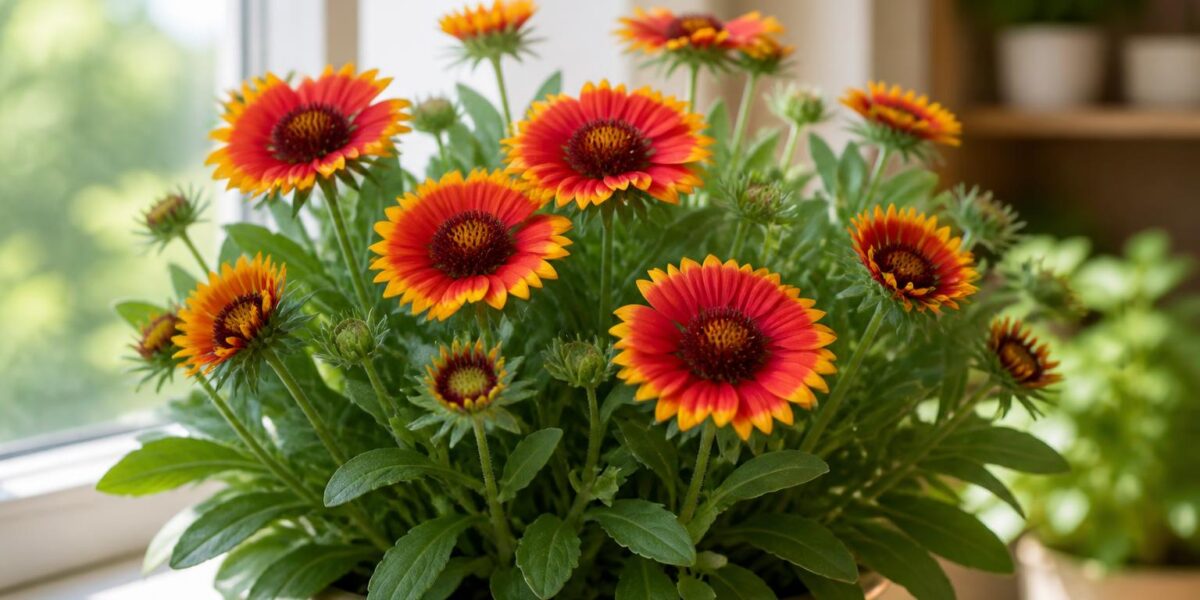
Gaillardia is a genus of about 30 species in the Asteraceae family, native to North and South America. The plants form short, hairy clumps with deeply lobed gray-green basal foliage and tall flowering stems topped by 2-3 inch daisy flowers. The classic bloom is bicolor: a brick-red or burgundy center ring fading to gold or yellow on the outer petal tips, with notched or fringed petal margins. Modern cultivars expand the palette to peach, pink, copper, mahogany, and pure yellow.
Common species and selections include:
- Gaillardia × grandiflora — perennial blanket flower hybrid, the most-sold form, in cultivars like ‘Goblin’, ‘Arizona Sun’, ‘Burgundy’, and ‘Mesa’
- Gaillardia aristata — true perennial blanket flower native to North America
- Gaillardia pulchella — annual or short-lived perennial Indian blanket, the species seen in roadside wildflower meadows
The common name “blanket flower” comes from the dense colorful display of flowers covering an established stand, reminiscent of a Native American woven blanket. The plants are short-lived in the strict sense (3-5 years for most cultivars) but reseed enough to maintain a continuous stand.
The ASPCA Position on Gaillardia
The ASPCA’s toxic-plant database does not list Gaillardia as toxic to dogs, cats, or horses. Veterinary toxicology framing for unlisted plants is “not specifically listed by ASPCA as toxic — generally considered safe with mechanical or sap caveats.” Gaillardia fits that framing. There are no published clinical patterns of Gaillardia poisoning in pets, and the chemistry of the genus does not predict a hidden toxicity problem.
This places Gaillardia comfortably on the safe-perennial roster alongside coreopsis tickseed, coneflower, perennial Helianthus, and Liatris. As with the rest of the safe-Asteraceae roster, family-level safety doesn’t apply across all genera — chrysanthemum, Shasta daisy, and Rudbeckia are toxic — but Gaillardia itself is firmly on the safe side.
The Chemistry, Briefly
Gaillardia contains the standard Asteraceae secondary metabolites at low concentrations — small amounts of sesquiterpene lactones, modest phenolic content, and pigment chemistry (carotenoids, anthocyanins) responsible for the brilliant red-and-yellow bloom colors. The lactones in Gaillardia have been studied chemically for their antimicrobial and anti-inflammatory properties, and a few species have a history of use in traditional Native American medicine, but none of this rises to the threshold of clinical pet toxicity.
The leaf hairs are mildly bristly compared to coreopsis, and contact with crushed foliage can produce a faint resinous smell. This is the same chemical profile we see in the rest of the safe-Asteraceae roster — bioactive but not concentrated enough to cause clinical effects. Compare with chrysanthemum, where the pyrethrin and lactone load is much higher and the family-level toxic flag applies. Gaillardia simply doesn’t carry that load.
Mechanical and Sap Caveats
The mechanical caveats for Gaillardia in pet households are minor:
- Slightly hairy foliage. Like coneflower, Gaillardia has fine bristles on the leaves and stems. A pet who pushes through a stand picks up no meaningful chemical exposure but might shake off briefly. Pets with sensitive skin can develop mild contact reaction in rare cases.
- Bee traffic during peak bloom. A heavily visited stand can deliver an accidental sting to a pet who lies down in the planting. Place Gaillardia in active-traffic zones rather than nap zones.
- Seed dispersal. The seedheads carry small barbed bristles that can stick briefly to fur. They release on their own with grooming and don’t lodge in skin the way burdock or stick-tights do.
None of these is severe. The vast majority of pet households with Gaillardia in the border experience no plant-related incidents at all.
Why Gaillardia Belongs in Pet-Friendly Pollinator Gardens
Gaillardia earns its place in pet-friendly borders through a combination of long bloom, drought tolerance, and pollinator value. The plant blooms from early summer through hard frost — one of the longest bloom seasons of any perennial — and the open daisy face is accessible to a wide range of pollinators, from small native bees to large butterflies. The bicolor display is a strong visual anchor in any composition.
Gaillardia pairs naturally with other safe perennials for layered bloom timing. Combine it with:
- Coreopsis verticillata at the front for mass yellow color
- Coneflower mid-border for height and a different daisy form
- Liatris for vertical spike contrast
- Anise hyssop for pollinator-spike density
- Bee balm for hummingbird value
The composition gives you continuous bloom from late spring through fall with no plants on the ASPCA toxic list. For a starting-from-scratch pollinator border, this is one of the easier reliable five-plant combinations to specify.
Differentiating Gaillardia From Look-Alikes
Gaillardia’s bicolor bloom is distinctive, but a few look-alikes can confuse the issue:
- Helenium (sneezeweed) — closely related to Gaillardia, similar bloom form, ALSO often safe but worth confirming species; some Helenium species have been historically associated with mild GI in livestock
- Coreopsis tinctoria (annual plains tickseed) — bicolor red-and-yellow but smaller, more delicate; on the safe list
- Echinacea (coneflower) — different overall structure with bristly cone center and singular ray-petal color
The fastest field test for Gaillardia: bicolor red-center-to-yellow-tip pattern, notched or fringed petal margins, gray-green hairy foliage, short clump habit. If your bloom matches all four characteristics, you have Gaillardia and the safe profile applies. If your bloom is uniformly yellow with notched petals and fern-like foliage, you have Coreopsis or possibly cosmos — also safe.
Garden Care for Pet Households
Gaillardia wants full sun, well-drained soil, and minimal fertilizer. It rots in heavy wet clay over winter, which is the most common reason gardeners “lose” their Gaillardia. The plant is short-lived even under good conditions (3-5 years for most cultivars) but reseeds modestly to maintain a stand. For pet households specifically:
- Plant in a sunny well-drained spot the dog doesn’t habitually nap in
- Deadhead to extend bloom and reduce seed-spread to unwanted areas
- Cut back hard in early spring to encourage fresh basal growth
- Divide every 2-3 years if clumps decline; or replant from new nursery stock as needed
- Avoid mulching too thickly over the crown — Gaillardia rots if buried
The plant is generally pest-free. Powdery mildew can occur in humid summers but rarely warrants treatment, and the fungicides used to manage mildew aren’t a pet concern at standard application rates.
Gaillardia as a Cut Flower
Gaillardia blooms last 5-7 days in a vase and add bicolor warmth to summer arrangements. From a pet-safety standpoint, cut Gaillardia in vases is fine — the same safe profile as the plant in the ground. The vase-water caveat applies (don’t let pets drink it if floral preservative was added), but no chemical concerns from the plant itself.
Mixed-bouquet caveats matter more than the Gaillardia itself. Florists often combine Gaillardia with lilies, eucalyptus, and other plants whose pet-safety profiles are very different. If you receive a mixed bouquet that contains lilies, the cat-safety calculus is dominated by the lily presence, not the Gaillardia. Identify every component of any cut arrangement before placing it within a cat’s reach.
Annual vs. Perennial Gaillardia
Gaillardia pulchella is the annual species — actually a short-lived perennial in warm climates but treated as an annual in much of the country. It’s the species seen in roadside wildflower meadows and the one often included in “wildflower seed mix” packets. From a pet-safety standpoint, annual Gaillardia shares the same safe profile as the perennial species. Either form is fine in a pet household.
For garden design purposes, choose the perennial G. × grandiflora hybrids if you want a reliable returning clump, or sow annual G. pulchella if you want a self-seeding meadow effect. Both are equally pet-friendly. Many gardens use a perennial cultivar like ‘Arizona Sun’ as the structural anchor and let some annual Indian blanket reseed at the edges for a more naturalized look.
What to Watch For (Realistic, Low-Probability)
Gaillardia ingestion is generally a non-event. Possible but uncommon outcomes:
- One episode of vomiting after a large foliage ingestion
- Soft stool within 24 hours, resolving on its own
- Brief drooling or head-shaking from leaf-hair contact
- Mild contact dermatitis in rare hypersensitive pets (resolves with rinse)
What you should not see are tremors, weakness, irregular heart rate, dilated pupils, or sustained vomiting. Any of those points to a different plant or cause. With a confirmed Gaillardia exposure and only mild GI signs, monitoring at home is reasonable; persistent or severe signs warrant a vet call.
If You Need a Phone Number
For owners who want professional reassurance, the standard path: call your own veterinarian first; then the ASPCA Animal Poison Control Center at 888-426-4435 (per-call fee) or the Pet Poison Helpline at 855-764-7661 (per-call fee). Both are 24/7 with veterinary toxicology coverage. A photo of the actual plant helps with identification — the bicolor bloom and notched petals are reliable Gaillardia markers.
If your pet ate something from a mixed garden bed and you’re not sure which plant, save what’s left and bring it (or a clear photo) to the vet visit. Misidentification is the most common reason a poisoning workup goes sideways. The cat-safe planting guide covers indoor counterparts for the same general philosophy.
Frequently Asked Questions
Is Gaillardia toxic to dogs?
No. Gaillardia (blanket flower) is not on the ASPCA’s list of plants toxic to dogs. Mild GI upset is possible after large foliage ingestions, but chemical poisoning is not a concern with the genus. Most dogs show no interest in the gray-green hairy foliage.
Is Gaillardia safe for cats?
Yes, Gaillardia is not listed by the ASPCA as toxic to cats. The hairy foliage rarely attracts feline interest, and the genus does not contain compounds known to cause feline poisoning. As with any non-food plant, large ingestions could cause brief self-limiting vomiting.
How is Gaillardia different from Rudbeckia black-eyed Susan?
Gaillardia (blanket flower) has bicolor red-center-to-yellow-tip blooms with notched or fringed petal margins, and is on the safe list. Rudbeckia (black-eyed Susan) has uniformly golden-yellow petals around a brown-black raised cone, and is on the ASPCA toxic list with mild GI effects. The bicolor pattern is the fastest test for Gaillardia.
Will Gaillardia reseed all over my yard if I plant it?
Modestly, yes — Gaillardia self-sows enough to maintain a stand but rarely takes over a yard. Deadheading reduces unwanted spread. The annual species (G. pulchella) reseeds more aggressively than perennial G. × grandiflora hybrids, so choose the cultivar that matches your tolerance for self-sowing.
Can my dog play in a Gaillardia stand without issue?
Yes. The plants tolerate being brushed past without damage and the foliage isn’t chemically irritating. The only real-world caveat is bee traffic during peak bloom — a dog who rolls in a heavily visited stand could pick up a sting from a foraging bee. Place Gaillardia where dogs run rather than where they nap to minimize sting risk.


