
Last updated: May 16, 2026
In this article
- The Short Answer on Artichokes for Cats
- What Is an Artichoke, Exactly
- The Choke Is a Real Choking Hazard
- Marinated and Restaurant Artichokes Are Off the Table
- How to Offer a Safe Artichoke Taste
- The Mild Diuretic Effect
- Cats With Specific Health Conditions
- How Artichoke Compares to Other Cat-Safe Vegetables
- What to Do If Your Cat Eats Marinated Artichoke
- The Texture Question: Why Some Cats Investigate Artichoke
- Restaurant Artichoke Dishes Are a Hidden Risk
- Frequently Asked Questions
The Short Answer on Artichokes for Cats
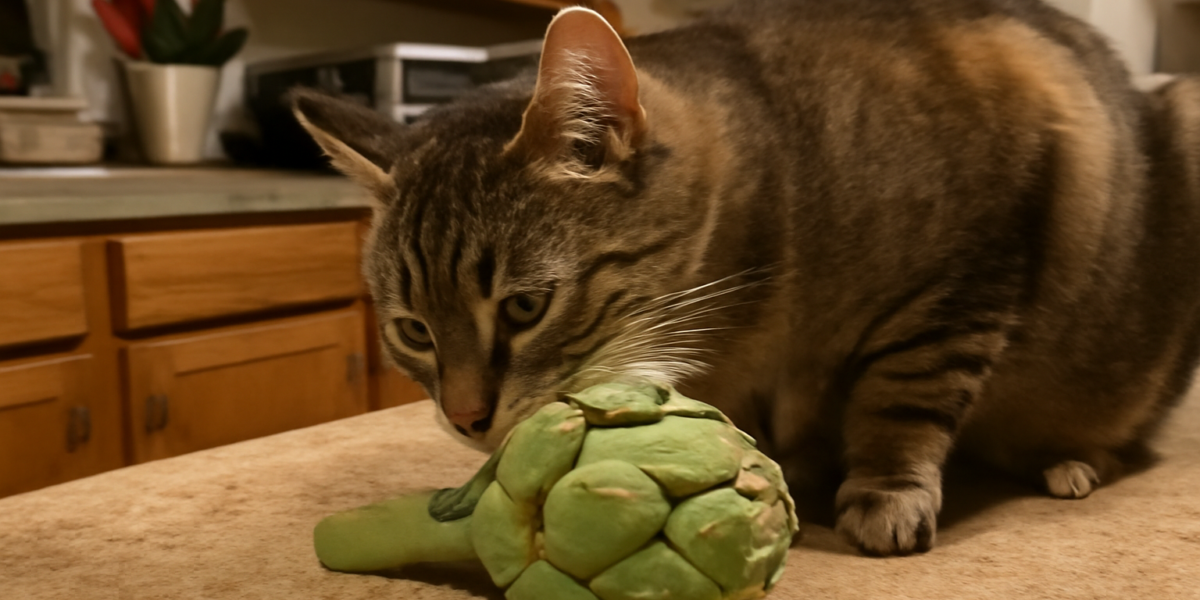
Can cats eat artichoke? Yes, in moderation, when it is plain and properly cooked. A tiny amount of cooked artichoke heart, with the tough outer leaves and the fuzzy choke removed, is generally safe for a healthy adult cat to taste. That said, artichoke is not a food your cat needs, and most cats greet it with the same indifference they show toward any leafy plant. Your obligate carnivore is not lacking globe artichoke in her life.
The honest framing is this: artichoke heart sits in the same category as steamed broccoli florets or a sliver of cooked carrot — fine as a curiosity nibble, useless as a regular meal component, and clearly off-limits in its restaurant or jarred form. The hazards are not the vegetable itself; they are the choking risk from the choke and outer leaves and the seasonings that almost always accompany artichoke in cooked dishes.
What Is an Artichoke, Exactly
The globe artichoke is the immature flower bud of a thistle, and it grows on a plant that looks like a giant spiky herb. The parts humans eat are the fleshy base of each scaly leaf and the heart at the bottom, after the inedible fuzzy choke is scraped away. It is a Mediterranean vegetable that shows up steamed, grilled, baked into dips, or marinated in oil and vinegar. It is rich in fiber, antioxidants, and a compound called cynarin that is mildly hepatoprotective in human research.
None of those benefits translate meaningfully to cat nutrition. Cats meet their fiber needs from the small amount in a balanced commercial cat food and from the trace plant matter in the gut contents of small prey. They have no dietary requirement for the antioxidants in artichoke. Cynarin’s effect on bile flow is interesting in human metabolic studies, but no controlled feline data backs any benefit. So artichoke for your cat is a “no harm, no real benefit” food when prepared correctly.
The Choke Is a Real Choking Hazard
The fuzzy interior of a globe artichoke, called the choke, is a dense pad of immature flower fibers. Humans scrape it out with a spoon before eating the heart. It is named the choke for a reason: those fibers are wiry, indigestible, and capable of lodging in a small throat or causing intestinal upset if swallowed. A cat who licks at an artichoke heart should never get any of that fuzzy material.
The same applies to the tough outer leaves. While the soft fleshy tip of each inner leaf is fine for a human to scrape with their teeth, the leathery outer leaves are not chewable for a cat. If you are sharing artichoke, use only the soft, fully cooked heart, sliced into a piece smaller than a pea. Discard the leaves and the choke entirely. There is no version of an artichoke leaf that is safe for a cat to bite into.
Marinated and Restaurant Artichokes Are Off the Table
Almost every artichoke product humans buy ready-made is unsuitable for cats. Jarred marinated artichoke hearts swim in oil, vinegar, salt, garlic, and herbs. Spinach-artichoke dip combines two trouble foods with cream, cheese, and more garlic. Frozen breaded artichoke comes coated in seasoned crumbs and fried in oil. Roman-style fried artichokes (carciofi alla giudia) are deep-fried and salted.
Garlic is the deal-breaker in most of these preparations. Even small amounts of garlic and onion damage feline red blood cells in a process called oxidative hemolysis, which can lead to anemia. The dose that causes problems is much smaller in cats than in dogs, and chronic small exposures add up. Our guide on garlic toxicity in cats walks through the mechanism and the warning signs. The takeaway: any artichoke that has touched garlic is not a cat food.
How to Offer a Safe Artichoke Taste
If you are committed to letting your cat sample artichoke, the procedure is simple. Steam or boil a fresh artichoke in plain water with no salt, garlic, lemon, or oil. Let it cool fully. Pull the cooked heart away from the leaves, scrape away every speck of the fuzzy choke with a spoon, and slice off a sliver no bigger than the tip of your little finger. That sliver is the entire serving. Offer it on a plate or your finger and let your cat investigate at her own pace.
Most cats will sniff, lick once, and lose interest. A few will eat the sliver. A few will turn their nose up entirely. None of these reactions is a problem. If your cat eats the sliver and shows no vomiting, diarrhea, drooling, or change in behavior over the next day, you know how she handles plain artichoke. Even then, this is at most an occasional curiosity, not a weekly food.
The Mild Diuretic Effect
Artichoke has been used in traditional European herbalism as a mild diuretic and digestive aid. The cynarin and other compounds in the leaves can stimulate bile flow and slightly increase urine output. In a healthy adult cat eating a sliver of heart, this effect is too small to matter clinically. In a cat with kidney disease, urinary tract issues, or chronic dehydration, even mild diuretic foods are worth avoiding because they shift fluid balance in a body that is already working hard to manage water.
If your cat has diagnosed chronic kidney disease, urinary stones, or a history of crystals, skip artichoke entirely and stick with the diet your veterinarian has prescribed. The same logic applies to cats with feline lower urinary tract disease (FLUTD) — diuretic foods can complicate the careful hydration balance these cats need.
Cats With Specific Health Conditions
Several feline groups should not be offered artichoke at all, even plain. Diabetic cats benefit most from low-carb, meat-based diets, and a non-essential vegetable nibble adds nothing useful. Cats managing inflammatory bowel disease often react unpredictably to new foods, so introducing fiber from artichoke can trigger flare-ups of vomiting or diarrhea. Cats on prescription therapeutic diets should not get table extras of any kind without veterinary approval.
Pregnant or nursing cats should also skip experimental foods. A queen’s body is already working hard to support kittens, and the diet she trusts is the one her veterinarian put her on. Save artichoke for a healthy, non-pregnant adult cat at a stable weight, and only as a tiny taste.
How Artichoke Compares to Other Cat-Safe Vegetables
Among curiosity vegetables for cats, artichoke is more inconvenient than most. The hazardous parts (choke, leaves) outnumber the safe part (the small heart), and most artichokes you encounter outside of fresh produce are seasoned. Other vegetables are easier to share safely. A small amount of cooked cauliflower, broccoli, or cabbage involves no inedible fuzzy core to scrape away.
Crunchy vegetables some cats enjoy include cooked asparagus tips, celery ribs (chopped small), and bell pepper. None of these are required, but they are simpler to prepare safely and less likely to involve a hidden choking hazard. Leafy greens like bok choy or arugula are also options for the rare vegetable-curious cat.
What to Do If Your Cat Eats Marinated Artichoke
If your cat steals a piece of marinated artichoke off a charcuterie board or licks a spinach-artichoke dip, the urgency depends on how much she ate and what was in it. A single lick of dip with garlic is usually not a poisoning emergency in an average-sized cat, but more than that warrants a call to your veterinarian or the ASPCA Animal Poison Control Center. Watch for vomiting, diarrhea, drooling, weakness, pale gums, dark or red-tinged urine, fast breathing, or loss of appetite over the next several days.
Garlic and onion damage to red blood cells can take three to five days to appear, so a cat who seems fine the day after a garlic exposure may still develop anemia later in the week. If you suspect significant ingestion, your veterinarian may recommend bloodwork at the visit and again a few days out. Bring the jar or product label so your team can see exactly what your cat consumed.
The Texture Question: Why Some Cats Investigate Artichoke
Cats who do show interest in artichoke are usually responding to texture rather than flavor. The cooked heart is soft and slightly fibrous, with a mouthfeel that some cats find satisfying to chew. This is similar to the way some cats enjoy cooked carrot or steamed green bean — the eating experience matters more than the taste. If your cat is one of these texture-driven samplers, you can offer a tiny piece occasionally without worrying that you are setting up a problematic preference.
The real preference problem comes when cats start associating an artichoke heart with a buttery dipping situation, because cats who learn there is butter on the artichoke will try to lick the butter directly. Keep your cat off the table during artichoke dinners, and if you want to share, use the unseasoned piece you set aside before the rest of the dish was prepared.
Restaurant Artichoke Dishes Are a Hidden Risk
Eating out with a cat at home means leftovers come home, and restaurant artichoke dishes are particularly poor candidates for sharing. Stuffed artichokes from Italian restaurants are typically packed with breadcrumbs, garlic, parmesan, parsley, and olive oil. Spinach-artichoke dip from chain restaurants is loaded with mayonnaise, sour cream, multiple cheeses, and seasoning blends. Mediterranean platters often combine marinated artichoke with olives, feta, and herbed oil — none of it appropriate for cats.
If you bring home artichoke leftovers and want to give your cat a taste, you almost always cannot do so safely. The garlic and onion content of restaurant preparations is unknown unless the restaurant publishes detailed allergen lists, and even then, the seasonings make these dishes wrong for feline biology. Eat your leftovers and give your cat a different treat.
Frequently Asked Questions
Can cats eat canned artichoke hearts?
Canned artichoke hearts in water and salt are not ideal because of the sodium content; canned in oil with garlic or herbs is unsafe. If you must use canned, rinse thoroughly under fresh water and offer only a tiny piece of the plain heart. Fresh-steamed is far better.
What about Jerusalem artichokes (sunchokes)?
Jerusalem artichokes are a different plant entirely — they are the tubers of a sunflower relative. Cooked plain sunchoke in tiny amounts is generally tolerable, but the high inulin content can cause gas and loose stool. Most cats find them unappealing, and there is no reason to add them to her diet.
My cat ate the fuzzy choke from an artichoke. What should I do?
Watch for choking, gagging, repeated swallowing motions, drooling, or vomiting. Small amounts may pass without incident, but the fibers can cause irritation or partial obstruction in the throat or stomach. Call your veterinarian for guidance, especially if symptoms appear or persist beyond a few hours.
Is artichoke leaf extract safe for cats?
Artichoke leaf extract is sold as a human supplement for liver and digestive support. The dosing has not been validated in cats, and feline-specific studies are essentially nonexistent. Do not give human supplements to your cat without your veterinarian’s explicit guidance.
Will artichoke help my cat lose weight?
No. Cat weight loss is best managed through portion control, a balanced therapeutic diet, and play that increases activity. Adding low-calorie vegetables does not replace a structured plan. Talk to your veterinarian about a weight management diet and feeding schedule designed for cats.


