
Last updated: May 4, 2026
In this article
- Quick Answer: Tiny Amounts Only, With Real Sodium Concerns
- What Makes Parmesan Different From Other Cheeses
- Why Sodium Matters So Much for Cats
- The Sodium Math: How Much Is Too Much
- Lactose, Casein, and Aged Cheese
- Training Treats and Parmesan Crumbs
- Forms of Parmesan That Are Not Safe
- Cats Who Should Skip Parmesan Entirely
- Comparing Parmesan to Other Cheeses
- Signs of Sodium Overload in Cats
- Frequently Asked Questions
Quick Answer: Tiny Amounts Only, With Real Sodium Concerns
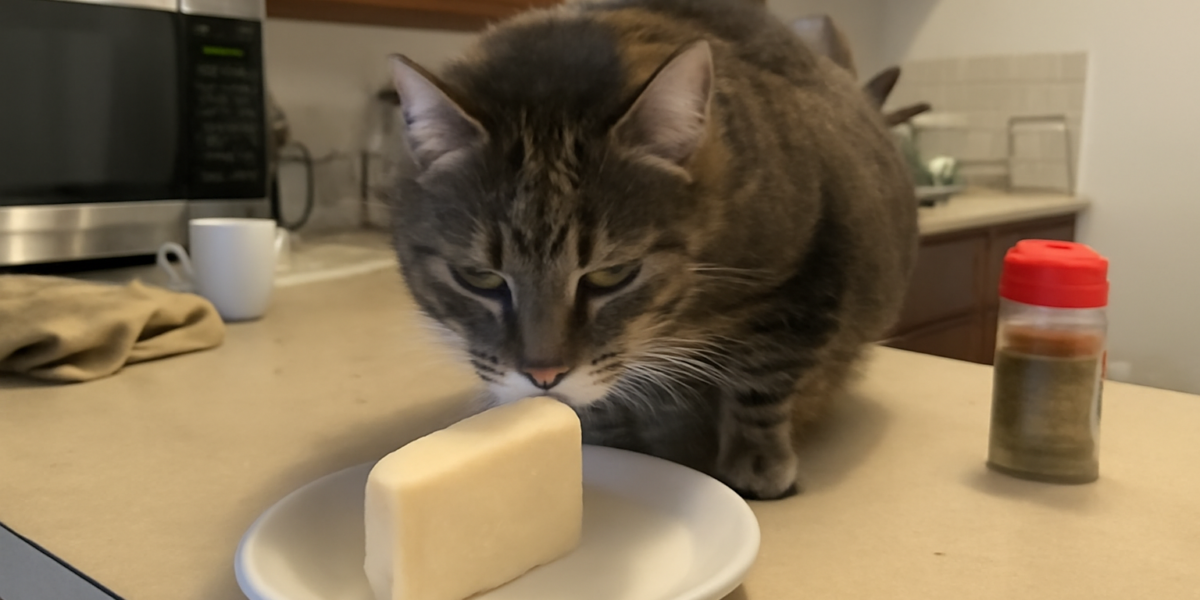
Cats can eat parmesan in tiny amounts very occasionally, but parmesan is not a cheese we recommend as a regular treat. The good news is that parmesan’s long aging process breaks down most of the lactose, so the dairy-intolerance issue that complicates softer cheeses is largely absent here. The bad news is that aging concentrates sodium dramatically, and a single ounce of grated parmesan delivers around 450 milligrams of sodium, more than three times what a healthy ten-pound cat should consume in a full day. For cats with hypertrophic cardiomyopathy, chronic kidney disease, or hypertension, parmesan is a real risk, not a theoretical one.
Healthy adult cats with no diagnosed cardiac, renal, or blood pressure issues can occasionally have an eighth-teaspoon dusting of finely grated parmesan as a flavor accent. That is the upper bound, not a target. Skip parmesan entirely for cats with chronic disease, kittens, and cats on therapeutic diets. There are no nutritional benefits parmesan provides that your cat cannot get more safely from species-appropriate food.
What Makes Parmesan Different From Other Cheeses
Parmesan, properly Parmigiano-Reggiano, is a hard granular cheese aged for a minimum of twelve months and often twenty-four months or more. The aging process accomplishes several things. Microbial cultures and enzymes break down lactose into lactic acid, leaving aged parmesan essentially lactose-free. Proteins are partially predigested into smaller peptides and free amino acids, which is why parmesan tastes so umami-rich and savory. Moisture is driven out, concentrating both flavor and minerals.
That same concentration is what makes parmesan a sodium-dense food. Salt is added during cheesemaking and during the brining process, and as moisture evaporates over months in the aging cellar, the salt that remains becomes proportionally more concentrated. The end product is a hard, dry cheese that is almost a quarter sodium chloride by some measures.
Parmesan substitutes including Grana Padano and domestic American parmesan have similar sodium profiles, sometimes slightly lower or higher depending on brand. The risk profile is consistent across the category. For comparison, our cottage cheese guide covers a fresh, lower-sodium cheese on the opposite end of the spectrum, and our cream cheese guide covers a soft fresh cheese with different trade-offs.
Why Sodium Matters So Much for Cats
Cats are physiologically sensitive to sodium because of three common feline diseases: hypertrophic cardiomyopathy (HCM), chronic kidney disease (CKD), and hypertension. All three are managed in part through dietary sodium control, and all three are common enough that any given household cat has a meaningful chance of being affected, especially as it ages.
HCM is the most common heart disease in cats. Affected cats have thickened heart muscle that compromises pumping efficiency. High dietary sodium increases blood volume and blood pressure, which adds workload to an already-struggling heart. Our HCM guide covers the diet implications in detail. CKD affects roughly one in three senior cats and is managed in part through phosphorus and sodium restriction; see our CKD overview. Hypertension often develops secondary to CKD or hyperthyroidism and warrants strict sodium discipline.
A healthy adult cat consuming a complete commercial diet already gets about the right amount of sodium for its needs. Adding parmesan stacks extra sodium on top of an already-balanced intake. For a healthy cat, occasional small additions are tolerable. For a cat with any of the conditions above, even small additions can be clinically meaningful over time.
The Sodium Math: How Much Is Too Much
An average ten-pound adult cat needs roughly 42 milligrams of sodium per day for maintenance. A healthy cat eating a balanced commercial diet typically consumes around 100 to 200 milligrams of sodium daily through food, which is well within tolerance. The body excretes excess sodium through the kidneys, assuming kidney function is normal.
One level teaspoon of finely grated parmesan weighs about 2 grams and contains roughly 75 milligrams of sodium. That single teaspoon nearly doubles the cat’s daily sodium minimum. An eighth of a teaspoon, the smallest practical dusting, contains about 9 milligrams. That is the realistic upper bound for an occasional treat for a healthy cat.
If your cat is already eating a sodium-restricted prescription diet, every milligram of added sodium counts. Talk to your vet before adding any cheese, parmesan included, to a therapeutic diet plan.
Lactose, Casein, and Aged Cheese
The aging process strips parmesan of nearly all its lactose. By twelve months of aging, residual lactose is typically under 0.1 grams per ounce, which is below the threshold most lactose-intolerant cats can tolerate. That makes parmesan more digestible than fresh dairy from a lactose perspective.
Casein, the dominant milk protein, is still present and partially broken down. Cats with confirmed milk-protein allergy may still react to parmesan even though lactose is not the issue. If your cat has previously reacted to other dairy products with itching or skin issues, suspect a casein allergy and skip parmesan as well.
The lower lactose makes parmesan slightly more tolerated than ricotta or fresh milk, which is one reason some owners gravitate toward it as a “safer” cheese. The lactose argument is real, but it is offset by the sodium concern. Net, parmesan is not safer overall, just differently risky.
Training Treats and Parmesan Crumbs
Some commercial cat training treats use parmesan crumb as a flavor accent because cats find aged cheese intensely palatable. The umami from glutamate-rich aged cheese hits the same receptors as the meat-flavor components cats are wired to seek. That is why a single fleck of parmesan can capture a cat’s full attention.
If you use parmesan-flavored treats, check the sodium per treat on the label. Many premium training treats keep individual treat sodium under 5 milligrams, which is fine for occasional training. Treats marketed as “extra savory” or “flavor bombs” may run higher and warrant scrutiny if your cat eats more than a couple per day.
Homemade parmesan training crumbs (literally a few specks of grated parmesan) work as occasional rewards for healthy cats but should be measured carefully. Three or four sessions per day with a fleck each is fine. A pinch each session is too much.
Forms of Parmesan That Are Not Safe
Plain authentic Parmigiano-Reggiano, Grana Padano, or domestic block parmesan is the only form worth considering, and only in tiny amounts. Several common variants add additional risks:
- Pre-grated parmesan in shelf-stable canisters. Often contains anti-caking agents (cellulose powder, potassium sorbate) and sometimes added cheese flavor. Cats do not need additives.
- Parmesan crisps or chips. Marketed as keto snacks. Often contain garlic powder, onion powder, herbs, or pepper. Garlic and onion are toxic to cats.
- Parmesan-flavored crackers or bread. Wheat, sugar, salt, often with garlic. Skip entirely.
- Italian seasoning blends with parmesan. Almost always contain garlic and onion powders along with sodium-heavy parmesan crumb. Skip.
- Parmesan-stuffed pasta or sauces. Garlic, butter, sometimes alcohol in the sauce reduction. Off-limits.
If the parmesan is not just plain hard cheese, it is not appropriate to share with your cat.
Cats Who Should Skip Parmesan Entirely
Several profiles warrant complete avoidance. Cats with HCM or any diagnosed cardiac disease should not have parmesan, even occasionally; the sodium load is real. Cats with CKD, especially stages 2 through 4, should stick to their phosphorus- and sodium-controlled prescription diet. Cats with hypertension, often diagnosed alongside CKD or hyperthyroidism, should have strict sodium control.
Hyperthyroid cats can be on therapeutic diets that depend on iodine restriction; cheese is not a major iodine source but can disrupt the careful caloric balance. Diabetic cats should avoid carbohydrate variability; while parmesan is low-carb, the sodium issue still applies. Kittens under six months should stay on kitten food, which is already optimized for growth nutrient ratios.
Comparing Parmesan to Other Cheeses
Within our cat-cheese coverage, parmesan sits at the high-sodium end. Our cheese overview walks through the spectrum. Cottage cheese and ricotta are lower in sodium and lactose but moisture-heavy, with their own concerns. Cream cheese is moderate-sodium but very high-fat. Brie is moderate in both. Halloumi sits at the extreme high-sodium end, even higher than parmesan, and we recommend skipping it entirely.
Brined cheeses also fall into the higher-sodium category. Our feta cheese guide covers a brined sheep-milk cheese with sodium concerns similar in scale to parmesan, and our paneer guide covers an unbrined fresh Indian cheese that sits much closer to ricotta in profile. Cultured fresh cheeses like labneh show yet another trade-off, with moderate sodium and fewer aged-cheese compounds. Across all of these the rule is the same: tiny amounts, plain only, no version of any of them is a daily food for cats.
If your cat enjoys cheese flavor and you want a slightly lower-risk option, a tiny portion of fresh cheese with low residual lactose is closer to a “safer” choice than parmesan. Neither is necessary, and the trade-offs simply differ between sodium-heavy aged styles and lactose-heavy fresh styles. Our yogurt for cats guide walks through the broader cultured-dairy logic and helps frame how parmesan stacks up against cultured options.
Signs of Sodium Overload in Cats
Acute sodium toxicity from a small amount of parmesan is unlikely; you would need a tablespoon or more to push a healthy cat into immediate symptoms. The bigger concern is chronic accumulation in cats with subclinical cardiac or renal disease. Symptoms develop gradually and include increased thirst, increased urination, lethargy, vomiting, decreased appetite, and in advanced cases tremors or disorientation.
If your cat consumed an unintended large amount of parmesan, perhaps from a counter-surfing incident with a wedge of cheese, contact your vet or pet poison control. Provide fresh water and watch for symptoms. Do not induce vomiting unless directed by a professional.
Frequently Asked Questions
Can my cat have parmesan rind?
No. Rinds are even more sodium-concentrated than the interior, and chunks of rind can pose a choking risk. Save them for soup stock, not the cat bowl.
Is parmesan safer than other cheeses for lactose-intolerant cats?
Parmesan has very low lactose, so it is more tolerable from a lactose perspective. The sodium concern offsets that advantage. Net safety is not clearly better.
How often can a healthy cat have parmesan?
An eighth of a teaspoon of finely grated parmesan once a week or less is a reasonable upper bound for a healthy adult cat. There is no nutritional benefit, only flavor.
What about Parmesan-style nutritional yeast?
Nutritional yeast is a different food, lower in sodium but higher in B vitamins. It is not parmesan and has its own considerations, beyond the scope of this article.
My cat ate a whole shaving of parmesan. Should I worry?
A single shaving is unlikely to cause acute issues in a healthy cat. Watch for vomiting, diarrhea, or excessive thirst over the next 24 hours. Call your vet if symptoms develop or if your cat has a known cardiac or renal condition.


