
Last updated: May 16, 2026
In this article
- Quick Answer: Tiny Amounts of Plain Ricotta Only
- What Ricotta Is and How It Differs From Other Cheeses
- Why Most Adult Cats Are Lactose Intolerant
- Sodium and Fat in Ricotta
- Safe Serving Size: How Tiny Is Tiny
- Forms of Ricotta That Are Not Safe
- Signs Your Cat Did Not Tolerate Ricotta
- How Ricotta Compares to Other Cat-Friendly Cheeses
- Cats Who Should Not Have Ricotta at All
- Practical Alternatives if You Want to Share a Treat
- Frequently Asked Questions
Quick Answer: Tiny Amounts of Plain Ricotta Only
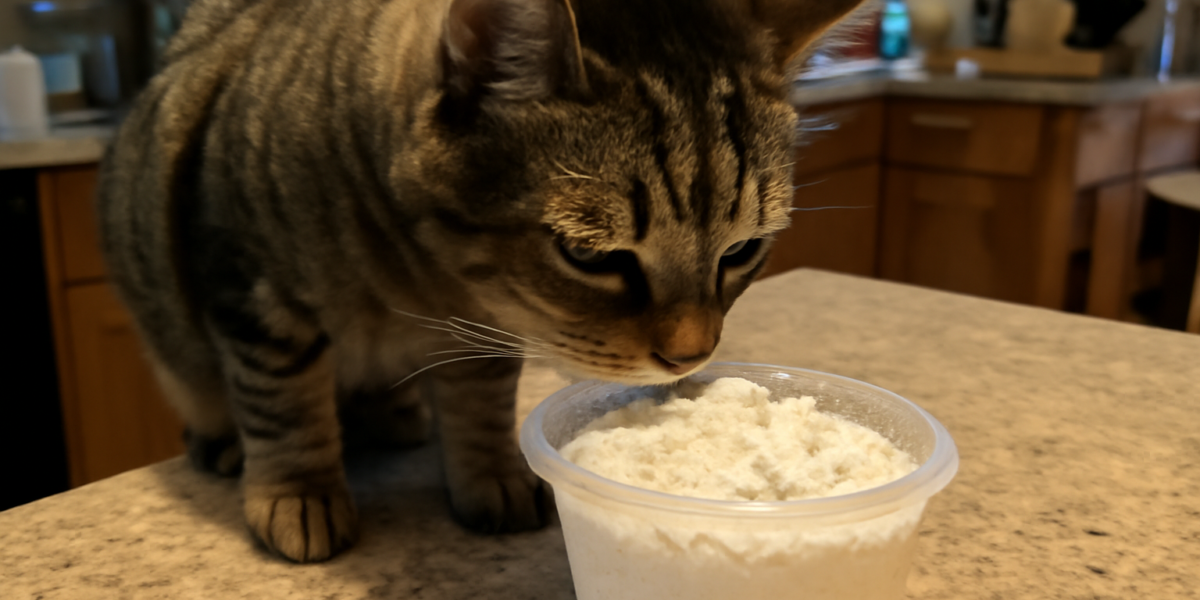
Cats can eat plain ricotta in tiny amounts on rare occasions, but ricotta is not a food cats need and not a food most adult cats fully tolerate. Ricotta is a fresh Italian whey cheese, milder and lower in lactose than fresh milk because much of the lactose is removed when curds are separated from whey. It is also lower in sodium than aged cheeses like parmesan or feta, which is the small advantage it offers if you want to share a tiny dab. The disadvantage is that most adult cats are lactose intolerant, and even ricotta’s reduced lactose can trigger soft stool, gas, or vomiting if you offer more than a half-teaspoon-sized taste.
Limit ricotta to plain, unsweetened, unflavored versions. Anything labeled cannoli filling, cheesecake base, lemon ricotta, or Italian-seasoned should be off-limits because of added sugars, citrus, garlic, or alliums. Treat ricotta as an occasional curiosity, not a regular treat. If your cat tolerates it well, that is fine, but there is no nutritional reason to add it to the bowl.
What Ricotta Is and How It Differs From Other Cheeses
Ricotta is technically not a cheese in the strict sense; it is a whey product. When traditional Italian cheesemakers produce mozzarella, provolone, or pecorino, they end up with a large volume of whey as a byproduct. That whey is reheated (the name “ricotta” means “recooked”) and the residual proteins coagulate into soft, fluffy white curds that are scooped, drained, and sold fresh.
Because ricotta is made from whey rather than full milk, its composition is different from cow’s-milk-based cheeses. It has lower fat than cream cheese, less sodium than aged cheeses, and a noticeably milder flavor. It is also wetter than firmer cheeses, with a soft scoopable texture that is easier for a small cat to handle in small quantities. The fresh-style ricotta sold in plastic tubs at most supermarkets is what we mean here. Hard, aged ricotta salata is a different product with different concerns and is not what we are discussing.
Ricotta sits in the same family of cat-questionable dairy as cottage cheese and cream cheese, both of which we cover in their own guides. The pattern across all three is the same: tiny amounts only, plain only, not a regular food.
Why Most Adult Cats Are Lactose Intolerant
Kittens are born with high levels of lactase, the enzyme that breaks down lactose into glucose and galactose. That makes sense: kittens drink milk. As cats wean, lactase production drops sharply, and by adulthood most cats produce so little lactase that they cannot digest the lactose in cow’s milk efficiently. Undigested lactose pulls water into the gut and ferments, leading to the classic combination of gas, bloating, and diarrhea.
The amount of lactose in ricotta is lower than in fresh milk, around 0.2 to 0.4 grams per ounce, but it is not zero. For a sensitive ten-pound cat, even an eighth of an ounce of ricotta could cross the threshold and produce loose stool. The unpredictability is the practical problem: you cannot tell in advance how lactose-tolerant your individual cat is until you offer a tiny test portion and watch.
If your cat has already shown intolerance to milk, cream, or yogurt, treat ricotta the same way and skip it. Our yogurt for cats guide walks through the broader dairy logic if you want a refresher on which cultured dairy products are most tolerated.
Sodium and Fat in Ricotta
Ricotta is one of the lower-sodium cheeses on the market. Plain whole-milk ricotta typically contains around 100 milligrams of sodium per quarter cup, compared to roughly 450 milligrams in the same volume of grated parmesan and over 1,000 milligrams in halloumi. For a cat with hypertrophic cardiomyopathy or chronic kidney disease, where sodium control matters, ricotta is a less risky cheese choice if you must offer cheese at all.
Fat content varies. Whole-milk ricotta is roughly 13 percent fat, part-skim around 8 percent, and fat-free versions exist but typically rely on stabilizers that we would prefer cats not consume. For cats with pancreatitis history or fat sensitivity, even the small amount of fat in ricotta can be relevant. Read our pancreatitis in cats guide if your cat has had a previous flare and you are wondering whether ricotta fits into a low-fat plan.
Safe Serving Size: How Tiny Is Tiny
For an adult cat with no known dairy issues, a tiny taste means a quarter to a half teaspoon of plain ricotta on a fingertip or a small spoon. That is roughly the volume of a single pea. It is not a meal, not a topper, not a daily addition. Offer once, watch for the next 12 to 24 hours, and only repeat if your cat showed no signs of digestive upset.
Cats with smaller body weights, kittens, or cats with any history of GI sensitivity should skip ricotta entirely. There is no nutritional case for offering it, only a flavor and curiosity case. If you do offer it, consider it a single-event tasting rather than something on a treat schedule.
Never use ricotta to disguise medication. Cats often refuse food they associate with a bitter pill, and you may also confound your tolerance read if your cat reacts to the medication rather than the cheese.
Forms of Ricotta That Are Not Safe
Plain ricotta in a tub is the only version worth considering. Several common variants are problematic for different reasons:
- Sweetened ricotta or cannoli filling. Sugar, vanilla, sometimes chocolate chips, sometimes powdered sugar. Chocolate is toxic to cats. Sugar is unnecessary and contributes to obesity.
- Cheesecake base. Mixed with eggs, sugar, vanilla, sometimes lemon. Lemon zest contains essential oils and psoralens that are unsafe for cats.
- Italian-seasoned ricotta or stuffed pasta filling. Often contains garlic, onion powder, parsley, or basil in herb blends. Garlic and onion are toxic to cats at low doses.
- Lemon ricotta or fruit-flavored ricotta. Citrus oils are problematic. Some fruit additions may include grapes or raisin equivalents in fruit-mix products. Skip entirely.
- Smoked or aged ricotta salata. Higher sodium, smoking compounds, and harder texture. Different food with different risks.
If you are unsure what is in a ricotta product, read the ingredient label. Anything beyond milk, whey, salt, and starter culture or vinegar moves it out of “plain” territory.
Signs Your Cat Did Not Tolerate Ricotta
Watch for changes within 12 to 48 hours after the tasting. The most common symptoms of dairy intolerance are loose stool, gas, mild bloating, and a single episode of vomiting. These typically resolve on their own within 24 hours as the offending food clears the gut.
Persistent diarrhea beyond 48 hours, repeated vomiting, lethargy, or loss of appetite are not normal lactose-intolerance signs and warrant a vet call. Cats can dehydrate quickly, especially smaller cats and seniors, so do not wait to see if it resolves on its own past two days.
If your cat shows itching, ear scratching, or skin redness in the days following the tasting, that points more toward a milk-protein allergy than lactose intolerance. The two are different mechanisms, and both warrant skipping ricotta in the future.
How Ricotta Compares to Other Cat-Friendly Cheeses
Among the cheeses we cover, ricotta sits in the milder, lower-risk corner alongside cottage cheese and paneer. All three are fresh, soft, and lower in sodium than aged cheeses. Ricotta is the wettest of the three, which can be helpful for cats that need extra moisture but problematic if you are trying to control texture for a finicky eater.
At the other end of the spectrum, hard aged cheeses like parmesan are very low in lactose but very high in sodium, which flips the trade-off. Soft bloomy-rind cheeses like brie are moderate in both lactose and fat. Brined cheeses like halloumi are sodium bombs we recommend skipping. The general rule across all of them: tiny amounts, plain only, not a daily food. Our overview of cheese for cats ties the whole category together.
Cats Who Should Not Have Ricotta at All
Several cat profiles should skip ricotta entirely. Cats with confirmed dairy allergy will react regardless of ricotta’s lower lactose content. Cats with chronic kidney disease are typically managed on phosphorus-restricted diets where dairy adds unhelpful phosphorus. Cats with IBD or other chronic GI disease often have hair-trigger reactions to any new food, dairy or not. Diabetic cats should not be given even small carbohydrate or sugar increases, and although plain ricotta is mostly protein and fat, the calorie-dense additions are not aligned with diabetic management.
Kittens under six months are still developing GI maturity and should stay on kitten formula or commercial kitten food. The mother’s milk and commercial kitten milk replacers are formulated for that life stage; ricotta is not.
Practical Alternatives if You Want to Share a Treat
If your cat looks longingly at your dinner and you want to offer a tiny share, consider species-appropriate options first. A small piece of plain cooked chicken, plain cooked salmon, or plain freeze-dried liver is more aligned with feline nutrition than any cheese. Commercial cat treats are formulated for cats and rarely cause GI upset.
That said, the occasional dab of plain ricotta is unlikely to harm a healthy adult cat. Frame it as a one-off curiosity, not a routine, and pay attention to the next litter box visit.
Frequently Asked Questions
How much ricotta can my cat have?
A quarter to a half teaspoon of plain ricotta on rare occasions for an average adult cat. Smaller cats and kittens should skip ricotta entirely.
Is part-skim ricotta safer than whole-milk ricotta?
Slightly, in terms of fat content, but the lactose content is similar. The bigger differentiator is whether your cat tolerates dairy at all.
What about lactose-free ricotta?
Lactose-free ricotta is rare commercially. If you find one, it removes the lactose risk but milk proteins remain. Cats with milk-protein allergy will still react.
Can I give my cat ricotta with honey or fruit?
No. Sweetened ricotta moves the food into territory that includes added sugar, possible artificial sweeteners, or fruit ingredients that may be unsafe. Plain only.
My cat loves ricotta. Can I make it a regular treat?
No. Even tolerated ricotta should remain occasional. There is no nutritional benefit, and repeated dairy exposure can sensitize some cats to milk proteins over time.


