
Last updated: May 4, 2026
In this article
- The Short Answer on Cats and Paneer
- What Is Paneer?
- Lactose, Lactase, and Why Most Cats Struggle With Dairy
- Fat, Calories, and Pancreatitis Risk
- Salt Considerations
- Safe Serving Size for Healthy Cats
- How Paneer Compares to Other Cat Dairy Options
- Symptoms to Watch For After Paneer
- What to Skip Entirely
- Indian Kitchen Safety for Cat Households
- Frequently Asked Questions
The Short Answer on Cats and Paneer
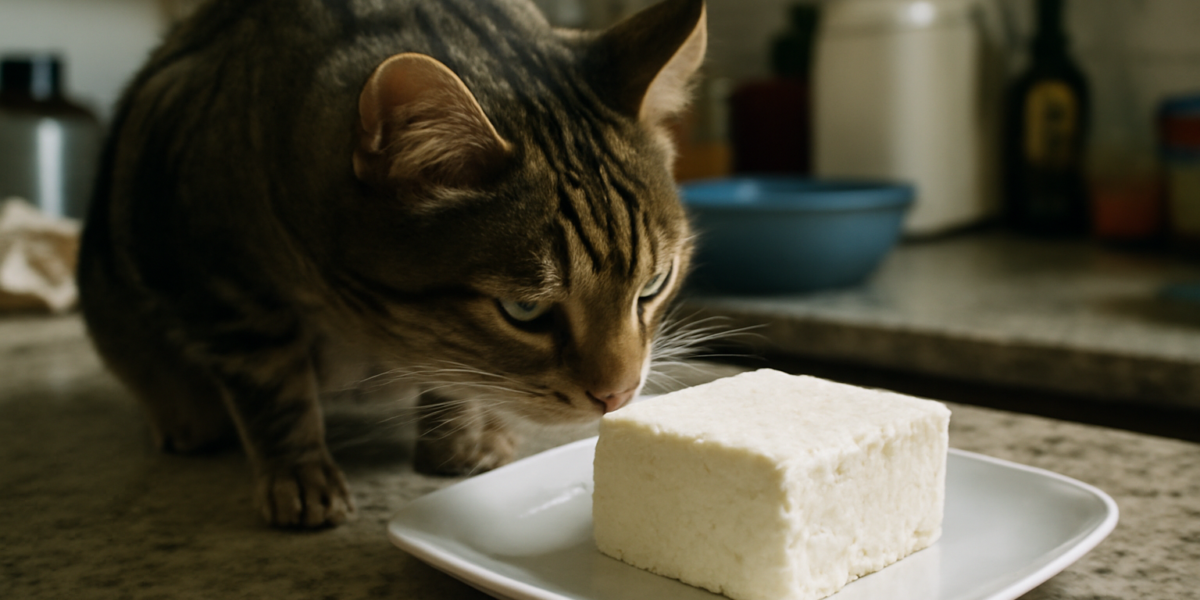
Cats can have a tiny crumb of plain paneer occasionally, but it is not a recommended treat. Paneer is a fresh, non-aged Indian cheese made by curdling hot milk with lemon juice or vinegar and pressing the curds into a soft block. Compared to fresh milk, paneer has less lactose because much of the whey (which holds the lactose) drains off during pressing. That makes it slightly easier for cats to tolerate than a saucer of milk — but most adult cats lose much of their lactase enzyme after weaning, so any dairy can still trigger digestive upset.
The answer to “can cats eat paneer” is yes in tiny amounts, only for healthy adult cats with no history of dairy intolerance, IBD, pancreatitis, or obesity. A piece the size of a half-pea once a month at most. Skip paneer entirely if your cat is overweight, has a sensitive stomach, or has any underlying GI condition. Paneer in restaurant or home dishes is usually cooked with garlic, onion, ghee, salt, and chili — none of which belong in a cat.
What Is Paneer?
Paneer is the most common fresh cheese in Indian, Pakistani, Bangladeshi, and Nepalese cooking. It is made by heating cow’s milk (or sometimes water buffalo milk) to near-boiling, then adding an acid — lemon juice, vinegar, or sour yogurt — to separate the curds from the whey. The curds are gathered in a cloth, pressed under weight to expel water, and chilled until firm. The result is a mild, slightly tangy, pleasantly chewy cheese that holds its shape when cooked.
Unlike aged cheeses (cheddar, parmesan, blue), paneer is not fermented or ripened. It does not contain mold cultures, ammonia by-products, or concentrated salt. Sodium is moderate at roughly 200 to 250 mg per 100 grams of homemade paneer, considerably lower than aged cheeses (cheddar around 600 to 700 mg per 100 g) but higher than what cats need.
Lactose, Lactase, and Why Most Cats Struggle With Dairy
Kittens produce lactase, the enzyme that breaks down the milk sugar lactose, throughout the nursing period. Around 8 to 12 weeks of age, lactase production declines dramatically as kittens are weaned onto solid food. By adulthood, most cats produce only small amounts of lactase — enough to handle the trace dairy in some cat treats but not enough to comfortably digest a meaningful serving of milk.
The lactose that is not digested in the small intestine continues into the colon, where bacteria ferment it, producing gas, drawing water into the bowel, and causing diarrhea. Some cats retain more lactase activity into adulthood than others. There is no easy at-home test, so the practical rule is: assume your cat is lactose intolerant unless proven otherwise, and offer dairy in tiny amounts if at all.
Paneer’s lower lactose content (roughly 1 to 2 grams per 100 g compared to 4 to 5 g per 100 g in fresh milk) makes it more forgiving than milk, but still not ideal. Compare with our cottage cheese guide and cream cheese guide — paneer falls between the two in lactose and fat content.
Fat, Calories, and Pancreatitis Risk
Whole-milk paneer contains roughly 20 to 25 percent fat. That is fine for humans in moderation but a heavy fat load for a 10-pound cat. Cats prone to pancreatitis — and feline pancreatitis is more common than once thought, often subclinical — should avoid sudden high-fat treats. Pancreatitis in cats can present quietly with reduced appetite, weight loss, mild lethargy, or intermittent vomiting rather than the dramatic illness seen in dogs. Our feline pancreatitis guide covers the early signs.
For overweight cats, the calorie load also matters. A cubic inch of paneer is roughly 70 to 80 calories — about a third of a small cat’s daily calorie budget. Treats overall should stay under 10 percent of daily calories, so a half-pea-sized crumb (a fraction of a gram) is the appropriate scale. Reduced-fat paneer exists but is not common; whole-milk is the default in most kitchens.
Salt Considerations
Plain homemade paneer made without added salt has minimal sodium. Store-bought paneer often has small amounts of salt added during pressing for flavor and shelf life. Restaurant paneer dishes (paneer tikka, palak paneer, shahi paneer) are heavily salted and seasoned. A cat-sized portion of plain unsalted paneer contributes negligible sodium; a piece of salted restaurant paneer can push toward problematic levels for cats with heart or kidney disease.
Cats with hypertrophic cardiomyopathy, the most common feline heart disease, benefit from sodium-conscious diets. Our HCM guide covers the breeds and warning signs. Cats with chronic kidney disease (around 30 to 50 percent of seniors) also benefit from limiting added sodium. For these cats, paneer in any form is best avoided.
Safe Serving Size for Healthy Cats
If you decide to share a tiny piece of plain paneer with a healthy adult cat with no medical conditions, here is the safest approach.
- Use plain, unseasoned paneer with no added salt
- Cut a piece roughly the size of a half-pea (less than a quarter teaspoon)
- Offer at room temperature on a clean dish
- Limit to once a month or less — this is a novelty, not a regular treat
- Watch for vomiting, diarrhea, gas, or refusal of next meal over 12 to 24 hours
- Stop offering paneer if any GI symptoms appear
Do not offer cooked paneer dishes — they almost always contain garlic, onion, or both, which are toxic to cats. See our garlic safety guide and onion guide for the allium toxicity details. Even paneer that has been simply pan-fried in ghee carries a high fat load that is not appropriate for cats.
How Paneer Compares to Other Cat Dairy Options
Within the cat-dairy landscape, paneer sits between cottage cheese (lower fat, similar lactose) and cream cheese (higher fat, similar lactose). All three are tolerated in tiny amounts by most healthy adult cats. None of them are nutritionally beneficial. The aged-cheese category — general cheese guide, blue cheese — is generally lower in lactose but much higher in sodium and, in the case of blue cheeses, contains mold compounds that can harm cats.
Plain unsweetened yogurt is another lower-lactose option (the live cultures pre-digest some lactose), and coconut yogurt avoids dairy entirely. Sibling B109 articles cover related cheeses: labneh, feta, and mascarpone. None replace a complete cat food.
Symptoms to Watch For After Paneer
If your cat has tried paneer for the first time, watch for the following over 12 to 24 hours.
- Vomiting or repeated nausea
- Loose stool or full diarrhea
- Excessive gas or visible abdominal discomfort
- Refusal of the next regular meal
- Lethargy or hiding
- Pawing at the mouth or excessive drinking
Mild symptoms usually pass without intervention. Offer plenty of fresh water and skip the next treat. Persistent vomiting, repeated diarrhea, or any sign of dehydration warrants a vet call. If your cat is a kitten, senior, or has a chronic condition, call sooner rather than later — these cats have less margin for GI upset.
What to Skip Entirely
Several paneer-containing foods are unsafe for cats and should be kept fully out of reach.
- Paneer butter masala, paneer tikka, palak paneer (garlic, onion, salt, chili, cream)
- Paneer pakora or fried paneer (oil, batter, salt, often spiced)
- Paneer kebabs or skewers with marinades
- Sweet paneer desserts: rasmalai, sandesh, kalakand (high sugar)
- Paneer paratha or stuffed flatbreads (wheat, salt, ghee)
- Anything labeled “spicy paneer” or “tandoori paneer”
If your cat steals a piece of cooked paneer from a plate, identify what was in the dish. Garlic and onion exposures may need a vet call regardless of how much paneer was eaten — the allium dose, not the cheese, is the urgent concern.
Indian Kitchen Safety for Cat Households
Indian cooking uses a remarkable variety of spices, fats, and aromatics that overlap with feline toxin lists. Garlic, onion, asafoetida (hing — which contains onion-related compounds), green chili, and large amounts of ginger all appear in everyday paneer dishes. Ghee is heavy fat. Tandoori marinades contain garlic and onion paste. Garam masala blends often contain mace, cardamom, and clove — none acutely toxic in the small amounts cats typically encounter, but not feline-friendly either.
If you cook frequently with paneer and have a curious cat, manage the kitchen environment proactively. Keep the cat off countertops while you work — a baby gate at the kitchen entrance helps during cooking sessions. Plate human meals and put leftovers away in sealed containers immediately. Wipe down counters with cat-safe cleaners after cooking to remove garlic and onion residues that a cat could lick up later. The single biggest accidental-exposure scenario in cat households is the cat that jumps onto an unattended dinner plate.
For cats that have grown up around Indian cooking and seem indifferent to paneer dishes, your low-effort safety wins are: a closed-door dining room while eating, a covered trash can for food scraps, and a habit of asking visitors not to share human food with the cat. Most cats with no exposure history simply do not seek paneer out — the bigger risk comes from ad-hoc treat-giving.
Frequently Asked Questions
Can lactose-intolerant cats eat paneer?
Lower-lactose dairy like paneer is more tolerated than milk, but lactose-intolerant cats can still react. The conservative answer is no — skip dairy entirely if your cat has had GI symptoms after dairy in the past.
Is homemade paneer safer than store-bought?
Slightly, because you can control salt and ensure no added preservatives. Either way, plain unseasoned paneer is the only form to consider for cats.
How much paneer is too much?
A piece bigger than half a teaspoon is too much for almost any cat. The smaller the cat, the smaller the appropriate portion. When in doubt, smaller and less often.
Can paneer cause pancreatitis in cats?
A single small piece is unlikely to trigger pancreatitis in a healthy cat. Repeated high-fat treats, or a single large fatty indulgence in a sensitive cat, can precipitate symptoms. See our pancreatitis guide.
What about paneer for kittens?
Skip it. Kittens need a balanced kitten diet for growth — see our kitten feeding guide — and dairy treats provide no benefit and risk diarrhea.


