
Last updated: May 4, 2026
In this article
- The Short Answer on Cats and Feta Cheese
- What Is Feta Cheese?
- The Sodium Problem for Cats
- Symptoms of Salt Overload in Cats
- Lactose and Cats
- Reduced-Sodium Feta and “Light” Versions
- Mediterranean Dishes With Feta — What to Avoid
- What to Do If Your Cat Eats Feta
- Better Alternatives Than Feta
- Hypertension and Salt in Senior Cats
- Sodium Math for Cat Owners
- Frequently Asked Questions
The Short Answer on Cats and Feta Cheese
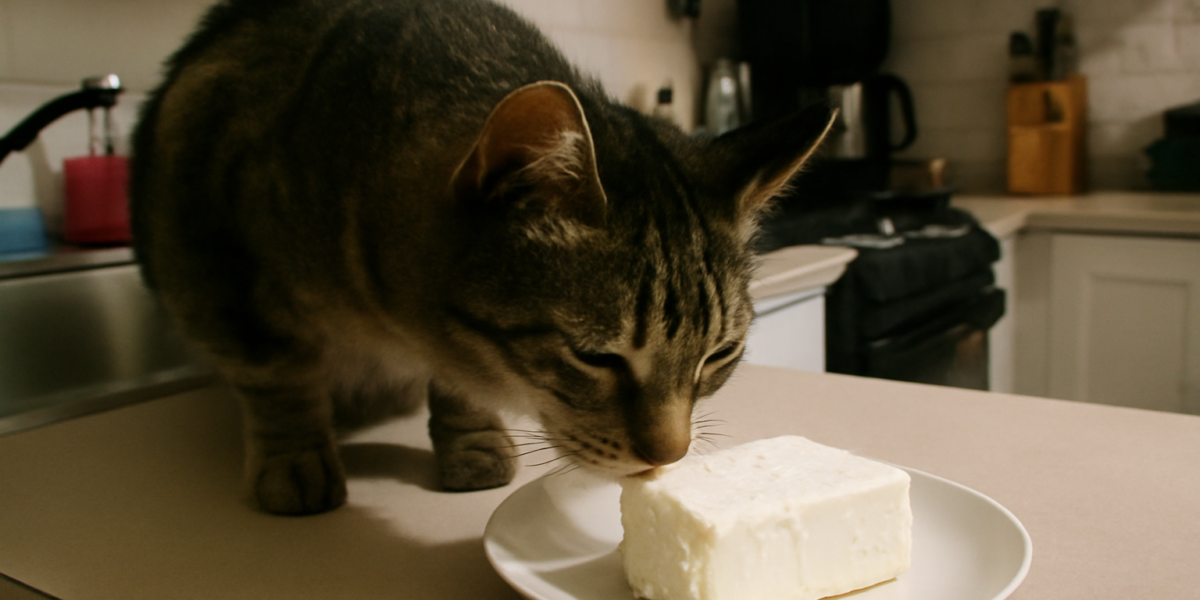
Cats should not eat feta cheese. Feta is a brined sheep’s milk cheese (sometimes blended with goat’s milk) traditionally produced in Greece and surrounding regions. The brining process — soaking the curds in salt water for weeks to months — gives feta its tangy flavor and crumbly texture, but it also pushes the sodium content to roughly 1,100 mg per ounce (about 28 grams). That is one of the highest sodium levels of any common cheese, and it is several times more sodium than a 10-pound cat needs in an entire day.
Lactose in feta is moderate — lower than fresh milk because of fermentation and curing, but higher than aged hard cheeses. The salt is the bigger concern. The answer to “can cats eat feta cheese” is a strong skip for most cats, especially those with heart disease, kidney disease, hypertension, or any HCM-prone breed. If your cat steals a single small crumb, it is not an emergency, but it is not a treat to offer intentionally either.
What Is Feta Cheese?
Feta (the name is protected under European Union geographic indication rules) is made primarily from sheep’s milk, often with up to 30 percent goat’s milk added. The milk is curdled with rennet, the curds are cut and pressed into blocks, and then soaked in a brine solution of 7 to 14 percent salt for at least two months. The cheese ages in this brine, which is why feta retains its salty character and crumbly-yet-creamy texture.
Compared to fresh cheeses like paneer or cottage cheese, feta is “cured” rather than “aged” — its texture stays soft, but the brine acts as a preservative and flavor agent. Nutritionally, an ounce of feta contains roughly 75 calories, 6 grams of fat, 4 grams of protein, and 1,100 mg of sodium. For perspective, a healthy adult cat needs roughly 40 to 60 mg of sodium per day. A single thin slice of feta delivers a quarter or more of that day’s needs.
The Sodium Problem for Cats
Sodium overload affects multiple feline body systems. In the short term, a single high-sodium snack causes increased thirst and increased urination. In a healthy cat with free access to water, this is usually self-correcting. The problem comes with cats that have any underlying cardiovascular or renal disease, or with cats that have repeated exposure to salty human foods.
Hypertrophic cardiomyopathy (HCM) is the most common heart disease in cats, with disproportionate prevalence in Maine Coons, Ragdolls, British Shorthairs, and Sphynx breeds, plus a meaningful background rate in mixed-breed cats. HCM-affected cats benefit from sodium-conscious diets to reduce cardiac workload and minimize fluid retention. Our HCM guide covers the breed risks and management approach.
Chronic kidney disease, present in 30 to 50 percent of cats over age 12, also calls for sodium restriction. Excess salt forces stressed kidneys to work harder filtering and excreting it. Our CKD guide walks through diet considerations. For these cats, feta is a clear no.
Symptoms of Salt Overload in Cats
If a cat eats a meaningful amount of feta — say, a tablespoon or more — symptoms of sodium overload can appear within hours. Watch for the following.
- Excessive thirst and frequent trips to the water bowl
- Increased urination
- Vomiting
- Diarrhea
- Lethargy or weakness
- Tremors or muscle stiffness
- Loss of coordination or wobbly walking
- In severe cases, seizures or coma
Severe salt poisoning is rare in cats with access to fresh water but possible. Cats with heart disease may show worsening of their underlying condition — increased respiratory rate, open-mouth breathing, or fluid retention — within 24 to 48 hours of a salty indulgence. Any of these signs warrants immediate veterinary care.
Lactose and Cats
Feta has moderate lactose content, less than fresh milk but more than aged hard cheeses like parmesan. Most adult cats produce only small amounts of lactase enzyme after weaning, so any meaningful dairy serving can trigger diarrhea, gas, or vomiting. Even if you ignore the salt issue (which you should not), the lactose alone makes feta a poor cat treat.
For lower-lactose dairy options that some cats tolerate, see our cottage cheese guide, cream cheese guide, and yogurt guide. The general rule across all dairy: tiny amounts only, plain only, healthy adult cats only.
Reduced-Sodium Feta and “Light” Versions
Some commercial feta brands sell reduced-sodium versions with sodium content closer to 600 to 800 mg per ounce. While that is lower than traditional feta, it is still very high compared to almost every other cheese and far above what cats need. Reduced-sodium feta is still not appropriate as a cat treat. The marketing focus is human cardiovascular health, not feline nutrition.
“Light” or low-fat feta is similarly aimed at human calorie reduction. The sodium content is often unchanged. Substitution with fresher, less-cured cheeses — see our paneer guide for an example — is a better path if you want to share a tiny taste of dairy with your cat.
Mediterranean Dishes With Feta — What to Avoid
Feta rarely appears alone in human meals. It shows up in Greek salads, spanakopita, stuffed peppers, baked dishes, and as a salad topping. Most of these dishes contain ingredients that are independently problematic for cats.
- Greek salad — onion (toxic), olives (high salt), olive oil (high fat), feta (high salt)
- Spanakopita — onion, garlic, salt, butter, phyllo dough
- Stuffed peppers with feta and rice — onion, garlic, herbs, salt
- Pasta with feta and tomatoes — garlic, olive oil, salt
- Pita with feta and tzatziki — garlic in tzatziki is toxic
If your cat steals a bite of any of these, the most urgent concern is usually the garlic or onion, not the feta. See our cat garlic guide and onion guide for allium toxicity details. Call your vet if your cat consumed dishes with these ingredients.
What to Do If Your Cat Eats Feta
For a small accidental crumb (less than a pea-sized piece), the typical outcome is no clinical effect. Provide fresh water and watch for vomiting or diarrhea over the next 12 hours. For a larger ingestion (a tablespoon or more), monitor more carefully — increased thirst is expected and not concerning if water is available; any neurological symptoms (wobbliness, tremor, lethargy) are emergency signs.
Cats with known HCM, CKD, hypertension, or heart murmurs should be evaluated by your vet after any meaningful feta ingestion. For these cats, even a single high-sodium snack can tip a fragile balance. Bring the cheese label or a photo of the dish to help the vet estimate sodium load.
Better Alternatives Than Feta
If you want to share a tiny taste of cheese with your cat, choose lower-sodium and lower-lactose options. Plain mozzarella, plain cottage cheese, plain ricotta, and plain unsalted paneer are all far better choices than feta. Even within those, the portion should be a pea-sized crumb at most, offered occasionally.
Sibling B109 articles cover other cheeses with their own profiles: paneer (low salt, fresh), labneh (strained yogurt, lower lactose), and mascarpone (very high fat). For a complete view of the cat-cheese landscape, see our general cheese guide and blue cheese article.
Hypertension and Salt in Senior Cats
Feline hypertension (high blood pressure) is more common than once recognized, especially in cats with chronic kidney disease, hyperthyroidism, or heart disease. Roughly 20 to 65 percent of senior cats with CKD have measurable hypertension, depending on the population studied. The symptoms are often subtle until end-organ damage occurs — sudden blindness from retinal detachment is unfortunately one of the more common presenting signs. Twice-yearly blood pressure measurement starting at age 10 is now standard of care among feline medicine specialists.
Sodium is not the sole driver of hypertension in cats the way it is sometimes framed in human medicine, but in a cat with already-stressed kidneys or thyroid imbalance, sodium loads from human food add measurable burden. Feta is one of the highest-sodium common foods. A senior cat that habitually steals bites of feta or olives during family meals is getting chronic exposure that shows up as worsening blood pressure trends over time. The simple intervention — strict no-table-feeding for senior cats — is more impactful than any single dietary change.
Sodium Math for Cat Owners
Understanding cat sodium needs makes feta and other cured cheeses easier to evaluate. A 10-pound healthy adult cat needs roughly 21 mg of sodium per 100 kcal of food consumed, working out to about 40 to 60 mg per day depending on caloric intake. Commercial complete-and-balanced cat foods provide this amount built in. Cats with heart disease may have a prescribed sodium ceiling closer to 30 mg per day. Add a single cube of feta (about 14 grams) and you have just delivered roughly 200 to 250 mg of sodium — three to five times the daily budget in one bite.
Repeated salty snacks contribute to chronic sodium overload, which forces compensatory mechanisms in the kidneys and cardiovascular system. Even healthy young cats develop subclinical hypertension and renal stress from chronic high-sodium feeding. The clinical signs — increased thirst, urinary changes, weight loss — develop slowly and are easy to attribute to “getting older.” For multi-cat households, see our multi-cat feeding guide for tips on keeping high-sodium human snacks away from a sodium-sensitive cat.
If you live with a cat with a known heart or kidney condition, audit the household food map. Where does the cat have access? What plates get left out? Who in the family is most likely to slip a cat a piece of cheese off a charcuterie board? Pre-empting those scenarios with closed doors, pet gates, and clear family rules protects the cat better than counting on perfect supervision.
Frequently Asked Questions
How much feta is dangerous for a cat?
The exact toxic dose depends on the cat’s size and health. As a rough guide, anything more than a quarter-teaspoon of feta meaningfully increases sodium load for a 10-pound cat. A tablespoon or more in a small cat warrants vet contact, especially if the cat has any cardiac or renal history.
My cat licked feta off a plate. Should I worry?
A small lick is unlikely to cause clinical issues in a healthy cat. Provide fresh water and watch for vomiting or excessive thirst. If your cat has heart or kidney disease, call your vet for tailored advice.
Is goat-milk feta safer than sheep-milk feta?
The salt content is the same regardless of milk source — both are brined to similar concentrations. Goat versus sheep does not change the cat-safety calculus.
Can I rinse the salt off feta to make it safer?
Rinsing reduces surface salt slightly but does not affect the salt that has migrated into the cheese during brining. The bulk of the sodium remains. Better to skip feta entirely.
What about feta-flavored snacks marketed to humans?
These usually contain even more sodium than fresh feta plus added preservatives, MSG, or onion powder. Keep these well out of cat reach.


