
Last updated: May 16, 2026
In this article
- Goldenrod and Pets: The Reassuring Answer
- The Ragweed Mix-Up — The Single Most Important Clarification
- Why Goldenrod Is Not on the Toxic List
- Common Garden Solidago Species and Cultivars
- Goldenrod’s Pollinator Value
- What If My Pet Eats Some Goldenrod?
- Goldenrod and Allergies in Pets
- Pet-Friendly Garden Design With Goldenrod
- Distinguishing Goldenrod From Ragweed in the Yard
- Frequently Asked Questions
Goldenrod and Pets: The Reassuring Answer
If you have golden plumes of Solidago lighting up your late-summer perennial border and a curious dog or cat in the same yard, here is the short version: goldenrod is not listed by the American Society for the Prevention of Cruelty to Animals (ASPCA) as toxic to dogs or cats, and goldenrod plants are generally considered safe for pets. There is no documented systemic toxicity profile in companion animals, no cardiac glycosides, no calcium oxalate raphides, no pyrrolizidine alkaloids in the species commonly grown in gardens.
This article uses goldenrod plants safe for pets as the focus phrase because that is exactly what worried owners type when they spot their dog grazing in the back of the border or their cat batting at a stem of plume-flowers. The answer holds across the dozen-plus Solidago species commonly planted in North American gardens — S. canadensis, S. rugosa, S. caesia, S. nemoralis, S. speciosa, and the popular cultivars like “Fireworks” and “Golden Fleece.”
What this article will also do is clear up the single biggest piece of misinformation surrounding goldenrod: the hay-fever blame. Goldenrod gets accused every fall of triggering hay fever in humans and respiratory irritation in pets. It is not the actual culprit. We will walk through the ragweed-versus-goldenrod confusion below, because that misperception drives a surprising amount of unnecessary worry in pet households.
The Ragweed Mix-Up — The Single Most Important Clarification
Goldenrod blooms at the same time of year as ragweed (genus Ambrosia) — late summer through early fall, exactly the period that human seasonal allergies spike. The two plants share a habitat, a bloom season, and a botanical family (Asteraceae), and goldenrod’s bright yellow flower plumes are conspicuous while ragweed’s green-yellow flower spikes are easy to miss. Result: gardeners blame the visible plant for the symptoms, even though it is the inconspicuous plant doing the actual damage.
Here is the chemistry. Hay fever is triggered by airborne pollen — pollen that enters the nasal passages and respiratory tract. The two plants pollinate completely differently:
- Goldenrod (Solidago) is insect-pollinated. Its pollen is heavy, sticky, and designed to cling to bee legs and butterfly wings. It does not become airborne in significant quantity. You can stand next to a blooming goldenrod stand and breathe normally without inhaling its pollen.
- Ragweed (Ambrosia) is wind-pollinated. Its pollen is light, dry, and produced in enormous quantity, designed to drift on air currents. A single ragweed plant can produce a billion pollen grains in a season. This is the pollen that triggers hay fever in humans and respiratory irritation in sensitive pets.
The takeaway: if you or your pet are sneezing in September, the bright yellow plant in the meadow is probably innocent. The boring green-yellow weed two feet over is probably the cause. Goldenrod gets blamed because it is visible, but the actual allergen is wind-pollinated ragweed.
Why Goldenrod Is Not on the Toxic List
Solidago has been studied extensively because it has been used in folk and herbal medicine for centuries — for kidney support, urinary tract issues, and as a wound astringent. The pharmacology is well characterized. Goldenrod contains saponins, flavonoids (including rutin and quercetin), tannins, and small amounts of essential oil. None of these compound classes are in concentrations that produce companion-animal toxicity at typical garden-grazing exposures.
The ASPCA non-toxic framing means: the plant is not known to cause systemic poisoning when ingested by dogs or cats. It does not mean a pet can eat unlimited amounts as a snack. Like most leafy garden plants, a large-volume ingestion can produce mild GI upset (vomiting, soft stool) purely from the bulk of fibrous plant material. That upset is volumetric and self-limiting, not chemical.
For comparison, plants in the same Asteraceae family that ARE on the toxic list — chrysanthemum, mums, Shasta daisy — are toxic because of sesquiterpene lactones (notably pyrethrin-related compounds). Goldenrod does not produce those compounds in problematic concentrations and does not share their clinical profile.
Common Garden Solidago Species and Cultivars
Goldenrod is one of the most diverse native genera in North America, with over 100 species. The ones you are most likely to encounter in a residential garden:
- Solidago canadensis (Canada goldenrod) — the tall, classic meadow goldenrod. Aggressive spreader, often considered weedy in maintained gardens.
- Solidago rugosa (rough-stemmed goldenrod) — including the popular cultivar “Fireworks” with arching plume-shaped sprays.
- Solidago caesia (blue-stemmed goldenrod) — shade-tolerant, more delicate, woodland-edge species.
- Solidago nemoralis (gray goldenrod) — shorter, drought-tolerant, well-behaved in gardens.
- Solidago speciosa (showy goldenrod) — upright pyramid-shaped flowerheads, less aggressive than S. canadensis.
- Solidago “Golden Fleece” — compact dwarf cultivar (S. sphacelata), 18 to 24 inches tall, well-suited to small spaces.
From a pet-safety standpoint, all Solidago species fall under the same not-on-toxic-list framing. The differences in growth habit and aggressiveness matter for garden design, but not for pet management.
Goldenrod’s Pollinator Value
Goldenrod is one of the most ecologically important fall-blooming plants in North America. It feeds an enormous diversity of native bees, including specialist solitary bees that emerge specifically when goldenrod blooms; honeybees rely on goldenrod nectar to build up winter stores; monarch butterflies drink goldenrod nectar during their fall migration; and dozens of other butterfly, beetle, and fly species visit the flowers. Soldier beetles, pearl crescent butterflies, and locust borers are all classic goldenrod visitors.
For pet households building a pollinator-friendly garden, goldenrod pairs particularly well with other safe natives: Joe-Pye weed, ironweed, coneflower, liatris, and bee balm. Together these provide nectar and pollen from June through October without putting any plant on the ASPCA toxic list.
If you also want to include a monarch host plant — milkweed (Asclepias) — be aware that milkweed is the one toxic exception in this otherwise safe planting palette. See are Asclepias plants toxic to pets for the management approach: dedicated bed, fenced or back-of-border, away from main pet zones.
What If My Pet Eats Some Goldenrod?
For the typical incidental graze — a dog who pulls a stem off in the yard, a cat who chews on a plume in a flower arrangement — the realistic outcome is no symptoms, or at most mild and self-limiting GI upset. You may see one or two episodes of vomiting if your pet ate a substantial amount of leaf material, or a day of soft stool. This is volumetric upset, not toxicity, and it usually resolves on its own with rest and access to water.
Situations where you should call your vet:
- Repeated vomiting (more than two or three episodes in a few hours).
- Diarrhea persisting more than 24 hours, or any blood.
- Lethargy or refusal to eat or drink lasting more than a day.
- Any neurologic sign — wobbliness, tremors, dilated pupils — which is NOT consistent with goldenrod and would suggest your pet ate something else in the garden as well.
If your dog or cat ate “something” in the garden and you aren’t sure whether goldenrod was the only thing, the appropriate calls are: your own vet, the ASPCA Animal Poison Control Center at 888-426-4435 (per-call fee), or the Pet Poison Helpline at 855-764-7661. Both helplines are 24-hour and can help triage the situation by phone.
Goldenrod and Allergies in Pets
Even though goldenrod is not the seasonal-allergy culprit, dogs and cats can occasionally have contact reactions to plants — typically mild skin irritation from sap or pollen on the muzzle. With goldenrod specifically, this is uncommon, but pets with sensitive skin or pre-existing atopic dermatitis can react to almost anything. Signs of plant-contact irritation include redness, itching, or rubbing at the face after time in the garden.
If your pet shows respiratory signs in late summer — sneezing, watery eyes, reverse sneezing in dogs, eye discharge in cats — the more likely culprit is environmental ragweed pollen rather than goldenrod, and the management is the same as any seasonal allergy: discuss with your vet, consider antihistamines if your vet recommends them, wipe down paws and coat after time outside, and limit outdoor exposure during peak ragweed pollen days. Air-quality / pollen-forecast apps can help you time outdoor activity around peak ragweed.
None of this rules out goldenrod-specific contact reactions in unusually sensitive individuals, but those are rare and typically mild.
Pet-Friendly Garden Design With Goldenrod
Goldenrod’s reputation in formal gardens is mixed because some species — notably Canada goldenrod (S. canadensis) — spread aggressively by rhizomes and seed. For a tidy, pet-friendly perennial border, choose better-behaved species and cultivars:
- “Fireworks” (S. rugosa) — clump-forming, well-behaved, dramatic arching plumes.
- “Golden Fleece” (S. sphacelata) — dwarf, 18 to 24 inches, suitable for small beds and containers.
- S. caesia (blue-stemmed) — shade-tolerant, doesn’t spread aggressively.
- S. nemoralis (gray goldenrod) — drought-tolerant, modest size, good for borders.
If you have a meadow-style or naturalized area where you can let things spread, the Canada goldenrod and giant goldenrod species are spectacular and ecologically valuable. Just don’t put them next to a small formal bed expecting them to stay in their lane.
Position goldenrod where it gets full sun and reasonable air circulation — crowded plantings can develop powdery mildew on the leaves. Mildew is not toxic to pets, but mildewed plants are not at their best aesthetically.
Distinguishing Goldenrod From Ragweed in the Yard
Since the ragweed-versus-goldenrod mix-up drives so much misinformation, here is how to tell them apart in your own yard:
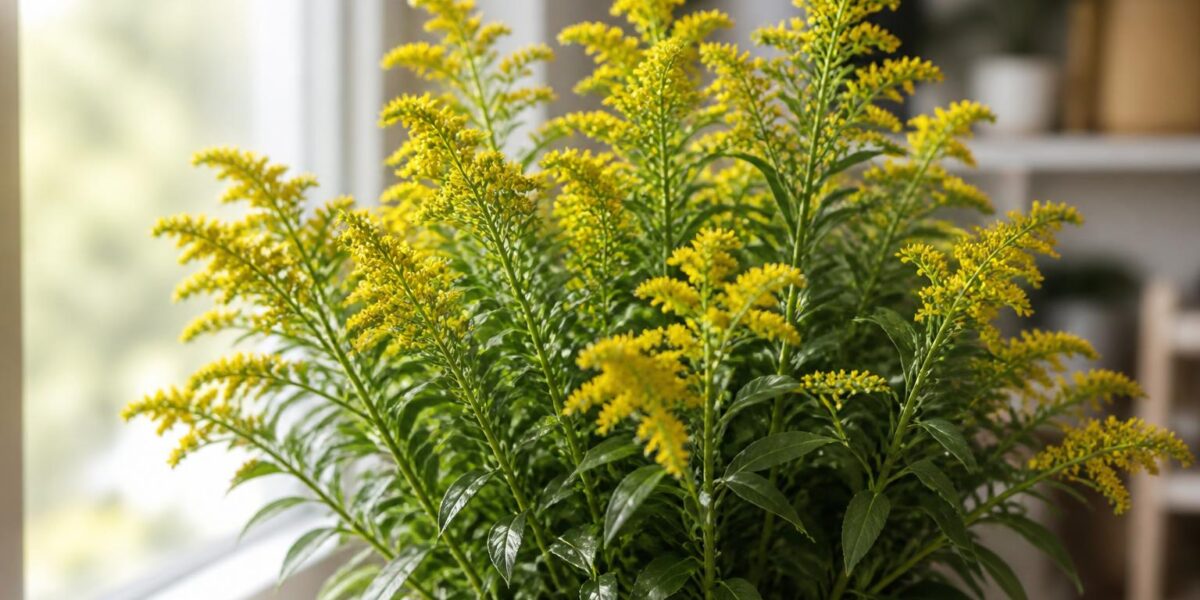
- Goldenrod (Solidago): bright yellow flower plumes, conspicuous from a distance, dense flowerheads, often over 3 feet tall, leaves lance-shaped and toothed.
- Common ragweed (Ambrosia artemisiifolia): green-yellow inconspicuous flower spikes, leaves deeply lobed and almost fern-like, plant 1 to 4 feet tall, often growing as a weed in disturbed soils.
- Giant ragweed (Ambrosia trifida): similar inconspicuous flower spikes, but a much larger plant (up to 12 feet) with broad three-lobed leaves.
If you want to reduce the actual airborne-pollen load that triggers hay fever in your household, target the ragweed in your yard and along your fence lines, not the goldenrod. Pulling ragweed before it goes to flower is one of the highest-yield air-quality interventions you can make for both human and pet allergic individuals.
Frequently Asked Questions
My dog seems sneezy and itchy in late summer when the goldenrod blooms. Is goldenrod the cause?
Almost certainly not. Goldenrod’s pollen is heavy and insect-distributed, not airborne. The actual seasonal-allergy culprit blooming at the same time is ragweed, which is wind-pollinated and produces enormous amounts of airborne pollen. Talk to your vet about ragweed-season management — wiping down paws after outdoor time, antihistamines if recommended, and limiting peak-pollen-day outings.
Is goldenrod safe for cats specifically? My cat chews on flower stems.
Goldenrod is not on the ASPCA cat-toxic list. A chewing cat may vomit from sheer volume if she eats a lot, but you do not have a chemical-poisoning concern. For chronic plant-chewing cats, providing safer indoor greens (cat grass, the plants in our cat-safe houseplants guide) gives the instinct a safer outlet.
Are goldenrod cultivars safer or more dangerous than the wild species?
The cultivars (Fireworks, Golden Fleece, etc.) and the wild species share the same chemistry and the same not-on-toxic-list framing. Cultivars are bred for ornamental traits — size, flower form, foliage color — not for changes in chemistry that would affect pet safety.
Can my pet drink water from a vase that holds cut goldenrod?
That is not a chemical-toxicity concern. Refresh the water for general hygiene reasons (any plant material in standing water grows bacteria), but goldenrod does not leach harmful compounds into vase water in a way that would poison a pet who drinks from the vase.
What should I do if my dog ate a large amount of goldenrod and now seems unwell?
Mild GI upset (one or two vomits, soft stool for a day) is consistent with volumetric upset and usually self-limiting. If your dog is having repeated vomiting, persistent diarrhea, or any neurologic signs (wobbliness, tremors), call your vet — those signs are NOT typical for goldenrod and would suggest something else may also be involved. The ASPCA APCC at 888-426-4435 and the Pet Poison Helpline at 855-764-7661 are both 24-hour resources for over-the-phone triage.


