
Last updated: May 16, 2026
In this article
- Is Joe-Pye Weed Safe for Pets?
- The 2010 Eutrochium Reclassification
- Why Joe-Pye Weed Is a Pollinator Garden Favorite
- Why Joe-Pye Weed Is Not on the Toxic List
- Common Garden Species and Cultivars
- Mechanical and Practical Cautions
- What If My Pet Eats a Mouthful of Joe-Pye Weed?
- Distinguishing Joe-Pye Weed From Boneset in the Yard
- Pet-Safe Native Pollinator Garden Design
- Frequently Asked Questions
Is Joe-Pye Weed Safe for Pets?
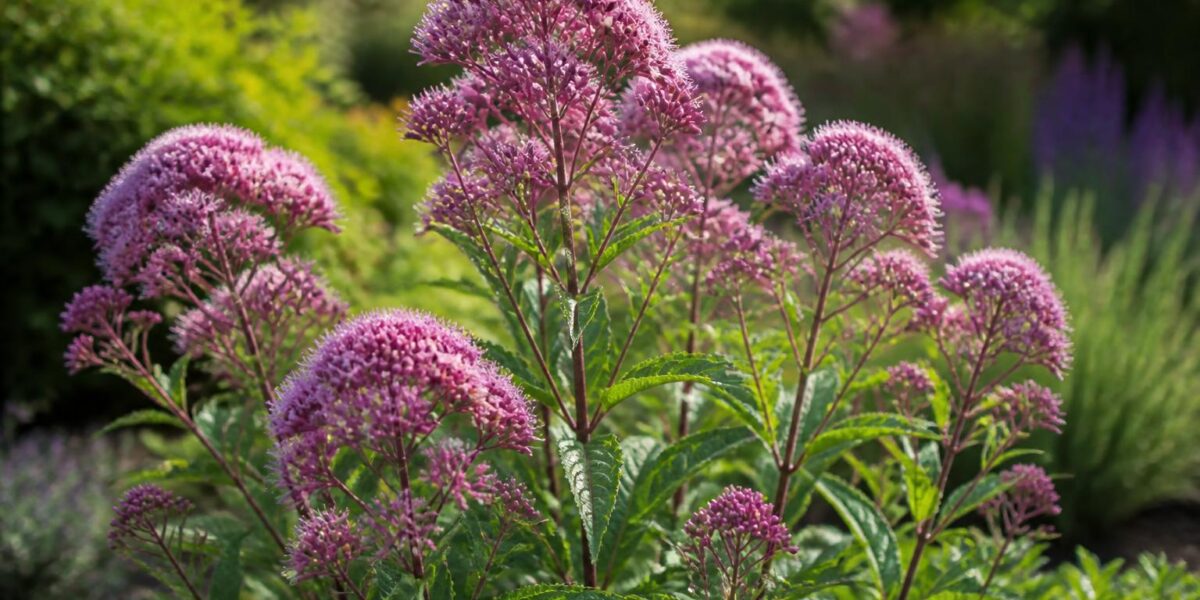
If you have planted Joe-Pye weed at the back of a perennial border for its cloudlike pink-mauve summer bloom, here is the reassuring answer: Joe-Pye weed is not listed by the American Society for the Prevention of Cruelty to Animals (ASPCA) as toxic to dogs or cats, and it is generally considered safe for pets to share a yard with. The genus is Eutrochium, the most common garden species are E. purpureum, E. fistulosum, and E. maculatum, and pet-safety inquiries on Joe-Pye weed safe for pets repeatedly come back to the same conclusion: not on any toxic-plant database, no documented systemic-toxicity profile, no chemistry to worry about beyond the ordinary mechanical risks any large leafy plant carries.
That does not mean a pet can graze freely on Joe-Pye weed without consequence. Like most garden plants, ingesting a large quantity of any leafy material can produce mild gastrointestinal upset — vomiting or loose stool — purely from the volume. But this is the same caveat that applies to almost any non-listed ornamental: it is a “safe” plant in the sense that we use the word for non-toxic plants, not in the sense that pets can eat unlimited amounts as a snack.
This article walks through the genus, the historic Eupatorium reclassification that still confuses online toxicity sources, and how to plant Joe-Pye weed in a yard you share with dogs or cats.
The 2010 Eutrochium Reclassification
One of the most important things to know about Joe-Pye weed for pet-safety research purposes is that the genus name changed in the early 2000s and the change was formally adopted around 2010. Joe-Pye weed used to be classified as Eupatorium — Eupatorium purpureum, Eupatorium maculatum, and so on — and it sat in the same genus as boneset (Eupatorium perfoliatum, which is genuinely toxic — see are boneset plants toxic to pets).
Botanists eventually concluded, based on molecular phylogenetic work, that the Joe-Pye weeds were distinct enough from true Eupatorium to warrant their own genus. The Joe-Pye weeds were moved into Eutrochium, and boneset, hemp agrimony, and several other species stayed in Eupatorium. This matters for two reasons:
- Older field guides, gardening books, and herbal-medicine references still call Joe-Pye weed Eupatorium. If you read a 1990s source warning about pyrrolizidine alkaloids in “Eupatorium purpureum,” that source is referring to what is now Eutrochium purpureum and is using outdated nomenclature.
- The toxic-plant databases (including ASPCA’s) caught up to the reclassification, but legacy concerns about pyrrolizidine alkaloids in the old Eupatorium genus do not transfer cleanly to the new Eutrochium genus. Boneset (still Eupatorium perfoliatum) does contain pyrrolizidine alkaloids and is hepatotoxic. Joe-Pye weed (now Eutrochium) does not produce significant quantities of those alkaloids and is not on the toxic list.
If you are reading multiple sources and getting conflicting answers, this nomenclature drift is almost certainly the reason. Trust current ASPCA framing on the genus you actually have in your yard.
Why Joe-Pye Weed Is a Pollinator Garden Favorite
Joe-Pye weed is a magnet for late-summer pollinators. The big domed flowerheads bloom from late July into September across most of the eastern and midwestern United States, and they attract swallowtail butterflies, monarchs (as nectar — Joe-Pye is not a monarch host plant), painted ladies, native bees, hummingbirds, and goldfinches once the seedheads form. For a pet-safe pollinator bed, Joe-Pye weed is one of the strongest mid-back-of-border anchors you can plant.
Plant pairings with Joe-Pye weed in pet households often include other safe natives like goldenrod, ironweed, coneflower, liatris / blazing star, and bee balm. All of these are not listed by ASPCA as toxic, and together they cover the bloom calendar from June through October.
If you want to add a true monarch host plant to the same bed, the only honest option is milkweed — but that is a toxic plant. We cover the management strategy in are Asclepias plants toxic to pets; the practical compromise is a fenced or back-of-bed milkweed station within an otherwise safe planting.
Why Joe-Pye Weed Is Not on the Toxic List
Joe-Pye weed has a long history of folk-medicine use — the common name comes from a Native American healer named Joe Pye who reportedly used the plant to treat fevers, particularly typhoid. That folk-medicinal history sometimes makes online searches surface “is Joe-Pye weed poisonous” results that conflate it with the medicinal-overdose concerns of related Asteraceae plants.
From a current pharmacology and toxicology perspective, Eutrochium species do not produce the pyrrolizidine alkaloid concentrations that make boneset hepatotoxic, and they are not known to contain cardiac glycosides, calcium oxalate raphides, cyanogenic glycosides, or any of the other major toxin classes that drive companion-animal toxicity. The plant simply does not have a chemistry profile that warrants a toxic-list entry.
That said, “not on the ASPCA toxic list” and “completely inert” are not the same thing. The leaves are coarse and hairy, and a dog who eats a large quantity may vomit from sheer volume the same way they would after eating a salad bag’s worth of any leafy green. This is mechanical / volumetric upset, not chemical toxicity, and it usually resolves on its own.
Common Garden Species and Cultivars
The species and cultivars you are most likely to encounter in a US garden:
- Eutrochium purpureum (sweet Joe-Pye weed) — the most widely planted species. Reaches 5 to 7 feet tall, dome-shaped flowerheads, mauve-pink color.
- Eutrochium fistulosum (hollow Joe-Pye weed) — taller, up to 9 feet. Hollow stems. Often the species sold under the cultivar name “Gateway” with intense purple-pink flowers.
- Eutrochium maculatum (spotted Joe-Pye weed) — purple-spotted stems, slightly shorter than E. fistulosum, prefers moister soils.
- Eutrochium dubium (coastal-plain Joe-Pye weed) — shorter, more compact form often sold as “Little Joe.”
From a pet-safety standpoint, all four species fall under the same not-on-toxic-list umbrella. Cultivar differences (compact “Little Joe,” dwarf “Baby Joe,” intense-color “Gateway”) do not change the underlying chemistry and do not change the safe-for-pets framing.
Mechanical and Practical Cautions
A few practical considerations that are worth noting even though Joe-Pye weed is not chemically toxic:
Tall mature plants — particularly E. fistulosum at 7 to 9 feet — can lean and fall in a strong storm. A 9-foot stem falling on a small dog or cat is a mechanical hazard, not a poisoning hazard, but it is still something to plan around. Position large Joe-Pye weed plants where a fall would not block a doorway or land in a high-traffic pet area.
The flowers attract bees in large numbers. A dog who likes to chase or snap at flying insects can pick up a sting near actively blooming Joe-Pye weed. This applies equally to any pollinator-attractor plant; if your dog is a known bee-snapper, supervise during peak bloom.
The plant self-seeds readily and can spread well beyond the bed you planted it in. Volunteers may pop up in lawn areas where you did not plan to have it. The volunteers are not chemically dangerous to your pet, but they are also not what you wanted growing through the lawn.
What If My Pet Eats a Mouthful of Joe-Pye Weed?
For an opportunistic mouthful from a curious dog or cat, the realistic outcome is: nothing dramatic. Possibly some mild GI upset (vomiting once or twice, soft stool for a day, brief loss of appetite). Resolution is typically self-limiting within 24 hours, the same way an isolated grass-binge might resolve.
That said, you should still be aware of a few situations where a vet call is warranted:
- Repeated vomiting (more than two or three episodes in a few hours).
- Diarrhea that persists more than 24 hours, or any blood in the stool.
- Lethargy, weakness, refusal to drink, or any sign your pet feels worse over time rather than recovering.
- Any neurologic sign — wobbliness, tremors, dilated pupils — which would not be expected from Joe-Pye weed and would suggest your pet ate something else in the garden as well.
If you are unsure whether what your pet ate was actually Joe-Pye weed, or whether they may have grazed on something more concerning at the same time, call the ASPCA Animal Poison Control Center at 888-426-4435 (per-call fee) or the Pet Poison Helpline at 855-764-7661 for an over-the-phone assessment. Both lines are staffed 24 hours by veterinary toxicologists.
Distinguishing Joe-Pye Weed From Boneset in the Yard
Because boneset and Joe-Pye weed are taxonomic neighbors and used to be in the same genus, gardeners occasionally have both planted nearby and need to tell them apart. The distinguishing features:
- Joe-Pye weed (Eutrochium): leaves arranged in whorls of 3 to 7 around the stem; flowers pink to mauve to purple; flowerheads dome-shaped; height 4 to 9 feet depending on species.
- Boneset (Eupatorium perfoliatum): leaves opposite, joined at the base around the stem (this is the “perfoliatum” feature — leaves appear pierced by the stem); flowers white; flowerheads flatter; height 2 to 4 feet.
If you are not sure which you have, the leaf-arrangement test is the easiest. Whorled leaves around the stem = Joe-Pye weed = safe-for-pets framing. Opposite, fused-at-the-base white-flowered = boneset = toxic — see are boneset plants toxic to pets for the full hepatotoxicity picture.
Pet-Safe Native Pollinator Garden Design
For a yard you share with pets, Joe-Pye weed is one of the best back-of-border anchor plants you can use to build a native pollinator garden. A simple design template:
- Back row (5 to 9 feet): Joe-Pye weed, ironweed, perennial sunflower (helianthus).
- Middle row (3 to 5 feet): goldenrod, coneflower, beebalm, agastache (anise hyssop).
- Front row (1 to 3 feet): liatris, coreopsis (tickseed), gaillardia (blanket flower), penstemon (beardtongue).
That stack covers the bloom season from late spring through October, supports native bees and butterflies, and contains nothing on the ASPCA toxic-plant list. It is the go-to design for pet households who want to plant for pollinators without adding management burden.
Frequently Asked Questions
I read online that Eupatorium is toxic — should I be worried about my Joe-Pye weed?
That source is using outdated nomenclature. Joe-Pye weed was reclassified out of the Eupatorium genus and into Eutrochium around 2010. The pyrrolizidine alkaloid concerns that drive Eupatorium toxicity (boneset, hemp agrimony) do not apply to current Eutrochium species. Joe-Pye weed in your garden today is not on the ASPCA toxic list.
Can I let my dog drink water from a dish that has Joe-Pye weed leaves floating in it after a storm?
Yes — that’s not a toxicity scenario. Joe-Pye weed leaves do not leach harmful compounds into water. Refresh the dish for hygiene reasons (any vegetative debris in standing water is a bacterial-growth risk regardless of the plant species), but you do not have a poisoning concern.
Is Joe-Pye weed safe for cats specifically? My cat sometimes nibbles plants.
Joe-Pye weed is not on the ASPCA cat-toxic list. A nibbling cat may vomit if she eats a substantial amount, but that is mechanical / volume upset rather than chemical toxicity. For chronic plant-nibbling cats, consider providing pet-safe indoor greens (cat grass, our cat-safe houseplants guide) so the chewing instinct has a safer outlet.
Does deer-resistance translate to pet-safe?
Not always — many deer-resistant plants are deer-resistant precisely because they are toxic (yew, foxglove, monkshood). Joe-Pye weed is moderately deer-resistant for unrelated reasons (the coarse hairy leaves are unappealing rather than poisonous), and it happens to also be pet-safe. But “deer-resistant” on a plant tag is not a reliable indicator of pet safety. Check ASPCA framing per plant.
How do I tell if my Joe-Pye weed got cross-contaminated with herbicide drift from a neighbor’s yard?
Visible signs of herbicide damage on a Joe-Pye weed plant are leaf yellowing, curling, or stunting that is unusual for late summer. The plant itself is not made toxic by light herbicide drift in a way that creates a poisoning concern for a casual chew, but if you suspect significant drift, do not let your pet graze in that area until the plant either recovers or is replaced. Call your vet or the ASPCA APCC at 888-426-4435 if your pet shows signs of unusual GI or neurologic upset and herbicide exposure is plausible — herbicide is the toxin in that scenario, not the plant.


