
Last updated: May 16, 2026
In this article
- Mustard Plants and Your Pets: The Short Answer
- What Mustard Plants Actually Are
- The Toxicity Mechanism — Glucosinolates and Allyl Isothiocyanate
- Severity Tier — Moderate, Not Severe
- Mustard Plant vs Mustard Condiment
- What to Watch For After Ingestion
- Cats and Mustard Plants
- Dogs and Mustard Plants
- Mustard’s Brassica Family Context
- Designing Around Mustard If You Grow It
- If Your Pet Just Ate Mustard Plant Material
- Frequently Asked Questions
Mustard Plants and Your Pets: The Short Answer
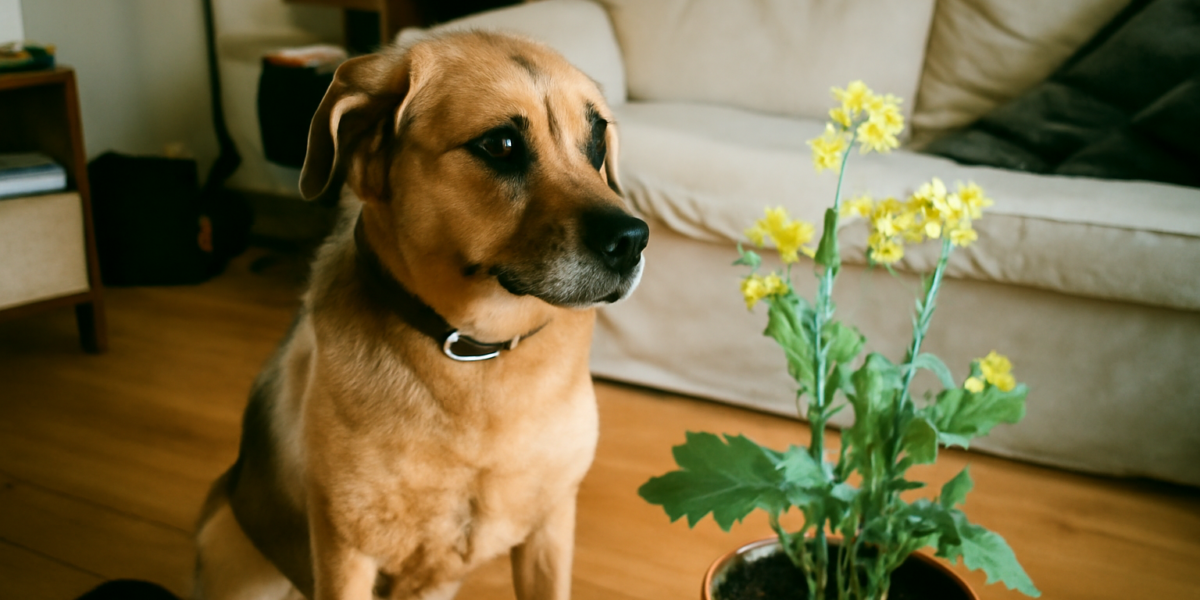
Mustard plants — the Brassica juncea (brown or Indian mustard), Brassica nigra (black mustard), Sinapis alba (white or yellow mustard), and the various wild and feral mustards in the same group — are the asterisk of the Brassica family. They are not on the same urgent toxic shelf as lilies or sago palms, but they are NOT in the same easy-grazing bucket as kale, cabbage, broccoli, and arugula. The leaves and seeds of mustard plants accumulate higher concentrations of glucosinolates than most salad-stage Brassicas, and a moderate ingestion can cause real GI upset in dogs and cats: vomiting, drooling, soft stool, and abdominal discomfort. ASPCA toxicity references list wild mustard as toxic to livestock, and the foraging-pet concern follows the same chemistry at a smaller scale.
This article covers the mustard PLANT — what happens if your dog or cat nibbles the leaves, stems, flowers, or seed pods in your vegetable or herb garden. For whether prepared mustard condiment is safe to feed your pet (a different question — vinegar, spice, salt, and tiny amounts of seed oil), search our food-safety side. The plant-side answer for actual mustard plants: low concern for a single small bite, moderate concern for larger ingestions, and genuine concern if a pet eats a lot of seeds.
What Mustard Plants Actually Are
“Mustard” covers several Brassica family species grown for their leaves, oil, or seeds. The main ones you’ll see in gardens or wild margins are:
- Brassica juncea — brown mustard, Indian mustard, mustard greens, gai choy. Grown for both leaves (cooking greens) and seeds (brown mustard condiment, Indian-style cooking).
- Brassica nigra — black mustard. The classic source of pungent black mustard seed; tall, weedy, often naturalized along roadsides.
- Sinapis alba — white or yellow mustard. The bright-yellow seed in American hot dog mustard.
- Sinapis arvensis / Brassica arvensis — wild mustard, charlock. A common agricultural weed.
- Brassica rapa mustard-type cultivars — overlap with the Asian-greens group covered in our bok choy guide.
All of these are in the Brassicaceae (mustard) family along with the safer Brassicas like kale, broccoli, cabbage, collards, bok choy, arugula, and radish. What sets the “true mustard” species apart is glucosinolate concentration, especially sinigrin, which converts to allyl isothiocyanate when the plant is chewed or crushed. That conversion is what gives mustard its sharp, eye-watering bite — and what irritates a pet’s mouth and gut at meaningful doses.
The Toxicity Mechanism — Glucosinolates and Allyl Isothiocyanate
Glucosinolates are sulfur-containing plant compounds present across the Brassica family. Mustard plants concentrate them, and especially concentrate sinigrin, which is the precursor to allyl isothiocyanate — the volatile, pungent oil that gives mustard, horseradish, and wasabi their kick. When a pet chews mustard leaves, stems, or seeds, the enzyme myrosinase mixes with sinigrin and produces allyl isothiocyanate locally in the mouth and gut.
The clinical effects in pets are usually a moderate GI picture rather than a severe organ-level toxicity:
- Drooling, mouth pawing, or “lip smacking” from oral irritation
- Vomiting, sometimes repeatedly
- Abdominal discomfort and a refused meal
- Diarrhea, sometimes with mucus
- Mild lethargy in the hours after ingestion
Severity scales with dose, plant maturity, and which part of the plant was eaten. Seeds and flowering plants concentrate the compounds more than young salad-stage leaves. Symptoms qualitative only — we don’t have reliable published thresholds in pet body weight terms, and we won’t fabricate them.
Severity Tier — Moderate, Not Severe
Mustard plants sit in the “moderate” toxicity tier for pets in most foraging scenarios. They are not life-threatening at typical garden amounts, but they are also not a benign nibble. A small dog who eats a meal-sized portion of mustard greens or a handful of seed pods can have a rough twelve-to-twenty-four hours. The bigger livestock-poisoning literature on Brassica species (cattle and sheep grazing mustard at high volumes) describes more serious outcomes — anemia, photosensitivity, rare neurological signs — but those follow days-to-weeks of forced grazing, not a foraging incident.
Cats are generally more sensitive to many plant toxins than dogs by body weight. With mustard specifically, cats are also more put off by the smell and taste, so a self-limiting bite is the more common scenario. Dogs are the typical mustard-bed offenders.
Mustard Plant vs Mustard Condiment
People often conflate “the mustard plant” with “the bottle of yellow mustard in the fridge.” They’re related but separate questions:
- Mustard PLANT (this article): the live plant in a garden or wild margin. Higher glucosinolate concentration than most other Brassicas; moderate GI toxicity at meaningful doses.
- Mustard CONDIMENT: ground mustard seed mixed with vinegar, salt, turmeric, water, and spices. Tiny accidental amounts (a smear on a dropped sandwich crust) usually cause minimal trouble in a healthy adult dog. The bigger concern with condiment is the salt, vinegar, and any added garlic powder or onion powder — those carry their own pet toxicity risks. Repeated or large amounts are not recommended.
If your pet snatched a sandwich with mustard, the questions to ask are about the OTHER ingredients (chocolate? grapes? onion? cooked bone?) more than the mustard smear itself. If your pet ate a leaf out of a mustard plant, that’s the conversation this article is for.
What to Watch For After Ingestion
If your dog or cat has been around mustard plants, observe for:
- Drooling or pawing at the mouth (oral irritation)
- Vomiting or repeated retching
- Diarrhea, especially with mucus
- Refused meals or visible abdominal discomfort
- Lethargy beyond mild slowness
- Any sign of weakness, pale gums, or stumbling (uncommon, but worth recognizing)
Mild self-limited GI signs after a small ingestion can usually be managed with watchful waiting, fresh water, and a held-back next meal. Repeated vomiting, persistent diarrhea, lethargy, or any neurological sign deserves a vet call. Remember that severity is about the dose: a single chewed leaf is one situation, a stripped-bare plant or a cleared row of seed pods is another.
Cats and Mustard Plants
Cats are obligate carnivores and don’t graze plants for nutrition; their plant interactions are usually exploratory chewing, fiber-seeking, or hairball-clearing instincts. Most cats reject mustard after one bite — the pungent oils are sharply unpleasant, and cats with intact senses tend to walk away. The cat-and-mustard scenario most likely to cause real trouble is a confined cat with limited safe greens to choose from, especially a young cat exploring a wild-mustard yard.
If your cat does eat mustard plant material and shows drooling, vomiting, or off behavior, call your vet. Cats hide GI distress more than dogs do, and the absence of dramatic vomiting doesn’t mean nothing is wrong. Cats with chronic kidney disease or any chronic GI condition should not be exposed to mustard plants at all.
Dogs and Mustard Plants
Dogs are the typical mustard-plant offenders. The “weed margin” or “neglected vegetable bed” scenario is the most common — a dog rooting around in a patch of bolted greens or wild mustard along a fence line. Casual single-bite encounters are usually self-limiting; the dog tastes the bite, makes a face, and moves on. The trouble starts when a dog finds the plant interesting enough to keep chewing, or when a curious puppy explores a bed of seedlings.
Watch for the GI signs listed above. A dog who vomits once or twice in the first hours and then settles often does fine with rest and bland food. A dog who keeps vomiting, won’t keep water down, becomes lethargic, or shows abdominal discomfort needs a vet. As always, don’t forget that a foraging dog may have eaten more than just mustard — and the plant’s pungency means the dog who ate a lot was either very motivated or very confused about what is food.
Mustard’s Brassica Family Context
Most of the Brassica family is on the safe side of the line. The asterisk-not-rule pattern is worth keeping in mind: mustard is the exception, not the family rule. Compare with the safer neighbours in our companion guides — kale plants and pets, collard greens and pets, broccoli plants and pets, cabbage plants and pets, and bok choy and pets. For pet owners with mustard plants near non-mustard Brassicas, the practical move is usually to recognize the difference at planting time — keep mustard varieties in a separate bed if you have a foraging pet.
Mustard’s chemistry overlaps with another category worth knowing: leaf-and-stem-toxic plants where the rest of the plant tells a different story. Tomato and eggplant plants follow the same pattern in the Solanaceae family — see tomato plants and cats and tomato plants and dogs for that family’s parallel.
Designing Around Mustard If You Grow It
You don’t need to give up mustard greens or seed crops if you garden with pets. The simplest move is separation — a raised bed, a fenced plot, or container plants out of pet reach. If you free-range a vegetable garden, lean on the safer Brassicas (kale, collards, broccoli, cabbage, bok choy, arugula, radish) and keep mustard somewhere your pet doesn’t browse. Wild mustard along property edges is another worth pulling preemptively if your dog rummages in those margins.
For more pet-safe planting ideas, see our pet-safe garden plants roundup. The point is not to fear mustard — it’s to put it in the same mental category as ornamental ivies and tomato foliage, where you keep it but you keep it separated from grazing access.
If Your Pet Just Ate Mustard Plant Material
If the amount was small (a single leaf bite) and your pet looks fine, the right move is usually to watch and wait. Offer fresh water, hold the next meal for an hour or two, and observe through the next day. Most small ingestions resolve uneventfully.
If the amount was larger, if your pet is showing drooling, repeated vomiting, diarrhea, lethargy, or any neurological sign, contact your veterinarian without delay. You can also call the ASPCA Animal Poison Control Center at (888) 426-4435 or the Pet Poison Helpline at (855) 764-7661 for around-the-clock guidance. Be ready to identify which mustard species was eaten if you can — Brassica juncea garden mustard greens versus Brassica nigra wild mustard versus Sinapis seed plants matter to a poison-control specialist. Do not induce vomiting at home unless a veterinarian instructs you to — the wrong agent or wrong timing can do more harm than the original ingestion.
Frequently Asked Questions
Are mustard greens (gai choy) at the grocery store dangerous to my dog?
Cooked mustard greens in the small amounts a dog might find on a dropped plate are usually self-limiting. Plain cooked greens have lower active glucosinolate levels than raw plants because the volatile compounds dissipate with heat. Avoid dishes with garlic, onion, or sauces high in salt — those add their own toxicity concerns.
What about mustard sprouts and microgreens?
Mustard microgreens have intense flavor for their size — the glucosinolate concentration is high relative to mass. A small accidental nibble usually self-limits, but mustard microgreens are worth keeping out of pet reach for the same reasons mature mustard plants are.
Is mustard oil dangerous to pets?
Concentrated mustard oil (high in allyl isothiocyanate) is irritating to pet skin, eyes, and gut. Cooking-grade mustard oil at culinary amounts is less concerning than essential-oil-style products. Avoid putting any concentrated essential oils on or near pets without veterinary guidance — see our guide on essential oils toxic to cats for context.
My dog ate wild mustard along the trail — should I rush to the ER?
Watch first. A single trail-side bite often self-limits within a few hours. Repeated bites, swallowed stems or seed pods, or any symptoms (drooling, vomiting, diarrhea, lethargy) warrant a vet call. If you’re unsure of the volume, err on the side of calling poison control.
Where can I read about other Brassica family plants?
Start with our kale plants and pets guide for the safer family contrast, and visit adopt a dog hub or adopt a cat hub for broader pet-care resources.


