
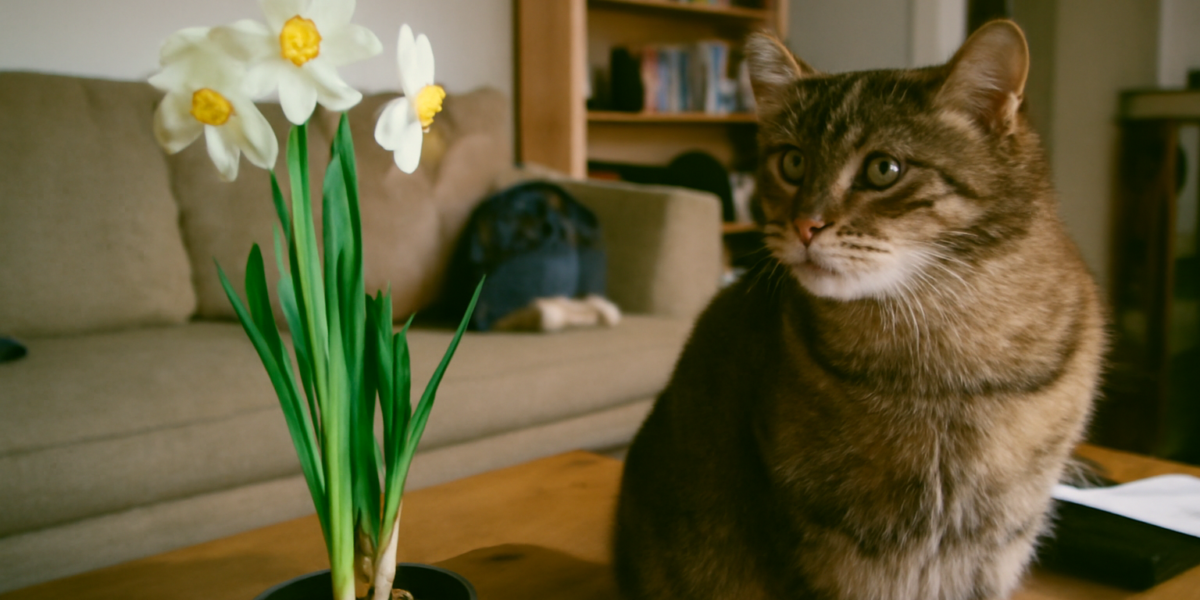
The Short Answer: Narcissus Is Toxic to Cats
Narcissus plants are toxic to cats. The entire Narcissus genus — which includes daffodils, jonquils, paperwhites, and all the hybrids sold as spring bulbs — contains alkaloids and calcium oxalate crystals that can make a cat seriously ill. The narcissus toxic to cats warning applies to every part of the plant, but the bulb is by far the most dangerous component. Cats who nibble flowers or leaves usually develop unpleasant but survivable GI upset. Cats who chew or ingest bulbs can end up in emergency care.
In this article
Narcissus toxicity is one of the more common spring plant poisonings in cats because paperwhite bulbs are sold as forced indoor arrangements, daffodils appear in cut flower bouquets, and cats naturally investigate anything new in the home. If you keep either in a house with cats, understanding the risk helps you decide whether to display them at all and what to do if your cat beats you to a nibble.
The Toxic Compounds in Narcissus
Narcissus plants contain two main categories of toxin. The first is lycorine, an alkaloid concentrated most heavily in the bulb but present throughout the plant. Lycorine acts as an emetic — it reliably triggers vomiting — and at higher doses causes low blood pressure, tremors, and cardiac effects. The second category is insoluble calcium oxalate crystals, which act mechanically on tissues the plant contacts. Those crystals cause burning in the mouth and throat and can make swallowing painful.
Bulbs contain the highest concentration of lycorine by a wide margin. A cat who chews a daffodil flower is looking at a different risk category than a cat who chews into a paperwhite bulb. Unfortunately, indoor bulb arrangements put the most dangerous part of the plant in the easiest-to-reach position.
Severity Rating
Narcissus sits in the moderate-to-severe range for cats. Most cats who sample a flower will have a miserable few hours of drooling and vomiting followed by recovery. Cats who eat meaningful amounts of bulb are at risk of severe dehydration, electrolyte disturbances, cardiac arrhythmias, and in rare cases death. The difference between a mild and a severe case often comes down to which part of the plant was eaten and how much.
Kittens, small adult cats, and cats with kidney or heart disease sit at the higher end of risk for the same exposure. Any cat who eats bulb material deserves immediate veterinary attention regardless of size and age.
Clinical Symptoms of Narcissus Poisoning
Symptoms can appear within 15 to 30 minutes for oral irritation and within one to several hours for systemic effects. Vomiting usually starts early because lycorine is a strong emetic.
- Heavy drooling and foaming
- Pawing at the mouth
- Vomiting, often repeated
- Diarrhea, sometimes bloody
- Loss of appetite
- Lethargy and hiding
- Tremors or muscle twitching
- Low blood pressure
- Irregular heart rhythm
- Difficulty breathing in severe cases
- Collapse
Cats with oral oxalate irritation will often paw at their face or refuse to close their mouths. That specific picture is a useful clue that a plant is involved even if you did not see the chewing happen.
What to Do If Your Cat Ate Narcissus
Narcissus ingestion is always a vet call. Do not attempt to manage it at home. Move quickly through these steps:
- Remove any remaining plant from your cat’s mouth if you can safely.
- Identify the plant. Photograph it or bag a sample. If it came from a florist or garden center, the variety tag or receipt helps with identification.
- Figure out what part of the plant was eaten. Bulb, leaf, flower, and water from a cut-flower vase all matter to the vet.
- Estimate the amount and timing.
- Call your veterinarian or an animal poison control hotline immediately. The ASPCA Animal Poison Control Center and the Pet Poison Helpline are available 24 hours a day for a fee.
- Do not induce vomiting in a cat at home. Feline emetic protocols are restricted to specific vet-administered drugs because at-home methods are unsafe for cats.
At the clinic, treatment typically includes IV fluids to counter dehydration and support blood pressure, anti-nausea medication, pain control for oral irritation, and in severe cases cardiac monitoring. Vets may also use activated charcoal if the ingestion was recent, though its role in bulb toxicity is debated because lycorine absorbs quickly.
When to Go to the Emergency Vet Right Now
Skip the phone calls and drive directly to an emergency hospital if your cat has eaten any bulb material, if the cat is a kitten or small breed, if the cat has vomited multiple times, if you notice weakness or collapse, if breathing looks labored, or if the cat is unresponsive or tremoring. Even cats that seem only mildly affected should be seen the same day because hidden dehydration and electrolyte shifts can sneak up.
Do not be reassured if your cat vomits once and then seems to settle. Lycorine can continue to act on the heart and blood pressure even after the stomach has emptied. Professional monitoring for several hours is the only way to be sure the cat is out of the woods.
Preventing Narcissus Exposure in a Cat Home
The safest approach is to skip narcissus entirely when you share a home with cats. Spring florist bouquets and forced paperwhites are both common sources of accidental poisoning, and cats are remarkably persistent about reaching cut flowers even on high shelves. If you want seasonal flowers, stick to cat-safe options like roses without added filler greenery, snapdragons, lisianthus, and orchids.
For outdoor daffodil beds, fence the bed or plant bulbs in a part of the yard indoor cats cannot reach. Outdoor cats who roam gardens should be kept inside during peak bloom, both for their own safety and for the health of local wildlife. If you use bulbs as mulch protection or winter planting, keep unplanted bulbs in a sealed container — they look like onions and are among the more tempting items to a curious pet.
For more on household and garden plant safety, see our guides on gladiolus risks, periwinkle toxicity, and mistletoe dangers. Our cat care blog and cat adoption hub include pet-proofing tips for every room.
Frequently Asked Questions
Are paperwhites as toxic as daffodils?
Paperwhites are Narcissus papyraceus and contain the same toxic alkaloids as daffodils, plus they are commonly sold as indoor forcing bulbs in winter. That combination makes them one of the highest-risk narcissus products for household cats.
My cat drank from a daffodil bouquet vase. Is that dangerous?
Yes. Water from a narcissus bouquet can contain leached toxins and is considered risky. Call your vet or poison control and describe how much your cat drank. This is a real and common exposure route.
How much bulb is enough to cause severe poisoning?
Exact dose information is not well published, but because bulbs are so concentrated, even a bite or two can trigger serious effects in a small cat. Treat any bulb ingestion as an emergency.
Are jonquils the same risk?
Jonquils are a type of narcissus and carry the same risks. The common names in the daffodil family overlap a lot, but the toxicity is consistent across the genus.
Can narcissus poisoning be fatal?
Fatal cases are uncommon with prompt veterinary care but do occur, especially when bulbs are involved and treatment is delayed. Early action is the single biggest factor in a good outcome.


