
Last updated: April 9, 2026
In this article
Quick Answer: No — orchids are not toxic to cats. The ASPCA confirms that orchids (family Orchidaceae) are non-toxic to cats, dogs, and horses. Your cat is not in danger from the plant itself. That said, pesticide residues, fertilizer additives, and the habit of eating large amounts of any plant can still cause problems worth knowing about. Read on for the full picture.
Few houseplants are as elegant or as widely kept as orchids, which makes the question of whether they are safe around cats an important one for a large number of pet owners. If you have been searching “are orchids toxic to cats” before placing a phalaenopsis on your windowsill, you are in luck: orchids toxic to cats is not a medically valid concern. The plant itself poses no poisoning risk. But non-toxic does not mean entirely without hazard, and there are a few practical considerations every cat owner should understand before deciding how to display and care for orchids in a home with felines. This guide covers everything you need to know.
Are Orchids Safe for Cats?
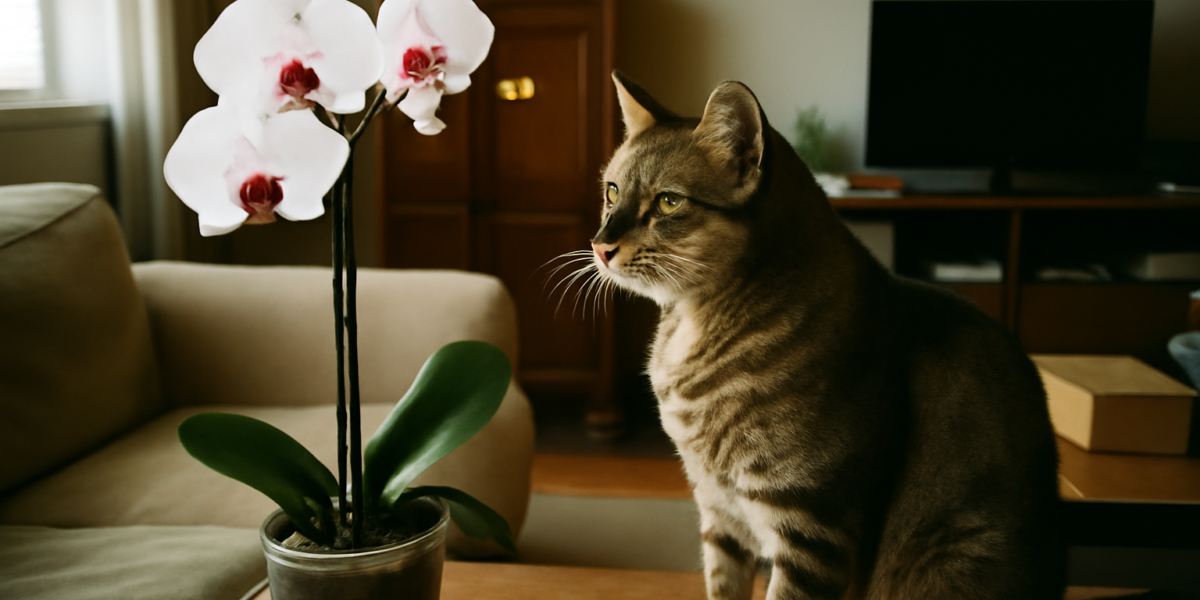
Yes — orchids are safe for cats, and this is one of the clearer answers in the world of cat-safe plants. The American Society for the Prevention of Cruelty to Animals (ASPCA) explicitly lists orchids on its non-toxic plant database for cats, dogs, and horses. This applies to the most common varieties kept as houseplants, including phalaenopsis (moth orchids), dendrobium, cattleya, and oncidium. The petals, leaves, stems, and roots of orchids do not contain compounds that poison a cat’s kidneys, liver, nervous system, or heart. So if you have been wondering whether are orchids toxic to cats, the definitive answer from veterinary and animal welfare authorities is no. Orchids are one of a relatively small group of popular flowering plants that can genuinely be called cat-safe. For more guidance on creating a pet-friendly home environment, visit our cat care blog.
Can Orchids Still Cause Problems?
Even though orchids are non-toxic to cats, there are a few ways an orchid-and-cat household can still run into trouble. Understanding these scenarios helps you keep both your pet and your plants in good shape.
Pesticides and fungicides. Orchids sold at garden centers, grocery stores, and florists are frequently treated with pesticide and fungicide sprays during cultivation and transport. These chemical residues can linger on leaves, blooms, and bark growing medium long after you bring the plant home. A cat that chews on a treated leaf or grooms itself after rubbing against a sprayed plant can ingest a meaningful dose of those chemicals. Pesticide toxicity in cats can cause drooling, vomiting, diarrhea, muscle tremors, and in serious cases, neurological symptoms. If your cat has been near a newly purchased orchid and begins showing any of these signs, contact your veterinarian promptly.
Fertilizer residue. Orchids are often sold in pots that still contain slow-release fertilizer pellets or have recently been fed with liquid fertilizer. These fertilizers typically contain concentrated forms of nitrogen, phosphorus, and potassium, along with trace minerals. They are not intended for ingestion by pets. A cat that digs in the growing medium or chews on a bark chip coated in fertilizer residue may experience stomach upset. Keep fertilizer bags sealed and stored well out of reach, and be cautious about letting cats investigate freshly fed orchid pots.
Stomach upset from large amounts. Even a truly non-toxic plant can cause mild gastrointestinal irritation if a cat eats a significant quantity of it. Plant material is not a natural part of a cat’s diet, and the fiber and cellulose in orchid leaves or roots can trigger vomiting or loose stools. This is not a toxicity reaction — it is simply the digestive system responding to unfamiliar material. It typically resolves on its own within a few hours, but it is worth monitoring.
What If Your Cat Ate an Orchid?
If your cat nibbled on an orchid petal or chewed a leaf, there is generally no cause for alarm. Because orchids toxic to cats is not a real toxicological concern, the plant itself will not cause organ damage or a systemic poisoning reaction. In most cases, a cat that eats a small amount of orchid will be completely fine. You may see mild vomiting or a brief bout of loose stools if your cat ate a notable quantity — this is a common response to eating any plant material and typically resolves within a few hours without treatment.
If the orchid came from a store or nursery and may have been treated with pesticides, call your veterinarian or the ASPCA Animal Poison Control Center at (888) 426-4435 to describe the situation. Bring the plant’s label or packaging if you still have it. Watch for drooling, repeated vomiting, lethargy, or muscle tremors, and seek veterinary attention right away if any of those signs appear.
How to Protect Your Orchids from Cats
While orchids are cat-safe from a toxicity standpoint, cats are famously hard on orchids. The real challenge for many plant owners is not keeping the cat safe from the orchid — it is keeping the orchid safe from the cat. Cats are drawn to the narrow, wobbling stems and dangling aerial roots of orchid plants, and a single curious swipe can send a pot crashing to the floor, snapping the flower spike and displacing the delicate root system. Here are practical strategies to protect both sides of this equation.
Elevation and placement. Place orchids on high shelves, hanging planters, or inside glass-front cabinets where cats cannot easily reach them. Cats can jump impressively high, so “out of reach” means genuinely inaccessible rather than just inconvenient. Wall-mounted shelves with no adjacent furniture to jump from are often the most effective solution.
Physical barriers. A closed room or a glass display case gives orchids reliable protection. If your orchids live in a dedicated plant room, consider keeping the door closed or using a baby gate fitted with a cat-proof barrier.
Deterrents. Some cat owners have success placing double-sided tape, aluminum foil, or citrus peels around the base of orchid pots. Cats generally dislike sticky textures and citrus scents. Commercial cat deterrent sprays that are safe for plants are another option worth trying.
Enrichment and redirection. Cats often chew on or knock over plants out of boredom. Providing plenty of interactive toys, climbing structures, and dedicated cat grass or catnip can reduce the appeal of your orchid collection. A well-stimulated cat is a less destructive one. For more tips on creating a cat-friendly home, browse our cat care blog.
Other Cat-Safe Flowering Plants
Since orchids are non-toxic, they join a select group of flowering plants that are genuinely safe to keep in a home with cats. If you enjoy having blooms around the house and want to build an entirely cat-safe plant collection, the following options are all confirmed non-toxic by the ASPCA.
Roses (genus Rosa) are non-toxic to cats and one of the most classic choices for cut flower arrangements. Thorns and pesticide residue are the main practical concerns, rather than toxicity. Sunflowers are cheerful, widely available, and carry no poisoning risk for felines. Snapdragons add vertical interest to any arrangement and are completely safe around cats. Gerbera daisies are bright, long-lasting, and non-toxic — a reliable choice for a cat-friendly bouquet. Freesias bring fragrance and color and pose no toxicity risk. African violets are popular low-light houseplants that the ASPCA lists as non-toxic to cats, making them an excellent windowsill companion to an orchid collection. Lisianthus resembles a peony or rose and is safely non-toxic. Zinnias and marigolds round out a cat-safe garden planting.
Flowers to avoid entirely include all true lilies in the Lilium and Hemerocallis genera, tulips, daffodils, hyacinths, azaleas, and chrysanthemums. Always inspect a mixed bouquet or new plant purchase carefully before bringing it into a home with cats, and when in doubt, check the ASPCA’s online toxic plant database before buying.
Frequently Asked Questions
Are orchids toxic to cats if they only smell the flowers?
No. Sniffing an orchid is completely harmless to cats. The plant is non-toxic, and inhaling the fragrance — even from a heavily scented variety — does not carry any poisoning risk. The only concerns arise when a cat actually eats plant material (which may cause mild stomach upset) or when the plant has been treated with pesticides that the cat could ingest through grooming. A cat that sniffs your orchid and moves on has nothing to worry about.
Which orchid varieties are safe for cats?
The most common houseplant orchid varieties — phalaenopsis (moth orchids), dendrobium, cattleya, oncidium, and cymbidium — are all non-toxic to cats. The ASPCA’s listing covers orchids broadly as a family (Orchidaceae), so the non-toxic status applies across the genus rather than being limited to a single species. If you are ever unsure about a specific variety, the ASPCA’s toxic and non-toxic plant database is a free and regularly updated resource you can search by plant name.
Are orchids toxic to cats the same way lilies are?
No — orchids and lilies are completely different in terms of feline toxicity, and the difference is significant. Lilies (particularly those in the Lilium and Hemerocallis genera) are among the most dangerous plants a cat can encounter, capable of causing acute kidney failure and death from even a very small exposure. Orchids, by contrast, are non-toxic and do not contain any compounds that damage a cat’s organs. The question of are orchids toxic to cats has a reassuring answer, unlike the question of lilies. Do not confuse the two, and never assume that because one flowering plant is safe, others must be as well.
Should I keep orchids away from my cats even though they are non-toxic?
From a toxicity standpoint, there is no medical reason to remove orchids from a home with cats. However, keeping orchids physically out of reach is still a good idea for two practical reasons. First, commercially purchased orchids may carry pesticide or fertilizer residue that could irritate your cat’s digestive system. Second, cats can cause significant physical damage to orchids — knocking over pots, snapping flower spikes, and chewing on roots. High shelves, closed rooms, or glass-front plant cabinets protect both your cat from chemical residues and your orchids from curious paws.


