
Last updated: April 9, 2026
In this article
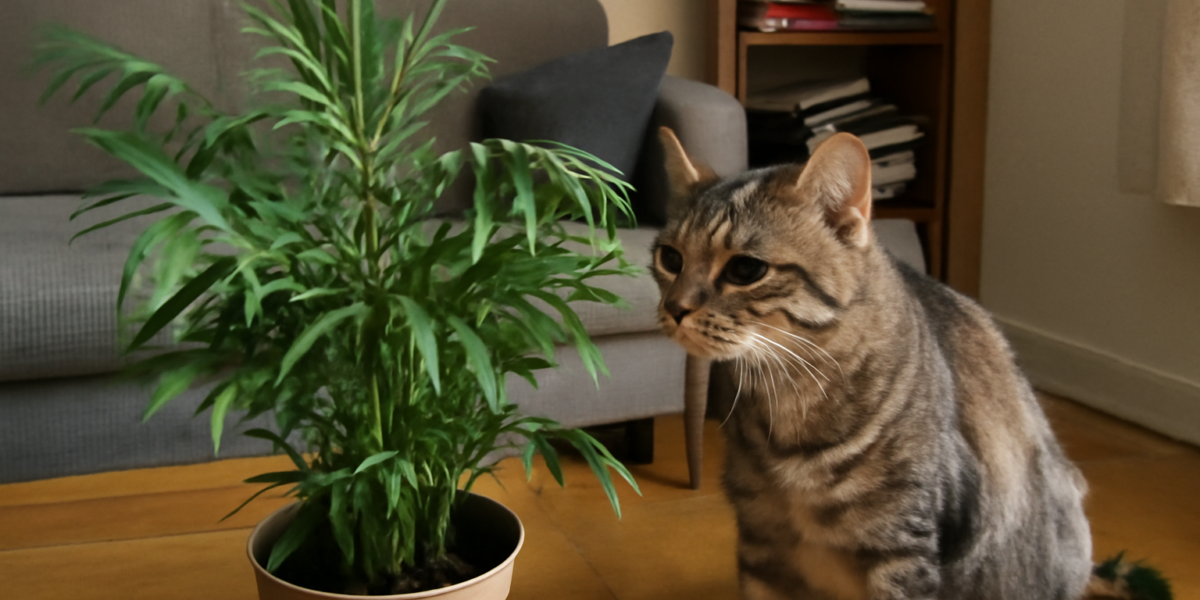
Quick Answer: NO — bamboo palms are not toxic to cats. The ASPCA confirms that the bamboo palm (Chamaedorea seifrizii) is non-toxic to both cats and dogs, making it one of the safest tropical houseplants for pet-friendly homes. You can keep a bamboo palm in the same room as your cat without worrying about serious harm. Read on for the full picture, including what minimal issues can still arise and which other palms are safe — or dangerous — to keep around cats.
If you have searched “are bamboo palms toxic to cats” after spotting your cat pawing at your favourite tropical plant, you are in the right place. Bamboo palms are a popular choice for indoor plant lovers, prized for their graceful canes, feathery fronds, and ability to thrive in lower-light conditions. For cat owners, they have one more thing going for them: they are completely non-toxic to cats. This guide explains the science and authority behind that reassurance, what benefits bamboo palms bring to cat-friendly homes, and what the one genuinely dangerous palm species looks like so you can keep your household safe.
Are Bamboo Palms Safe for Cats?
Yes, bamboo palms are safe for cats. The American Society for the Prevention of Cruelty to Animals (ASPCA) operates the most widely referenced toxicology database for companion animals in the United States, and bamboo palms appear on their list of plants that are non-toxic to both cats and dogs. This is not a case of a plant being merely “unlikely to cause serious harm” — bamboo palms are listed as genuinely non-toxic, meaning they do not contain compounds known to cause organ damage, systemic illness, or life-threatening reactions in cats.
Unlike true lilies, which can cause fatal kidney failure in cats, or sago palms, which are acutely toxic, the question of whether bamboo palms are toxic to cats has an unambiguous answer. The plant does not contain cardiac glycosides, calcium oxalate crystals, or cycasin — the types of compounds responsible for serious feline poisoning cases. If your cat has taken a bite out of a bamboo palm frond, there is no need for the same level of alarm you would feel with a genuinely dangerous plant.
If you are ever uncertain about a plant in your home, the ASPCA Animal Poison Control Center is available 24 hours a day at (888) 426-4435.
Why Bamboo Palms Are Great for Cat Owners
Beyond their safe toxicity profile, bamboo palms offer a number of practical advantages for households that include cats, making them one of the smartest indoor plant choices for pet owners.
Bamboo palms are among the houseplants most studied for their air-purifying properties. Research associated with NASA’s Clean Air Study identified bamboo palms as effective at filtering common indoor air pollutants including formaldehyde, benzene, and carbon monoxide — chemicals found in everyday household products. A cleaner indoor air environment benefits both cats and humans.
From a structural standpoint, bamboo palms are more resilient than many tropical houseplants. Their cane-like stems are sturdier than the fragile trailing vines of pothos or the delicate stalks of peace lilies, which means they are less likely to be completely destroyed by a curious cat in a single afternoon. They also grow in a naturally upright form, which can be easier to place out of casual reach than spreading or trailing plants.
Aesthetically, bamboo palms bring a lush, tropical look to any indoor space. Their arching green fronds and multi-stem growth habit make them a statement plant that fills corners beautifully — and cat owners can enjoy that visual impact without a background worry about toxicity. For more advice on building a cat-safe home environment, visit our cat care blog.
Can Bamboo Palms Cause Any Problems?
While bamboo palms are not toxic to cats, that does not mean a cat eating bamboo palm leaves will always have zero consequences. A few minor issues are worth being aware of.
If a cat consumes a significant quantity of palm frond material, the plant fibre can irritate the gastrointestinal tract and cause mild vomiting or loose stools. This is not a toxic reaction — it is simply the digestive system responding to an unfamiliar plant material in a larger quantity than is ideal. The same mild upset can result from a cat eating grass or any other plant not normally part of its diet. Symptoms of this kind are typically brief and self-resolving.
A more practical concern is the soil and any fertilizer or pest treatment the plant may have been given. Nursery-purchased plants are sometimes treated with systemic pesticides or chemical fertilizers that can be harmful to cats even when the plant itself is safe. Before placing a new bamboo palm in a room your cat can access, repot it with fresh, untreated potting mix and avoid chemical fertilizers going forward. Opt for organic, pet-safe alternatives instead.
If your cat vomits repeatedly or seems unwell after contact with any plant, contact your veterinarian regardless of the plant’s toxicity status.
Other Cat-Safe Palms
Bamboo palms are not the only palm species safe to keep in a cat-friendly home. Several other palms share a non-toxic profile and bring their own aesthetic appeal.
Areca palm (Dypsis lutescens) is one of the most popular indoor palms available and is confirmed non-toxic to cats by the ASPCA. Also called the butterfly palm or golden cane palm, it produces clusters of slender yellow-green canes topped with feathery fronds. It grows well in bright indirect light and is particularly effective as an air-purifying plant, which makes it another excellent choice for pet households.
Parlor palm (Chamaedorea elegans) is a close relative of the bamboo palm and shares its non-toxic status. It is one of the most forgiving indoor palms for lower-light environments and has been a popular houseplant since the Victorian era. Its compact growth habit makes it well-suited to smaller spaces, and like the bamboo palm, it poses no serious risk to cats that investigate it.
Ponytail palm (Beaucarnea recurvata) is not a true palm but is commonly grouped with them in garden centres and is listed as non-toxic to cats by the ASPCA. Its distinctive swollen base, which stores water, and its long, curly, grass-like leaves make it a visually interesting plant that is easy to care for and safe for curious cats to sniff and bat at without risk of poisoning.
If you are building a cat-safe plant collection, any of these palms — alongside the bamboo palm — give you tropical visual impact without the toxicity risks associated with many other popular houseplants.
Palms That Are NOT Safe for Cats
While several palm and palm-like species are safe for cats, one is critically important to know about: the sago palm. Confusing the sago palm with a cat-safe palm is a mistake that can be fatal.
Sago palm (Cycas revoluta) is not a true palm at all — it is a cycad — but it is widely sold in garden centres alongside true palms and is commonly kept as a garden plant and occasional houseplant in warmer climates. Every part of the sago palm is highly toxic to cats, including the seeds, leaves, and roots. The plant contains cycasin, a compound that causes severe liver failure. Ingestion of even a small amount — a single seed — can be fatal. Symptoms include vomiting, diarrhoea, lethargy, jaundice, and neurological signs, with liver failure following within days if treatment is not immediate. The survival rate even with aggressive veterinary intervention is low.
If you have a sago palm in your garden or home and cats have access to it, it needs to be removed or placed completely out of reach. This is one situation where “probably won’t go near it” is not an acceptable risk assessment. The contrast between sago palms and bamboo palms toxic to cats searches is stark: one leads to a safe answer, the other leads to one of the most serious toxicity warnings in pet ownership.
Other plants sometimes confused with palms, such as the cardboard palm (Zamia furfuracea), are also cycads and carry similar toxicity. When in doubt, verify the botanical species name, not the common name, against the ASPCA database before bringing any palm-like plant into a cat household.
Frequently Asked Questions
Are bamboo palms toxic to cats if they eat the leaves regularly?
Bamboo palms are not toxic to cats in any meaningful sense — the ASPCA lists them as non-toxic, meaning they do not contain compounds that cause organ damage or systemic illness. However, a cat that regularly chews bamboo palm leaves is likely to experience recurring mild gastrointestinal upset, including occasional vomiting, simply because plant fibre is not a normal part of a cat’s diet. Repeated grazing will also degrade the plant significantly over time. It is better to discourage the habit and provide dedicated cat grass or wheatgrass as an alternative outlet for plant-chewing behaviour.
Is the bamboo palm the same as a sago palm?
No, and this distinction is critically important. The bamboo palm (Chamaedorea seifrizii) is a true palm in the Arecaceae family and is non-toxic to cats. The sago palm (Cycas revoluta) is not a true palm — it is a cycad — and is one of the most toxic plants a cat can be exposed to, capable of causing fatal liver failure. They look quite different: bamboo palms have slender, reed-like canes with feathery leaflets, while sago palms have a stout, rough trunk and stiff, dark green fronds radiating in a circular pattern. If you are ever uncertain which plant you have, check the label or search the botanical species name rather than relying on the common name.
What should I do if my cat ate part of a bamboo palm?
If your cat has eaten a small amount of bamboo palm and appears otherwise normal, the situation is unlikely to require emergency veterinary attention — bamboo palms are non-toxic to cats, and mild stomach upset is the most serious outcome expected. Monitor your cat for the next several hours and watch for repeated vomiting, lethargy, loss of appetite, or any sign of distress. If symptoms persist beyond 24 hours or your cat seems unwell in any way, contact your veterinarian. For immediate reassurance or if there is any doubt about which plant was eaten, call the ASPCA Animal Poison Control Center at (888) 426-4435 any time of day or night.
Can bamboo palms and cats coexist peacefully?
Yes, bamboo palms and cats can absolutely coexist in the same home. Because bamboo palms are not toxic to cats, the risk from incidental leaf-chewing is minimal. Placing the plant on a raised surface, a plant stand, or in a room the cat only accesses supervised gives the plant a better chance of staying intact while keeping the cat safe. Providing cat grass nearby can redirect plant-chewing urges. Many cat owners keep healthy bamboo palms in cat-friendly homes without issue, particularly once the initial novelty of the plant wears off and the cat loses interest. For more guidance on creating a pet-safe home, browse our cat care blog.


