
Last updated: May 16, 2026
In this article
- Reassurance First: Blackberry Plants Are Non-Toxic
- What Plant Are We Actually Talking About?
- Cousins in the Rubus Genus
- Why ASPCA Listing Status Matters
- How Pets Tend to Encounter Blackberry
- The Mechanical Hazard Deep Dive
- Practical Garden Setup for Pet Households
- Symptoms After Ingestion
- When and How to Get Veterinary Help
- Where Blackberry Sits in the Bigger Berry Picture
- If You Are Setting Up for a New Pet
- Frequently Asked Questions
Reassurance First: Blackberry Plants Are Non-Toxic
If you have a blackberry patch in the yard or a wild bramble at the edge of the woods, the news is good. Blackberry plants are safe for pets in the toxicological sense — the ASPCA Animal Poison Control Center does not list any species in the cultivated Rubus fruticosus aggregate or the wild North American Rubus allegheniensis (Allegheny blackberry) as toxic to dogs, cats, or horses. Leaves, ripe berries, canes, and roots are not known to contain compounds that poison companion animals. The juice on your dog’s chin after a successful raid is harmless.
The honest caveat is the same one that applies to every bramble: the thorns are the real hazard. Blackberry canes carry hooked, recurved thorns that can puncture paw pads, scratch corneas, and rip thin-skinned ears. A pet who shoves through a thicket may emerge sneezing, squinting, or limping — not from poison, but from a hundred small mechanical insults. This guide explains what is and is not a worry, how to garden around bramble safely, and when to pick up the phone for veterinary help.
What Plant Are We Actually Talking About?
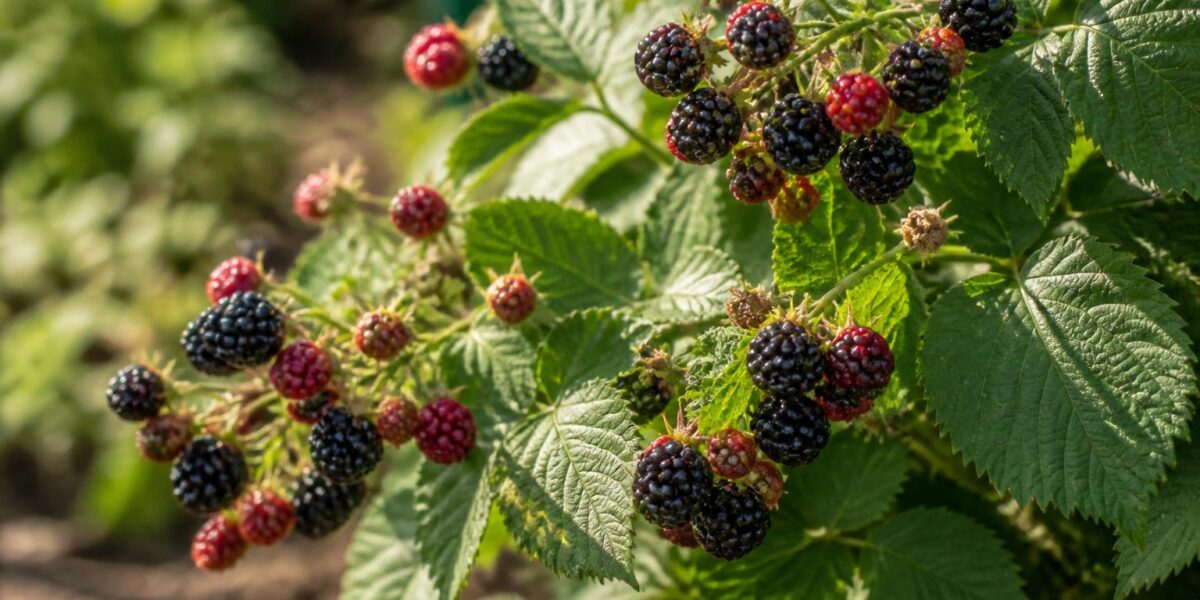
“Blackberry” in the home garden usually means a cultivar drawn from the Rubus fruticosus aggregate — a complicated taxonomic group of European and naturalized hybrids that includes ‘Triple Crown’, ‘Ouachita’, ‘Navaho’, ‘Apache’, and the famously thorny ‘Chester’. In wild North American settings, you are more likely meeting Rubus allegheniensis, the Allegheny blackberry, or Rubus argutus, the southern sawtooth blackberry. All belong to the rose family (Rosaceae) and all share biennial cane growth, compound leaves, white-to-pink five-petaled flowers, and aggregate-drupe fruit that ripens through green, red, and finally jet-black stages.
Cultivars vary in thorn density. Trailing types (the dewberry side of the family) tend to be highly thorny. Modern erect cultivars like ‘Navaho’ and ‘Ouachita’ are thornless, which dramatically reduces the household risk profile. The toxicology, though, is identical across the genus: none of them are poisonous.
Cousins in the Rubus Genus
Blackberry shares its genus with several sibling plants you may already grow:
- Raspberry plants (Rubus idaeus, R. occidentalis) — non-toxic, similarly thorny
- Boysenberry plants — a Rubus hybrid descended in part from blackberry
- Loganberry, tayberry, and dewberry — all Rubus, all non-toxic
If your patch is mixed, the bramble safety advice in this article applies across all of them. The only Rubus relative worth treating differently is, well, none — they are a uniformly non-toxic genus.
Why ASPCA Listing Status Matters
The ASPCA’s toxic-plant database is the working reference most North American veterinarians and poison-control specialists consult when a worried owner calls. A plant that does not appear on that list has been reviewed and is not considered to pose a meaningful poisoning risk in normal exposures. Blackberry’s absence from the list is the basis for the “non-toxic” framing throughout this article. Pet Poison Helpline similarly does not flag Rubus species as toxic.
Independent veterinary literature is consistent. Blackberry leaf is even sometimes used as a folk-medicine astringent for mild diarrhea in livestock. That is not a recommendation to dose your dog — your veterinarian should authorize anything ingestible — but it underlines the very low concern profile.
How Pets Tend to Encounter Blackberry
The typical exposure scene falls into three patterns:
- Berry theft. A medium-or-large dog discovers ripe berries at nose height, eats five to twenty, and proudly presents you with a purple chin. Outcome: gentle satisfaction, possibly one slightly looser stool.
- Leaf nibbling. A bored cat or puppy gnaws a low leaf or two while exploring the garden. Outcome: usually nothing. Occasionally one episode of vomiting from plant fiber.
- Bramble dive. A dog chases a squirrel into a thicket. Outcome: scratched muzzle, paw thorn, possibly a corneal abrasion. This is the visit-the-vet scenario, and it is mechanical, not toxic.
If your pet’s encounter falls in the first two categories and they seem comfortable, you are watching, not panicking.
The Mechanical Hazard Deep Dive
Blackberry thorns are different from raspberry thorns in shape — they hook backwards, which makes them very efficient at catching skin and very inefficient at letting go. The injuries that bring pets to the clinic from bramble are:
- Paw-pad punctures. A thorn embeds, the dog licks, the wound closes around it, and three days later you have a swollen toe with a small abscess. Soak the foot in warm Epsom salt solution and call your vet if it does not back out.
- Corneal abrasions. Squinting, tearing, light sensitivity, holding the eye shut — any of these after a brushy run is a same-day vet exam, not a wait-and-see.
- Lip and gum lacerations. Usually self-resolving but can bleed dramatically. Check that no thorn fragment remains.
- Ear-tip tears. Floppy-eared breeds catch thorns easily. The skin is thin and bleeds heavily but heals well with cleaning.
If you see a wound, examine it under good light. If you cannot tell whether a thorn is still embedded, that is a reason to have a professional look.
Practical Garden Setup for Pet Households
You can have a productive blackberry patch and a happy dog. The trick is design:
- Plant thornless cultivars where you can — ‘Navaho’, ‘Ouachita’, ‘Apache’, ‘Triple Crown’
- Trellis on a two-wire system at 30 inches and 60 inches; this lifts thorny canes off the ground
- Mulch the row heavily so dropped berries do not lie on the ground long enough to mold
- Prune out floricanes (second-year fruiting canes) immediately after harvest — fewer dead thorny canes means fewer paw-pad thorns later
- If your dog is a chronic squirrel-chaser, fence the row off entirely with a low garden fence
For broader landscape ideas that prioritize safety, see our pet-safe garden plants guide.
Symptoms After Ingestion
Blackberry-ingestion symptoms, when they appear at all, are usually mild and self-limiting:
- One or two soft stools, possibly stained dark from anthocyanins (do not mistake the color for blood — it is pigment)
- A single episode of vomiting if a large volume of plant material was eaten
- Mildly reduced appetite for the next meal
- Drooling if a thorn nicked the gum
What is not normal: persistent vomiting over many hours, true blood (red or coffee-ground) in stool or vomit, profound lethargy, a hunched abdomen, refusal to drink, or any squinting or eye discharge. Those signs are reasons to call the vet promptly.
When and How to Get Veterinary Help
Blackberry exposure rarely needs a clinic visit on toxicological grounds. Mechanical injury is the more common reason. Whichever side prompts the call, your routing options are:
- Your own veterinarian — start here during clinic hours; they know your pet’s history
- ASPCA Animal Poison Control Center: (888) 426-4435 — 24/7; consultation fee may apply
- Pet Poison Helpline: (855) 764-7661 — 24/7; consultation fee applies
- Local emergency veterinary clinic — for after-hours mechanical injuries, especially eye trauma
Do not induce vomiting at home for a non-toxic plant like blackberry. There is no benefit and a real risk of aspiration if your pet is already drooling or has thorn injuries to the mouth.
Where Blackberry Sits in the Bigger Berry Picture
If you grow several berry types, here is the scorecard. Safe siblings: blueberry plants (Vaccinium genus, no thorns), cranberry plants, plus the Rubus relatives mentioned above. Definitely not safe: elderberry plants — raw berries, leaves, and stems contain cyanogenic glycosides and should not be casually browsed. On the fruit-tree side, neighbors like mulberry trees, apple trees, and pear trees are also non-toxic, though apple and pear seeds contain trace cyanogens that matter only in massive ingestions.
For the food-side question of feeding actual berries to your dog, our can dogs eat blackberries guide covers serving size and frequency.
If You Are Setting Up for a New Pet
Reading this in advance of bringing a dog or cat home? You are doing the right kind of homework. Have a quick walk-through of your yard, identify thorny zones, and decide whether to fence or replant before the new family member arrives. When you are ready, browse adopt dogs or adopt cats — a thorn-aware backyard is one of the small kindnesses that makes the first month easier on everyone.
Frequently Asked Questions
Are wild blackberry brambles toxic to dogs?
No. Wild Rubus allegheniensis, R. argutus, and the European naturalized R. fruticosus aggregate are all non-toxic. The thorns are the safety issue, not the plant chemistry.
My cat ate a blackberry leaf — should I worry?
Almost certainly not. Cats often nibble greenery and stop after one or two bites. Watch for one episode of vomiting; offer water; carry on. If vomiting persists for hours or your cat seems unwell, call your vet.
Can dogs eat unripe (red or green) blackberries?
Unripe blackberries are not poisonous, but they are tart and astringent. A few accidental ones do nothing. A large pile of unripe fruit can produce a day of soft stool. Pull green clusters out of reach if your dog is a vacuum.
How do I tell a wild blackberry from elderberry?
Different plants entirely. Blackberries grow on thorny canes (brambles); fruit is an aggregate of small drupelets that pull off as a unit. Elderberry grows on a small woody shrub with no thorns and pinnate compound leaves; fruit is small round berries in flat or domed clusters. If you cannot tell, treat the unknown plant as toxic and keep pets away.
What should I do about a paw thorn?
If you can see and grasp it cleanly with tweezers and the dog will allow it, pull it straight out, soak the paw in warm water with a pinch of salt for 10 minutes, and watch for swelling over the next two days. If the thorn breaks off, embeds deeply, or you are unsure, that is a vet visit.


