
The Short Answer About Cats and Holly Berries
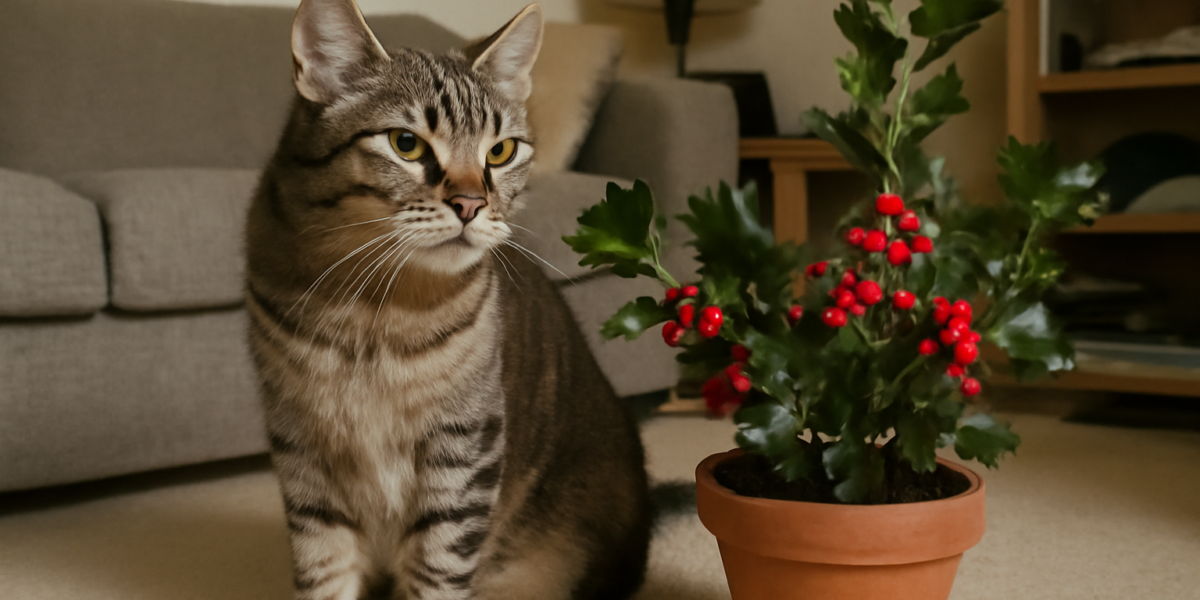
Yes, holly berries are toxic to cats. The bright red berries on Christmas holly (genus Ilex) contain saponins, methylxanthines (theobromine-like compounds), and cyanogenic compounds that cause vomiting, diarrhea, drooling, and GI upset in cats and dogs. The leaves are also irritant — partly chemically, partly because of their stiff spiny edges. Holly is on the ASPCA toxic plant list for cats, and the seasonal pattern of Christmas decorating means cats are most exposed to holly in December and January, when poison hotline calls about holly spike.
In this article
- The Short Answer About Cats and Holly Berries
- What Holly Is and Why Cats Encounter It
- Why Holly Is Toxic — The Compound Profile
- Symptoms of Holly Ingestion in Cats
- The Mechanical Hazard of Spiny Leaves
- What to Do If Your Cat Eats Holly
- What Treatment Looks Like
- Holly in Christmas Decorating — The Seasonal Risk
- Other Holiday Plant Hazards in Cat Households
- Cats vs Dogs — Holly Risk Comparison
- Prevention and Pet-Safe Decorating
- Frequently Asked Questions
The realistic severity tier is moderate — most cat-holly encounters cause GI signs that resolve with supportive care, but larger ingestions can dehydrate a small cat quickly and the spiny leaves can cause oral injuries. Cats are less likely than dogs to consume large amounts of holly because the leaves and berries are bitter and the leaves are physically uncomfortable to chew. That said, kittens and curious cats often investigate holiday decorations, and even a few berries can cause meaningful symptoms. Treat any holly ingestion as a vet-call situation.
What Holly Is and Why Cats Encounter It
Holly is a genus of about 480 species of evergreen and deciduous shrubs and trees. The most familiar species in pet households is Ilex aquifolium (English holly) and Ilex opaca (American holly), both featured heavily in Christmas decorating. Other common species include Japanese holly (Ilex crenata), yaupon holly (Ilex vomitoria), and inkberry (Ilex glabra).
The classic Christmas holly look — glossy dark green leaves with sharp spiny edges and bright red berries — is what shows up in wreaths, garlands, table centerpieces, and live-cut sprigs throughout December. Holly leaves and berries are also added to mixed greenery arrangements with mistletoe, fir, and pine. Wreaths on doors and stair garlands are particularly accessible to indoor-outdoor cats who jump and climb.
Indoor cats are most at risk during the holiday decorating season specifically because their environment suddenly includes plant material that wasn’t there the rest of the year. Outdoor cats may encounter holly hedges or planted holly bushes in landscaping year-round, but the typical indoor cat exposure is seasonal. Knowing this seasonal pattern helps owners plan prevention.
Why Holly Is Toxic — The Compound Profile
Holly contains a mix of toxic compounds. Saponins are detergent-like glycosides that disrupt cell membranes and cause GI irritation — they are the main culprits behind the vomiting and diarrhea seen in holly ingestion. Methylxanthines (caffeine-like compounds, theobromine-like compounds) add stimulant effects, including potentially increased heart rate at higher doses. Cyanogenic compounds are present in trace amounts and contribute to overall irritation.
The saponins are concentrated in the berries but are also present in the leaves, bark, and sap. The methylxanthine content is what makes one holly species — yaupon holly — historically used to brew “black drink” caffeinated teas in some indigenous American traditions. The same compounds that humans deliberately extracted for stimulation also make holly toxic to pets.
Holly does not contain the lethal cardiac glycosides found in oleander or yew, nor the calcium oxalate raphides found in dieffenbachia. The toxicity profile is “moderate GI plus mild systemic” rather than “potentially lethal.” Most pets recover with supportive care. The danger is dehydration and the discomfort of severe GI signs, not a direct threat to life — but for small cats, dehydration alone can be serious.
Symptoms of Holly Ingestion in Cats
Symptoms usually begin within a few hours of ingestion. The first signs are oral: drooling, lip licking, pawing at the mouth, head shaking, and reluctance to eat. The cat may go to the water bowl repeatedly. Gum or tongue irritation may be visible if you can examine the mouth. Some cats will sneeze or shake their head from leaf spine pricks.
GI signs follow: vomiting (often containing leaf or berry fragments), diarrhea, abdominal discomfort, and lethargy. The cat may hide and refuse food. Dehydration develops over hours, especially if vomiting is repeated. Watch for sunken eyes, lethargy, and reduced skin elasticity (gentle pinching of the scruff that does not snap back is a dehydration sign).
Larger ingestions can cause more dramatic systemic signs: increased heart rate, tremors, weakness, or in worst cases collapse. These are uncommon at typical exposure levels but warrant immediate emergency care if present. Bloodwork at the vet may show signs of GI inflammation and potential mild liver enzyme elevation.
The Mechanical Hazard of Spiny Leaves
One distinctive feature of holly toxicity is the dual-hazard profile: the chemistry causes GI illness, but the spiny leaves also cause mechanical injury. The sharp leaf spines can puncture lips, gums, tongue, palate, and the soft tissues of the upper airway. Cats who chew holly leaves often have visible cuts and pricks in the mouth.
These oral injuries can become infected and may complicate the GI picture. A cat with cuts in the mouth is reluctant to eat and drink, which compounds the dehydration risk from any GI symptoms. Examine the mouth carefully if your cat shows reluctance to chew or excessive drooling after holly exposure — visible spines or splinters may need to be removed.
For decorations, this is one of the reasons to choose artificial holly in pet households. The leaves and berries on artificial holly are typically softer and rounder than the real thing, removing the mechanical hazard even if the cat manages to chew on them. Pet-safe artificial holly is widely available at Christmas time.
What to Do If Your Cat Eats Holly
Call your veterinarian as soon as you know or suspect holly ingestion. Even though the typical case is moderate rather than life-threatening, the combination of GI signs and possible mouth injuries warrants professional assessment. If your regular vet is closed (Christmas hours can be tricky), head to an emergency clinic.
You can also call ASPCA Animal Poison Control (888-426-4435, fee applies) or Pet Poison Helpline (855-764-7661, fee applies) for telephone advice. Both lines stay open during holidays. They will likely advise either monitoring or in-clinic care depending on the size of the cat and the amount eaten. Have the plant ID ready (English holly, American holly, etc.) if possible.
Do NOT induce vomiting at home. Hydrogen peroxide is dangerous in cats and not recommended. The mechanical hazard from leaf spines also makes home emesis riskier — reverse passage of spiny material can damage the esophagus. Decontamination decisions belong to the vet, who has access to safer feline-specific options.
What Treatment Looks Like
Veterinary treatment for cat holly exposure typically begins with an oral exam to look for embedded spines or visible injuries. Bloodwork checks hydration status and basic organ function. Depending on the time since ingestion and the cat’s clinical signs, the team may induce vomiting (using safer cat-appropriate emetics) or focus on supportive care.
IV fluids correct dehydration from vomiting and diarrhea. Anti-emetic medications (maropitant, ondansetron) control further vomiting. Gastroprotectants help heal the irritated GI lining. Pain control may be needed for cats with significant oral irritation from leaf spines. Activated charcoal may bind any remaining toxin in the GI tract.
Most cats are sent home within 24 hours of presentation. Severe cases — extensive ingestion, complicating health conditions, or significant oral injuries — may require longer hospitalization. The prognosis is generally good with prompt care. Untreated severe cases can develop dangerous dehydration and electrolyte imbalances, which is why the vet visit matters even when the chemistry alone is “moderate.”
Holly in Christmas Decorating — The Seasonal Risk
The Christmas holiday season is high-risk for cat-holly exposure because the plant is suddenly everywhere in homes that don’t normally have it. Wreaths on doors, garlands on stair rails, sprigs in centerpieces, and mixed greenery in flower arrangements all bring holly into cat-accessible spaces. Cats who explore unfamiliar holiday objects may chew the new plant material out of curiosity.
Cats also climb. A wreath or garland that seems out of reach to a casual observer may be perfectly accessible to a determined cat. Christmas tree decorations often include small holly accents that fall to the floor when knocked. Live cut holly sprigs in vases drop berries that become floor toys. The accumulated risk over a 4–6 week holiday season can be significant.
For cat households, the simplest move is to switch to artificial holly entirely. High-quality artificial holly looks indistinguishable from real, lasts indefinitely, and removes the toxicity and spine hazards. If you must have real holly for tradition or aesthetic reasons, place arrangements where cats genuinely cannot reach (high mantles with frequent supervision, in rooms where the cat is not allowed during decorating season).
Other Holiday Plant Hazards in Cat Households
Holly is not the only Christmas plant cats need protecting from. Mistletoe berries contain phoratoxins and are toxic, with risks similar to holly. Poinsettias are mildly toxic — historically overstated as deadly, but still cause GI upset. Christmas trees themselves (fir, spruce, pine) drop sap that is mildly irritant, and tree water can harbor bacteria.
Live cut true lilies in holiday bouquets are an absolute disaster for cats — every part is potentially fatal. Always check Christmas flower arrangements for any lily species before bringing them into a cat household. The tannin family — acorns, oak leaves, certain decorative pine cones — also appears in some seasonal arrangements.
The household items toxic to cats roundup covers seasonal hazards in more depth. Walking through your home each December with a cat-safety lens is worthwhile — the holiday season is the highest-risk time of year for accidental plant poisoning.
Cats vs Dogs — Holly Risk Comparison
The companion holly and dogs article covers the canine picture in more detail. Dogs are more likely than cats to consume holly in large volumes — the spiny leaves do not deter them as effectively, and the bright berries are appealing. Dog presentations to ER vets during the holiday season often include holly ingestions in larger amounts.
Cats are less commonly affected because the spines are off-putting and the bitter taste discourages most cats after a single chew. That said, the cat case is not “just like a dog case scaled down.” Cats have unique vulnerabilities — narrower margins for dehydration, different drug metabolism, smaller body mass. A holly ingestion that would be a minor event for a 60-pound dog might be a significant event for a 9-pound cat.
For multi-pet households, holiday decorating decisions need to consider both species. Artificial holly is the best choice. If real holly is used, all access (cat reach AND dog reach) must be eliminated.
Prevention and Pet-Safe Decorating
The simplest prevention is replacing real holly with high-quality artificial alternatives. Modern artificial holly is realistic, and the convenience benefits go beyond pet safety — no falling berries, no dropped leaves, no replacement needed each year. Pet-aware home decor stores often carry pet-safe holiday lines.
If you keep real holly for any reason, place it where cats absolutely cannot reach. Closed rooms, high mantles with consistent observation, and outdoor wreaths where the indoor cat does not go are the lower-risk options. Pick up any fallen leaves or berries daily — these are the most common ingestion sources because they look like cat toys on the floor.
For households exploring cat adoption in late autumn or winter, it’s worth thinking about holiday planning before the cat arrives. New cats are most curious about new environments, and a December adoption combined with elaborate real-holly decorating is a recipe for an emergency vet visit. Schedule decorating with cat safety in mind, especially during a transition period.
Frequently Asked Questions
How many holly berries are dangerous to a cat?
Even a few berries can cause symptoms in a small cat. There is no published “safe” number. The variability between holly species and individual cat sensitivity makes it impractical to estimate a safe dose. Treat any berry ingestion as a vet-call event.
My cat batted holly berries off the wreath but didn’t seem to eat any. Should I still worry?
If the berries are intact and not chewed, the risk is low. Examine any berries you find for tooth marks. If the berries appear chewed or partially eaten, call the vet. Either way, move the wreath out of cat reach so this doesn’t recur.
Are some holly species more toxic than others?
Yes — yaupon holly contains higher methylxanthine concentrations than English or American holly. In practice, treat all hollies as risk for cats. The species ID matters less than the fact of ingestion.
What about silk or plastic holly — is that safe?
Artificial holly removes the chemical and spine hazards but introduces a new mild risk: cats can chew small plastic decorations and potentially ingest pieces. This is rarely a serious problem but worth noting if your cat is a determined chewer of plastic. Choose well-made artificial decorations and supervise during decorating.
What is the prognosis after holly poisoning?
For prompt vet care after a small to moderate ingestion, the prognosis is excellent — most cats recover within a day or two with supportive care. Larger ingestions or delayed presentations have a more complicated course but are usually still recoverable. The key is calling the vet promptly rather than waiting to see if symptoms resolve on their own.


