
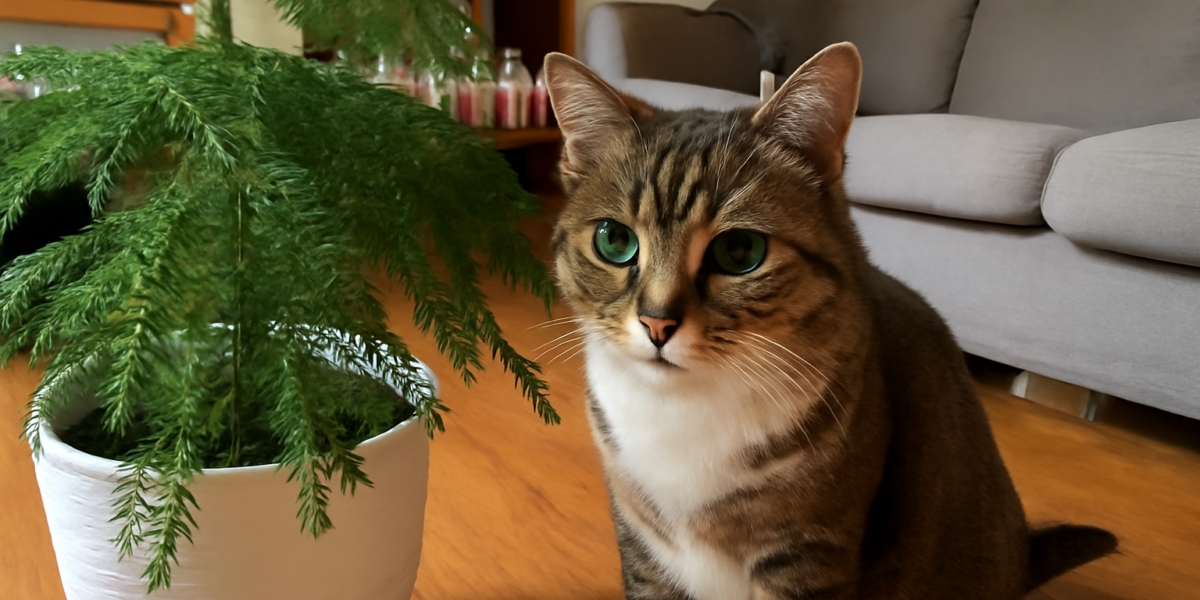
Yes, Pine Needles Can Be Toxic to Cats
Pine needles are mildly toxic to cats, and they present additional mechanical hazards that make them riskier than the toxicity alone suggests. Cats who chew on pine branches, bat at fallen needles, or drink from a Christmas tree stand are exposing themselves to plant oils, sharp needle fragments, and potentially contaminated water. While deaths from pine needle exposure are rare, vomiting, drooling, and gastrointestinal obstruction are real possibilities worth preparing for.
In this article
True pines (genus Pinus) are the main concern, but cats can also react to spruces, firs, and other conifers commonly brought indoors as Christmas trees. The oils in all of these plants contain terpenes and other aromatic compounds that irritate the mouth, stomach, and intestines when ingested. Some cats have stronger reactions than others, and individual sensitivity is hard to predict.
Severity rating: Mild to moderate. Chemical toxicity is usually low, but mechanical injuries and tree-water contamination can cause serious problems.
What Makes Pine Needles a Problem
Pine needles present three separate risks when your cat gets near them:
- Chemical irritation: Terpenes, resin acids, and other oils in the needles irritate the mouth and digestive tract. Ingestion causes drooling, vomiting, and diarrhea in many cats.
- Mechanical injury: The sharp, stiff needles can puncture the tongue, gums, throat, stomach, or intestinal lining. In rare cases, this can lead to infection or intestinal perforation.
- Tree water contamination: Christmas tree water may contain fertilizers, preservatives, bacterial growth, and leached plant chemicals. Cats drinking from the stand can become sick from any of these.
It is worth noting that artificial tree needles are chemically inert but still pose choking and obstruction risks if swallowed. No tree is completely risk-free around determined chewers.
Clinical Symptoms of Pine Needle Exposure
Most cats who interact with pine needles show mild symptoms that resolve within a day or two. Watch for:
- Drooling and lip smacking
- Pawing at the mouth
- Vomiting, sometimes with visible needle fragments
- Diarrhea
- Loss of appetite
- Lethargy
- Mild oral irritation or reluctance to eat hard food
More serious signs requiring immediate veterinary care include:
- Repeated vomiting or blood in vomit
- Significant abdominal pain
- Weakness or collapse
- Difficulty breathing (possible airway injury)
- Visible bleeding from the mouth
- Straining to defecate or signs of obstruction
- Fever, which may indicate infection from a puncture
Needle punctures in the intestines can cause peritonitis, a life-threatening infection, and this is the main reason even apparently mild cases should be monitored for several days after suspected ingestion.
What to Do If Your Cat Ate Pine Needles
Follow these steps immediately:
- Check your cat’s mouth gently for stuck needles or visible bleeding. If you find needles lodged in the gums or tongue, do not pull them out yourself, let the vet do it.
- Remove access to the tree to prevent additional exposure.
- Note what species of tree it was and approximately how much your cat chewed or swallowed.
- Call your veterinarian or the ASPCA Animal Poison Control Center at 888-426-4435 for guidance.
- Do not induce vomiting at home. Sharp needles can cause more damage coming back up.
- Offer small amounts of water and observe closely for the next 24 to 72 hours.
If you know your cat drank from the tree stand, mention that to the vet as well, since the water can contain additional irritants or contaminants.
Veterinary Treatment for Pine Needle Issues
Most mild cases are treated with supportive care. Your vet may recommend:
- Oral examination to check for stuck needles or wounds
- Anti-nausea medication to control vomiting
- Sucralfate or other gastric protectants to soothe the stomach lining
- Subcutaneous or IV fluids for dehydration
- Bland diet recommendations for home care
- X-rays or ultrasound to check for obstructions or perforations in more serious cases
- Antibiotics if there are wounds or signs of infection
- Endoscopy or surgery in rare cases involving perforation or obstruction
Recovery is usually quick for mild exposures. More serious cases may require a few days of hospitalization and longer monitoring.
Christmas Tree Safety for Cats
If you have a cat and celebrate the holidays with a live tree, a few precautions go a long way:
- Choose a fir or spruce over a true pine when possible, as they tend to be slightly less irritating, though none are risk-free
- Secure the tree so it cannot be toppled by climbing or jumping
- Cover the tree stand with a skirt or tree water cover to block access to the water
- Vacuum fallen needles daily
- Skip tinsel, which causes dangerous intestinal obstruction if swallowed
- Avoid glass ornaments on lower branches
- Use pet-safe tree water additives or nothing at all, rather than fertilizers or preservatives
- Consider a small tree on a stable surface if your cat is an enthusiastic climber
- Block access to the tree room when you are not home
For more holiday-specific hazards, our guides on mistletoe and cats, holly and pets, and cedar and cats cover other plants you may encounter during the holidays.
When to Call Your Vet Immediately
Do not delay veterinary care if your cat:
- Has needles stuck in the mouth or throat that you can see
- Is bleeding from the mouth or nose
- Is vomiting repeatedly or has bloody vomit or stool
- Is weak, collapsed, or unresponsive
- Has difficulty breathing
- Is straining without producing stool
- Has a fever, hunched posture, or distended belly
- Drank tree water with known preservatives
The ASPCA Animal Poison Control Center (888-426-4435) and the Pet Poison Helpline (855-764-7661) are available 24/7 for emergencies. Both are worth calling even late at night if you are unsure how serious the situation is.
Frequently Asked Questions
Are pine needles more toxic than fir or spruce needles?
True pines tend to have higher concentrations of irritating oils than firs and spruces, but all conifers can cause problems. Douglas fir and noble fir are often cited as slightly safer options, though no live tree is completely risk-free with cats.
Can my cat get sick just from brushing against the tree?
Direct contact alone is unlikely to cause toxicity. The main risks come from eating needles, drinking tree water, or getting oils on the fur and then grooming them off.
What about essential oils from pine?
Concentrated pine essential oils are significantly more toxic to cats than whole needles. Never use pine oil products, diffusers, or cleaners in areas where your cat spends time.
My cat drank Christmas tree water. Should I worry?
Yes, enough to call your vet. Even plain tree water can contain bacteria, sap, and chemical residues. Water with added preservatives is more dangerous. Watch for vomiting, diarrhea, and lethargy.
Are artificial trees safer for cats?
Chemically yes, but cats can still eat plastic needles and ornaments, causing choking or intestinal obstruction. Supervision and tree barriers are still important. For more plant dangers, see our guide on rhubarb leaves and cats.


