
Last updated: April 10, 2026
In this article
- Why String of Pearls Is Dangerous: Pyrrolizidine Alkaloids
- Symptoms of String of Pearls Poisoning in Cats
- Emergency Steps If Your Cat Eats String of Pearls
- Why Cats Are Especially Attracted to String of Pearls
- Safe Succulent Alternatives for Cat Owners
- Related Toxic Senecio Species to Avoid
- Frequently Asked Questions
Are String of Pearls Toxic to Cats? Understanding the Hidden Danger
String of pearls (Curio rowleyanus, formerly Senecio rowleyanus) is one of the most visually striking succulents you can grow. Its cascading strands of round, bead-like leaves draping from a hanging planter have made it a social media darling and a must-have for houseplant enthusiasts. But beneath its charming appearance lies a serious risk for cat owners. String of pearls is toxic to cats, and the compounds it contains are among the more concerning plant toxins your feline companion could encounter.
In this article, we will explore the specific toxins in string of pearls, the symptoms of poisoning, what steps to take in an emergency, and how to choose cat-safe succulents that deliver the same aesthetic appeal without the danger.
Why String of Pearls Is Dangerous: Pyrrolizidine Alkaloids
The toxicity of string of pearls comes from pyrrolizidine alkaloids (PAs), a class of naturally occurring compounds found in many plants within the Senecio and related genera. There are over 600 known pyrrolizidine alkaloids, and while not all are equally toxic, the ones found in string of pearls are classified as hepatotoxic, meaning they can cause liver damage.
Pyrrolizidine alkaloids work differently from many other plant toxins. They are metabolized in the liver, where they are converted into highly reactive pyrrole compounds. These reactive metabolites damage liver cells (hepatocytes) by cross-linking DNA and disrupting normal cell function. The result can be a condition called hepatic veno-occlusive disease, in which the small veins within the liver become blocked, leading to progressive liver damage.
What makes pyrrolizidine alkaloids particularly insidious is that the damage can be cumulative. Even small, repeated exposures over time can lead to chronic liver injury that may not become apparent until significant damage has already occurred. A cat that occasionally nibbles on a string of pearls plant may not show immediate dramatic symptoms, but could be slowly accumulating liver damage with each exposure.
All parts of the string of pearls plant contain pyrrolizidine alkaloids, including the distinctive pearl-shaped leaves, the stems, and the small brush-like flowers. The sap that oozes from broken stems or crushed leaves is also toxic and can cause skin irritation on contact. For a cat, even a playful swat that breaks a stem and leads to licking the sap off their paw could introduce enough toxin to cause problems.
Symptoms of String of Pearls Poisoning in Cats
The symptoms of pyrrolizidine alkaloid poisoning in cats can be divided into acute symptoms from a single large ingestion and chronic symptoms from repeated smaller exposures.
Acute symptoms may appear within hours to a day of ingestion and include:
- Vomiting: Often one of the first signs, as the body attempts to expel the toxic material.
- Diarrhea: May be watery or contain mucus. In severe cases, bloody diarrhea can occur.
- Drooling: Excessive salivation may accompany gastrointestinal distress.
- Lethargy: Your cat may become unusually quiet, withdrawn, or reluctant to move.
- Loss of appetite: Refusal to eat is common during the acute phase.
- Abdominal pain: Cats may hunch their posture, resist being picked up, or cry when their belly is touched.
Chronic or delayed symptoms, which may not appear for days or even weeks after exposure, can include:
- Jaundice: Yellowing of the gums, inner ears, and whites of the eyes indicates liver dysfunction.
- Weight loss: Gradual, unexplained weight loss can be a sign of chronic liver damage.
- Increased thirst and urination: Changes in drinking and urination habits may signal kidney or liver problems.
- Neurological symptoms: In advanced liver failure, toxins that the liver can no longer process may affect the brain, causing disorientation, circling, head pressing, or seizures (hepatic encephalopathy).
The delayed nature of liver damage symptoms is what makes pyrrolizidine alkaloid poisoning so dangerous. By the time a cat shows signs of jaundice or neurological symptoms, the liver may already be severely compromised. This is why prevention is so critically important.
Emergency Steps If Your Cat Eats String of Pearls
Given the potential for serious liver damage, any suspected ingestion of string of pearls should be treated as a veterinary emergency. Do not wait for symptoms to develop before taking action. Our pet poisoning emergency guide offers additional resources, but here are the immediate steps to follow.
Remove the plant immediately. Take the string of pearls plant away from your cat and move it to a room your cat cannot access. If there are pieces of the plant on the floor, clean them up right away.
Check your cat’s mouth. If it is safe to do so, gently open your cat’s mouth and remove any plant material you can see. Look for bead-like leaves or stem fragments.
Do not induce vomiting unless directed by a veterinarian. While it may seem logical to try to get the plant material out, inducing vomiting at home can be dangerous for cats and should only be done under professional guidance.
Call your veterinarian or an emergency poison hotline immediately. Provide details about the plant, the estimated amount consumed, and the time of ingestion. Your vet may recommend bringing your cat in for decontamination with activated charcoal, intravenous fluid therapy, blood work to assess liver function, and ongoing monitoring.
Bring a sample of the plant. When you go to the vet, take a piece of the string of pearls plant or a photo of it. This helps the veterinary team confirm the identification and guide treatment appropriately.
Blood work may need to be repeated over the following days and weeks, as liver damage from pyrrolizidine alkaloids can develop on a delayed timeline. Your veterinarian will advise you on the appropriate follow-up schedule.
Why Cats Are Especially Attracted to String of Pearls
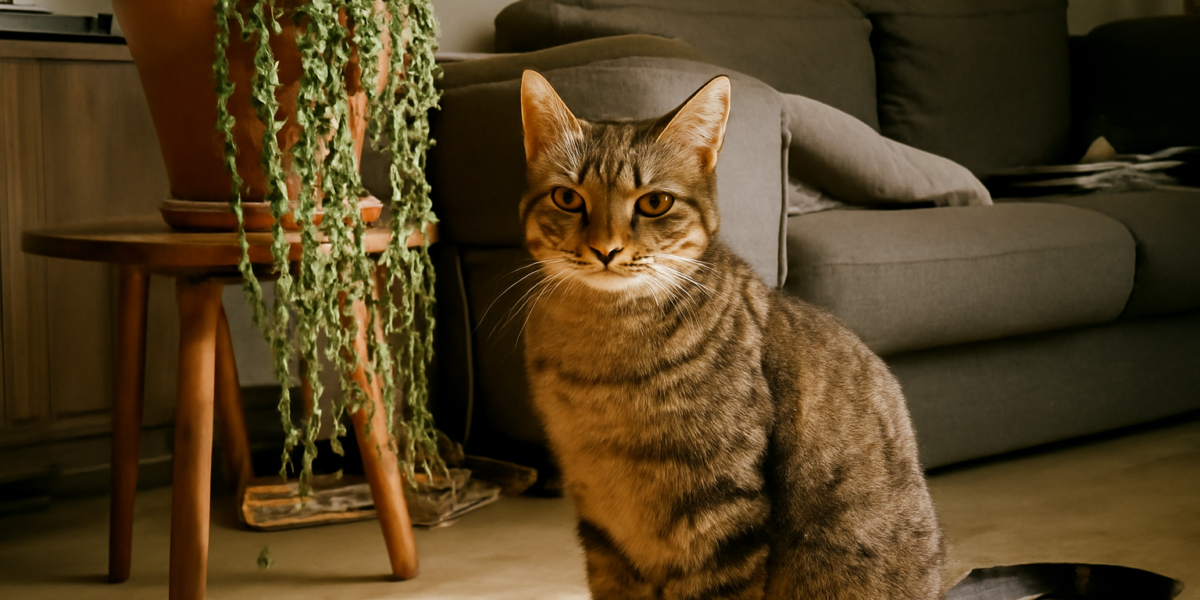
One of the frustrating aspects of string of pearls from a cat safety perspective is that everything about this plant seems designed to attract feline attention. The dangling strands of round beads look remarkably like cat toys, swaying gently in air currents and practically begging to be batted and chewed.
Cats are hardwired to be attracted to small, moving objects. It is the same instinct that makes them chase feather wands, laser pointers, and dangling strings. A hanging string of pearls planter, with its cascading strands swinging in a breeze, triggers this predatory play behavior. Once a cat has grabbed a strand and brought it to their mouth, a few chewed pearls are almost inevitable.
Even cats that normally ignore houseplants may find string of pearls irresistible. The texture of the round, slightly firm beads is interesting to bite, and the way the strands pull and bounce when tugged mimics the movement of prey. This is not a plant you can simply place on a high shelf and hope for the best. If your cat can see it, they will likely try to reach it, and cats are remarkably persistent and creative when they want to access something that has caught their attention.
This combination of high attractiveness and genuine toxicity makes string of pearls one of the worst houseplant choices for a home with cats. The risk-to-reward ratio is simply not worth it when so many safe and equally beautiful alternatives exist.
Safe Succulent Alternatives for Cat Owners
The good news is that the succulent world is vast, and many species are completely safe for cats. You can build an impressive and visually interesting succulent collection without including any toxic species. For a more complete overview, see our guide to succulents and cat safety.
Here are some cat-safe succulents that offer visual interest comparable to string of pearls:
- Haworthia (Haworthiopsis species): These small, rosette-forming succulents come in fascinating textures and patterns, from the translucent windows of H. cooperi to the zebra stripes of H. fasciata. All haworthias are non-toxic to cats.
- Echeveria: With their perfect rosette shapes and pastel colors, echeverias are among the most photogenic succulents, and they are safe for cats.
- Burro’s tail (Sedum morganianum): If you love the trailing habit of string of pearls, burro’s tail offers a similar cascading look with plump, blue-green leaves. It is non-toxic to cats.
- Hens and chicks (Sempervivum): Hardy, attractive, and completely safe for cats, sempervivum comes in a huge range of colors and sizes.
- Christmas cactus (Schlumbergera): A non-toxic succulent that produces beautiful flowers, making it both safe and rewarding to grow.
- Air plants (Tillandsia): While technically not succulents, air plants are non-toxic, require no soil, and make fascinating displays.
Burro’s tail is perhaps the best direct substitute for string of pearls, as it shares the trailing growth habit and looks stunning in hanging planters. The key difference is that it will not harm your cat if a curious paw pulls off a leaf or two.
Related Toxic Senecio Species to Avoid
String of pearls is not the only Senecio species that poses a risk to cats. Several other popular houseplants in this genus contain the same pyrrolizidine alkaloids and should be treated with equal caution.
String of bananas (Curio radicans) is closely related to string of pearls and has the same toxicity profile. Its banana-shaped leaves make it equally appealing to cats. String of dolphins (Curio x peregrinus), a hybrid between string of pearls and string of bananas, is another toxic variety that has surged in popularity. String of watermelons, string of tears, and other trailing Senecio species all carry the same risk.
Blue chalksticks (Curio serpens), dusty miller (Jacobaea maritima, formerly Senecio cineraria), and other ornamental Senecio species used in gardens and floral arrangements also contain pyrrolizidine alkaloids. If you are a cat owner building a plant collection, it is safest to avoid the entire Senecio/Curio genus entirely and choose from the many safe alternatives available.
When purchasing succulents, always verify the botanical name, as common names can be misleading. A plant sold simply as a “trailing succulent” or “bead plant” could easily be a Senecio species. When in doubt, look up the Latin name before buying.
Frequently Asked Questions
How much string of pearls does a cat need to eat to get sick?
There is no established safe threshold for pyrrolizidine alkaloid ingestion in cats. Even a small amount can be harmful, and the damage is cumulative, meaning that repeated small exposures can add up to significant liver injury over time. A cat that chews on just one or two beads may not show immediate dramatic symptoms, but this does not mean no harm was done. Any ingestion should be reported to your veterinarian, regardless of how small the amount appears to be.
Can string of pearls cause skin irritation in cats?
Yes, the sap from string of pearls can cause contact irritation on a cat’s skin, particularly on sensitive areas like the nose, lips, and paw pads. If your cat breaks a stem while playing with the plant, the sap that contacts their skin or fur may cause redness, itching, or mild irritation. If your cat then grooms the affected area, they may ingest the sap, compounding the risk. Wash any sap off your cat’s fur or skin with mild soap and warm water, and monitor for signs of ingestion.
Is string of pearls toxic to dogs as well?
Yes, string of pearls is toxic to dogs. The pyrrolizidine alkaloids that affect cats are equally harmful to dogs, causing similar gastrointestinal symptoms and the same risk of liver damage. Dogs are less likely than cats to play with dangling plants, but puppies and dogs that chew on household items can still be at risk. If you have any pets in your home, string of pearls should be avoided or placed in an area that is completely inaccessible to all animals.
Your cat’s safety is always worth more than any houseplant, no matter how trendy. By choosing cat-safe houseplants and keeping toxic species like string of pearls out of your home entirely, you create an environment where both your plants and your pets can thrive without worry.


