
Last updated: May 16, 2026
In this article
- Are Sweetgum Trees Safe Around Cats and Dogs?
- Sweetgum at a Glance
- Why the Tree Itself Is Considered Pet-Safe
- The Real Risk: Sweetgum Balls
- Mechanical Hazards in Detail
- Comparing Sweetgum With Other Yard Trees
- Yard Management for a Sweetgum-and-Pet Household
- Sweetgum Sap: A Minor Caveat
- If Your Pet Steps on or Mouths a Sweetgum Ball
- Common-Name vs. Latin-Name Search Confusion
- When to Call Your Vet vs. Wait It Out
- Bottom Line on Sweetgum
- Frequently Asked Questions
Are Sweetgum Trees Safe Around Cats and Dogs?
Sweetgum (Liquidambar styraciflua) is not listed by the ASPCA as toxic to dogs or cats. The leaves, bark, and even the resinous sap of this large eastern North American tree have no documented systemic toxin profile, and the species is widely planted as a shade and street tree without producing pet poisoning incidents from routine yard exposure. If your dog naps under the canopy or your cat investigates fallen leaves, the realistic chemical outcome is no symptoms.
The actual hazard sweetgum poses to pets is mechanical rather than chemical. The famously spiky, woody seed pods (commonly called “gumballs” or “sweetgum balls”) drop in huge quantities through fall and winter and are a meaningful puncture, choking, and oral-injury hazard for dogs and cats walking through them. This guide covers the chemistry briefly, then focuses on the gumball management that makes a sweetgum yard genuinely safe for a multi-pet household.
Sweetgum at a Glance
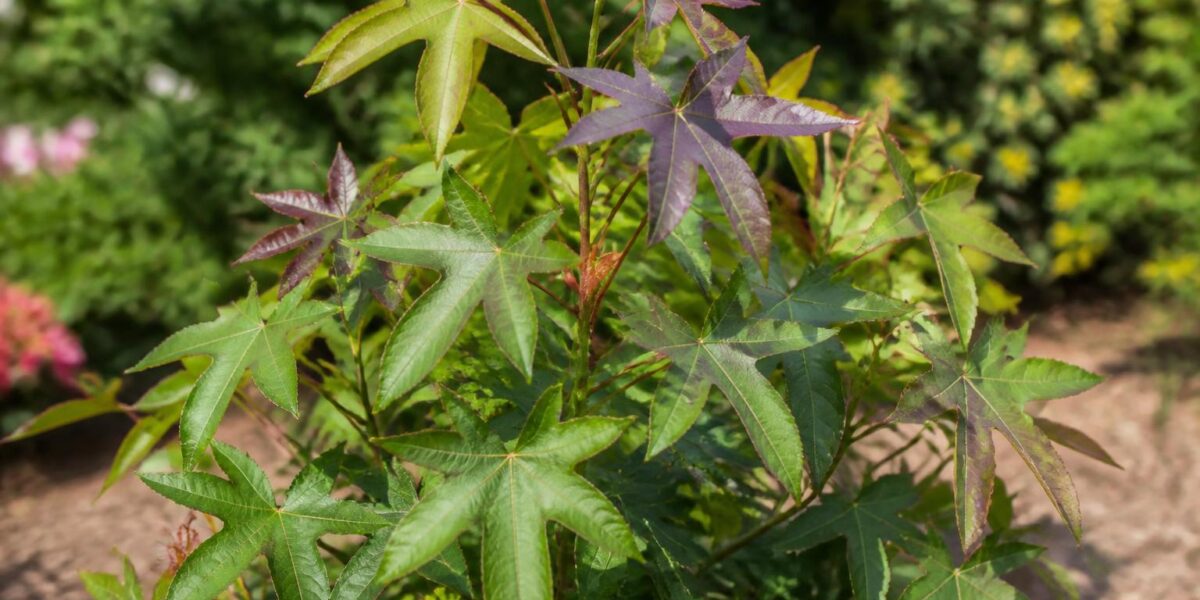
Liquidambar styraciflua is the Latin botanical name for the American sweetgum, a tall (60 to 80 feet at maturity) deciduous tree native to the eastern and southeastern United States. The leaves are five- to seven-pointed star shapes, often confused with maple leaves at a glance, but with a distinctly different leaf attachment and a finer-toothed margin. Autumn color is exceptional: a single tree can show purple, red, orange, and yellow leaves simultaneously across the canopy.
The tree gets its common name from the fragrant resinous sap that exudes from cuts in the bark, historically used in chewing gum and as a fixative in traditional medicine and perfumery (the related Asian species L. orientalis is the source of “storax” balsam). Sweetgum is widely planted as a street tree because it grows fast, tolerates urban conditions, and produces dramatic autumn color, but it has fallen out of favor in some areas because of the seed-pod litter. For other large yard trees with similar pet-safety profiles, see our beech trees guide and elm trees guide.
Why the Tree Itself Is Considered Pet-Safe
The ASPCA Toxic and Non-Toxic Plant List does not include Liquidambar styraciflua, and the genus is not flagged as systemically poisonous in major veterinary toxicology references. The leaves and bark contain trace tannins and resinous compounds (the same family of compounds that give the sap its fragrance), but the concentrations are not at clinically meaningful levels for dogs or cats at landscape-exposure doses.
The leaves are leathery and unappetizing to chew, the bark is corky and hard, and the sap, while sticky, is not chemically irritating to skin or oral tissue. Most veterinary calls about sweetgum involve gumball-related injuries (paw punctures, lodged-in-mouth pieces, choking attempts) rather than chemical poisoning. No documented cases of leaf or bark-induced systemic poisoning appear in the published toxicology literature.
The Real Risk: Sweetgum Balls
Sweetgum balls are spherical, woody, spiky seed capsules about one to one-and-a-half inches across, formed of dozens of fused capsule segments each bearing a sharp protruding point. They develop in summer, ripen and brown in fall, and drop heavily from late autumn through winter, often staying scattered across lawns and walkways for months. Walking barefoot on them is painful for humans; for pets, the risks scale up.
The realistic injuries from sweetgum balls in pet households include: paw-pad punctures from stepping on a ball directly, oral injuries from a dog mouthing or chewing a ball (bleeding gums, lodged spike fragments between teeth, occasional palate punctures), and choking incidents from dogs that try to swallow a partially-chewed ball. Cats are at lower risk because they generally pick their way around obstacles rather than walking through a leaf-pile, but kittens occasionally bat at gumballs and end up with paw scratches.
Mechanical Hazards in Detail
Paw-pad punctures from sweetgum balls are the most common injury reported. The spike on a fully-dried ball is firm enough to penetrate the soft pad on a pet’s foot, especially in dogs trotting at speed across a lawn covered in fallen balls. The puncture itself is usually small and self-limiting, but it can introduce infection and is acutely painful enough that most dogs limp until the spike is removed or works itself out.
Oral injuries are the next most common. A dog that picks up a sweetgum ball usually drops it within seconds because the spikes are uncomfortable, but during that brief mouthing some dogs chip teeth, gash gums, or get a small spike fragment lodged between teeth. Choking incidents are less common but more serious: a partially-chewed ball can lodge in the airway, especially in medium and small dogs. If you see a pet picking up a sweetgum ball, redirect immediately rather than waiting for the dog to drop it on its own.
Comparing Sweetgum With Other Yard Trees
For pet-safety considerations, sweetgum’s profile is unusual among yard trees: chemically safe but mechanically hazardous. Most other yard trees are either chemically toxic (oak, black locust, yew) or chemically and mechanically benign (ash, beech, elm). Our ash trees guide, cottonwood trees guide, and hickory trees guide cover other large deciduous yard trees that share sweetgum’s chemical safety without the gumball mess.
The trees you genuinely want to keep dogs away from are the chemically toxic species: black locust (toxic, see locust trees guide), oak (acorns problematic, see oak trees and dogs), yew (severe-tier toxic), and Japanese maple (mildly toxic). Sweetgum is much safer than those at the chemistry level; it’s just messier underfoot.
Yard Management for a Sweetgum-and-Pet Household
If you have a sweetgum on your property, the practical management priorities for pet safety are: rake and remove fallen seed pods regularly during the heavy drop period (October through February in most regions), keep dogs on leash on lawns covered in unraked balls, and check paws after outdoor sessions for stuck spikes. A sturdy push-broom or a “gumball roller” tool (essentially a spiked drum that picks up balls in volume) makes cleanup manageable for a normal-sized yard.
For dogs that habitually mouth random objects in the yard, gumballs are an active behavior to redirect. Drop-and-trade training (your dog drops the ball, gets a treat) is the standard approach. For homes with very young dogs or breeds with strong oral fixations, consider keeping the dog on leash or restricted to a gumball-free portion of the yard during peak drop season. Cats are usually self-managing on this front; most adult cats step around gumballs or simply use the yard areas without them.
Sweetgum Sap: A Minor Caveat
The fragrant resinous sap that gives sweetgum its name can occasionally drip from wounded branches or be exuded from twig cuts. The sap is sticky and slightly aromatic; pets that get it on their fur typically need a warm-water bath or a small amount of vegetable oil to loosen it. Chemically, the sap is not on the ASPCA toxic list and does not cause systemic poisoning. The pulpy sap chunks are not appetizing and most dogs don’t try to chew them.
Historically, sweetgum sap was chewed as a primitive chewing gum (hence “sweetgum”), so the safety of small-amount oral exposure to humans is well-established. For pets, the same broad picture applies: a small amount licked off fur is harmless, larger ingestion would produce at most mild GI upset. There are no documented cases of sweetgum-sap poisoning in companion animals.
If Your Pet Steps on or Mouths a Sweetgum Ball
For paw-pad punctures, examine the foot carefully for any embedded spike fragments. Most are small and work themselves out within a day or two; visible fragments can be carefully removed with tweezers if your pet allows. Clean the puncture with mild soap and water, watch for redness, swelling, or limping that worsens over 24 to 48 hours. A small puncture does not usually require veterinary care; a clearly-infected wound (pus, swelling, persistent limping) does.
For oral injuries, check inside the mouth gently if your pet allows. Visible bleeding from gums or palate usually resolves on its own within minutes; persistent bleeding, visible spike fragments lodged between teeth, or signs of pain (refusing food, pawing at the mouth) warrant a vet visit. For choking, follow standard pet first aid: if the airway is partially blocked, encourage coughing; if fully blocked, perform Heimlich-style abdominal compressions and head to the closest emergency clinic immediately. The ASPCA Animal Poison Control Center is at 888-426-4435 (a per-call fee applies) and the Pet Poison Helpline is at 855-764-7661; both can advise on related questions, though for mechanical injuries your regular vet or emergency clinic is the more appropriate first call.
Common-Name vs. Latin-Name Search Confusion
Pet owners arrive at this article from several different searches: “sweetgum safe for pets,” “liquidambar safe for dogs,” and “gumball tree safe for cats.” All three map to the same plant. The two species that are commonly grown ornamentally in North America are L. styraciflua (American sweetgum) and L. orientalis (oriental sweetgum); both have similar pet-safety profiles, with the American species being far more commonly encountered.
Be aware that “gum tree” in Australia and parts of the world refers to Eucalyptus species, which have different chemistry and are mildly toxic to pets in volume. If your tree is described as a “gum tree” in a non-North-American context, it may be a Eucalyptus rather than a Liquidambar; the leaf shape (long lance shape vs. star shape) makes them easy to tell apart. American sweetgum has the star-shaped leaves and the prickly seed balls.
When to Call Your Vet vs. Wait It Out
Watchful waiting is appropriate for: a few chewed leaves with no symptoms, sap on fur (bath at home), small paw-pad punctures that close cleanly, brief mouthing of a gumball with no injury, or a dog that grazed on a few fallen leaves with no issue. Pets should be eating, drinking, and behaving normally over 24 hours.
Call the vet promptly if: your pet swallowed a gumball whole or in large pieces (choking and obstruction risk), oral injuries from gumball chewing show persistent bleeding or visible foreign material, a paw-pad puncture is clearly infected or causing persistent limping, or your pet shows any severe sudden distress (sign of choking or airway obstruction). For broader pet-safe yard and home planning, our cat-safe houseplants guide and dog-safe houseplants guide apply similar reasoning to indoor companions.
Bottom Line on Sweetgum
Sweetgum (Liquidambar styraciflua) is chemically safe for dogs and cats: not on the ASPCA toxic list, no documented systemic poisoning from leaf, bark, or sap exposure, and routine yard contact produces no symptoms. The story would end there for most yard trees, but sweetgum is the rare case where mechanical hazards from the seed pods deserve their own management plan.
If you have a sweetgum and a multi-pet household, rake gumballs diligently in fall and winter, redirect dogs that mouth them, and check paws after outdoor sessions during peak drop. The tree’s autumn color and shade are genuine assets; the gumball mess is the price of admission, and it’s a manageable price with consistent yard maintenance. For homes choosing what to plant, a fruitless cultivar like ‘Rotundiloba’ produces no gumballs at all and is the obvious low-hassle option for a pet-friendly yard.
Frequently Asked Questions
Will my dog get sick from chewing sweetgum leaves?
A few chewed leaves are very unlikely to cause meaningful harm. Sweetgum leaves are not on the ASPCA toxic list, and the trace tannins in fresh leaves are not at concentrations that affect pets at casual-exposure doses. You may see brief drooling or one bout of vomiting from gastric upset, but recovery within a day is the expected outcome.
What about a dog that swallowed a whole sweetgum ball?
This is potentially serious. A whole gumball can be a choking hazard or, once swallowed, can cause GI obstruction or perforation due to the spikes. Call your vet or emergency clinic immediately if you suspect a dog swallowed a gumball whole or in large pieces. Watch for vomiting, refusing food, abdominal pain, or visible distress; imaging may be needed to confirm whether the piece is moving safely through the GI tract.
How can I tell if my pet stepped on a sweetgum ball?
Watch for sudden limping after a yard session, especially during fall and winter when balls are on the ground. Check the affected paw for visible spikes embedded in the pad. Most punctures are small and resolve on their own with cleaning and a day or two of rest; persistent or worsening limping warrants a vet check for infection or deeper foreign material.
Are fruitless cultivars actually fruitless?
Yes. The ‘Rotundiloba’ cultivar (with rounded rather than pointed leaf lobes) is genetically male-sterile and produces no viable seed pods at all. If you’re planting a new sweetgum and want autumn color without gumball mess, this cultivar is the standard choice. Older male trees of the regular species also produce few pods, but only the named cultivars are guaranteed.
Is the sweetgum sap dangerous if my pet licks it?
The fragrant resinous sap is not on the ASPCA toxic list and is not chemically harmful in the small amounts a pet might lick off fur. Historically the sap was chewed as a primitive chewing gum. The bigger concern is the stickiness: dogs and cats with sap on their fur often need a bath with warm water and possibly a small amount of vegetable oil to loosen the residue. No systemic poisoning is expected from incidental sap exposure.


