Last updated: May 4, 2026
In this article
- Two First-Generation Hybrids, Two Wild Ancestors
- Wild Parent and Foundation Cross
- Size: Savannah Towers Over Bengal
- Build and Appearance
- Cost: Savannah Several Times Higher
- Energy and Care Complexity
- Color Variation
- Behavior and Bonding
- Water Affinity and Prey Drive
- Reproductive Status and Legality
- Choosing Between Them
- Frequently Asked Questions
Two First-Generation Hybrids, Two Wild Ancestors
The F1 Savannah versus F1 Bengal comparison is the question many serious hybrid prospects eventually ask. Both are first-generation crosses between a wild felid and a domestic cat. Both produce striking phenotypes, intense prey drive, and ownership challenges that exceed almost every other cat. The differences come from the wild parent species, and those differences shape size, cost, temperament, and what daily life with the cat actually looks like.
The F1 Savannah is a direct serval cross. The wild parent is the African Serval, a tall long-legged predator. The F1 Bengal is a direct Asian Leopard Cat cross. The wild parent is a much smaller spotted forest cat from Asia. Those two ancestors produce two very different first-generation hybrids, and the choice between them is rarely close once owners understand the trade-offs.
This guide is written for owners who have already decided they can responsibly take on an F1 hybrid. If you are still in the should-I-get-a-hybrid stage, our hybrid cat legality, vet considerations, and insurance challenges guides cover the foundational considerations. Here we focus on the head-to-head between two specific F1 generations.
Wild Parent and Foundation Cross
The F1 Savannah’s wild parent is the African Serval (Leptailurus serval), a wild felid that stands twenty-two to twenty-four inches at the shoulder and weighs twenty to forty pounds in adulthood. The serval is a long-legged solitary hunter that takes prey ranging from small rodents to birds in flight. Our serval and domestic pairing overview covers the foundational breeding work. The domestic side of an F1 Savannah is often a Siamese, a Domestic Shorthair, or in some lines an Egyptian Mau or other lean-built domestic.
The F1 Bengal’s wild parent is the Asian Leopard Cat (Prionailurus bengalensis), a much smaller wild felid weighing typically seven to fifteen pounds in adulthood. The species ranges across South and East Asia in forested habitats. Our Asian leopard cat foundation profile details the species. The domestic side of an F1 Bengal is typically a domestic shorthair selected for spotted coat and lean build.
The size of the wild parent is the single biggest driver of F1 size. A serval × domestic produces a markedly larger cat than an Asian leopard cat × domestic, because the serval itself is several times larger than the Asian leopard cat.
Size: Savannah Towers Over Bengal
F1 Savannahs typically weigh seventeen to thirty pounds and stand notably taller than any standard domestic cat. Some F1 Savannahs exceed thirty pounds. The breed produces what are arguably the tallest domestic-registered cats. Our F1 Savannah owner’s guide details the size range and the proportions that come with it.
F1 Bengals typically weigh eight to fifteen pounds, which is in the upper range for domestic cats but nowhere near Savannah territory. The build is muscular and compact rather than tall and elegant. Our F1 Bengal owner’s guide covers the breed’s first-generation profile in detail.
The size difference has practical consequences. An F1 Savannah cannot be easily picked up by anyone who is not strong enough to handle a small dog. Furniture, climbing structures, carriers, and litter boxes all need to be sized for the cat. An F1 Bengal fits standard cat infrastructure with no modification. This single factor changes daily life with the cat in ways that owners often underestimate until the cat arrives.
Build and Appearance
The F1 Savannah is long-limbed, narrow-bodied, and tall. The head is relatively small for the body, with large rounded ears, hooded eyes, and a long neck. The breed’s ground color in standard brown spotted tabby is tawny, with bold black spots running along the body. Coat texture is short and coarse. In motion the cat shows a fluid serval-like stride that no other domestic cat reproduces.
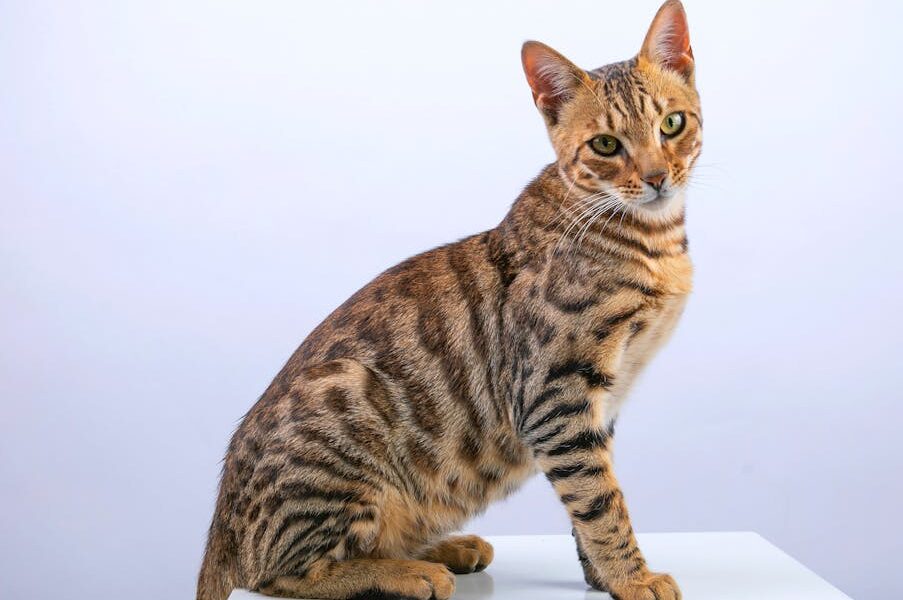
The F1 Bengal is muscular, athletic, and compact. The head is broad relative to the Savannah’s, with smaller rounded ears, oval eyes, and a thicker neck. Coat patterns include classic spotted, rosetted, and marbled variants, with the rosetted pattern emerging more reliably from later generations than from F1. F1 Bengals show pattern but the elaborate rosetting that defines show Bengals tends to develop in F4 and later. Our rosetted Bengal coat guide covers the pattern specifics.
Both breeds are visually distinctive. The Savannah is unmistakably tall and lean. The Bengal is unmistakably wild-patterned and athletic. The two are easy to tell apart at a glance, and the appearance preference often drives owner choice as much as any other factor.
Cost: Savannah Several Times Higher
F1 Savannahs from reputable breeders typically run from fifteen thousand dollars to twenty-five thousand dollars or more, with some lines exceeding that range. F1 Bengals typically run from three thousand to eight thousand dollars from reputable breeders. The pricing reflects the difficulty of the cross. Serval-to-domestic breeding is technically harder than Asian leopard cat-to-domestic breeding, with smaller and rarer litters, and the F1 Savannah supply is substantially more constrained.
Verify pricing with active breeders rather than assuming any specific number. Both markets shift year to year, and reputable breeders price within a band that reflects current demand, kitten availability, and the specific characteristics of each litter. Both breeds appear in our most expensive cat breeds roundup.
Beyond the purchase price, both F1 generations require enrichment infrastructure, hybrid-experienced veterinary care, and ongoing costs that exceed those of a standard domestic. Budget for the cat’s full life, not just the first year. Our first-year cost of owning a cat guide gives a baseline that you should treat as a floor for either F1 hybrid.
Energy and Care Complexity
Energy levels are similar between F1 Savannah and F1 Bengal. Both are at the top of any energy-ranking list. Both need eight or more hours of daily activity, multiple interactive play sessions, vertical climbing structures, foraging puzzles, and water enrichment. Neither is appropriate for a quiet household or a working professional with no time for daily engagement.
Care complexity tracks energy. Both F1 generations need comprehensive enrichment, hybrid-experienced veterinary support, and the kind of household supervision that keeps a high-drive cat from redirecting energy into destruction. The Savannah’s larger size makes some destructive behaviors more consequential. A twenty-five-pound F1 Savannah swatting a flat-screen television off its stand is a different problem from an eleven-pound F1 Bengal doing the same thing to a smaller object.
Both breeds benefit from a feline play partner. Bengal-with-Bengal pairings are common and successful. Savannah-with-Bengal and Savannah-with-Savannah pairings also work in households that can accommodate the multiplied resource requirements. The combination of two F1 hybrids in one household is uncommon and demands real space and time investment.
Color Variation
The F1 Savannah’s standard color is brown spotted tabby. Silver, melanistic, and snow variants exist but appear less frequently in F1 than in later generations because the foundation servals contribute the dominant brown spotted pattern. Owners seeking specific colors at F1 may need to wait for a particular litter and breeder.
The F1 Bengal shows broader color variation in the first generation. Brown spotted, brown rosetted, brown marbled, and snow variants all appear in F1 litters with reasonable frequency. Snow Bengals, marble Bengals, and silver Bengals are all achievable at F1, though the spectacular rosette development tends to peak in F4 and later. Charcoal Bengal and melanistic Bengal variants also occur.
The wider color range in F1 Bengals reflects the breed’s longer history of selective breeding for color variation, plus the smaller wild parent’s more flexible genetic contribution. F1 Savannah breeders tend to focus on the breed’s signature spotted look rather than chasing color variants at the foundation generation.
Behavior and Bonding
The F1 Savannah often forms an intense bond with one or two household members. The cat may be aloof or even avoidant with strangers and acquaintances, while showing strong attachment, follow-me-around behavior, and deep eye contact with bonded humans. Owners describe the bond as more dog-like than the typical cat-human relationship. Our cat breeds that bond with one person roundup covers the broader pattern.
The F1 Bengal tends to be more independent and more uniformly distributed in attention across household members. Bengals are highly engaged but less likely to form an exclusive primary-person bond. The cat will play, hunt, and interact across the household, with the prey-driven personality dominating the relational style. Bengals tend to be busier and less cuddly than Savannahs in the bonded-human moments.
Both breeds train well to leash, recall, and selected behaviors. Both respond to clicker training. Both are vocal in distinctive ways: the Savannah’s chirping and peeping inherited from the serval, the Bengal’s wider repertoire of meows, chirps, and vocalizations characteristic of the Asian leopard cat side. Our most vocal cat breeds guide includes both.
Water Affinity and Prey Drive
Both F1 generations show significant water affinity. F1 Savannahs and F1 Bengals commonly drink from running faucets, dip toys in water bowls, splash in shallow water, and in some cases swim. Owners build water enrichment into both breeds’ environments. Our cat breeds with water affinity roundup covers the broader water-loving cat population.
Prey drive is intense in both breeds. Birds, fish, small mammals, reptiles, and insects all trigger strong predatory response. Households with caged or aquarium pets need to be designed around the cat. Free-flying birds in a household with an F1 hybrid is a tragedy waiting to happen. Outdoor wildlife is at real risk if the cat gains unsupervised access. Catio enclosures and supervised leash time are the responsible answers for both breeds.
The two breeds differ slightly in prey-drive style. The F1 Savannah’s hunting style mirrors the serval: tall pounce, leap-and-grab, occasional reach for prey at height. The F1 Bengal’s hunting style mirrors the Asian leopard cat: low stalk, ambush, repeated short rushes. The differences appear in play preferences. Savannahs love wand toys lifted high and dropped from above. Bengals love floor-level prey toys that simulate ground-running rodents.
Reproductive Status and Legality
F1 males of both breeds are typically sterile, the same pattern seen in many wild × domestic crosses. F1 females of both breeds are usually fertile and are the cats used to produce F2 generations. Owners receive their F1 kittens already neutered or under spay/neuter contracts, and the reproductive question is rarely a daily concern.
Legal status is similar across the two breeds in most jurisdictions. F1 hybrids of both breeds are restricted or prohibited in some US states, partial restrictions apply in additional states, and city or county rules may apply on top of state law. Our hybrid cat legality by state guide covers the framework. Verify your specific location before any purchase, because legality is the one variable that can void the entire ownership plan.
Insurance, travel, and housing all interact with legal status. An F1 Bengal that is legal in your home state may not be legal at a destination state, which complicates moves and travel. Document the legal status in writing wherever possible.
Choosing Between Them
Choose the F1 Savannah if you want the most physically imposing domestic cat available, prefer a one-person bonding profile, can absorb the cost, and have living space that accommodates a tall long-bodied cat with eight-foot vertical needs. The breed offers presence that no other domestic cat matches.
Choose the F1 Bengal if you want significant wild-cat character at a more moderate size and price point, prefer a household-distributed bonding style, value spotted and rosetted coat aesthetics, and want a cat that fits standard cat infrastructure with no modification. The breed offers the wild-cat look in a more practical package.
Neither cat is the right choice if you are not already an experienced cat owner with hybrid familiarity. F1 generations are the steepest learning curve in the hybrid world. Many breeders specifically discourage F1 sales to first-time hybrid owners and route them toward F3, F4 Savannah, or F4 Bengal generations instead.
Frequently Asked Questions
How much bigger is an F1 Savannah than an F1 Bengal?
Substantially. F1 Savannahs commonly weigh seventeen to thirty pounds; F1 Bengals typically weigh eight to fifteen pounds. The Savannah is also notably taller, with longer legs and a longer neck.
Which is more affectionate?
Both are capable of strong bonds. The F1 Savannah tends toward an intense one-person bond. The F1 Bengal distributes attention more evenly across the household. Affection style differs more than total affection.
Are F1 generations fertile?
F1 males of both breeds are typically sterile. F1 females are usually fertile and are used in producing later generations. Owners receive F1 kittens under alteration contracts in most cases.
Can I keep both an F1 Savannah and an F1 Bengal in the same household?
Yes, with careful introductions, adequate space, and significant enrichment infrastructure. Two F1 hybrids multiply the resource and supervision requirements but are achievable for experienced owners.
Which is more legal across US states?
The two breeds face similar restriction patterns. F1 status is the variable that drives most legal restrictions, not the specific breed. Verify your jurisdiction before purchasing either.
Looking to adopt a F1 Savannah Versus F1 Bengal Owner’s Comparison?
Browse F1 Savannah Versus F1 Bengal Owner’s Comparison cats and mixes available for adoption from shelters and rescues near you.
Find F1 Savannah Versus F1 Bengal Owner’s Comparison Cats for Adoption