Last updated: May 4, 2026
In this article
- Icelandic Sheepdog Overview
- Viking Heritage and Modern Preservation
- Temperament and Personality
- Size and Appearance
- Exercise and Activity Needs
- Grooming and Care
- Health and Lifespan
- Daily Life with an Icelandic Sheepdog
- Adopting an Icelandic Sheepdog from Rescue
- Is the Icelandic Sheepdog Right for You?
- Frequently Asked Questions
Icelandic Sheepdog Overview
This icelandic sheepdog breed profile covers Iceland’s only native dog breed and the only Icelandic dog recognized by the AKC, a Nordic spitz with a documented Viking-era pedigree and a temperament unusually warm for a primitive working spitz. The Icelandic Sheepdog (Islenskur fjarhundur in Icelandic) arrived with Norse settlers around the ninth century, when migrating Vikings brought working spitzes from Norway and the British Isles to populate the newly settled island. Those founding dogs adapted to a harsh subarctic farming life of sheep, ponies, and isolated farmsteads, and they have remained largely unchanged for more than a thousand years.
Unlike many primitive spitzes, the Icelandic Sheepdog is genuinely friendly with people, including strangers, which makes it one of the more pet-suitable working spitzes you can adopt. They herd by voice and movement rather than the silent stalk of border collies, they love being involved in family life, and they tolerate children well. The trade-offs are real: they bark, they shed heavily, and they need a job to do, but they are not the wary, owner-only dog that many Nordic working spitzes can be.
Quick facts: medium size, herding group (AKC), spitz family, double coat in long-haired and short-haired varieties, lifespan generally in the twelve-to-fifteen-year range, moderate exercise needs, friendly with people and children, vocal worker, generally healthy compared to giant breeds. Notable breed quirk: double dewclaws on the hind legs are a standard feature.
Viking Heritage and Modern Preservation
The Icelandic Sheepdog’s history begins with Norse settlement. When Viking colonists arrived in Iceland in the late ninth century, they brought working dogs of Nordic spitz type, descended from the broader population of medieval European farm dogs. Those founding dogs encountered an environment with no native dog population, no ground predators larger than the Arctic fox, and a farming culture that depended on sheep, hardy Icelandic ponies, and small mixed livestock holdings spread across thousands of isolated farmsteads.
The dogs evolved into a specific working type: small enough to live indoors during long winters in turf-roofed homes, hardy enough to handle subarctic weather, and biddable enough to work loose-stock sheep and pony herding without supervision. References to the Icelandic Sheepdog appear in early sagas including Njal’s Saga, in which a dog is described in detail in passages that match the modern breed type. Genetic studies of the modern Icelandic Sheepdog have linked the breed to Norwegian working spitzes and to ancestral Nordic stock that predates most modern breed standards.
The breed nearly disappeared in the late nineteenth and early twentieth centuries. Distemper outbreaks devastated the working population, and attempts to import foreign herding dogs further reduced the pure population to a handful of authentic working dogs. Recovery began in the 1950s, led by British dog breeder Mark Watson, who imported surviving dogs to England and bred them carefully, and continued by Icelandic breed clubs that gathered remaining village stock and rebuilt the population. The FCI recognized the breed in 1972, the United Kennel Club accepted it shortly after, and the AKC fully recognized the Icelandic Sheepdog in 2010 as the only Icelandic-origin breed in the registry.
Temperament and Personality
Icelandic Sheepdogs are cheerful, sociable, and people-oriented in a way that surprises owners coming from other Nordic spitzes. They greet visitors with curiosity rather than reserve, slot into family life with enthusiasm, and tend to choose the family rather than a single primary human. The breed standard explicitly values the friendly, alert, watchful temperament, and reputable breeders avoid producing dogs that are sharp, sharp-shy, or stranger-aggressive.
With family members they are affectionate and physically present, often following their people from room to room and seeking close contact on couches and beds. They are typically excellent with children they grow up around, more tolerant of small-child handling than most working breeds, and gentle with elderly family members. The herding instinct shows up as soft body-blocking and movement-tracking rather than nipping or driving.
With other dogs they are usually friendly and well-socialized, although same-sex dynamics in adult intact dogs can occasionally need management. With cats and small pets, especially those they grow up with, most Icelandic Sheepdogs are tolerant; the prey drive is moderate compared to many spitzes thanks to centuries of farm-cooperative selection. Force-free training methods work well; harsh corrections damage the bond and shut down the engaged willingness that makes the breed enjoyable to live with.
Size and Appearance
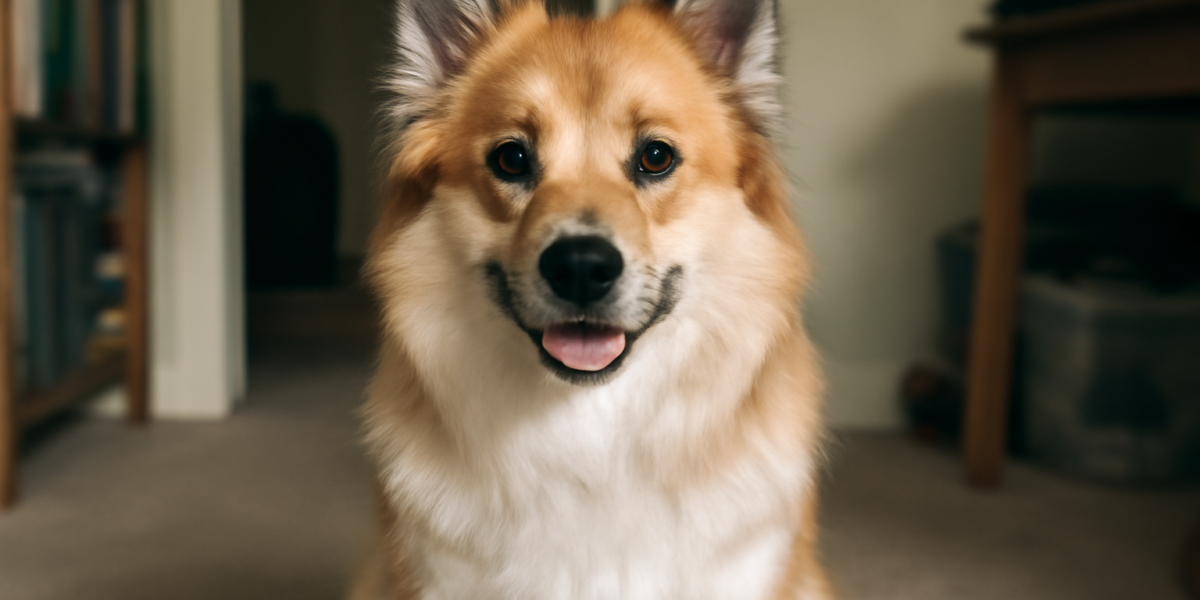
Icelandic Sheepdogs are medium-sized working dogs. Adult males typically stand around eighteen inches at the shoulder and females slightly smaller, with weights generally in the qualitative thirty-to-forty-pound range for a healthy adult. The build is sturdy and slightly longer than tall, with a deep chest, well-furred curled tail carried over the back, and a fox-like alert expression.
The double coat comes in two varieties recognized in the breed standard: long-haired and short-haired. The long-haired variety has a longer outer coat with feathering on the legs, chest, and tail, and is the more common and recognizable type. The short-haired variety has the same dense undercoat with a shorter outer coat. Both varieties shed substantially. Coat colors are wide-ranging: tan, chocolate brown, gray, cream, and black, often with white markings on the face, chest, legs, and tail tip. White is required to be present somewhere on the body per the standard.
The most distinctive structural feature is the breed-standard double dewclaws on the hind legs, a quirk shared with the French Beauceron, the Norwegian Lundehund, and a few other ancient working breeds. Double dewclaws were historically valued for traction on icy terrain and steep slopes, and the trait remains required in the breed standard today. Front dewclaws are also typically retained. Reputable breeders preserve all dewclaws rather than removing them, which is the standard convention internationally.
Exercise and Activity Needs
Icelandic Sheepdogs need moderate daily exercise: forty-five to ninety minutes of structured activity, including walks, off-leash time in safe areas, and mental work such as training, scent games, herding trials, or dog sports. They excel in agility, rally, obedience, and any sport that combines physical activity with handler interaction.
The energy level is more moderate than the relentless drive of a Border Collie or Australian Shepherd. Icelandic Sheepdogs settle well indoors when their needs are met, and they have a noticeable off-switch in the home that many working breeds lack. They are happy to nap on the couch between activity sessions rather than constantly seeking stimulation.
Cold tolerance is excellent, hot weather is harder. Plan summer exercise for early morning and late evening, with shade and water available, and limit midday activity in hot, humid climates. The double coat insulates against both cold and heat to some extent, but heatstroke remains a risk in heavy-coated breeds during peak summer hours. Reading our dog body language guide helps owners catch the early signs of heat stress in coated breeds.
Grooming and Care
The double coat sheds moderately year-round and heavily during the twice-yearly seasonal coat blows that can last several weeks. Plan on weekly brushing during normal periods with a slicker brush and undercoat tool, daily brushing during seasonal blowouts, and routine attention to feathering on the legs and tail in the long-haired variety. A high-velocity dryer or serious undercoat rake speeds the seasonal shed work substantially.
Never shave a double-coated spitz. The coat regulates temperature in both directions, sheds dirt naturally as it dries, and protects the skin from sun and insect damage. Shaving disrupts the system, can cause uneven regrowth that never fully restores, and increases the dog’s vulnerability to weather extremes. Bathing every six to eight weeks or as needed is sufficient. The harsh outer coat is naturally fairly clean.
Beyond coat care, the routine includes nail trims every two to three weeks (with attention to the double hind dewclaws, which need trimming like any other nail), weekly ear checks for the prick-eared breed type that is generally less prone to ear issues than dropped-eared dogs, and dental care from puppyhood. Diet should be a quality medium-breed formula matched to activity level, with attention to weight management since the heavy coat can hide gradual weight gain until it affects joint health.
Health and Lifespan
Icelandic Sheepdogs are generally a healthy mid-size breed with a typical lifespan in the twelve-to-fifteen-year range, sometimes reaching the upper teens with attentive care. The recovery from near-extinction in the twentieth century used a relatively small founding population, which means modern breeders pay careful attention to genetic diversity and screening to manage inherited concerns.
The most commonly discussed health concerns include hip dysplasia, where reputable breeders screen with OFA, PennHIP, or European equivalents and disclose results. Patellar luxation appears in some lines and is screened for in breeding stock. Eye conditions including cataracts and progressive retinal atrophy have been documented in the breed, and reputable breeders perform annual eye exams with veterinary ophthalmologists and disclose results through CHIC or equivalent registries.
Cryptorchidism appears occasionally in male puppies and can be a consideration for show or breeding placements. Bloat risk is lower than in deep-chested giants, but reading our bloat in dogs guide remains worthwhile for any owner of a medium working dog. Talk to a veterinarian familiar with rare working breeds about appropriate screening, vaccination, and parasite prevention for the dog’s lifestyle and region. Cancer rates appear to be moderate compared to working breeds overall, with the typical age-related cancers appearing in older dogs.
Daily Life with an Icelandic Sheepdog
An adult Icelandic Sheepdog in a settled household is engaged but balanced. Mornings typically include a long walk or training session, mid-day involves household interaction or a mental enrichment activity, and evenings settle into close family contact and quiet rest. Most owners find them more emotionally connected than the typical working spitz.
The vocal nature of the breed is real. Icelandic Sheepdogs were bred to herd by voice, and modern pet dogs use barking for greeting, alerting, requesting, and announcing changes in the environment. This is manageable with training but not eliminable. Apartment dwellers with thin walls or sound-sensitive neighbors should consider this honestly before adopting.
The friendly, sociable temperament also affects the kind of household that works. Icelandic Sheepdogs do best with families where someone is home a meaningful part of the day. They struggle with long stretches of isolation. Households that travel frequently or want a dog that entertains itself should look at different breeds.
Adopting an Icelandic Sheepdog from Rescue
Icelandic Sheepdogs are uncommon in North American rescue. Population numbers globally remain modest, and breed-specific rescue networks coordinate most placements. Surrender reasons typically include owners underestimating the activity needs, the barking tendency, or the coat care commitment, plus standard family-change scenarios. Adopting often requires patience and active participation in breed-club waiting lists.
Breed-specific rescues evaluate dogs carefully. Ask whether the dog has been observed in a home rather than only a kennel run, evaluated with other dogs and children, and assessed for handler trust, recall, and visitor behavior. Foster placements are typically more informative than shelter assessments because the breed’s true temperament emerges only in a settled household.
Behavioral rehabilitation focuses on building handler trust through force-free training, providing daily mental work, and establishing new household routines. Most adopted Icelandic Sheepdogs settle within two to three months because the breed’s friendly baseline temperament accelerates bonding. Reading our 3-3-3 rule, decompression period guide, and first week with a rescue dog overview sets reasonable expectations.
Is the Icelandic Sheepdog Right for You?
Icelandic Sheepdogs suit active families or individuals who want a friendly, fluffy, vocal companion and are prepared for grooming and barking. They thrive with hiking, training, dog sports, and committed daily activity, and they slot into family life with enthusiasm. They struggle in households that want a low-maintenance, quiet pet, in long-isolation work-from-office homes, and in apartments with sound-sensitive neighbors.
If you are exploring related Nordic spitz breeds before deciding, our Finnish Lapphund profile, Lapponian Herder profile, Norwegian Elkhound profile, Finnish Spitz profile, and Keeshond profile show the spectrum of Nordic spitz temperaments. The Icelandic Sheepdog is among the friendliest and most pet-suitable on that spectrum.
For the broader rescue process, see our adopting an adult dog overview, adopting from a foster guide, and the dog care blog for ongoing guidance. Browse current listings at our adopt-a-dog hub or the broader adopt page to start the search.
Frequently Asked Questions
Are Icelandic Sheepdogs good family dogs?
Yes, for active families who accept the coat and the bark. They are unusually friendly for a Nordic spitz, warm with children, and reliable in family life. They are not the right breed for sedentary households or owners who want a quiet, low-maintenance pet.
Why do Icelandic Sheepdogs have double dewclaws?
The double hind dewclaws are a breed-standard feature shared with a few other ancient working breeds including the Beauceron and Norwegian Lundehund. The trait was historically valued for traction on icy and steep terrain and is preserved by reputable breeders rather than removed.
How much do Icelandic Sheepdogs shed?
A lot. The double coat sheds year-round and blows seasonally twice a year. Plan on weekly brushing during normal periods and daily brushing during the seasonal coat blow, plus routine vacuuming. The short-haired variety sheds slightly less in volume but still significantly.
Are Icelandic Sheepdogs good with cats and small pets?
Usually, especially with cats they grow up with or are introduced to thoughtfully. The prey drive is moderate compared to most working spitzes thanks to centuries of farm-cooperative selection. Individual variation exists, and introductions still need to be careful.
How rare are Icelandic Sheepdogs?
Globally rare. The breed nearly went extinct in the early twentieth century and was rebuilt from a small founding population. Population numbers in North America remain modest, and adopting one usually means waiting for a breed-club rescue placement or working with a small network of breeders.
Looking to adopt a Icelandic Sheepdog Breed Profile?
Browse Icelandic Sheepdog Breed Profile dogs and mixes available for adoption from shelters and rescues near you.
Find Icelandic Sheepdog Breed Profile Dogs for Adoption