Last updated: May 4, 2026
In this article
Quick Comparison
The Mekong Bobtail vs Thai Cat comparison brings together two pointed cats with deep Southeast Asian roots and very different paths to formal recognition. The Mekong Bobtail is a landrace cat from the Russian and Southeast Asian border regions, formerly known as the Thai Bobtail, with a dominant bobtail mutation and a sturdy build. The Thai Cat is the modern preserved version of the original apple-headed Siamese: a moderate-bodied pointed cat with a rounded face and a full tail.
Both share the iconic colorpoint coat that the wider world associates with Siamese-type cats. Both are intelligent, talkative, and deeply attached to their people. Where they part ways is in tail anatomy, head shape, and registry profile. The Mekong has a short kinked or pom-pom tail, a slightly cobby body, and recognition primarily through WCF and TICA. The Thai Cat has a normal full-length tail, a more balanced moderate body type, and broader recognition including FIFe.
If you want the look of a classic pointed cat with a full tail, the Thai Cat is the natural choice. If you are drawn to a sturdier, bobtailed version of the same coat heritage, the Mekong Bobtail is the more interesting pick. Both are uncommon in North America and require some patience to source ethically.
Origin and History
Pointed cats from the Kingdom of Siam reached Europe in the late nineteenth century, where they were quickly adopted by the early cat fancy. As show breeders selected for the extreme wedge-headed, tubular look of the modern Siamese, a parallel preservation movement formed to keep the older apple-headed type alive. That preservation effort eventually became the Thai Cat, recognized by WCF, TICA, and FIFe in recent decades. The Thai Cat is genetically and historically the same population as the original Siamese, just held to the older conformation standard.
The Mekong Bobtail comes from a different branch of the same broad pointed-cat family. Cats with naturally short tails were observed for centuries throughout the Mekong River basin and across into southern Russia. Russian breeders began formalizing the type in recent decades under the name Thai Bobtail, later renamed Mekong Bobtail to reflect its geographic range. WCF accepted the breed for championship status, and TICA followed with recognition.
Both cats are therefore old populations under modern breed labels, not laboratory creations. The Mekong’s bobtail is a naturally occurring autosomal dominant mutation distinct from the genes seen in Manx or Japanese Bobtail cats. The Thai Cat carries the same pointed Siamese gene as its modern wedge-headed cousin, expressed on a moderate body and head.
Appearance and Build
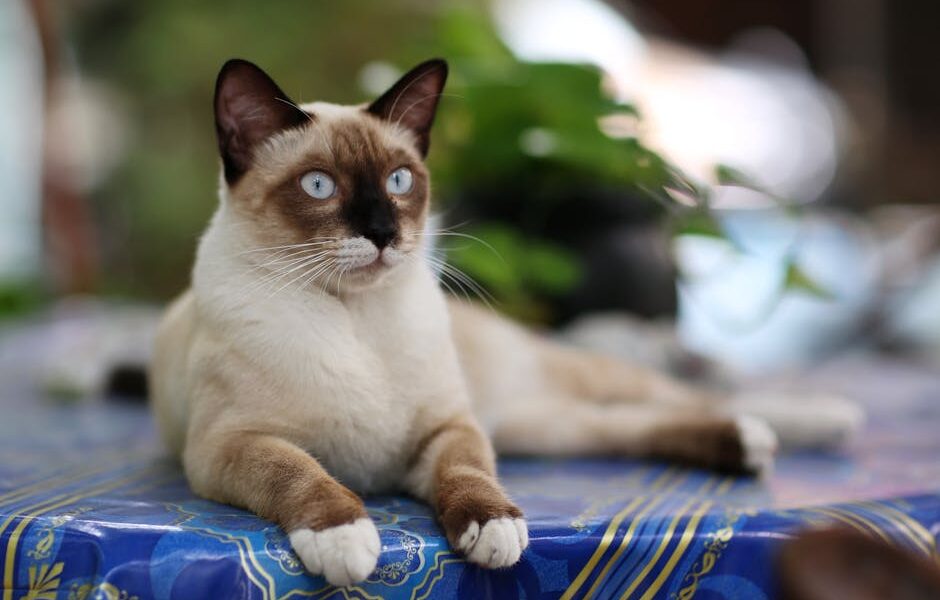
The Thai Cat presents as a medium-sized, moderately built cat with a rounded modified-wedge head, a softly defined muzzle, walnut-shaped blue eyes, and medium-sized ears. The body is muscular but not heavy, with proportional legs and a normal full-length tapered tail. The coat is short, fine, and lies close to the body, with classic pointed coloration: seal point, blue point, chocolate point, lilac point, and several extended-color points depending on registry.
The Mekong Bobtail is also medium-sized but reads as sturdier and slightly cobbier. Its head is a softer rounded triangle, the eyes are oval and intensely blue, and the ears are medium-sized and tilted slightly forward. The defining feature is the tail, which is a short kinked or curled bobtail of varying length, typically not exceeding about a quarter of the body length. Each Mekong tail is unique in shape, like a fingerprint. The coat is short, glossy, and pointed in the same color range as Siamese-derived breeds.
Side by side, the Thai Cat has a more elegant outline and the Mekong has a more rustic, heritage-cat look. Coat colors are essentially overlapping, so the visual differences come down to body type, head shape, and tail.
Temperament and Personality
Both breeds are highly social, intelligent, and people-oriented. The Thai Cat is talkative, often vocal in the classic Siamese way with a wide range of meows, trills, and chirps. They form intense bonds with their primary humans and can become anxious or destructive if left alone for long stretches. They are playful well into adulthood, learn tricks readily, and often follow their owners from room to room.
The Mekong Bobtail is described as slightly calmer than a Thai Cat but still social and engaged. They are confident, curious, and known for getting along well with dogs and respectful children. Many enthusiasts describe Mekong Bobtails as “dog-like,” walking on harness, fetching toys, and greeting visitors at the door. Vocalization is moderate rather than constant, with a softer voice than a Thai Cat.
Both breeds want to be involved in your life. They do best in homes where someone is around for at least part of the day, or where another pet provides company. Households that travel often, work long hours, and lack environmental enrichment will struggle with either cat. For ideas on keeping social breeds engaged, see our cat enrichment ideas guide.
Care, Grooming, and Activity Needs
Grooming is straightforward for both. The short, fine coat needs only a weekly comb-through to remove loose hair, with light shedding year-round and modest seasonal increases. Bathing is rarely required outside of show prep. Nail trims, ear checks, and dental care follow a typical pedigreed cat schedule.
Activity needs are high for both breeds. The Thai Cat in particular has classic Siamese energy and requires daily interactive play, vertical climbing space, and puzzle feeders to stay mentally satisfied. The Mekong Bobtail is comparably active, with strong prey drive and excellent jumping ability despite the shorter tail. Both breeds are good candidates for clicker training, harness walks, and supervised outdoor enclosure time.
Multi-cat households work well with both breeds, especially if introduced young. They typically tolerate or enjoy other social cats, friendly dogs, and even some bird-free small pet environments. For introduction tips, see our introducing kitten to resident cat guide and our puzzle feeders for cats overview.
Health and Lifespan
Pointed cat populations in general are robust, and both breeds benefit from broad genetic foundations. The Thai Cat shares health considerations with the broader Siamese-derived family: amyloidosis, asthma in some lines, and dental disease are points to ask breeders about. Eye and respiratory health are usually fine because the Thai Cat retains a moderate, non-extreme face. Read about feline asthma in our asthma in cats overview.
The Mekong Bobtail’s dominant bobtail gene is not associated with the spinal problems sometimes seen in Manx cats, because it acts through a different mutation. Reputable breeders still avoid pairings that would risk neurological issues, and the breed has so far shown a strong overall health profile. As with any pedigreed cat, ask about HCM screening and dental health.
Both breeds typically live into their mid to late teens with attentive care, regular wellness exams, and good dental hygiene. Our adult cat wellness checklist and senior cat care checklist outline routine care expectations across the lifespan.
Living Situation Fit
Both cats do well in apartments and houses, provided they get daily mental stimulation. They are not best suited to households where everyone is gone twelve hours a day with no other pets. Multi-cat or cat-plus-dog homes often suit them better than solo living.
Children who can be taught gentle interaction usually do well with either breed, especially the Mekong Bobtail’s more easygoing nature. Both cats are typically tolerant of harness training, car travel, and visitors, which makes them flexible companions for active households. For more on activity-friendly breeds, see cat breeds that act like dogs.
Climate is rarely an issue for either short-coated breed. Both adapt well to indoor temperature ranges and tolerate moderate cold or heat without difficulty. A warm bed, sunny window, and access to climbing space will keep them content year round.
Cost and Availability
Thai Cats are uncommon in North America but have an established presence in Europe, particularly Germany, the Netherlands, and Eastern Europe. Pet-quality Thai Cat kittens generally fall in the mid four figures from European breeders, with import logistics adding cost. Within Asia, Thai Cats are more accessible and historically priced lower at origin.
Mekong Bobtails are even harder to source outside of Russia and Eastern Europe. A handful of TICA breeders work with the breed in Western Europe and a small number in North America. Pet-quality kittens typically command a similar mid-four-figure range to Thai Cats, again with import costs to consider for North American buyers. Waitlists are common.
For both breeds, look at our Asian cat breeds overview and cat breeds from Russia roundups to see related options. Sibling breed profiles for direct context include the Mekong Bobtail cat breed profile and the Thai Cat breed profile.
Decision Framework: When to Choose Each
Choose the Thai Cat if you want a classic apple-headed Siamese-style cat with a full tail, broad registry recognition (TICA, WCF, FIFe), and a moderate look that avoids the extremes of modern show Siamese. Thai Cats are ideal for owners who love a vocal, intensely bonded companion and have time to engage them daily. Compare directly with the modern Siamese cat breed profile if conformation is your main interest.
Choose the Mekong Bobtail if a short kinked tail is appealing rather than off-putting, you want a sturdier rustic-looking pointed cat, and you appreciate a slightly calmer, dog-like personality. The Mekong is also a strong pick if you have respectful children or a friendly dog already in the household.
Skip both if you cannot commit to daily interactive engagement. Both breeds become unhappy in low-stimulation environments, and a bored Thai Cat or Mekong Bobtail will find creative outlets that you may not appreciate. Consider a calmer breed from our calmest cat breeds list instead.
Frequently Asked Questions
Is the Mekong Bobtail the same as the Japanese Bobtail?
No. Both have naturally occurring bobtail mutations, but the underlying genes are different. The Mekong Bobtail’s mutation is autosomal dominant and arose in the Russian and Southeast Asian border region, while the Japanese Bobtail’s mutation is a separate dominant gene with a different population history.
Is the Thai Cat just an old-fashioned Siamese?
Functionally yes. The Thai Cat is the moderate-bodied apple-headed Siamese type that existed before show breeders pushed the modern Siamese toward the extreme wedge head. WCF, TICA, and FIFe all recognize the Thai Cat as its own breed in part to preserve that conformation.
Do Mekong Bobtails have spinal problems like Manx cats?
The Mekong’s bobtail gene is genetically distinct from the Manx mutation and is not associated with the neurological and spinal issues seen in Manx homozygotes. Reputable breeders still pursue careful pairings to safeguard health, but the Mekong Bobtail population has not shown the same risk profile.
Are Thai Cats and Mekong Bobtails good with children?
Both can be excellent with respectful older children, especially when raised in busy households. The Mekong Bobtail tends to have a slightly calmer baseline temperament than the more intensely vocal Thai Cat, which some families prefer. Either way, supervise interactions and teach children to handle gently.
Where can I adopt a pointed cat in this style?
Both breeds are uncommon in rescue, but Siamese mixes and pointed cats turn up regularly. Browse the adopt cats hub and ask local cat-only rescues. For breed-specific options, breeder waitlists are usually the most reliable path. Bobtailed cats more broadly are covered in our cat breeds with bobbed tails roundup.
Looking to adopt a Mekong Bobtail vs Thai Cat?
Browse Mekong Bobtail vs Thai Cat cats and mixes available for adoption from shelters and rescues near you.
Find Mekong Bobtail vs Thai Cat Cats for Adoption