
Obesity in dogs treatment starts with a frank acknowledgment that the extra weight your dog is carrying is not cosmetic — it is a chronic disease that shortens lifespan, reduces quality of life, and predisposes your dog to a long list of secondary illnesses. Roughly half of dogs in the U.S. and a growing share in Singapore now meet the clinical definition of overweight or obese, and most of their owners do not realize it. The good news is that obesity is one of the few chronic conditions in dogs that you, the owner, can largely reverse with consistent, structured effort.
In this article
- Why Obesity in Dogs Is a Serious Disease
- How Owners Miss the Diagnosis
- Step One: The Vet Workup
- Step Two: Set the Target Weight
- Step Three: Calorie Restriction Done Right
- Step Four: Increase Movement
- Step Five: Weigh-Ins and Adjustments
- Behavior Strategies for the Begging Dog
- Maintenance: The Real Test
- Frequently Asked Questions
This guide walks through the health risks of canine obesity, the vet workup that should precede any weight loss plan, the components of a safe treatment program, and the behavioral changes — both yours and your dog’s — that determine whether the weight stays off. None of this is quick, and none of it is glamorous, but the dog you have on the other side is healthier, more mobile, and likely to live longer.
Why Obesity in Dogs Is a Serious Disease
Excess body fat is metabolically active tissue. It does not sit quietly under the skin — it pumps out inflammatory signals that drive disease throughout the body. The dog you see waddling slowly across the room is dealing with low-grade inflammation in every joint, organ, and blood vessel.
The major secondary diseases linked to canine obesity include osteoarthritis (every extra pound multiplies stress across the joints — see our guide on osteoarthritis in dogs), diabetes mellitus (obesity is a leading risk factor — see our diabetes mellitus in dogs guide), heart and respiratory disease, increased anesthetic risk during surgery, certain cancers, urinary incontinence, skin fold infections, and pancreatitis (covered in our pancreatitis in dogs article). Obesity shortens lifespan and reduces quality of life — a dog at ideal body weight has more comfortable years to give you.
How Owners Miss the Diagnosis
Obesity creeps up gradually. Owners see their dog every day, so the half-pound a month gain over two years — twelve pounds total — looks normal. By the time the dog is dramatically overweight, the body has adapted, the dog moves less, and the new shape is the baseline.
The other reason owners miss it: many of us were raised to equate a “well-fed” dog with a loved dog. A round, soft Labrador looks happy in photographs. A lean, athletic Labrador can look almost neglected to the untrained eye. Resetting that mental image — toward a visible waist behind the ribs and ribs you can feel without pressing — is half the work.
Step One: The Vet Workup
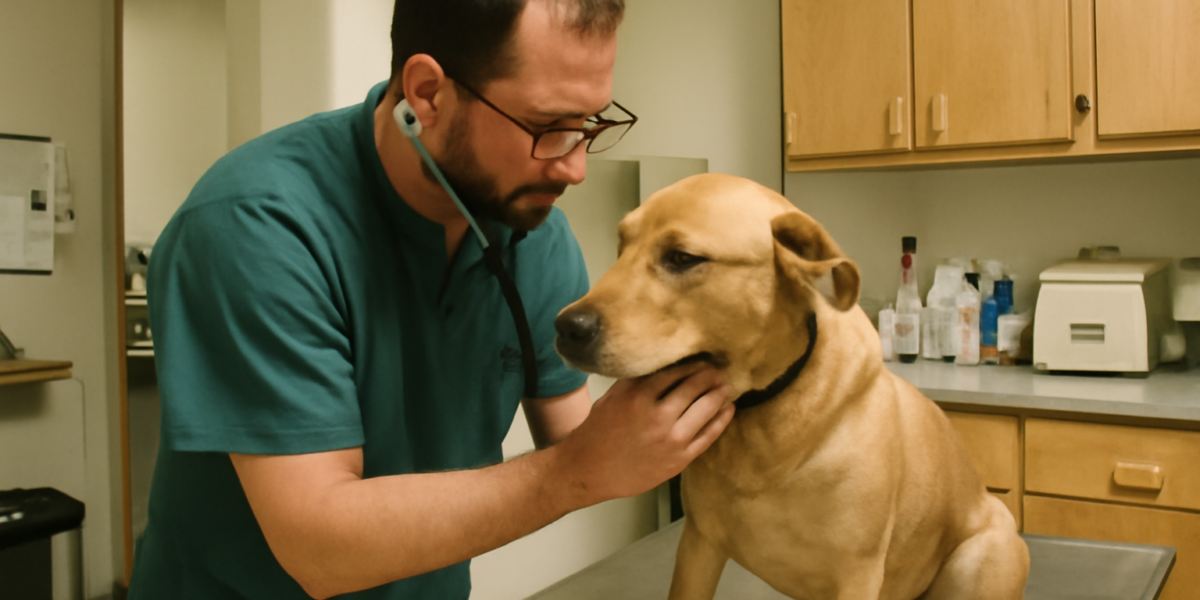
Before you cut calories, your dog needs a vet visit and bloodwork. Two endocrine diseases produce or worsen weight gain in dogs and need to be identified before any weight loss plan starts.
Hypothyroidism
An underactive thyroid slows metabolism, causes weight gain even with normal calorie intake, and produces lethargy, hair loss, and skin issues. A simple blood test (T4, often with free T4 and TSH) screens for it. Treatment with daily oral levothyroxine restores normal metabolism and makes weight loss possible.
Cushing’s Syndrome
Hyperadrenocorticism — Cushing’s — causes a classic potbellied appearance, increased thirst and urination, panting, hair loss, and what looks like weight gain (though it is actually fat redistribution and muscle loss). It is more common in older dogs and certain breeds. See our detailed write-up on Cushing’s syndrome in dogs. Treating Cushing’s is a separate medical track from a basic weight loss plan.
Routine senior bloodwork should also screen for arthritis pain, heart and lung function (panting and exercise tolerance change weight loss exercise prescriptions), and any subclinical diabetes.
Step Two: Set the Target Weight
The number on the bag chart, the breed standard, and the weight your dog was three years ago are starting points — not the answer. Your veterinarian sets the target weight based on body condition score, frame size, age, and any orthopedic issues. For most overweight dogs, the initial target is the weight that brings them from their current BCS down to BCS 5 on the 9-point scale.
For severely obese dogs (BCS 8-9), the target is set in stages. Aiming directly for ideal weight from severe obesity is too long a runway and discourages owners. Set an interim target at 10-15% loss, achieve and stabilize, then reset for the next stage.
Step Three: Calorie Restriction Done Right
Weight loss in dogs requires a calorie deficit. The veterinary approach uses approximately 80% of the dog’s resting energy requirement (RER) for weight loss, calculated from the target weight, not the current weight. The formula structure is RER = 70 × (body weight in kg)^0.75, but the actual prescription should come from your vet — individual variation, activity level, and metabolic differences make a vet-calculated number far more reliable than an internet calculator.
The diet itself usually shifts to a therapeutic weight loss formula. Brands like Hill’s, Purina ProPlan, Royal Canin, and Iams Healthy Naturals all produce prescription weight loss diets with high protein, high fiber, lower fat, and added L-carnitine. These diets keep dogs feeling full at lower calorie counts and preserve lean muscle during weight loss. Trying to achieve the same calorie restriction with a regular over-the-counter food often leaves dogs hungry, owners guilty, and the program failing.
Treats Count
The 10% rule: treats should make up no more than 10% of daily calories. For a 50-pound dog on a weight loss plan that eats roughly 800 kcal per day, that is 80 kcal of treats — about three small training treats and a single dental chew. See our dog treat calorie calculator for how to read treat labels and budget treats into the plan without sabotaging the calorie deficit.
Sneaky Calories
Most weight loss plans fail because of calories the owner is not counting: table scraps slipped under the table, the second breakfast from grandparents, the tablespoon of peanut butter in the Kong, the dental chew in the morning and the long-lasting chew at night, leftover food from the cat’s bowl, the lick of yogurt off the spoon. A household conversation — every adult on the same page about what the dog is and is not eating — is the foundation of success.
Step Four: Increase Movement
Exercise alone will not produce significant weight loss in dogs (the math doesn’t work — diet does the heavy lifting), but movement is essential for muscle preservation, joint health, behavioral wellbeing, and metabolic health. Build the exercise plan to your dog’s current capacity, not the goal.
For mildly overweight dogs without joint disease, increase walks gradually — add 5 minutes per outing weekly until you reach 30-60 minutes daily. For obese dogs or those with arthritis, start with multiple short outings (3-5 minutes) several times a day on flat ground. Swimming and hydrotherapy are gold-standard low-impact exercise for arthritic obese dogs.
Mental enrichment matters too. Puzzle feeders that make your dog work for the daily kibble allotment slow eating, increase satisfaction, and add light cognitive activity. A bored dog at home alone all day will not lose weight just by being on a diet — daily activity is the second pillar.
Step Five: Weigh-Ins and Adjustments
Weigh your dog every two weeks during active weight loss. Use the same scale, same time of day, ideally before the morning meal. Healthy weight loss in dogs runs 1-2% of body weight per week — for a 50-pound dog, that is half a pound to one pound weekly. Faster than this risks muscle loss and gallbladder issues; slower than this means the calorie target needs to drop or the activity needs to increase.
Plot the weigh-ins. If two consecutive readings show no progress, recalculate calories with your vet. Many dogs need a 10% calorie reduction at the 6-8 week mark as their metabolism adapts to the lower intake. Plateaus are normal and not a reason to give up.
Behavior Strategies for the Begging Dog
The hardest part of any weight loss plan is the behavior — both yours and your dog’s. Dogs on calorie restriction beg more, wake earlier asking for food, and learn quickly which family member is the soft touch.
Useful tactics: split the daily ration into 3-4 small meals instead of 1-2 large ones to keep the dog feeling fed throughout the day. Use a slow-feeder bowl or puzzle feeder to extend mealtime. Substitute green beans, frozen plain pumpkin (see our pumpkin for dogs guide), or carrot sticks for higher-calorie treats — the volume satisfies without the calories. Ignore begging consistently across the household; intermittent reinforcement creates the loudest, most persistent beggars. Distract with a walk, a play session, or a training drill rather than food.
Maintenance: The Real Test
Reaching target weight is not the finish line — keeping it off is. The day your dog hits target weight, calories shift from weight loss prescription (~80% of target RER) to maintenance (typically the full RER, adjusted for activity). Most dogs need 20-30% more food than they ate during the loss phase.
Continue weighing monthly for the first six months, then quarterly. A two-pound regain on a 50-pound dog is the time to act, not when the regain has hit ten pounds. The body composition you worked to achieve is permanent only if the eating and exercise habits become permanent. Plan for it.
Frequently Asked Questions
How fast should my dog lose weight?
Safe weight loss in dogs is 1-2% of body weight per week. Faster loss risks lean muscle wasting, gallbladder issues, and a metabolic adaptation that makes future weight loss harder. Slower loss usually means the calorie target needs to drop or activity needs to increase.
Do I need a prescription weight loss diet, or can I just feed less of regular food?
For mild overweight (BCS 6), portion-controlling a high-quality regular food often works. For dogs at BCS 7+, prescription weight loss diets are usually more successful — they deliver complete nutrition at lower calorie density, keep dogs feeling full, and preserve muscle better than simply restricting regular food, which can cause nutrient gaps.
Why is my dog gaining weight even though I haven’t changed his food?
Common causes: spay/neuter (drops calorie needs by 20-30%), aging (metabolic slowdown after age 7-8), reduced activity (a winter of less walking, an injury), an undiagnosed endocrine disease (hypothyroidism, Cushing’s), or sneaky calories from family members feeding behind your back. A vet visit and an honest household audit answer the question.
Are weight loss supplements safe for dogs?
Most “fat burner” or appetite suppressant supplements marketed for dogs lack good evidence and some are unsafe. The proven tools are calorie restriction, therapeutic diets, and exercise. Discuss any supplement with your vet before adding it to a weight loss plan.
My dog is starving on the new diet — what do I do?
Switch to a higher-fiber, higher-protein therapeutic weight loss diet if you are not already on one — these keep dogs significantly fuller. Split daily food into 3-4 small meals. Add low-calorie volume foods (green beans, plain pumpkin) to the meal. Use puzzle feeders to slow eating. If your dog still seems genuinely distressed, talk to your vet — the calorie target may be set too low.
How long does a dog weight loss program take?
Plan on 6-12 months for moderate cases, longer for severe obesity. A 50-pound dog needing to lose 10 pounds at 1% per week takes about 20 weeks (5 months). Severely obese dogs often work through staged targets over a year or more. Patience and consistency beat aggressive crash plans every time.


