Last updated: May 4, 2026
In this article
Tornjak Overview
This tornjak breed profile introduces one of the Balkans’ oldest livestock guardian dogs, a large mountain breed from the rugged highlands of Bosnia-Herzegovina and Croatia. The Tornjak (sometimes called the Bosnian-Herzegovinian and Croatian Shepherd Dog) traces its working lineage back centuries, guarding sheep against wolves and bears in remote alpine pastures. By the mid-twentieth century the breed had nearly vanished, and dedicated cynologists from both countries spent decades rebuilding the population from a handful of authentic working dogs found in isolated villages.
If you have read our Sarplaninac breed profile, you already know the Balkans produced several distinct guardian types. The Tornjak is often confused with the Sarplaninac, but the two are separate landraces with different histories and slightly different jobs. The Tornjak is taller, leggier, and more square in outline, often parti-colored or pied, while the Sarplaninac is denser and more uniformly colored. Both are serious working dogs, not casual pets.
Quick facts: large to giant size, working/livestock guardian group, double coat with heavy mane, lifespan generally in the eleven-to-fourteen-year range for the breed, moderate exercise needs, intensive socialization required, not recommended for first-time large-breed owners. Tornjaks are appearing in rescue more often as European populations grow and a handful of imports reach North America.
Temperament and Personality
Tornjaks were bred to live unsupervised with flocks for weeks at a time, which means they think for themselves. They are calm, watchful, and deeply attached to their family or charges, but they do not seek attention the way a retriever might. A well-bred Tornjak is dignified and reserved with strangers, friendly with people the family welcomes, and absolutely intolerant of perceived threats to home or livestock.
This independence is the breed’s defining feature and its biggest training challenge. Tornjaks will follow cues from a handler they respect, but they will also override those cues if their judgment says otherwise. That is not stubbornness, it is the working trait that kept lambs alive. Pet owners who want instant obedience will find this frustrating; owners who appreciate a thinking partner will love it.
With family, Tornjaks are gentle and patient, often forming strong bonds with children they grow up alongside. With other dogs they can be selective, particularly same-sex pairs of intact adults. Early and ongoing socialization, plus calm leadership, shapes a stable adult.
Size and Appearance
Adult males typically stand around twenty-six to twenty-nine inches at the shoulder with females slightly smaller, and weights commonly fall in the eighty-to-one-hundred-twenty-pound range, sometimes more in heavy-boned males. The build is balanced rather than massive: the Tornjak is a working athlete, not a draft Mastiff.
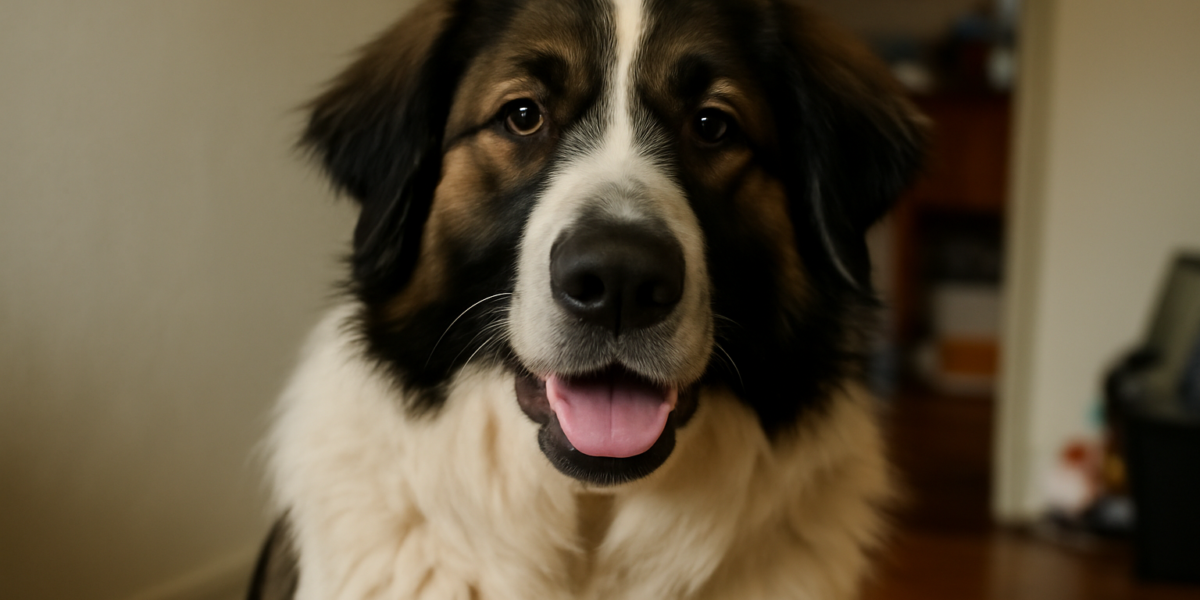
The double coat is long, harsh on top, with a dense undercoat and a pronounced ruff or mane around the neck. Coat colors are usually parti-colored or pied with a base of white and patches of black, gray, fawn, or red. The tail is well-feathered and carried high when alert. Eyes are almond-shaped and intelligent, ears triangular and dropped.
This is a breed built for cold mountain weather. They handle snow and freezing temperatures comfortably and struggle in hot, humid climates without shade, water, and air conditioning during peak summer hours.
Exercise and Activity Needs
Tornjaks are surprisingly moderate in exercise needs for a guardian breed. They patrol, they watch, they conserve energy for what matters. A good daily routine includes one or two long walks, a securely fenced yard for patrolling, and access to interesting sights, sounds, and smells around the property.
They are not jogging companions in the way a Vizsla is, and they should not be pushed into high-impact activity during the long puppy growth phase. Joint development in giant-breed pups is fragile, and forced running on hard surfaces before about eighteen months can contribute to lifelong issues. Free-form play in a safe yard is far better than structured running.
Mental stimulation matters more than physical drilling. Scent games, problem-solving toys, and varied environments keep a Tornjak engaged. A bored Tornjak in a small backyard with no job to do can develop intense barking patterns, which neighbors will notice quickly.
Grooming and Care
The double coat sheds heavily twice a year and moderately the rest of the time. Plan on weekly brushing with a slicker and undercoat rake during normal periods, daily during seasonal blowouts that can last several weeks. The mane and feathered tail need extra attention to prevent mats. Bathing is occasional rather than routine; the harsh outer coat sheds dirt naturally as it dries.
Nail trims every two to three weeks, ear checks weekly, and dental care from puppyhood are baseline maintenance. Many Tornjaks have substantial paw fur that needs occasional trimming between the pads, especially in summer when burrs and foxtails become a hazard.
Diet should be high-quality and appropriate for large to giant breeds, with attention to growth rate in puppies. Slow, steady growth produces healthier joints than racing to full size. Talk to a veterinarian familiar with giant breeds about feeding schedules and supplements.
Health and Lifespan
Tornjaks are generally a healthy landrace breed, partly because the modern population was rebuilt from working stock with strong functional traits. That said, the size category brings predictable concerns. Hip and elbow dysplasia appear in the breed; reputable breeders screen with OFA or PennHIP and share results openly. Read our elbow dysplasia in dogs guide for what screening certifications mean.
Deep-chested guardian breeds are at elevated risk for gastric dilatation-volvulus, the medical emergency commonly called bloat. Owners should learn the symptoms and the regional emergency protocol. Our bloat in dogs guide covers prevention strategies, including feeding multiple smaller meals, rest after meals, and prophylactic gastropexy in high-risk dogs.
Other concerns include hypothyroidism, occasional eye issues, and the general giant-breed shorter lifespan compared to medium dogs. A typical well-cared-for Tornjak lives well into the lower teens, with some individuals reaching fourteen or fifteen on a calm working farm.
History and Working Heritage
The Tornjak’s documented history reaches back to medieval Bosnia, with church records from monasteries near Sarajevo referring to large guardian dogs working alongside shepherds in the fourteenth and fifteenth centuries. The breed evolved as a working partner to transhumant shepherds who moved flocks between mountain pastures and lowland winter grazing, a pattern that demanded a dog tough enough to handle weeks in alpine weather and predator-aware enough to deter wolves and brown bears without leaving the flock.
By the early twentieth century, modernization, mechanized agriculture, and two world wars hollowed out the rural shepherding economy. The Tornjak nearly disappeared. In the 1970s and 1980s, Bosnian and Croatian cynologists began a coordinated rescue project, traveling to remote villages to find authentic working dogs and rebuild a breeding base. The modern breed standard reflects that conservation work, and the breed remains uncommon outside the Balkans even today. Adopting a Tornjak abroad often means working with a small network of LGD-focused rescues and breed clubs.
Living With a Tornjak Day to Day
Daily life with a Tornjak revolves around routine and territory. They like a predictable household, a defined space to patrol, and quiet downtime in a cool resting spot. Expect a dog who positions himself where he can see the front door, the back fence line, and you all at once. Morning and evening walks in your neighborhood are fine, but the heart of the dog’s day is patrolling his own ground.
Fencing is non-negotiable. A six-foot solid fence is a reasonable minimum, with no gaps a determined adult could push through. Tornjaks rarely roam for fun, but they will follow a perceived intruder across a property line and may not recognize your neighbor’s yard as off-limits. Visible boundaries also reduce the constant arousal that comes from watching every passerby through a chain-link panel.
Heat is the other daily concern. The double coat that protects them in mountain winters becomes a liability in humid summer afternoons. Plan exercise for early morning and after sunset during warm months, provide deep shade and constant fresh water, and bring the dog indoors to air conditioning when temperatures climb. Heatstroke is a real risk in heavy-coated breeds, and prevention beats treatment every time.
Adopting a Tornjak from Rescue
Tornjaks in rescue are most often surrendered by owners who underestimated the breed’s working drive, the noise level, or the space requirement. A common pattern is a young adult dog purchased as a puppy, raised in a suburban yard, and surrendered around eighteen to twenty-four months when the guardian instincts mature and the household can no longer manage the barking and territorial reactivity.
Shelter staff and foster homes will sometimes know how the dog reacts to strangers, livestock, other dogs, and household routine, but landrace LGD breeds confuse general-population shelters that are not used to evaluating guardian behavior. Ask whether the rescue has worked with Tornjaks, Sarplaninacs, or other LGDs before, and whether the dog has been observed in a home rather than only a kennel run. A kennel-stressed Tornjak can present very differently than a settled one. Reading our first week with a rescue dog guide and the decompression period overview will help you set realistic expectations for the first month.
Rehabilitation in a new home generally focuses on calm leadership, predictable routines, and gradual exposure to the boundary of the property. Force-free training methods build trust faster than corrections, and corrections rarely override a guardian’s instincts anyway. Most adult Tornjaks settle into a thoughtful family home within three to six months when given that structure.
Is the Tornjak Right for You?
Tornjaks are right for experienced owners with rural or suburban-acreage homes, a serious commitment to socialization, and an appreciation for an independent thinker. They thrive when they have a job, even a symbolic one such as patrolling a property line or watching over backyard chickens. They struggle in apartments, in hot urban environments, and with owners who want instant obedience.
Rescue Tornjaks are uncommon outside the Balkans, but they do appear in livestock-guardian rescues in North America and parts of Europe. If you are exploring an LGD adoption, our guide to livestock guardian rescue walks through the questions to ask. For the broader rescue process, see the 3-3-3 rule and decompression period guidance.
Compare with related guardian breeds before committing. Our Sarplaninac profile, Kuvasz profile, and Maremma profile show the spectrum of European LGDs. You can also browse current listings at our adopt-a-dog hub.
Frequently Asked Questions
Is the Tornjak the same as the Sarplaninac?
No. They are distinct Balkan landraces. Tornjaks tend to be taller, lighter-boned, and parti-colored, while Sarplaninacs are denser and usually solid-colored. They share guardian instincts and overlap geographically, but cynological clubs treat them as separate breeds.
Are Tornjaks good with children?
With family children they grew up around, yes, they are typically patient and protective. With visiting children they may be reserved at first. As with any guardian breed, supervision and clear household rules matter more than assumptions about the breed.
Can a Tornjak live in an apartment?
It is not a good fit. They need space to patrol, cool weather access, and a job to do. An urban high-rise stresses them and frustrates the owner.
Are Tornjaks heavy barkers?
Yes. Vocal alerting is part of the working role. Without livestock to guard they often shift that energy to guarding the property line, which creates conflict in dense neighborhoods.
How much grooming does the coat need?
Weekly during normal periods, daily during the twice-yearly heavy shed. Plan on a slicker brush, undercoat rake, and a steady fur supply on every soft surface in your home.
Looking to adopt a Tornjak Breed Profile?
Browse Tornjak Breed Profile dogs and mixes available for adoption from shelters and rescues near you.
Find Tornjak Breed Profile Dogs for Adoption