
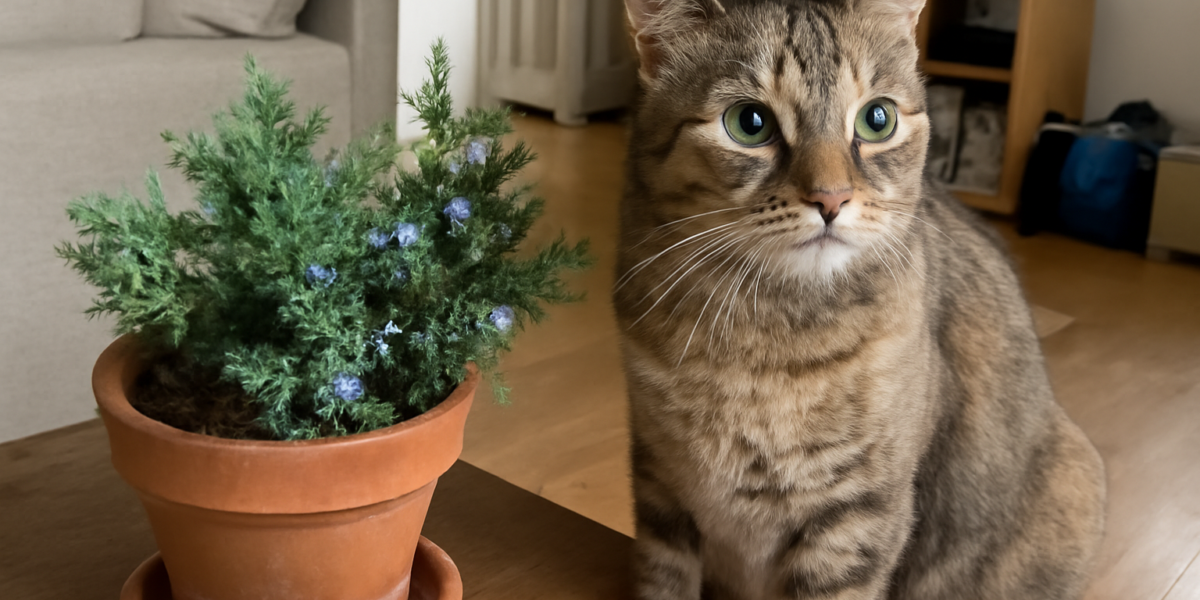
Are Juniper Berries Toxic to Cats? The Quick Answer
Yes, juniper berries are considered toxic to cats, but the severity is generally on the milder end of the toxic-plant spectrum. The ASPCA lists junipers (genus Juniperus) as toxic to both cats and dogs, with most ingestions producing gastrointestinal upset rather than life-threatening illness. The concerning compounds are the volatile oils concentrated in the berries and tips of the foliage, which can irritate the digestive tract and, with larger or repeated exposures, the kidneys.
In this article
- Are Juniper Berries Toxic to Cats? The Quick Answer
- What Juniper Looks Like and Where Cats Encounter It
- Why Juniper Is Toxic: The Volatile Oils
- Symptoms of Juniper Ingestion in Cats
- How Much Juniper Is Too Much?
- What to Do If Your Cat Eats Juniper
- Juniper in Holiday Decorations
- Outdoor Junipers and Yard Cats
- Juniper for Dogs vs Cats: Different Picture
- Pet-Safe Plant Alternatives
- When You Adopt: Add Plant Safety to Your Welcome-Home Checklist
- Frequently Asked Questions
If your cat has chewed juniper foliage or eaten one of those small blue-gray berries off a wreath, garland, or yard shrub, the situation is usually a “monitor closely and call your vet for guidance” event rather than a drop-everything emergency. Still, cats are uniquely sensitive to many essential-oil-bearing plants because of how their livers process those compounds, so do not brush this off. Call your veterinarian, the ASPCA Animal Poison Control Center at 888-426-4435 (fee applies), or the Pet Poison Helpline at 855-764-7661 (fee applies) for tailored advice.
What Juniper Looks Like and Where Cats Encounter It
Junipers are evergreen conifers ranging from low creeping ground covers to upright shrubs and small trees. The foliage is needle-like or scale-like depending on the species and age of the plant, and the “berries” are technically modified seed cones, ripening from green to a chalky blue or purple-black over a year or more. Common landscape species include eastern red cedar (Juniperus virginiana), Rocky Mountain juniper, common juniper (Juniperus communis), and the many cultivars used in foundation plantings.
Most cats are not enthusiastic foragers of juniper berries the way some dogs and birds can be. The bigger exposure routes for indoor cats are seasonal: holiday garlands, wreaths, swag, and centerpieces often include juniper sprigs because of the silvery-blue berry color, and a cat batting at decorations can absolutely end up chewing the foliage or ingesting a few fallen berries. Outdoor and indoor-outdoor cats may sample landscape juniper while grazing on greenery.
Juniper essential oil and juniper berry extract also show up in some household and aromatherapy products. Spilled diffuser water, scented sprays, or topical products that include juniper oil are a separate exposure category and one cats are particularly vulnerable to.
Why Juniper Is Toxic: The Volatile Oils
The toxic concern in juniper is not a single dramatic alkaloid like the colchicine in glory lily or the cardiac glycosides in oleander. Instead, it is a mixture of volatile (essential) oil components, including terpenes such as alpha-pinene, sabinene, and a compound called thujone in some species. These oils are present throughout the plant but are most concentrated in the berries and the new green tips of the foliage.
When ingested, these oils can irritate the lining of the mouth, esophagus, stomach, and intestines, producing the classic gastrointestinal signs of plant poisoning. With more substantial ingestions, the same oils can also irritate the kidneys, which is the more serious end of the juniper-exposure picture. Some traditional herbal preparations have used juniper berry as a diuretic in humans, but that same kidney effect is what makes meaningful ingestions a vet-call situation in cats.
Cats are particularly vulnerable to essential-oil-bearing plants because they have limited hepatic glucuronyl transferase activity, the liver enzyme system most mammals use to detoxify these compounds. That means a dose of essential oil that a dog might shrug off can hit a cat harder. This species-specific vulnerability is why many of our essential oil cautions for cats apply to juniper as well.
Symptoms of Juniper Ingestion in Cats
The most common signs after a cat chews juniper foliage or swallows berries are gastrointestinal. Watch for drooling, lip-smacking, pawing at the mouth, vomiting, soft stool or diarrhea, and a temporary loss of appetite. Some cats become lethargic and prefer to hide. These signs typically appear within a few hours of ingestion and resolve within a day or two with supportive care.
With larger ingestions, more concerning signs can develop. Increased thirst and increased urination, blood in the urine, abdominal discomfort, weakness, or unsteady walking deserve immediate veterinary attention because they suggest the volatile oils may be irritating the kidneys or the central nervous system. A cat that becomes very weak, has trouble breathing, or has a tremor needs to be seen at an emergency clinic without delay.
Skin and eye contact can also cause local irritation. If your cat has rubbed against a freshly-cut juniper sprig or had juniper essential oil applied (please do not use undiluted essential oils on cats), look for redness, scratching at the affected area, watery eyes, or sneezing.
How Much Juniper Is Too Much?
There is no published mg-per-kilogram threshold for juniper toxicity in cats, and reputable poison control resources do not give specific safe amounts. The honest answer is that small mouthing exposures, like a cat batting at a wreath and licking a berry off a paw, usually cause at most mild GI signs that resolve on their own. Sustained chewing of foliage, eating multiple berries, or ingesting concentrated juniper essential oil moves the needle toward a vet visit.
Body size matters. Cats are small, often weighing eight to twelve pounds, so a small amount of plant material represents a much larger relative dose than the same amount in a sixty-pound dog. Kittens and senior cats with pre-existing kidney disease are at higher risk because their margins for handling any extra renal stress are narrower.
The practical rule is the same one we use for nearly every cat-safe houseplant question: when you do not know how much your cat ingested, assume it might be enough to matter and call for guidance. A phone consult with poison control is far cheaper than waiting and ending up in emergency.
What to Do If Your Cat Eats Juniper
The first move is to remove your cat from the source. Pick up fallen berries, take down or relocate the wreath or garland, and put the plant or arrangement somewhere your cat cannot reach. Check your cat’s mouth gently for any plant material still stuck between teeth or on the tongue, and wipe the muzzle with a damp cloth if you see oily residue.
Then call. Tell the veterinary team or poison control hotline what your cat looks like (species, weight, age, any existing health issues), what part of the juniper they ingested, your best estimate of the amount, and when it happened. Have the plant or a photograph of it ready so the staff can confirm the species. Do not induce vomiting at home unless a veterinary professional explicitly tells you to. Some essential-oil ingestions are made worse by emesis because of aspiration risk.
If you are advised to bring your cat in, the veterinary team may offer fluids to support hydration and protect the kidneys, anti-nausea medication, and observation. Bloodwork to check kidney values is a reasonable precaution after a substantial juniper ingestion. Most cats who get into a small amount of juniper recover fully with supportive care.
Juniper in Holiday Decorations
The largest single exposure window for indoor cats is the December holidays. Juniper sprigs are popular in wreaths, garlands, centerpieces, and cut-flower arrangements alongside pine, fir, holly, and mistletoe. Many cats find swaying greenery irresistible, and decorative berries can fall and roll into corners where a curious cat will track them down.
If you decorate, plan as if your cat will at least investigate. Keep wreaths and garlands out of jumping range, sweep up dropped berries daily, and consider putting fragile or heavily-berried arrangements in a room your cat does not access. Live or freshly-cut juniper is more aromatic and tempting than older dried sprays. Faux juniper foliage avoids the toxicity issue entirely, though it introduces other risks (small parts, glitter) that you will want to think about for a kitten.
Holiday arrangements often combine multiple toxic plants. While you are juniper-proofing, look for mistletoe berries, poinsettias, holly, amaryllis, and any true lilies (especially serious for cats — the kidney toxicity is severe). One good plant audit at the start of the season prevents most emergencies.
Outdoor Junipers and Yard Cats
Eastern red cedar and other landscape junipers are extremely common in suburban and rural yards across North America, often used as privacy screens, foundation plantings, and erosion control. Indoor-outdoor cats and barn cats encounter them constantly, usually with no observed problem, because cats are typically not motivated to eat juniper foliage.
The realistic outdoor risk is occasional grazing, contact with sap or oils on the coat (which gets ingested during grooming), and rare cases of berry ingestion. If you have a cat who enjoys snacking on greenery, providing a tray of cat-safe flowers or cat grass indoors can redirect that urge toward something harmless. A cat with steady access to safe forage tends to leave landscape shrubs alone.
If your cat has chronic kidney disease or is a senior, talk with your vet about whether juniper-heavy landscaping near your home should be reduced. Cats with existing kidney compromise have less reserve to handle even mild renal irritants.
Juniper for Dogs vs Cats: Different Picture
Junipers are toxic to both dogs and cats, but the practical risk pictures differ. Dogs are more likely to actually eat berries, especially fallen ones, and to chew foliage as part of general yard exploration. Their larger body mass gives them somewhat more buffer against essential-oil exposures, though large ingestions still cause meaningful GI upset and sometimes kidney irritation. Our companion piece on juniper berries and dogs covers the dog-side picture in detail.
Cats, on the flip side, are smaller, less likely to forage in volume, but more biochemically vulnerable to essential-oil components. So a cat will usually encounter less juniper than a dog would, but the same amount lands harder on a per-kilogram basis. The species difference is most visible with concentrated essential oil products, which can be tolerated by a dog at low doses but cause real toxicity in a cat.
The other place dog vs cat matters is in juniper essential oil diffusers and topical products. Cats sharing a space with a passive diffuser are exposed continuously through respiration and grooming residues from their fur. If your home has both species, choose pet-safe scenting strategies that account for the more sensitive party.
Pet-Safe Plant Alternatives
If you love the silvery-blue evergreen look that juniper gives a yard or arrangement and want a lower-risk swap, there are options. Boxwood, while not on the ASPCA non-toxic list, is widely planted; pet families looking for true pet-safe evergreens can consider blue fescue grass for a low blue-gray accent and certain non-toxic conifers verified through the ASPCA database. For arrangements, eucalyptus is sometimes suggested but is itself toxic to cats, so do your homework on substitutes.
For indoor refreshes, see our roundups of cat-safe houseplants and pet-safe garden plants. Both have curated suggestions verified against ASPCA toxicity data, and both also include practical tips for using physical separation, hanging baskets, and species rotation in mixed households.
Holiday decor can lean on faux greenery, dried citrus garlands, fabric wreaths, and natural elements like cinnamon sticks or pine cones (rinsed and dry) that pose minimal risk to cats. The aesthetic does not have to come at the cost of the safety of the cats sharing the space, and many shelters and rescues use these alternatives as part of general household cat-proofing.
When You Adopt: Add Plant Safety to Your Welcome-Home Checklist
Adopting a new cat is a great moment to look at your home through their eyes, including its plants. Cats vary individually in how much they explore foliage; some are total leaf chewers and others ignore plants completely, but you cannot tell which kind you have on day one. Treat the first few months as if your new cat is curious by default.
If you are still in the meeting-pets phase, our team at Walk Me Home Rescue’s cat adoption page can talk you through prep work that includes a five-minute plant audit. We have walked many adopters through reorganizing wreaths and houseplants before homecoming, and the small effort up front saves a lot of emergency-vet stress later.
Cat-safe living is not about stripping all plants out of your life. It is about knowing which species are toxic, which are fine, and how to keep the toxic ones out of paw range when you absolutely have to keep them. Juniper falls into the “manageable with good positioning” category for most homes, but it is not a plant we would recommend setting down on the coffee table.
Frequently Asked Questions
Are juniper berries toxic to cats if they only chew one berry?
A single juniper berry is unlikely to cause severe illness in an average adult cat, but it can still cause mild GI signs like drooling, vomiting, or soft stool. Watch your cat for the next 24 hours and call your veterinarian if symptoms develop or worsen.
Is juniper essential oil safe to diffuse around cats?
No. Cats are particularly sensitive to essential oils because their livers cannot efficiently process certain volatile compounds. Avoid diffusing juniper or other essential oils in spaces your cat shares, and never apply juniper oil topically to a cat. If you must scent a space, talk to your vet about cat-safe options.
What about juniper-flavored gin or food products?
Even setting aside the juniper concern, alcohol is highly toxic to cats and is its own emergency. Foods or sauces containing trace juniper berry as a seasoning are very low risk in tiny amounts, but you should not intentionally feed juniper-flavored products to your cat.
What kind of vet visit should I expect after juniper ingestion?
For mild ingestion, your vet may recommend at-home monitoring with bland food and plenty of water. For larger ingestions, expect an exam, possibly bloodwork to check kidney values, anti-nausea medication, and IV fluid support. Most cats who get prompt care recover fully without lasting effects.
How can I tell juniper apart from other evergreen sprigs?
Juniper has either fine needle-like or scale-like blue-green foliage and produces small round bluish “berries” (technically modified cones) that are often dusty-looking. Pine has longer needles in clusters; fir has flat individual needles; cedar (true cedars) is similar to juniper but with different cone shapes. When in doubt, ask the florist or nursery to identify the greenery.


