
Last updated: May 16, 2026
In this article
- Are Pitcher Plants Toxic to Pets? The Honest Answer
- Two Genera, One Common Name
- Why Both Plants Are Non-Toxic
- The Pitcher Fluid Problem
- Telling Nepenthes from Sarracenia
- Realistic Supervision for Pets
- If Your Pet Drinks Pitcher Fluid
- If Your Pet Chews a Pitcher Leaf
- Setup Tips That Help Both Plant and Pet
- Other Non-Toxic Carnivorous Companions
- Vet Routing and Final Take
- Frequently Asked Questions
Are Pitcher Plants Toxic to Pets? The Honest Answer
The plant itself is not toxic to pets. The ASPCA does not list either Nepenthes (the tropical hanging-pitcher genus) or Sarracenia (the North American upright-pitcher genus) as toxic to cats, dogs, or horses, and there are no documented poisoning compounds in the leaves, pitchers, flowers, or roots. So if your concern is “will my dog be poisoned by chewing a leaf,” the answer is reassuring: no, this is not a chemically dangerous plant.
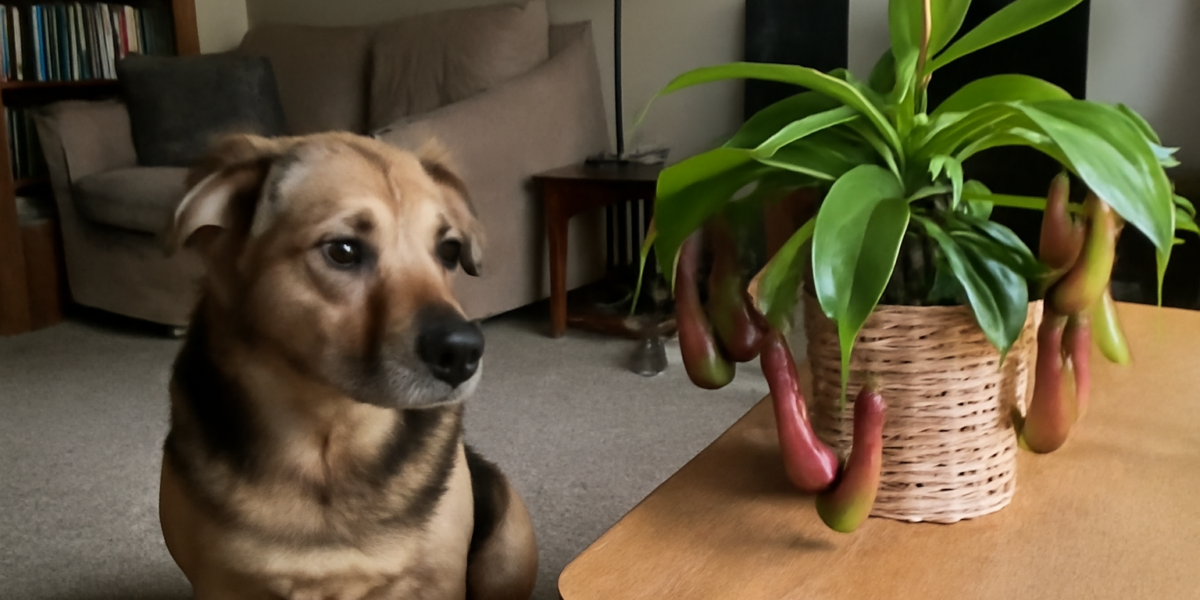
The honest caveat is that pitcher plants are not just leaves. Each pitcher is a hollow tube partially filled with watery digestive fluid plus a slowly accumulating soup of dissolved insects, bacterial colonies, and decomposing prey. A curious dog or cat that drinks from an open pitcher is not exposed to plant toxicity, but is exposed to a wet, warm, microbially active liquid that can cause stomach upset just by virtue of what is dissolved in it. So the practical framing is: the plant is non-toxic, but supervise to keep pets from drinking pitcher fluid. This guide walks through both genera, the difference between Nepenthes and Sarracenia, and the realistic supervision approach for a pet-friendly home.
Two Genera, One Common Name
“Pitcher plant” is a shared common name for two unrelated groups of carnivorous plants. Tropical pitcher plants are Nepenthes, native to Southeast Asia, the Philippines, Borneo, and parts of Madagascar and northern Australia. They form vining or shrubby plants with pitchers that hang from tendrils on the ends of leaves, often in dramatic colors and shapes. North American pitcher plants are Sarracenia, native to bogs of the southeastern United States and parts of Canada. Sarracenia pitchers are upright tubes that grow directly from the rhizome, often striped or veined with red.
Both genera evolved the same hollow-trap strategy independently. In each case, the pitcher is a modified leaf shaped into a watertight tube, with a slippery rim, downward-pointing hairs inside, and a pool of fluid at the bottom. Insects drawn by nectar fall in, fail to climb back out, and decompose into a nutrient soup that the plant absorbs. The pitcher is in essence a slow-cooking wet larder that runs continuously through the growing season.
Why Both Plants Are Non-Toxic
The plant tissue itself, leaves, pitchers, stems, and flowers, contains no significant alkaloids, glycosides, or oxalate crystals at levels that matter for mammalian poisoning. Nepenthes and Sarracenia have been studied in their native ranges and are not associated with livestock or pet toxicity in any documented case. Veterinary toxicology resources and the carnivorous-plant nursery industry both treat them as safe novelty houseplants.
That puts them on the green-light list with other non-toxic carnivorous neighbors. Venus flytraps, sundews, and butterworts all share the same generally safe profile, although pitcher plants alone have the “weird wet thing” caveat that distinguishes them from the rest.
The Pitcher Fluid Problem
Pitcher fluid is not plant sap. It is a complex mix of plant-secreted enzymes, rainwater, dissolved insect parts, and a thriving microbial community that varies pitcher by pitcher. In Nepenthes especially, mature pitchers can hold half a cup or more of fluid, and the bacterial flora can be vigorous enough to give a fresh pitcher a faintly sour smell. None of that is plant toxicity in the chemical sense, but it is also not something you want your dog drinking like a water bowl.
A cat or dog that drinks a small mouthful of pitcher fluid is most likely going to be fine. The realistic risks are mild gastrointestinal upset from the bacterial load, an occasional irritation from the digestive enzymes (which are dilute but nonzero), and the same generic risk that comes with any pet drinking standing water that has been sitting outdoors collecting whatever fell into it. Persistent vomiting, ongoing diarrhea, or lethargy after a pitcher-fluid encounter warrants a vet call, but the bar for emergency treatment is the same as for any pet that drank from a puddle.
Telling Nepenthes from Sarracenia
For pet-safety purposes the two genera carry the same broad non-toxic-but-supervise rating, but the practical setups are different. Nepenthes are tropical climbers or trailers that produce pitchers dangling from the ends of leaves, often in rich greens, reds, and deep mahogany tones. Each pitcher is generally a few inches to a foot long depending on species, with a hooded lid above the opening. They prefer warm humid conditions and are typically grown indoors or in greenhouses.
Sarracenia are temperate plants that form clumps of upright tubular pitchers growing straight from a rhizome at soil level. The pitchers are often boldly veined or striped, and the open mouth is usually decorated with a hood that funnels insects in. They want full sun, cold winter dormancy, and a damp acidic bog substrate. They are commonly grown outdoors in temperate gardens or in unheated cold-frames.
Realistic Supervision for Pets
The practical pet-safety move is to keep the pitchers themselves out of reach of muzzles. For Nepenthes, that means hanging baskets at well above floor level, a high shelf where a cat cannot leap, or a closed terrarium that keeps both humidity high and pets out. For Sarracenia in an outdoor garden bed, a low fence around the bog area or placement in a raised planter does the same job for dogs, and any pet-accessible Sarracenia pitchers can be tipped out and rinsed weekly to keep the fluid load manageable.
Indoor Nepenthes growers sometimes prune the lowest pitchers off to keep the plant’s “active” pitchers above pet height. The plant takes the loss easily because new pitchers grow continuously through the growing season. Outdoor Sarracenia growers sometimes set the bog garden inside a low cattle-panel fence or behind a small ornamental edging that keeps casual nose-poking away.
If Your Pet Drinks Pitcher Fluid
A small mouthful is most likely a non-event. Watch your pet for the next twelve to twenty-four hours for one or two episodes of vomiting or a soft stool, the same response a dog might have after drinking from an outdoor puddle. Provide fresh water, wait it out, and resume normal feeding when your pet is interested. No targeted treatment is needed for a small ingestion.
If your pet drinks the contents of an entire mature pitcher, the volume of fluid plus accumulated insect debris becomes a more meaningful gastrointestinal challenge. Persistent vomiting beyond two or three episodes, ongoing diarrhea past a day, lethargy, refusal to eat, or any sign of abdominal pain warrants a call to your veterinarian, the ASPCA Animal Poison Control Center at 888-426-4435, or the Pet Poison Helpline at 855-764-7661. The poison-control lines are staffed twenty-four hours a day and can confirm the non-toxic plant listing while screening for the bacterial-load and dehydration concerns that come with the fluid itself.
If Your Pet Chews a Pitcher Leaf
Chewed leaves and pitcher tissue are non-toxic. Most pets that take a sample bite of a Nepenthes or Sarracenia leaf experience nothing more than a brief mouth-feel surprise and walk away. A larger ingestion of leaf tissue may cause one or two episodes of vomiting or a soft stool, but the plant chemistry is benign. Watch for the same signs you would after any plant-matter ingestion, and use the same vet-routing thresholds described above.
The bigger casualty in chewing accidents is the plant. Pitcher tissue is slow to regrow, and a torn pitcher will eventually wither and be replaced by new ones, but a heavily damaged Nepenthes can lose months of growth from one chewing session. Place the plant out of reach if your pet has shown interest, just as you would with any expensive houseplant.
Setup Tips That Help Both Plant and Pet
Pitcher plants want very specific conditions, and most of those conditions are also incidentally pet-friendly. A bright windowsill above couch height, a hanging basket near a sunny window, or a glass terrarium with a grow light all serve the plant’s light needs while keeping pet noses away. Sarracenia outdoors thrive in raised bog beds that drain freely but stay moist, which also has the side effect of making the bed accessible to gardeners but not to most browsing dogs.
Use distilled water or rainwater for both genera, since tap water mineral content kills carnivorous plants over time. Empty out and refresh pitcher contents on Sarracenia annually in spring to keep the fluid load reasonable, especially if a pet has shown interest. Most indoor Nepenthes growers leave pitchers untouched and let the plant manage its own ecosystem.
Other Non-Toxic Carnivorous Companions
If pitchers end up too messy for your taste or too tempting for your pet, the other carnivorous categories are equally non-toxic and may suit better. Venus flytraps are dramatic but compact and have no fluid to worry about. Sundews are small sticky-leaved rosettes with tiny digestive volumes. Butterworts are flat sticky-leaved plants that closely resemble ordinary houseplants and have no pitchers at all.
For non-carnivorous companion plants on the same shelf, haworthia succulents, pilea, and fishbone cactus all share the non-toxic profile and the small, sculptural form factor.
Vet Routing and Final Take
Living with pitcher plants and pets works fine in most households as long as the pitcher fluid stays out of mouths. The plant chemistry is non-toxic, the only realistic risk is the wet contents of an active pitcher, and that risk is easily managed with placement and an occasional pitcher refresh. Keep your own veterinarian’s number, the ASPCA Animal Poison Control Center at 888-426-4435, and the Pet Poison Helpline at 855-764-7661 saved in your phone, as is good practice for any household.
If you are looking for a broader pet-friendly plant lineup, our cat-safe houseplants guide covers indoor options and our pet-safe garden plants guide extends the list to outdoor beds. Plant audits during the early days of pet ownership pay off enormously; the adopt-a-cat hub and adopt-a-dog hub include preparation checklists.
Frequently Asked Questions
Are Nepenthes and Sarracenia equally safe?
From a plant-toxicity perspective, yes. Both genera are non-toxic to cats, dogs, and horses. The fluid-ingestion supervision concern applies equally to both, although Nepenthes pitchers usually hold more fluid per pitcher than Sarracenia.
Is the digestive fluid acidic enough to burn my pet’s mouth?
No. Pitcher fluid in both genera is mildly acidic but well within the pH range a mammalian mouth handles routinely. The bigger risk is the bacterial and decomposed-insect load, which can cause gastrointestinal upset rather than chemical burns.
What if my dog drinks an entire pitcher’s worth of fluid?
Watch for persistent vomiting, ongoing diarrhea, or lethargy and call a vet or poison-control line if symptoms last beyond a day or worsen. The plant chemistry is non-toxic, but the dissolved contents and microbial load can challenge a sensitive gut.
Will dead bugs in a pitcher hurt my cat if she eats them?
Most pets handle a small dose of decomposed insect matter without lasting effects, although the same gastrointestinal upset window applies. If you find that your cat is regularly fishing dead insects out of pitchers, raise the plant out of reach.
Can I use any pitcher fluid as fertilizer for my houseplants?
You can use weak Sarracenia or Nepenthes pitcher dumpings on bog plants, but please do not pour pitcher fluid onto pet food or pet water bowls. Treat it as the slow-cooked insect soup it is, and keep it well away from anything your pet eats or drinks.


