
Last updated: May 16, 2026
In this article
- Are Venus Flytraps Safe for Pets? The Quick Answer
- Meet Dionaea Muscipula, the Showman of the Bog
- Why Venus Flytraps Are Non-Toxic
- What Happens If a Cat or Dog Touches a Trap
- Could a Pet Be Hurt by Eating a Flytrap?
- Why Triggering Traps for Fun Is a Bad Idea
- Smart Placement for a Flytrap-Friendly Home
- Cat Enrichment That Outcompetes a Flytrap
- Other Carnivorous Plants Worth Considering
- Vet Routing and Final Reassurance
- Frequently Asked Questions
Are Venus Flytraps Safe for Pets? The Quick Answer
Yes, Venus flytraps are safe for pets. The ASPCA does not list Dionaea muscipula as toxic to cats, dogs, or horses, and there are no documented poisoning compounds in the leaves, traps, flowers, or roots. A curious cat or dog who licks, mouths, or even chews a flytrap will not be chemically poisoned. The most you should expect is a brief huff of surprise if a small trap closes around a whisker, and possibly mild stomach upset if a pet eats a large mouthful of plant matter, just as with any houseplant.
That reassurance comes with a small dose of practical context. Venus flytraps are fascinating, theatrical houseplants, and that drama is exactly why a curious pet may take a swipe at one. The traps are too small and too weak to actually injure anything bigger than a fly, but repeated triggering is genuinely costly to the plant itself, which only has so much energy to spend on closing. So the question becomes less “is this dangerous to my pet” and more “how do we share a home with this strange green creature without stressing either party.” This guide walks through the carnivorous-plant biology, what to expect if your pet investigates, and how to set up a flytrap that thrives alongside cats and dogs.
Meet Dionaea Muscipula, the Showman of the Bog
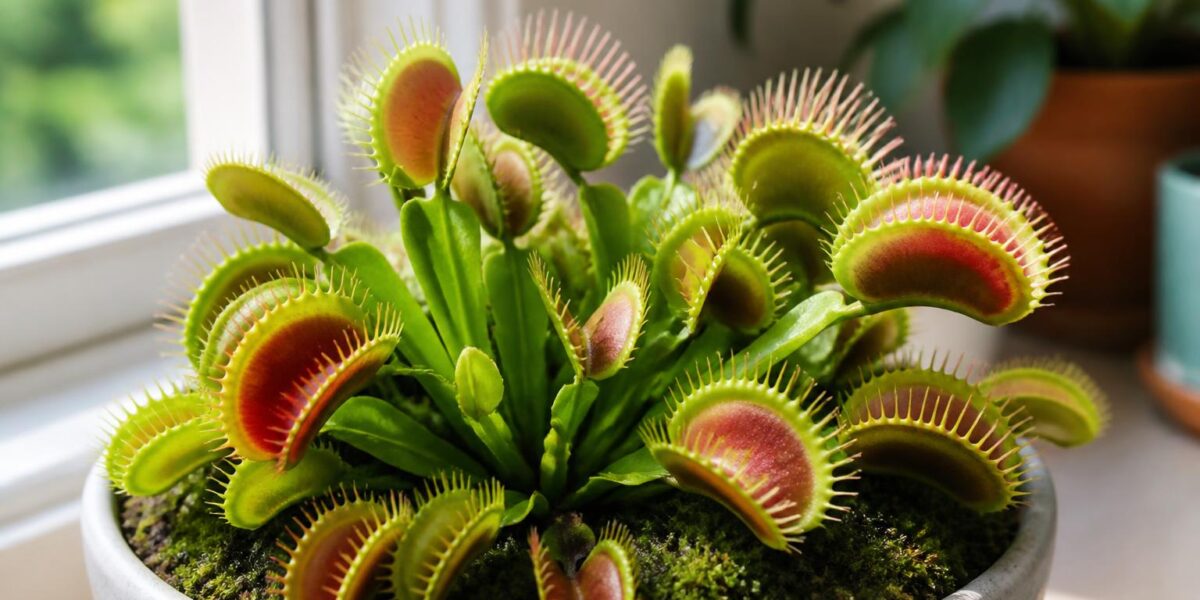
The Venus flytrap is a small perennial native to a tiny corner of subtropical wetlands in coastal North and South Carolina. In the wild it grows in nutrient-poor sandy bogs, where the soil delivers almost no nitrogen. The plant evolved its hinged-leaf traps to supplement its diet by catching insects, dissolving them in digestive enzymes, and absorbing the nitrogen the soil cannot provide. Each plant forms a low rosette of green-and-red trap leaves, never grows taller than about four to six inches, and occasionally throws up a tall flower stalk in spring with small white flowers.
Despite the dramatic reputation, a flytrap is a surprisingly delicate houseplant. The traps spring closed when two of the trigger hairs inside are touched in quick succession, sealing the leaf around prey for several days of digestion. After three to five trapping cycles, that individual trap turns black and dies, and a new one grows from the rhizome. The “carnivory” is real but small-scale, sized for gnats, ants, beetles, and the occasional spider, not for any creature your pet’s mouth could fit around.
Why Venus Flytraps Are Non-Toxic
The chemistry inside a flytrap is mostly water and a small amount of digestive enzymes that target insect cuticles. There are no alkaloids, no cardiac glycosides, no calcium oxalate raphides, none of the usual offenders found in classically toxic houseplants like pothos or monstera. The digestive fluid is too dilute and the volume too small to do anything to a mammalian mouth or stomach. Even the fluid that pools inside a closed trap during digestion is essentially harmless if a pet manages to lick it; the worst-case outcome is the same mild stomach upset you would get from eating any unfamiliar plant matter.
Veterinary toxicology references and carnivorous-plant nursery guides line up on this. Dionaea muscipula is treated as a safe novelty plant for households with cats and dogs, and the ASPCA’s broad listing of carnivorous houseplants reflects that. If you are doing a household plant audit before bringing home a new pet, flytraps belong on the green-light list alongside haworthia succulents, pilea, and fishbone cactus.
What Happens If a Cat or Dog Touches a Trap
Two things may happen when your pet noses a Venus flytrap. The trap may snap shut around the whisker, tongue, or paw, or it may not close at all because the trigger hairs were not stimulated in the right pattern. If the trap does close, your pet will feel a light pinch, similar to a soft clothespin, and almost always pulls free without effort. The trap is a hinged leaf, not a jaw, and the closing pressure is calibrated for insect bodies, not mammalian flesh. There is no toothy grip, no piercing, and no chemical sting.
The bigger casualty in these encounters is the trap itself. Each closure costs the plant precious energy, and a trap that snaps shut on something it cannot digest, like a paw or a curious nose, will reopen in twelve to twenty-four hours and eventually go through its normal three-to-five trapping life cycle whether or not it caught a real meal. Pets are not at risk; the plant simply pays a small metabolic price.
Could a Pet Be Hurt by Eating a Flytrap?
Realistically, no. A determined chewer who consumes an entire flytrap may experience a short bout of vomiting or a soft stool, the same generic plant-matter response a dog might have after grazing on lawn clippings. There is no specific antidote needed, no targeted treatment, no toxic compound to worry about. The plant tissue is unusual but biologically inert from a mammalian-poisoning perspective.
If you do witness a large ingestion, monitor for any persistent vomiting beyond a couple of episodes, ongoing diarrhea, lethargy, or refusal to eat. These signs are unlikely from flytrap consumption alone, but they warrant a call to your veterinarian, the ASPCA Animal Poison Control Center at 888-426-4435, or the Pet Poison Helpline at 855-764-7661. The poison-control lines are staffed twenty-four hours a day and can confirm the non-toxic listing while ruling out any concurrent issue.
Why Triggering Traps for Fun Is a Bad Idea
Children and curious adults often want to test traps by poking them with a finger or a pencil. From the plant’s point of view, every false closure is wasted effort. A flytrap stuck in the digestion phase with no insect inside still cycles through enzymes, water transport, and several days of being stuck closed before it reopens to find the disappointment. Three or four false alarms can permanently weaken a trap, and a routinely teased plant declines and dies.
If you place a flytrap somewhere a cat can swat at it for entertainment, you may end up with the same problem. A pet who has discovered that batting the leaves makes them move will revisit the toy until the plant is exhausted. The fix is placement, not punishment, and the next two sections cover sensible spots and substitute enrichment.
Smart Placement for a Flytrap-Friendly Home
A flytrap needs strong direct sunlight, distilled or rainwater (never tap water, which kills the plant), and a permanently damp boggy substrate. The ideal home is a bright south-facing windowsill, a sunny porch in summer, or a dedicated terrarium with grow lights. None of these setups need to be cat-accessible, so the easiest pet-proofing is also good plant care: put the flytrap somewhere your cat cannot leap to and your dog cannot reach.
A few practical suggestions. A wall-mounted plant shelf above couch height keeps the plant in good light without being a cat playground. A glass terrarium with a closed top keeps both the humidity high and the curious paws out. A windowsill protected by a flat-shelf bracket and the sheer drop on the other side discourages most cats. For dogs, simply elevating the plant onto a desk or counter is usually enough. Avoid placing a flytrap on a low side table next to a pet bed, since that combination invites investigation.
Cat Enrichment That Outcompetes a Flytrap
If your cat has fixated on the moving traps as a toy, the long-term solution is a more attractive alternative. Provide a feathered wand toy that you actively play with twice a day, a self-mover puzzle ball that delivers kibble in exchange for batting, and a window perch where birdwatching consumes the same predatory interest. Cats redirect away from “boring” enrichment quickly, but a wand toy that delivers the chase, pounce, catch, and small treat sequence is hard to beat.
Our cat-safe houseplants guide covers a broader set of indoor greenery that can soak up grazing energy. If you are still in the planning stage, the adopt-a-cat hub includes a checklist for plant audits and enrichment essentials before pickup day. For dog homes, the adopt-a-dog hub covers similar ground.
Other Carnivorous Plants Worth Considering
If the flytrap turns out to be too delicate for your household rhythm, several other carnivorous species are also non-toxic and may suit you better. Sundews are small rosette plants covered in sticky dewdrops that catch tiny insects without any moving traps to trigger. Pitcher plants, both the tropical Nepenthes and the temperate Sarracenia, are taller dramatic plants that catch prey passively in their tube-shaped leaves. Butterworts are flat low rosettes with sticky leaves that look more like ordinary houseplants.
All four of these carnivorous-plant categories share the same general “non-toxic but interesting” profile. They are also collectively easier to grow as a group than singly, since most of them want bright light, soft water, and damp acidic substrate, so a sunny windowsill bog garden can host several species at once.
Vet Routing and Final Reassurance
Living with a Venus flytrap and pets is overwhelmingly a non-event. The plant is non-toxic, the traps cannot hurt anything mammalian, and the worst-case scenario is a stressed plant that needs a less accessible spot. Keep your own veterinarian’s number, the ASPCA Animal Poison Control Center at 888-426-4435, and the Pet Poison Helpline at 855-764-7661 saved in your phone for general pet emergencies, since flytraps are not the things to worry about even on a busy plant-shopping spree.
If you find yourself enjoying the carnivorous-plant world, our pet-safe garden plants guide also extends the inventory outdoors. Most pet-related plant accidents involve something else entirely, so spend the planning energy on the genuinely toxic cousins and let the flytrap be the entertaining green pet it was always meant to be.
Frequently Asked Questions
Will a Venus flytrap hurt my cat’s tongue if it closes on it?
No. The trap is too small and too weakly hinged to do any damage. A cat who licks a trap may feel a light pinch and pull away, but the leaf is a soft hinged structure that simply reopens within hours. There is no biting mechanism and no chemical sting.
Is the digestive fluid inside a closed flytrap dangerous?
Not in any meaningful sense. The fluid is mostly water with a trace of enzymes that target insect cuticles. Mammalian tissues are unaffected, and the volumes are tiny. A pet who licks a trap is not in chemical danger.
Can I feed my flytrap with hamburger or other pet food?
Please do not. Flytraps are adapted to digest insects and cannot process fat, so a piece of hamburger or kibble inside a trap will rot, kill the trap, and may kill the whole plant. Stick to live or freshly killed flies, gnats, or small spiders if you want to feed the plant directly.
What if my dog eats the entire plant?
Most dogs experience nothing worse than a brief stomach upset. Monitor for persistent vomiting, ongoing diarrhea, or lethargy and call your veterinarian or a poison-control line if anything seems off. The plant itself is not chemically toxic, so the call is more about confirming the food, the amount, and whether your dog has any concurrent issues.
How do I tell a Venus flytrap apart from other carnivorous plants?
Flytraps have unmistakable hinged green-and-red traps with bristly fringe-like teeth, sized smaller than a quarter, growing in a low rosette. Sundews have sticky dewdrops on long red hairs, pitcher plants have tall hollow tube-shaped leaves, and butterworts have flat flat-rosette leaves with a sticky surface. The hinged-trap design is unique to Dionaea.


