
Last updated: May 16, 2026
In this article
- Trumpet Flower and Pets: Mildly Toxic with Naming Confusion
- Identifying Tecoma Trumpet Flowers
- The “Three Trumpets” Naming Problem
- What Symptoms to Expect from Tecoma Exposure
- What to Do If Your Pet Chews Trumpet Flower
- The Bignoniaceae Family Connection
- Where Trumpet Flower Grows and Why It Matters
- Reducing Risk in a Pet Home
- Tecoma vs Other “Trumpet” Plants — Quick Reference
- Watch for Look-Alikes During Walks
- Adoption Note
- Frequently Asked Questions
Trumpet Flower and Pets: Mildly Toxic with Naming Confusion
Trumpet flower is mildly toxic to cats and dogs based on the available data, and the question of whether trumpet flower toxic pets risks are realistic depends a lot on which “trumpet” plant you actually have. The common name “trumpet flower” most often refers to species in the Tecoma genus — most commonly Tecoma stans (yellow elder, yellow bells, yellow trumpetbush) and Tecoma capensis (Cape honeysuckle), both in the Bignoniaceae family. These shrubs and small trees are popular in southern California, Florida, the Gulf Coast, southern Africa, and tropical Americas where they thrive in full sun.
ASPCA toxicity data on Tecoma is limited, but the genus is generally listed as mildly toxic to cats and dogs, producing GI signs (vomiting, drooling, diarrhea, mild lethargy) when leaves, flowers, or seedpods are chewed. The much bigger practical concern is the naming confusion that puts pet owners on the wrong page entirely. Trumpet flower is NOT the same plant as trumpet vine (Campsis radicans) and NOT the same as angel’s trumpet (Brugmansia) — the latter is severely toxic with cardiac and neurological effects. If your pet has chewed any “trumpet” plant, call your veterinarian, the ASPCA Animal Poison Control Center at 888-426-4435, or the Pet Poison Helpline at 855-764-7661 with a clear plant ID before deciding how worried to be.
Identifying Tecoma Trumpet Flowers
Tecoma stans is a fast-growing shrub or small tree, six to twenty feet tall, with bright yellow bell-shaped flowers in clusters at the branch tips and pinnately compound leaves with serrated edges. It is the official flower of the U.S. Virgin Islands and the Bahamas, which gives a clue to its tropical preference. Tecoma capensis (Cape honeysuckle) is a sprawling evergreen shrub from southern Africa with bright orange tubular flowers and similar compound leaves; it can be trained as a vine on fences but is technically a shrub.
Both species produce long, slender seedpods that look like green beans before drying to brown — these can attract chewing pets the way real beans do, and the seeds inside have a papery wing. Both are typically planted in full-sun positions and tolerate drought once established, which is why they appear in low-water landscapes and street-tree plantings across the southern U.S. The leaves can be shed in cooler winters in marginal climates, leaving twigs and seedpods that pets sometimes investigate during yard time.
The “Three Trumpets” Naming Problem
Three different plant families, three different toxicity profiles, and similar common names create a real safety problem for pet owners. Here is the practical breakdown:
Trumpet flower (Tecoma stans, T. capensis) — Bignoniaceae family, mildly toxic, GI signs only. Bell-shaped or tubular flowers in yellow or orange, compound leaves, woody shrub or small tree form. Covered in this article.
Trumpet vine (Campsis radicans) — Bignoniaceae family, mildly toxic, GI signs and possible mild contact dermatitis. Aggressive climbing vine with orange tubular flowers and compound leaves. Covered in our sibling article on trumpet vine and pets.
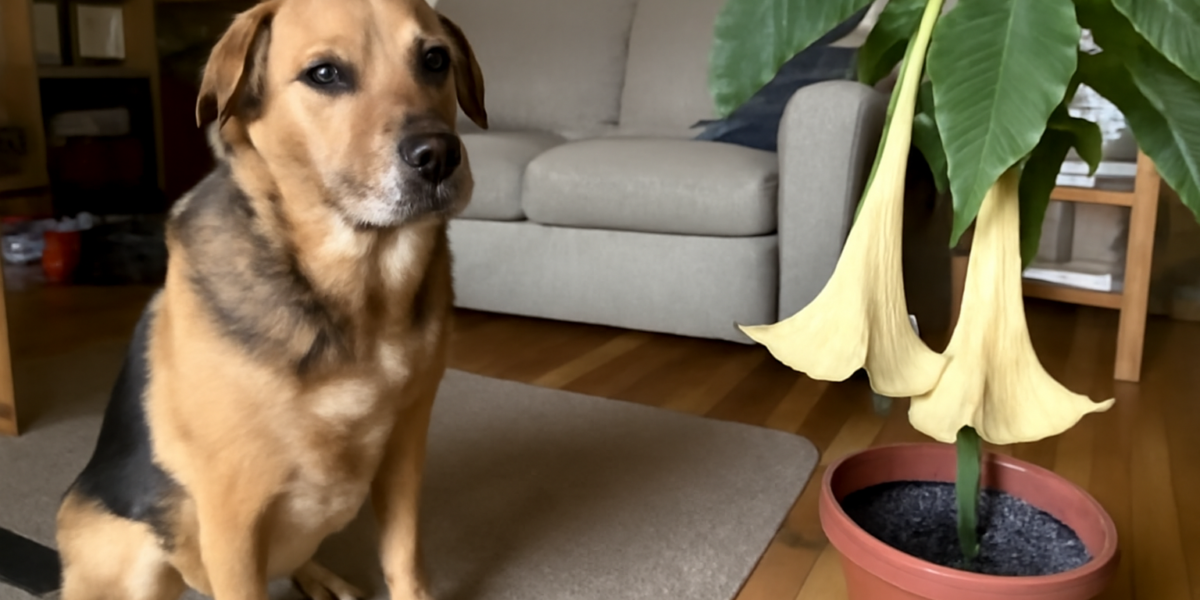
Angel’s trumpet (Brugmansia, sometimes Datura) — Solanaceae (nightshade) family, severely toxic. Large pendant trumpet flowers, simple leaves, soft-stemmed shrub or small tree. Tropane alkaloid poisoning produces hallucinations, dilated pupils, dry mouth, racing heart, and seizures in pets. Covered in our angel’s trumpet article.
If you do not know which trumpet you have, do not assume mild — assume severe and call for guidance with a clear photo. The flower orientation, leaf shape, and plant habit usually distinguish them at a glance for someone who knows the difference, but the common-name overlap genuinely does send pet owners to the wrong information.
What Symptoms to Expect from Tecoma Exposure
For Tecoma trumpet flowers specifically, reported symptoms after pet exposure are mild GI: drooling, vomiting, mild diarrhea, and short-lived lethargy. Most pets recover within twenty-four to forty-eight hours with simple supportive care. The flowers themselves are sometimes pulled and chewed by curious dogs because they hang at nose-height on smaller shrubs; the seedpods attract more interest from puppies and adolescent dogs.
Symptoms more concerning than mild GI — dilated pupils, racing heart, ataxia (uncoordinated gait), tremors, hallucination-like behavior, profound lethargy — strongly suggest you may not actually have a Tecoma but rather an angel’s trumpet (Brugmansia) or a related Solanaceae family plant. In that scenario the call to the vet or poison helpline is urgent rather than informational, and decontamination protocols are different. Always confirm the plant ID before assuming the response plan.
What to Do If Your Pet Chews Trumpet Flower
Move calmly. Take a photo of the plant (whole shrub, leaf detail, and flower close-up if possible), gather a sample of what was chewed if accessible, and estimate how much your pet actually ate. Note the time of the chew. Call your vet or a poison helpline before doing anything else. Do not induce vomiting at home with salt or hydrogen peroxide unless explicitly directed by a veterinary professional — the cat-vs-dog response to home emesis differs and DIY can make things worse.
If the plant is confirmed Tecoma and only a small chew has happened, your vet may advise watch-and-wait with offers of water and a bland meal. If symptoms develop or a substantial amount was ingested, an exam for fluids and anti-nausea medication is the typical plan. For very recent ingestions, activated charcoal may be considered — see our overview of activated charcoal for dogs for context. Most Tecoma exposures resolve within two days.
The Bignoniaceae Family Connection
Tecoma sits in the Bignoniaceae family alongside trumpet vine (Campsis), jacaranda, catalpa, and several less-common ornamentals. The family shares some chemistry, mostly low-grade glycosides and tannins that produce GI irritation rather than systemic poisoning, which is why most Bignoniaceae toxicity reports stay in the mild tier. Allamanda cathartica (yellow allamanda, sometimes called yellow trumpet vine) is in the Apocynaceae family, NOT Bignoniaceae, despite the trumpet name and similar yellow flowers — and it is more toxic than Tecoma. We cover that in our allamanda guide, which is a useful neighbor for anyone trying to sort out yellow-flowering trumpet plants.
Mandevilla (also Apocynaceae) belongs to the same problematic family as allamanda and oleander, and we cover it in our mandevilla and pets article. The Bignoniaceae versus Apocynaceae distinction is the practical line between mild GI and “potentially cardiac concern with larger ingestions,” so getting the family ID right matters for the response plan.
Where Trumpet Flower Grows and Why It Matters
Tecoma stans is found in landscape plantings from southern California through the Gulf Coast, across the Caribbean and tropical Americas, and as far afield as southern India and South Africa where it has naturalized. It is a popular street tree and median planting because it tolerates urban heat and drought. Tecoma capensis is more often a privacy hedge or pergola plant in southern California and warm-zone gardens.
For pet owners, the practical implication is that trumpet flowers are common in places where dogs walk on leashes near landscape beds and where cats roam outdoor patios. If your dog tends to nose at low flowers during walks, this is a plant to recognize visually. Vacation rentals in tropical destinations frequently feature trumpet flower in pool-side landscaping, so a quick photo identification at check-in is a useful habit if you are traveling with a pet.
Reducing Risk in a Pet Home
If you have an established Tecoma in your landscape and a pet who patrols the yard, the most effective intervention is supervision plus prompt cleanup of fallen flowers and seedpods. The plant itself is too large to relocate easily once mature, but pruning to keep flowers above pet reach and clearing windfall during the flowering season reduces exposure substantially. A short ornamental fence around the planting bed deters most casual chewers without affecting the look.
For new landscapes, plenty of pet-friendlier flowering shrubs offer similar tropical color. Hibiscus is generally considered safe for pets and provides comparable flower size. Bottlebrush (Callistemon) is also widely considered low-toxicity for typical exposure. Our pet safe garden plants roundup covers the broader options. If you are particularly attached to the trumpet form but want to skip the Tecoma genus, Mexican petunia (Ruellia) and bush honeysuckle (Diervilla) offer some of the same vibe with different chemistry.
Tecoma vs Other “Trumpet” Plants — Quick Reference
For pet owners who want a one-glance summary, here is the quick check. Yellow flowers, compound leaves, woody shrub: probably Tecoma stans (trumpet flower) — mild GI risk. Orange tubular flowers, aggressive vine, compound leaves: probably Campsis radicans (trumpet vine) — mild GI risk plus contact concerns. Large pendant trumpets, simple leaves, soft-stemmed: probably Brugmansia (angel’s trumpet) — SEVERE toxicity, urgent vet contact required. Yellow flowers, milky sap, rounded simple leaves: probably Allamanda — moderate toxicity, Apocynaceae family.
The reason this matters is that home decision-making during a pet exposure depends on accurate ID. A Tecoma chew is reasonable to triage with a phone consult; a Brugmansia chew is reasonable to drive directly to an emergency clinic. Sibling B117 articles like our trumpet vine guide and mandevilla guide sit on this same shelf for cross-referencing.
Watch for Look-Alikes During Walks
Even in regions where Tecoma is uncommon, you may encounter naturalized populations along roadsides, in vacant lots, or as escaped landscape plants. The bright yellow or orange tubular flowers are eye-catching and sometimes within reach for a leashed dog who lunges at flowers. For dog walkers in southern California, Florida, and the Gulf Coast, learning to spot Tecoma stans (yellow elder/yellow bells) is a small but useful skill.
Cape honeysuckle (T. capensis) is sometimes mistaken for true honeysuckle (Lonicera), which has its own toxicity profile. The Cape honeysuckle has compound leaves and is in Bignoniaceae; true honeysuckle has simple leaves and is in Caprifoliaceae. The chemistry is different, the response is different, and the names are confusingly similar — yet another reason to take a photo before assuming the worst (or the best).
Adoption Note
If you are still in the planning phase of bringing home a cat or dog, walking your yard and identifying every flowering shrub is a one-afternoon project that pays off later. The adopt cats and adopt dogs hubs walk through pre-adoption home preparation, and the trumpet-flower naming confusion is exactly the kind of detail that is easier to sort before there is a real exposure question to answer.
For households that already have a Tecoma planted, the plant is not a reason to panic — most exposures in healthy pets are mild and self-limiting. But knowing what is in your yard, by name, lets you skip the panicked Google search and get straight to the vet conversation when it is needed. That speed is worth a couple hours of plant identification.
Frequently Asked Questions
Is trumpet flower the same as trumpet vine?
No. Trumpet flower usually refers to Tecoma species (shrub or small tree, Bignoniaceae family). Trumpet vine is Campsis radicans (aggressive climbing vine, also Bignoniaceae). Both are mildly toxic but the plant habits are very different, and pet owners often confuse them with the much-more-toxic angel’s trumpet (Brugmansia, Solanaceae).
How toxic is Tecoma stans to dogs and cats?
Mildly toxic per the limited data available. Expected signs are GI: vomiting, drooling, mild diarrhea, lethargy. Most exposures resolve within twenty-four to forty-eight hours with supportive care. Severe symptoms suggest a different plant.
What if my dog chewed a yellow trumpet flower and is acting drugged?
This is a red flag for angel’s trumpet (Brugmansia) rather than Tecoma. Tropane alkaloid poisoning causes dilated pupils, ataxia, and altered behavior. Call an emergency vet immediately and bring photos of the plant for definitive ID.
Are the seedpods of trumpet flower a special concern?
The seedpods of Tecoma stans look like long green beans and may attract chewing pets. They share the same mild GI toxicity as the rest of the plant. Clear them from yard areas your pet uses, especially during late summer and fall.
What pet-friendly alternatives offer similar color?
Hibiscus, bottlebrush (Callistemon), and Mexican petunia (Ruellia) provide tropical-style color without Bignoniaceae or Apocynaceae chemistry. Our pet safe garden plants roundup walks through more flowering-shrub options.


