
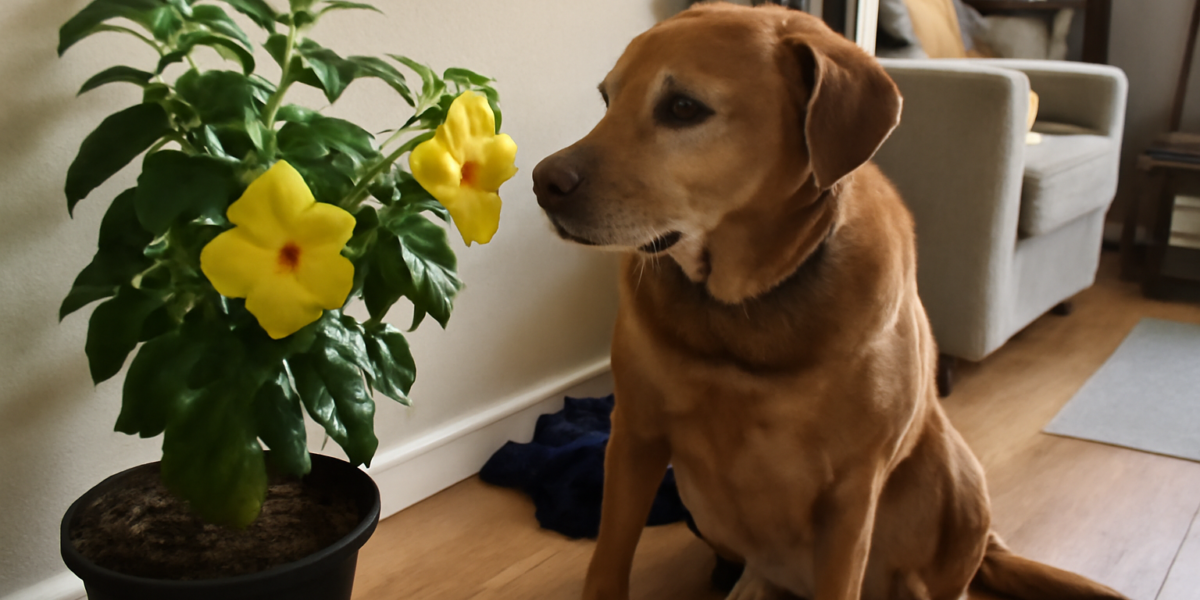
The Short Answer About Allamanda
Yes — allamanda is toxic to pets, including both dogs and cats. The yellow-flowering tropical vine, formally Allamanda cathartica, contains irritant compounds in every part of the plant: leaves, stems, sap, flowers, and seeds. The genus name “cathartica” is a botanical clue — it literally means “purgative,” and the species was named for its dramatic laxative effect when ingested. Pet owners who find their dog or cat chewing this glossy yellow climber should treat it as a moderate-to-severe toxic exposure.
In this article
- The Short Answer About Allamanda
- What Allamanda Is and Where It Grows
- Why Allamanda Is Toxic — The Chemistry
- Symptoms After Ingestion
- What Makes Cats vs Dogs Different
- Apocynaceae Family — Why Relatives Matter
- What to Do If Your Pet Eats Allamanda
- What Treatment Looks Like at the Vet
- Prevention — Allamanda in the Yard
- Allamanda Indoors and as Cut Flowers
- Frequently Asked Questions
The severity tier is moderate to severe GI distress with potential for systemic effects in larger ingestions. Allamanda is in the Apocynaceae family, the same group that includes oleander, frangipani, and periwinkle. While severe cardiac glycoside toxicity is more strongly associated with relatives like oleander, larger allamanda ingestions still warrant cardiac monitoring at the vet, and the GI signs alone (severe vomiting, diarrhea, drooling, abdominal pain) can dehydrate a small pet quickly. Vet care is essential.
What Allamanda Is and Where It Grows
Allamanda is a genus of about 15 evergreen flowering vines and shrubs native to tropical Central and South America. The most common ornamental species is Allamanda cathartica, also called golden trumpet, yellow allamanda, or buttercup flower. It produces large, showy, funnel-shaped yellow flowers up to four inches across, set against glossy lance-shaped leaves arranged in whorls.
The plant is wildly popular as an ornamental in tropical landscaping. You will see it sprawling across trellises and fences in Singapore, Florida, the Caribbean, Hawaii, the Philippines, and most of South and Southeast Asia. Pink and purple cultivars exist (sometimes sold as Allamanda blanchetii), as do dwarf bush forms. All allamanda species share the same toxic chemistry, so cultivar and color do not change the safety picture.
The vine produces a thick, sticky white latex from any cut surface — a classic Apocynaceae trait. This latex is the most concentrated source of irritant compounds and is what causes contact reactions in pet owners who prune the plant without gloves.
Why Allamanda Is Toxic — The Chemistry
Allamanda contains a mix of iridoid lactones (the most prominent being plumericin and isoplumericin), along with related compounds like allamandin and allamdin. These are bitter, irritant compounds that cause the dramatic GI signs the species was historically named for. The white latex sap concentrates these compounds and is the most acutely irritant part of the plant.
As an Apocynaceae member, allamanda also contains trace cardiac glycoside-like compounds, though at much lower concentrations than its more dangerous cousin oleander. The veterinary literature consistently treats allamanda as a moderate GI toxin with potential — but not certain — cardiac involvement in large ingestions. The practical takeaway is that the GI effects are the consistent feature, while cardiac signs are possible in heavier exposures and warrant monitoring.
The latex contact-irritant effect is mechanically straightforward: it causes redness, itching, and burning on skin or mucous membranes that touch it. Pet owners who prune unprotected often report contact dermatitis. For pets, the same latex contacts the lips, gums, and tongue when they chew — which is part of why drooling and oral irritation are so prominent in early symptoms.
Symptoms After Ingestion
Symptoms typically begin within 30 minutes to a few hours of ingestion. The earliest signs are oral — pawing at the mouth, drooling, head shaking, and reluctance to swallow. The cat or dog may go to their water bowl repeatedly, lick obsessively, or refuse food. Lips and gums may appear red or inflamed.
GI signs follow quickly: repeated vomiting (often within an hour), watery diarrhea (sometimes bloody), abdominal pain (a dog may stand with arched back or whine when picked up), and progressive lethargy. The diarrhea can be dramatic — the species name “cathartica” was earned. Dehydration can develop within hours, especially in puppies, kittens, small breeds, and seniors.
In larger ingestions, owners may see signs that suggest systemic involvement: weakness, wobbliness, irregular heart rate, pale gums, or collapse. Any of these signs warrants emergency veterinary care immediately. Even without systemic signs, the GI fluid losses alone can become serious for a small pet.
What Makes Cats vs Dogs Different
Both species are vulnerable, but the encounter patterns differ. Dogs are more likely to actively chew allamanda — the vine’s accessible position on fences and trellises puts it at dog-mouth height, and dogs will sample plants out of boredom or curiosity. Larger dogs eat more plant material before stopping, so dose tends to scale with body size.
Cats are more typically affected by indirect contact: brushing against latex while patrolling the garden, then grooming and ingesting the sticky sap from their fur. Cats are also more likely to chew flowers picked indoors as cut decoration. Because cats have a less efficient hepatic glucuronyl transferase pathway, they are generally more sensitive to many plant alkaloids — but for allamanda specifically, the dose-response data is limited and both species are treated as susceptible.
For both species, kittens and puppies are at higher risk because of smaller body mass and lower fluid reserves. Geriatric pets with kidney or heart disease are also at higher risk because the GI fluid losses and any cardiac effect compound their underlying disease.
Apocynaceae Family — Why Relatives Matter
Allamanda’s family is full of dangerous plants, and the cross-reactive concern is real. Oleander is the most dangerous family member — its cardiac glycosides can be lethal at very small doses. Frangipani (plumeria) shares the milky latex and irritant chemistry. Periwinkle (Vinca) and dogbane are also family members.
If your pet has ingested allamanda, mention the family connection to your vet. The clinical decision pathway for Apocynaceae toxicity often includes ECG monitoring even when cardiac signs are not immediately apparent, because cardiac glycoside-related arrhythmias can develop hours after exposure. Better to catch it early.
The desert rose (adenium) is another family relative used as an ornamental, with similar toxic potential. If you have a tropical garden featuring multiple Apocynaceae species, your vet should know the broader landscape — exposure history matters.
What to Do If Your Pet Eats Allamanda
This is a vet-routing situation, not a wait-and-see one. Call your veterinarian or an emergency clinic immediately. If your regular vet is closed, head to the nearest 24-hour veterinary hospital. Bring a sample of the plant or a clear photograph if you can do so safely; the species ID matters because oleander, frangipani, and allamanda are sometimes confused.
You can also call ASPCA Animal Poison Control (888-426-4435) or Pet Poison Helpline (855-764-7661). Both charge a fee but can give species-specific advice and create a case number that your vet can reference. They will likely advise you to head to the clinic regardless. Do not induce vomiting at home — modern guidance is that emesis decisions belong to the vet, especially for plants where esophageal irritation is part of the picture.
Do not give activated charcoal at home unless directly instructed by a veterinarian. Charcoal has its uses but is not appropriate for every ingestion and can interfere with later treatment. The right answer is professional decontamination at the clinic.
What Treatment Looks Like at the Vet
Veterinary care for allamanda exposure usually starts with rinsing the mouth and skin to remove any remaining latex. Depending on time since ingestion, the vet may induce vomiting (using injectable apomorphine for dogs or a maropitant-friendly protocol for cats — never hydrogen peroxide for cats). Activated charcoal may follow if the ingestion was recent.
Supportive care is the backbone of treatment. IV fluids correct dehydration from vomiting and diarrhea. Anti-emetic medications (maropitant, ondansetron) control further vomiting. Gastroprotectants protect the stomach lining from the irritant compounds. Bloodwork checks kidney and liver function, especially after significant fluid losses.
If your pet ingested a large quantity, expect ECG monitoring to look for arrhythmias from possible cardiac glycoside effect. Hospitalization for 24–48 hours is common after substantial ingestions. Most pets who get prompt care recover fully. The treatment pathway is well established because Apocynaceae exposures are common in tropical regions.
Prevention — Allamanda in the Yard
If you have allamanda growing in a yard your pet accesses, the safest move is to either remove it or fence it off. Allamanda is a vigorous climber and is hard to keep dog-trimmed; keeping it on a tall trellis or wall away from chewing height helps but does not prevent fallen flowers and trimmings from ending up on the ground.
When you prune allamanda, wear gloves and long sleeves. The latex causes contact dermatitis even in adults without sensitivities. Bag and remove all clippings — never compost them in a yard a pet can access. Cleaning up dropped flowers daily during peak bloom is wise.
For tropical gardeners who want yellow color without the toxicity, consider yellow hibiscus cultivars (see hibiscus safety), ixora in yellow form, or marigolds. The pet-safe garden plants roundup includes more substitutions, and the tropical toxic plants Singapore guide covers other regional hazards to avoid pairing with anything you keep.
Allamanda Indoors and as Cut Flowers
Allamanda is occasionally used as a cut flower because its yellow trumpets are striking. This is a genuinely bad choice in a household with pets. Cut flowers in a vase concentrate the latex hazard at table or counter height, where curious cats can knock the vase over and walk through the spilled water. Even the vase water can carry trace toxic compounds.
If you receive an allamanda bouquet, place it well out of pet reach (ideally in a room your pets do not enter), or politely return it. The same advice applies to oleander cuttings, lily bouquets for cat households (see lilies and cats), and frangipani arrangements.
For households actively involved in dog adoption or cat adoption, the rule of thumb is to research every plant entering your home — bouquet, houseplant, or yard transplant. The plants that hurt rescue pets are almost always the ones nobody thought to check.
Frequently Asked Questions
How much allamanda is dangerous?
There is no safe dose. Even small amounts can cause significant GI upset because the irritant compounds are concentrated throughout the plant. Larger ingestions raise the concern about cardiac involvement. Treat any ingestion as a vet event, not a wait-and-see situation.
What if my dog only chewed a leaf and seems fine?
Call your veterinarian for telephone advice and watch for symptoms over the next several hours. Even a chewed leaf can cause oral irritation and delayed GI upset. The vet may advise observation or recommend coming in depending on your dog’s size and the amount chewed.
Is allamanda’s white sap dangerous to humans too?
Yes — though usually only as a contact irritant for skin and eyes. People who prune allamanda without gloves often develop dermatitis. This is also why pets get oral irritation when they chew the plant; the latex acts the same way on mucous membranes.
Are the yellow flowers more or less toxic than the leaves?
All parts contain the irritant compounds. The latex is most concentrated in cut surfaces (so chewing stems releases more sap than chewing flowers), but flowers and leaves are both implicated in pet exposures. Don’t assume any part is safe.
Will activated charcoal at home help?
No — do not give activated charcoal at home unless your veterinarian directs you to. Improper use can cause aspiration pneumonia or interfere with later medical decontamination. Take your pet to the vet, who will decide whether charcoal is appropriate given the timing and amount of exposure.


