
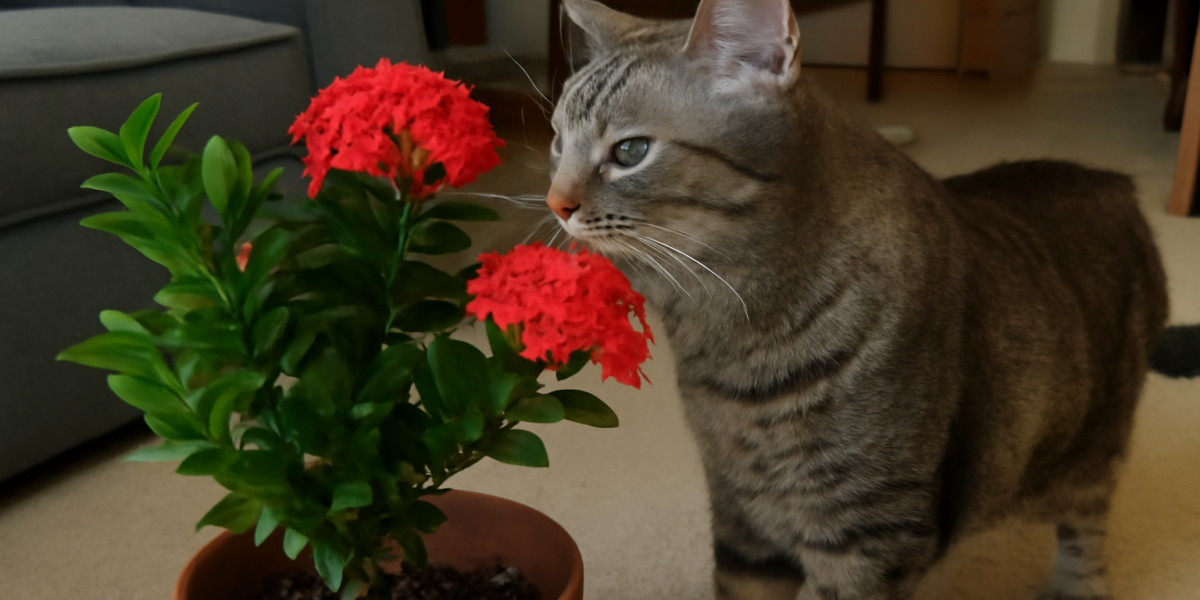
The Short Answer for Worried Cat Owners
Good news for tropical-hedge gardeners: ixora is not toxic to cats according to the ASPCA toxic-plant database. The popular flowering shrub Ixora coccinea, sometimes called jungle geranium or West Indian jasmine, is one of a small handful of common tropical hedges that pet owners can keep without losing sleep. Cats who chew a leaf or sniff at the bright orange-red flower clusters are very unlikely to suffer a serious chemical reaction.
In this article
- The Short Answer for Worried Cat Owners
- What Ixora Is and Where You Find It
- Why Ixora Earns Its Non-Toxic Status
- What Could Go Wrong Anyway
- How Cats Typically Interact with Ixora
- What to Do If Your Cat Eats Ixora
- Tropical Hedges That ARE Toxic — Don’t Confuse Them
- Cats with Existing Health Conditions
- Designing a Tropical Garden a Cat Can Live With
- Ixora and Other Pets in the Household
- Frequently Asked Questions
That said, “non-toxic” in veterinary terms means “no documented toxic principle” — not “completely without consequence.” Any cat who eats a significant volume of plant material can develop mild GI upset: drooling, a single episode of vomiting, or a soft stool. Larger ingestions, or ingestion of a tough flower stem, can occasionally cause a foreign-body issue. So the realistic severity tier is best described as “essentially safe with minor GI risk if your cat is determined to graze.”
What Ixora Is and Where You Find It
Ixora is a genus of about 500 evergreen flowering shrubs in the coffee family (Rubiaceae). The species you almost certainly have in your garden, Ixora coccinea, is the standard hedging plant across Singapore, Malaysia, the Philippines, southern India, the Caribbean, southern Florida, and Hawaii. It produces dome-shaped clusters of small four-petaled flowers in red, orange, pink, yellow, or white, blooming nearly year-round in tropical climates.
The common names are a hint about the plant’s reach. “Jungle geranium” comes from the geranium-like flower color, even though ixora and true geranium are unrelated. “Flame of the woods,” “Santan” (in the Philippines), and “Rugmini” (in southern India) are regional names. In Singapore, ixora hedges line condominium driveways, school courtyards, and HDB landscaping. In Florida and the Caribbean, dwarf ixora cultivars are sold as foundation plants.
The fact that ixora is so widespread is part of why this article matters. Owners often assume that anything thriving in a public hedge must be “checked” as pet-safe, but that assumption is wrong for plenty of common tropical plants. Ixora happens to be one of the genuinely safe ones. Frangipani, oleander, and many others nearby are not.
Why Ixora Earns Its Non-Toxic Status
Ixora has been screened repeatedly in veterinary toxicology databases and is listed as non-toxic to both cats and dogs by the ASPCA. The plant does contain trace amounts of phenolic compounds and tannins, as most plants do, but these are present at levels low enough that ordinary nibbling does not produce symptoms. There is no cardiac glycoside (unlike oleander), no calcium oxalate raphide (unlike monstera), and no irritant latex (unlike frangipani).
Coffee — the plant’s family cousin — does contain caffeine and is moderately toxic to cats. Ixora does not produce caffeine. The shared family lineage is essentially evolutionary trivia and does not transfer the toxicity. Sometimes pet owners find themselves worrying that “anything in the coffee family” is dangerous; for ixora specifically, that fear is unfounded.
This is not a case where a plant is dangerous in one country and safe in another. Ixora’s safety profile is consistent across the literature, including older botanical surveys from India and modern veterinary references from the US and Australia.
What Could Go Wrong Anyway
The realistic risks for a cat exploring an ixora are mechanical and dietary, not toxic. A cat who chews and swallows several tough flower stems can develop mild GI signs — usually a single episode of vomiting that brings up the plant fragments, then everything resolves. A cat who consumes a large mouthful of leaves all at once might have a soft stool the next day.
The bigger risk in any plant ingestion, even a non-toxic one, is foreign-body obstruction. This is rare with ixora because the leaves are not particularly tough or fibrous, but a kitten who manages to swallow a long flower stalk could theoretically get a partial blockage. Watch for repeated vomiting, refusal to eat for more than 12 hours, or lethargy after a known plant binge.
Pollen and floral debris can also be a minor irritant if a cat grooms a lot of it off their fur. This is a far cry from the lethal pollen issue with true lilies, but it can cause some sneezing or eye watering in sensitive cats. The treatment is simply gentle wiping with a damp cloth.
How Cats Typically Interact with Ixora
Cats are not generally enthusiastic plant-eaters. They lack the carbohydrate-craving, omnivorous habits of dogs and tend to chew plants out of boredom, curiosity, or to provoke vomiting when they have a hairball. Ixora is not particularly attractive to cats — the leaves are stiff and unappealing, and the flowers do not smell like anything irresistible.
Cats who do chew ixora are usually indoor-outdoor cats brushing past a hedge, kittens exploring the garden, or housebound cats whose owners have brought a cut flower indoors. The most dramatic ixora-cat scenario is usually a kitten batting at flower clusters and chewing a few petals — almost always benign.
If you have an ixora hedge in a yard your cat patrols, you can relax about the plant itself. Other tropical-yard hazards (cars, dogs, parasites, agricultural sprays) are far more pressing concerns for outdoor cats.
What to Do If Your Cat Eats Ixora
Because ixora is non-toxic, the practical response to a chewing incident is observation rather than emergency action. If your cat ate a few leaves or a flower or two, simply watch them for the next 12–24 hours. Note appetite, water intake, vomiting, and stool quality. Most cats will show no symptoms at all.
If symptoms appear — repeated vomiting, lethargy, refusing food, or any sign of pain — call your veterinarian. Also call if your cat ingested a large quantity (a whole branch’s worth of leaves, for example), or if they are very young, very old, or have a chronic illness like kidney disease that lowers their tolerance for any GI stress.
You do not need to induce vomiting at home. Modern emergency vet guidance is to never use hydrogen peroxide or salt on cats; cats do not tolerate at-home emesis well, and for a non-toxic ingestion there is no benefit anyway. If you want telephone reassurance, both ASPCA Animal Poison Control (888-426-4435) and Pet Poison Helpline (855-764-7661) offer paid consultations, but for an ixora ingestion they will almost always tell you to monitor at home.
Tropical Hedges That ARE Toxic — Don’t Confuse Them
The reason ixora’s non-toxic status matters is that tropical gardens are full of toxic look-alikes. Oleander (Nerium oleander) is severely toxic and shares a hedge-shrub habit. Frangipani (plumeria) has irritant latex sap. Allamanda, the yellow-trumpet vine, is in the same family as oleander and is moderately to severely toxic.
Other notable tropical hazards in mixed plantings include bougainvillea (mostly mechanical — thorns), heliconia (low toxicity but sometimes confused with stranger plants), and various aroids like alocasia with their calcium oxalate raphides. The Singapore-specific tropical toxic plants guide covers many of these in one place.
Knowing what your hedge actually is — by photo identification or by asking the landscaper — is the single most useful safety step. Ixora is identifiable by its glossy paired leaves and tight clusters of four-petaled tubular flowers. If your “ixora” has tubular trumpet flowers, that is probably allamanda or mandevilla, and the answer changes.
Cats with Existing Health Conditions
For most cats, ixora is a non-event. For cats with chronic kidney disease, inflammatory bowel disease, or recent GI surgery, even a non-toxic plant ingestion deserves a phone call to the vet. These cats have a narrower margin for any kind of GI upset, and a single episode of vomiting can dehydrate them faster than a healthy cat.
Cats with a history of pica (eating non-food items compulsively) need their environment managed regardless of which plants are present. If your cat repeatedly chews plants, ixora or otherwise, talk to your vet about underlying causes — sometimes pica is associated with anemia, GI parasites, or anxiety, all of which deserve attention separate from the plant.
For senior cats, the question is usually not “is this plant toxic” but “can my cat afford the GI upset of any indiscretion.” A senior with declining kidney function, for example, is at higher risk from dehydration after vomiting than from the plant itself. The CKD pillar covers this in more detail at chronic kidney disease in cats.
Designing a Tropical Garden a Cat Can Live With
Ixora is a genuinely good choice for households that want flowering color in a pet-accessible yard. It tolerates pruning well, blooms repeatedly, and grows in the same conditions as most other tropical hedges. Pair it with verified-safe tropicals from a curated pet-safe tropical houseplant guide for a fuller planting palette.
For Singapore and Southeast Asian gardens specifically, curry leaf plant, certain hibiscus varieties (see hibiscus safety), and pandan are also non-toxic options. Avoid pairing ixora with frangipani or oleander unless you can fence the toxic ones away from the cat zones.
Indoor cut-flower arrangements with ixora are also generally safe. Just keep an eye on whether the bouquet contains any other species — florists sometimes add greenery or fillers (eucalyptus, certain ferns, lily relatives) that are not cat-safe. The fact that one stem is non-toxic does not vouch for the whole bouquet.
Ixora and Other Pets in the Household
The companion article on dogs and ixora confirms that ixora is also non-toxic to dogs. So a multi-pet household can keep ixora without species-specific concern. Small pets like rabbits, guinea pigs, and birds, however, have not been studied as thoroughly, and the general veterinary advice is to keep ornamental plants out of small-pet enclosures regardless of the published toxicity.
If you are part of an active cat adoption household with multiple cats, the practical advice for ixora is simply “no special precautions needed.” Keep an eye on chewing behavior in any cat, plant or no plant — repeated chewing of any plant or fabric warrants a vet conversation about pica.
The takeaway: ixora is a rare bright spot on the tropical-plant safety map. Enjoy the hedge, monitor for the unlikely GI event, and save your worry budget for the genuinely dangerous tropical species.
Frequently Asked Questions
Is ixora completely safe for cats?
Yes, ixora is listed as non-toxic to cats by the ASPCA. Mild GI upset is possible if a cat eats a large quantity, but there is no toxic principle that causes serious illness. It is one of the safer tropical hedge plants you can grow.
What about ixora pollen — is it dangerous like lily pollen?
No. Ixora pollen is not toxic. The lily pollen warning applies specifically to true lilies (Lilium and Hemerocallis), which cause acute kidney injury in cats by a mechanism that ixora does not share. Ixora pollen at most causes minor sneezing or eye watering.
My cat ate several ixora flowers. Should I rush to the vet?
Probably not. Watch for vomiting, lethargy, or refusal to eat over the next 24 hours. Most cats will show no symptoms. If your cat is very young, very old, or has a chronic illness, call your vet for tailored advice.
Are dwarf ixora and regular ixora equally safe?
Yes. Dwarf cultivars (often used in Florida foundation plantings) are the same species or close hybrids of Ixora coccinea, with the same non-toxic chemistry. Cultivar size does not change toxicity.
Can I plant ixora in a yard my cat patrols?
Yes, with no special precautions for the ixora itself. The bigger question for outdoor cats in tropical regions is whether they should be outdoors at all — traffic, dogs, parasites, and pesticide-treated lawns are usually higher risks than any single plant.


