
Last updated: April 9, 2026
In this article
- The Short Answer: No for Cooked Bones, Maybe for Raw With Guidance
- Why Cooked Chicken Bones Are Dangerous
- Raw Chicken Bones: A Nuanced Picture
- What Happens If a Cat Swallows a Cooked Chicken Bone
- What to Do If Your Cat Ate a Chicken Bone
- Signs of Trouble to Watch For
- Preventing Chicken Bone Accidents
- Frequently Asked Questions
The Short Answer: No for Cooked Bones, Maybe for Raw With Guidance
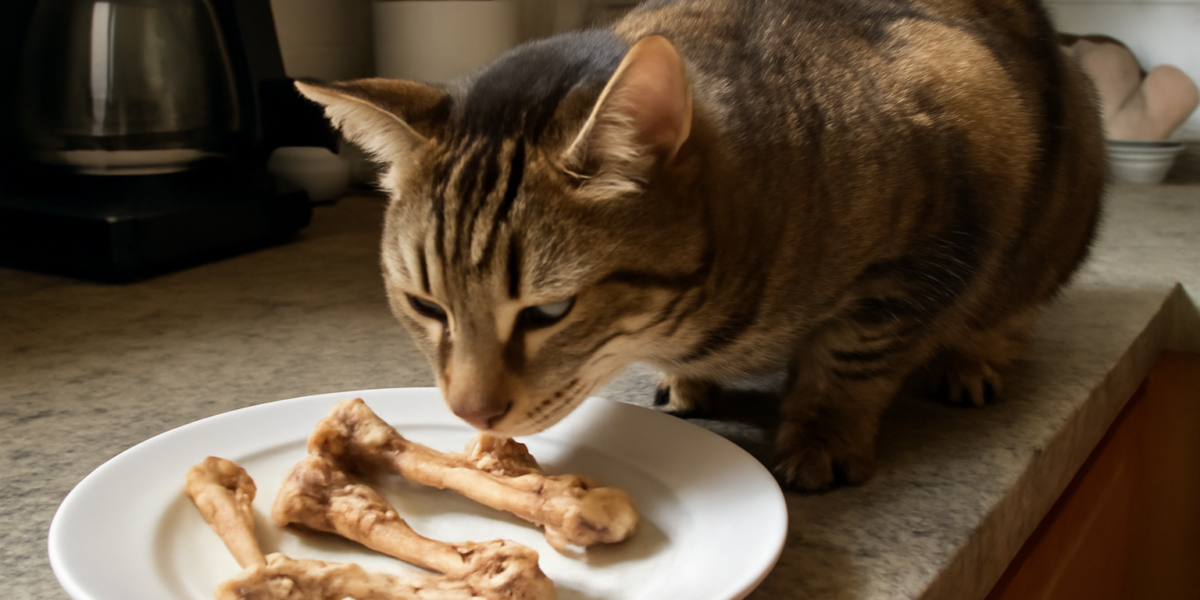
Can cats eat chicken bones? The answer depends entirely on whether the bones are cooked or raw. Cooked chicken bones are a clear no — they are brittle, splinter easily, and can cause serious injury to a cat’s mouth, throat, or digestive tract. Raw chicken bones are a different conversation. Some cats tolerate small raw bones as part of a carefully planned raw diet, but they carry bacterial risks and should only be fed with veterinary input. The default answer for most households should be: no chicken bones, period.
Chicken is one of the most common sources of accidental bone ingestions in cats because leftover chicken shows up everywhere — dinner plates, trash bins, takeout containers, picnic tables. Cats are drawn to the smell and flavor, and they will work surprisingly hard to reach even small scraps. Understanding the risks helps you react correctly if it happens.
Why Cooked Chicken Bones Are Dangerous
Cooking removes moisture from bone and leaves it brittle. A raw chicken bone bends and crushes under pressure. A cooked chicken bone snaps into sharp, dagger-like fragments. When a cat bites a cooked bone, the fragments can:
- Cut the gums, tongue, or the roof of the mouth
- Get wedged between teeth or across the palate
- Lodge in the back of the throat, blocking the airway
- Puncture the esophagus on the way down
- Damage the stomach lining
- Cause partial or complete intestinal obstruction
- Perforate the intestines, causing peritonitis
- Create painful, sometimes bloody constipation on the way out
Not every cat who swallows a cooked chicken bone will experience all of these, but any one of them can be serious. The risk goes up with bigger bones, larger chunks, and smaller cats.
Raw Chicken Bones: A Nuanced Picture
Raw chicken bones are part of some raw feeding protocols (BARF or prey model diets). Soft, pliable raw bones like chicken necks and chicken wing tips are chewed and broken down by a cat’s teeth and stomach acid more reliably than cooked bones, and they can provide calcium and dental benefits for cats on carefully planned raw diets.
That said, raw chicken bones carry their own risks:
- Bacterial contamination — Salmonella, Campylobacter, and E. coli are common in raw poultry
- Choking — even raw bones can be swallowed in pieces too big for the cat’s throat
- Obstruction or perforation — less likely than with cooked bones but still possible
- Dental fracture — cats can crack teeth on hard bone
- Nutritional imbalance — homemade raw diets are commonly deficient in nutrients if not formulated correctly
If you want to pursue raw feeding, work with a veterinarian who has training in raw nutrition. Do not assume that because something is “natural” or “what cats ate in the wild” that it is automatically safe. Wild cats have shorter lifespans and many die from injuries and infections that domestic cats never experience.
What Happens If a Cat Swallows a Cooked Chicken Bone
The exact consequence depends on the size of the bone fragment, the cat’s size, and how the fragment moves through the body. Possible outcomes include:
- Uneventful passage — the fragment makes it all the way through without causing damage. This is the best case and the most common outcome for small splinters in larger cats.
- Mouth or throat injury — obvious distress, pawing at the mouth, gagging, blood in saliva. Treatable but requires vet care.
- Partial obstruction — the cat seems uncomfortable, vomits intermittently, and eats less. Imaging usually identifies the problem.
- Complete obstruction — repeated vomiting, lethargy, refusal to eat or drink, abdominal pain. This is an emergency requiring hospitalization and sometimes surgery.
- Perforation — the fragment punctures the gut and allows bacteria to leak into the abdomen. This is a life-threatening emergency presenting with severe pain, fever, and shock.
Because you usually cannot tell which outcome applies until time has passed, every known cooked bone ingestion is worth a vet call.
What to Do If Your Cat Ate a Chicken Bone
Act right away. Steps to take:
- Remove any remaining bone from your cat’s reach and mouth.
- Check for immediate choking signs: pawing at the mouth, difficulty breathing, coughing, or silence after eating. Go to an emergency vet immediately if you see these.
- Note the size and type of bone (leg, wing, rib, neck) and roughly how much was eaten.
- Call your veterinarian or an animal poison control line to describe the situation and get case-specific advice.
- Do not induce vomiting. This is unsafe in cats, and sharp bone fragments on the way up can cause additional injury.
- Do not feed bread, oatmeal, or other bulking home remedies unless your vet specifically tells you to.
- Keep your cat calm and observe closely for the next 48 to 72 hours.
Your vet may recommend imaging to see where the fragment is, a short observation period in the clinic, or specific instructions for monitoring at home. In some cases, early intervention can remove a fragment before it causes damage, which is dramatically safer and cheaper than waiting for an emergency.
Signs of Trouble to Watch For
Symptoms may not appear immediately. Watch for these signs over at least three days after the ingestion:
- Drooling, pawing at the mouth, or reluctance to eat
- Gagging or retching
- Vomiting, with or without blood
- Loss of appetite
- Lethargy or hiding
- Abdominal pain or hunched posture
- Constipation, straining, or bloody stool
- Fever
- Rapid breathing or collapse
Any of these is a reason for an immediate vet visit, not a phone call. Delayed perforation can look fine for a day and then become an emergency within hours.
Preventing Chicken Bone Accidents
The most effective prevention is keeping cooked chicken bones completely out of reach. Specific habits that help:
- Dispose of chicken bones in a sealed trash container the cat cannot open
- Do not leave bones in kitchen compost bins
- Clear plates immediately after meals rather than leaving them on the table
- Be extra careful during holidays, barbecues, and takeout nights
- Train household members, especially children, not to feed chicken scraps to the cat
- Keep pet-sitting instructions clear when you travel
Safer ways to share chicken with your cat are plain cooked boneless chicken breast or thigh, cut into small pieces, served unseasoned. A small bite or two is a great treat and gives you the bonding moment without any bone risk.
For more cat feeding safety, see our articles on cooked bones in general, chicken skin safety, and chicken broth for cats. The cat care blog covers feeding and dental topics, and the cat adoption hub has resources for first-time cat owners.
Frequently Asked Questions
My cat ate a small cooked chicken bone and seems okay. Should I still worry?
Yes, you should still call your vet. Many bone ingestions do pass without incident, but problems can appear hours or days later. A vet conversation gives you a monitoring plan and clear signs to watch for.
Are chicken wing bones safer than leg bones?
Cooked chicken wing bones are not safer. They are smaller but still splinter and are actually more likely to be swallowed whole because of their size, which increases the risk of throat lodgment.
What if my cat only chewed on the bone without swallowing?
Chewing alone can cause gum or tooth injuries and can create tiny splinters that are swallowed even if the main bone stays in the mouth. Check the mouth for any damage and call your vet if you see blood or distress.
Can cats eat chicken neck raw?
Raw chicken necks are fed to some cats on raw diets with veterinary guidance. They are not something to try casually because of bacterial and choking risks. If you are interested in raw feeding, talk to a vet who specializes in feline nutrition first.
How long after eating a bone should I watch my cat?
Watch closely for at least 72 hours. Most problems appear within that window, and any concerning signs should prompt an immediate vet visit.


