
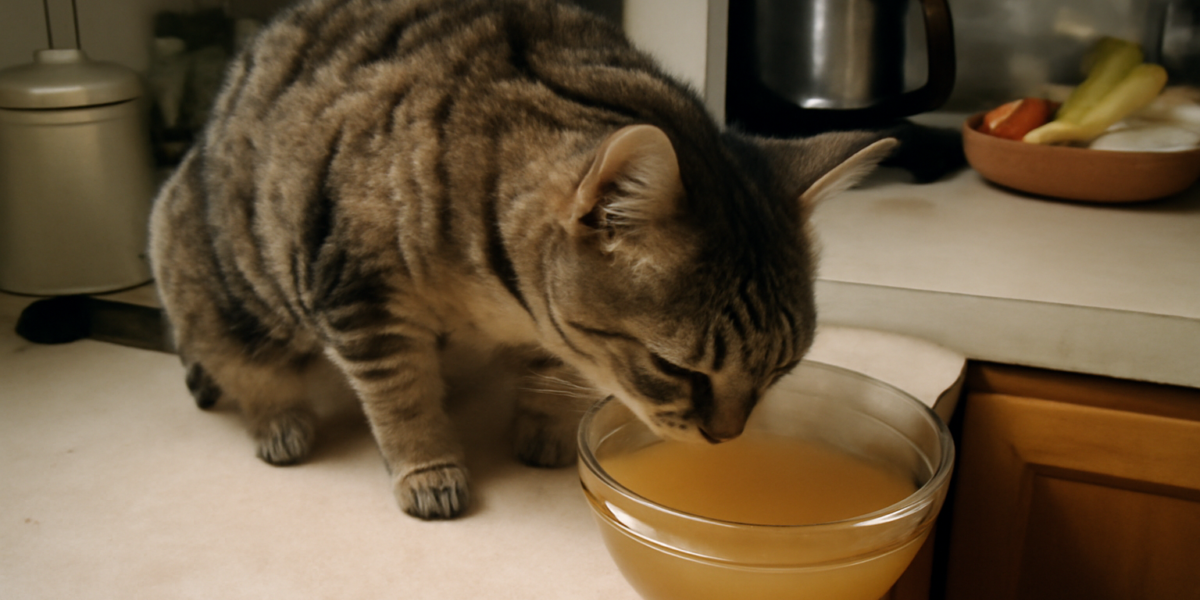
The Short Answer: Only Plain, Low-Sodium, Onion-Free Broth
Can cats drink chicken broth? Yes, but only plain chicken broth with no onion, no garlic, and minimal sodium. The problem is that almost every store-bought chicken broth on a supermarket shelf contains onion powder, garlic powder, or both — ingredients that are toxic to cats. Even many “low-sodium” and “organic” broths include these flavor enhancers. Homemade broth made specifically for your cat is the safest option, and a few carefully labeled commercial products work too if you read ingredients carefully.
In this article
- The Short Answer: Only Plain, Low-Sodium, Onion-Free Broth
- Why Store-Bought Broth Is Usually Unsafe
- How to Make Cat-Safe Chicken Broth at Home
- Safe Commercial Options
- Safe Portion Size and Frequency
- Nutritional Context
- Signs of Trouble After Chicken Broth
- What to Do If Your Cat Had Broth With Onion or Garlic
- Better Ways to Use Broth
- Frequently Asked Questions
Broth can be a useful tool for picky eaters, for cats who need encouragement to drink more fluids, and for flavoring medication. Used correctly, a spoonful of chicken broth is a low-risk treat. Used carelessly with the wrong product, it is a common cause of accidental Allium toxicity in cats.
Why Store-Bought Broth Is Usually Unsafe
The vast majority of commercial chicken broths are formulated for human cooking, which means they are designed to taste good in soups and sauces. That flavor profile depends on sodium and aromatics. The most common problem ingredients:
- Onion powder or onion juice — toxic to cats, damages red blood cells
- Garlic powder or garlic juice — same mechanism as onion, more potent per weight
- Salt — even “low sodium” broths often contain more sodium than is appropriate for a cat
- Celery, carrot, and herb extracts — generally not toxic but add nothing beneficial
- Yeast extract or “natural flavors” — may include onion or garlic as hidden ingredients
- Sugar — added to some broths for balance, not appropriate for cats
Read the ingredient list carefully on every product. Do not trust that a broth is cat-safe because it is labeled natural, organic, or low sodium. The question is specifically: does it contain any Allium family ingredient (onion, garlic, chives, leeks, shallots)?
How to Make Cat-Safe Chicken Broth at Home
The easiest way to guarantee a safe broth is to make it yourself. A basic cat-friendly chicken broth recipe:
- Place plain, boneless, skinless chicken breast or thighs in a pot.
- Cover with water. Use about four cups of water per pound of chicken.
- Bring to a simmer and cook for 20 to 30 minutes until the chicken is fully cooked.
- Remove the chicken and skim any fat off the top of the broth.
- Do not add salt, onion, garlic, herbs, oil, or any other seasoning.
- Let the broth cool to room temperature before offering to your cat.
- Strain if needed to remove any small bone fragments or tissue bits.
- Store in the fridge for up to three days or freeze in ice cube trays for longer storage.
Ice cube trays are especially convenient because a single cube is about a tablespoon — a perfect treat portion for a cat. Pop out one cube, thaw it in a dish, and serve when your cat needs an appetite boost or hydration encouragement.
Safe Commercial Options
If you do not want to make broth at home, there are a few commercial products to look for. Rather than recommending specific brands (because formulations change), here is what to screen for:
- Ingredient list that contains only “chicken broth” or “chicken stock” and water
- No onion, garlic, or Allium-family ingredients in any form
- No added salt, or clearly stated low sodium content (under 50mg per serving is ideal)
- No “natural flavors” without disclosure
- Products specifically marketed as pet-safe broths from reputable pet food companies
Pet-specific bone broths made for dogs and cats are increasingly available and are formulated with feline safety in mind. These are often the easiest way to offer broth as a treat without label-reading anxiety.
Safe Portion Size and Frequency
Broth is a treat, not a meal. Portion guidelines:
- One to two tablespoons per serving as a standalone treat
- Up to a quarter cup mixed into a bowl of fresh water to encourage drinking
- No more than a few times a week for a healthy cat
- Always offered alongside a fresh water bowl
Cats with kidney disease, heart disease, or urinary problems should have broth portions and frequency reviewed by their vet. Even low-sodium broth has some sodium, and fluid intake matters for these cats in specific ways that generic guidelines do not cover.
Nutritional Context
Plain chicken broth is mostly water with some dissolved protein and small amounts of minerals. It does not deliver meaningful nutrition on its own, but it does serve several useful purposes:
- Encourages drinking in cats with low water intake
- Provides a strong scent that can stimulate appetite in sick cats
- Softens kibble for cats with dental issues
- Adds moisture to dry food for cats on a hydration plan
- Acts as a vehicle for medications or supplements
Bone broth, made by simmering bones for hours, contains some collagen and glycine and is popular in human wellness circles. For cats, the benefits of bone broth specifically are not well proven, and the same cautions about ingredients apply. Bone broth for cats should still be plain, homemade or specifically pet-formulated, and served in small amounts.
Signs of Trouble After Chicken Broth
Safe broth given in appropriate amounts is unlikely to cause any problems. Watch for these signs if your cat has had broth, especially if you later realize the product may have contained onion or garlic:
- Vomiting or diarrhea
- Loss of appetite
- Lethargy or weakness
- Pale or yellowish gums
- Dark or reddish urine
- Rapid breathing or increased heart rate
- Tremors or weakness
- Excessive thirst
The worst-case scenarios come from Allium toxicity (onion or garlic in the broth) and can take a day or two to become fully obvious because the red blood cell damage unfolds over time. Sodium-related problems are also possible but usually cause more immediate symptoms like excessive thirst and lethargy.
What to Do If Your Cat Had Broth With Onion or Garlic
Accidental exposure happens, especially when well-meaning family members share soup or stock without knowing the risk. If you discover after the fact that your cat had broth containing onion, garlic, or any Allium ingredient:
- Stop offering the broth immediately.
- Note the specific product, the ingredient list, and the approximate amount your cat ate.
- Call your veterinarian or an animal poison control line right away. Do not wait for symptoms.
- Follow professional guidance, which may include coming in for bloodwork or beginning close home monitoring.
- Over the next few days, watch for any signs listed above and report them to your vet immediately.
Mild Allium exposures in healthy cats sometimes pass without incident, but the threshold for concern is low and early intervention gives the best outcomes. Do not assume a small amount is safe without confirmation.
Better Ways to Use Broth
Broth is especially useful in specific situations. For cats who do not drink enough water, a splash of plain broth on kibble or stirred into a water bowl can meaningfully increase fluid intake. For cats recovering from illness, a spoonful of warm broth can restart appetite. For medication time, a small dish of broth can be used to hide a crushed pill or stirred with a liquid medication.
Do not pour broth over an entire meal or use it as a replacement for fresh water. The goal is to encourage, not replace, normal eating and drinking habits.
For more cat feeding content, see our guides on beef broth for cats, tuna water safety, and baby food as a cat treat. The cat care blog covers hydration and feeding topics, and the cat adoption hub supports new cat owners.
Frequently Asked Questions
Is Swanson chicken broth safe for cats?
Most Swanson broths contain onion powder or “natural flavorings” and are not recommended for cats. Always check the current ingredient list because formulations can change. When in doubt, make your own.
Can I use bouillon cubes instead?
No. Bouillon cubes are extremely high in sodium and almost always contain onion and garlic. They are not safe for cats.
How long does homemade chicken broth last?
Store in the fridge for up to three days in a covered container. Freeze in ice cube trays or small portions for up to three months.
Can I give chicken broth to a cat with diarrhea?
Plain low-sodium broth can help with hydration during mild diarrhea, but it does not treat the underlying cause. If diarrhea lasts more than 24 hours, worsens, or contains blood, see your vet.
Is chicken broth better than plain water for cats?
No. Plain fresh water should always be available. Broth is a flavored treat, not a substitute for water. Use it alongside the regular water bowl, not instead of it.


