
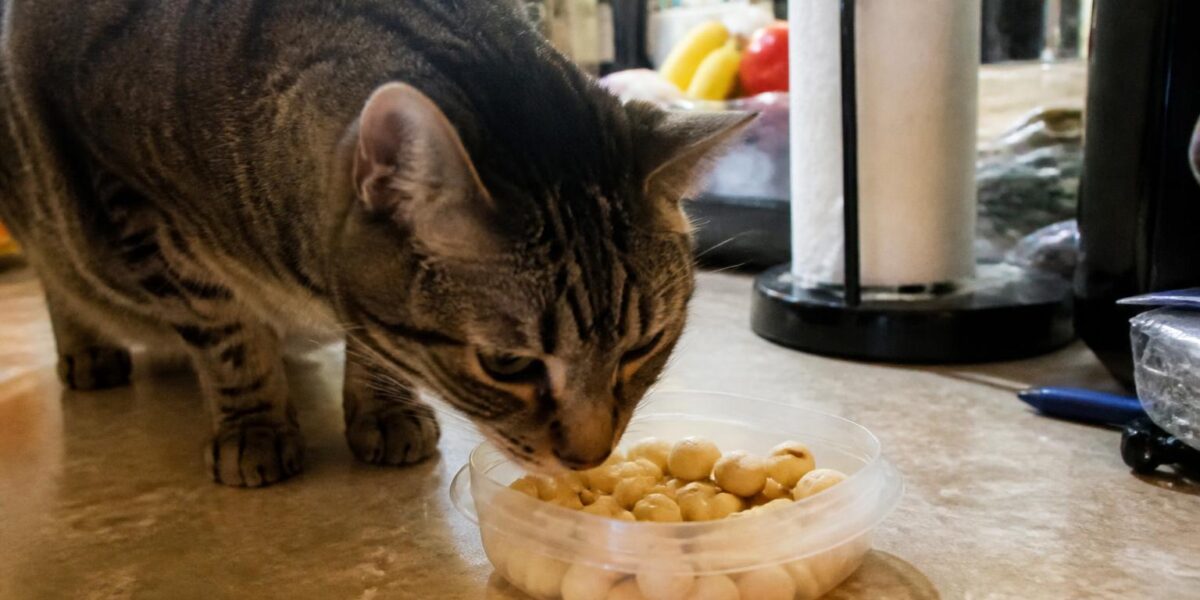
The Short Answer on Macadamia Nuts for Cats
Can cats eat macadamia nuts? No, you should avoid giving macadamia nuts to your cat. Macadamia nuts are documented as toxic to dogs, and they have not been established as safe for cats either. Combined with their very high fat content and choking risk, the prudent answer for any cat owner is a firm no.
In this article
Cats are obligate carnivores, meaning their bodies are built to run on animal protein, not nuts. A macadamia nut offers your cat nothing useful and brings several real risks, so there is simply no reason to share one.
If your cat licked a crumb of macadamia, the small amount is unlikely to cause serious harm, but you should monitor them and keep these nuts well out of reach going forward. Let’s go through exactly why they are a bad idea.
Cats and nuts are an unusual pairing to begin with. Most cats show little interest in a dry, oily nut, since their taste buds are tuned to detect meat rather than sweet or fatty plant foods. Curiosity, a stray crumb on the counter, or a nut hidden in a baked good is usually how a cat ends up tasting macadamia at all. That makes prevention fairly straightforward, but it also means the times a cat does eat one are often unexpected.
Why Macadamia Nuts Are Risky for Cats
Macadamia nuts carry several hazards that make them a clear avoid for cats.
Documented toxicity. Macadamia nuts are known to be toxic to dogs, causing weakness, tremors, and other symptoms. While research on cats is limited, the responsible veterinary stance is to treat them as unsafe for cats too rather than gamble on an unstudied food.
Very high fat. Macadamias are one of the fattiest nuts. For an obligate carnivore with a small body, that fat load can cause vomiting, diarrhea, and even pancreatitis, a painful inflammation of the pancreas.
Choking and obstruction. A whole nut is a choking hazard for a cat and could cause an intestinal blockage, especially in a small or young cat.
Salt and coatings. Many macadamia nuts are salted, flavored, or chocolate-covered, adding sodium and, in the case of chocolate, an outright toxin.
Are There Any Benefits?
It is fair to ask whether the protein or healthy fats in macadamia nuts could help a cat. The answer is no. Cats cannot use plant-based protein and fat the way they use animal sources, so the nutrients in a nut are essentially wasted on them while the risks remain.
Everything your cat needs comes from a complete, balanced, meat-based diet. There is no vitamin, mineral, or fatty acid in a macadamia nut that your cat cannot get more safely from proper cat food. Nuts of all kinds are poorly suited to feline digestion.
So while macadamias are marketed as a healthy human snack, none of that translates to cats. The kindest thing you can do is keep them as a people-only food.
It is also worth dispelling the idea that a tiny bit of nut might at least entertain a cat as a novel texture. Cats explore the world primarily through scent and the hunt, not through sampling fatty plant snacks, and there are far safer ways to enrich their day. A feather wand, a treat puzzle filled with their regular kibble, or a small piece of cooked meat will delight a cat far more than a macadamia nut ever could, with none of the risk. Enrichment and bonding never require an unsafe food.
What to Do If Your Cat Eats Macadamia Nuts
If your cat manages to eat a macadamia nut, stay calm and assess how much was eaten and whether it was plain, salted, or chocolate-covered. A single small lick is very different from a chocolate-coated nut.
Watch for these symptoms over the next 12 to 24 hours:
- Vomiting or diarrhea
- Lethargy or weakness
- Loss of appetite or signs of belly pain
- Tremors or unsteadiness
- Drooling or repeated gagging (a possible sign of choking or obstruction)
Call your veterinarian or an emergency clinic if your cat ate more than a tiny amount, ate a chocolate-covered nut, or shows any of these symptoms. Bring the packaging so the vet knows whether salt, chocolate, or other coatings are involved. When in doubt, a quick call is always worth it.
Do not try to make your cat vomit at home unless a veterinary professional specifically tells you to. Inducing vomiting incorrectly can cause more harm than good, and some situations make it unsafe. Instead, let the experts guide you. If it is after hours, an emergency veterinary clinic or a pet poison control hotline can advise you on whether your cat needs to be seen immediately or can be watched at home, taking the guesswork off your shoulders during a stressful moment.
Safer Treats for Cats
The best treats for cats play to their carnivore nature. Instead of nuts, reach for small amounts of animal-based snacks your cat can actually use.
- Small pieces of plain cooked chicken
- A little plain cooked salmon or other fish
- A small bite of plain scrambled egg
- Commercial treats made specifically for cats
Whatever you choose, keep treats to no more than about 10 percent of your cat’s daily calories, with the rest coming from a complete, balanced cat food. Introduce any new treat slowly and watch for digestive upset.
If your cat is a determined counter-surfer, store nuts in a closed cabinet and clean up promptly after snacking. For any questions about safe treats, your veterinarian can recommend options suited to your cat.
Other Foods to Keep Away From Cats
Macadamia nuts are far from the only human food cats should avoid. Knowing the common toxins helps you keep your home cat-safe.
Other foods to keep well away from cats include chocolate, onions, and garlic, along with grapes and raisins, all of which are toxic or dangerous to cats. Like macadamia nuts, these should never be offered, even in small amounts.
The simplest rule is to feed your cat a proper diet and treat human snacks as off-limits unless you have specifically confirmed they are safe. When you are unsure about any food, your veterinarian is the best and quickest resource.
Why Cats Handle Fatty Foods So Poorly
Understanding why macadamia nuts are a problem comes down to feline physiology. Cats evolved as desert-dwelling hunters whose natural diet is built almost entirely from animal prey: protein, animal fat, and moisture, with virtually no plant matter. Their digestive systems are streamlined for that diet and are not well equipped to process the rich, concentrated plant fats found in nuts.
When a cat eats a very fatty food like a macadamia nut, the sudden fat load can overwhelm the pancreas, the organ responsible for releasing the enzymes that digest fat. In some cats this triggers pancreatitis, an inflammation that causes vomiting, abdominal pain, loss of appetite, and lethargy. Because cats are small, it does not take much to tip them over, and a single nut represents a far bigger proportion of their body weight than it would for a person.
This is also why cats should not be given fatty trimmings, fried foods, or oily human snacks in general. Their bodies simply are not built to cope with a flood of fat the way an omnivore’s might. A diet that stays true to their carnivore nature, with controlled, appropriate fat from animal sources, keeps their digestion running smoothly.
Seen through this lens, the reason to avoid macadamia nuts is not only the unresolved toxicity question but also the basic mismatch between a fatty nut and a feline body. Even if a particular cat shows no dramatic reaction, there is genuinely nothing to gain and real potential for harm. That combination is exactly why the answer stays a confident no.
Frequently Asked Questions
Are macadamia nuts poisonous to cats?
Macadamia nuts are documented as toxic to dogs, and their safety in cats has not been established, so the prudent advice is to treat them as unsafe and avoid them entirely for your cat.
My cat licked a macadamia nut. Should I worry?
A tiny lick is unlikely to cause serious harm, but watch for vomiting, lethargy, or unsteadiness. Call your vet if your cat ate more than a trace amount or shows any symptoms.
Can cats eat any nuts safely?
Nuts are not a good food for cats in general. They are high in fat, hard to digest, and pose a choking risk, and as obligate carnivores cats gain nothing from them. Stick to meat-based treats.
What makes chocolate-covered macadamias especially dangerous?
Chocolate is toxic to cats on its own, so a chocolate coating adds a second, more serious hazard on top of the nut. If your cat ate a chocolate-covered nut, contact your vet right away.


