Last updated: May 4, 2026
In this article
- What an F3 Bengal Cat Is
- Legality and Permits
- Cost: Purchase and Ongoing
- F3 Temperament Profile
- Diet and Digestion
- Health Considerations
- Enrichment and Daily Routine
- Life Stages: Kitten Through Senior
- F3 Versus Adjacent Generations
- F3 Genetics and Trait Distribution
- Daily Routine and Owner Commitment
- Working with a Reputable F3 Breeder
- Is an F3 Bengal Right for You?
- Frequently Asked Questions
What an F3 Bengal Cat Is
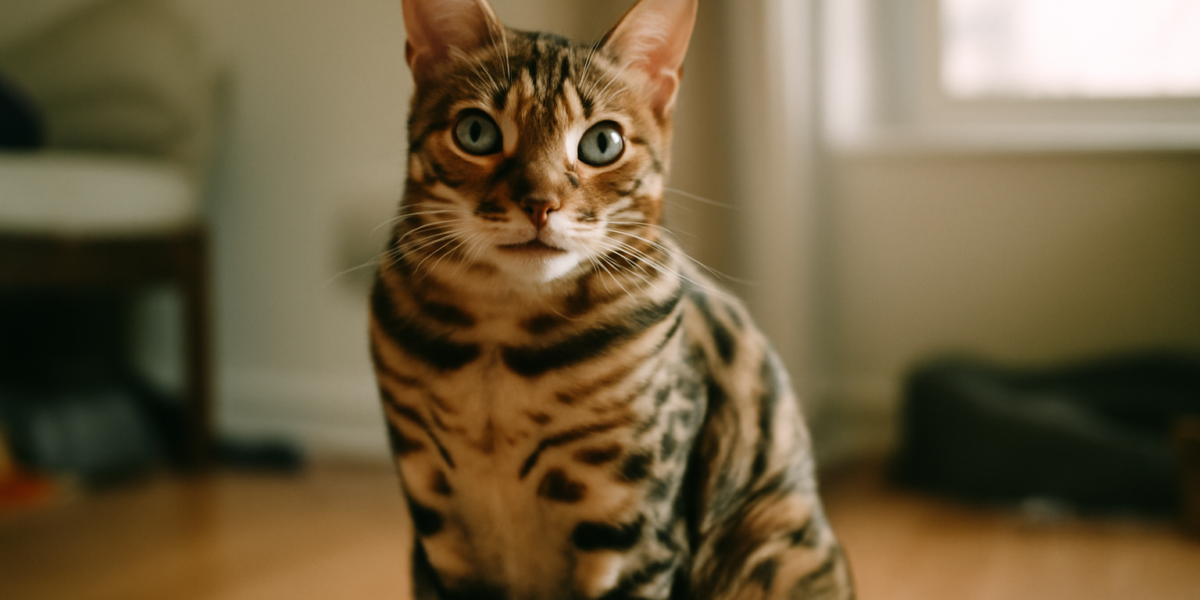
An F3 Bengal cat is the third filial generation from the Asian Leopard Cat ancestor. By pedigree distance, F3s carry roughly 12.5 percent Asian Leopard Cat heritage. They are produced by breeding an F2 Bengal to a domestic Bengal, continuing the dilution toward fully pedigreed Bengals while preserving the wild aesthetic and elements of the wild temperament.
F3s are noticeably more domestic than F1 Bengals or F2 Bengals in most households. Many are confident, social, and well-suited to experienced cat owners. Litter habits are more reliable, vocalization is often more manageable, and prey drive while still high is more responsive to redirection.
That said, F3s are still hybrids. Wild ancestry expresses unpredictably. Some F3s behave like a high-energy domestic cat; others retain notable wild quirks. Choose your kitten by meeting the parents in person and asking the breeder honestly about the litter’s temperament range.
Legality and Permits
F3 Bengals fall into the same restricted-generation bracket as F1 and F2 in many jurisdictions, although some states ease restrictions starting at F4 or F5. Legality varies by state, county, and city, with permits sometimes required. Verify before purchase rather than after.
Pet insurance providers may decline F3s outright; review our hybrid cat pet insurance challenges piece. Landlords and HOAs occasionally treat any hybrid generation as off-limits regardless of state law. Confirm your housing situation accepts an F3 Bengal before committing.
Rehoming an F3 down the line will face the same restrictions, narrowing where the cat can move next. Plan for the cat’s full lifespan in your home or have a written re-homing arrangement with the breeder.
Cost: Purchase and Ongoing
F3 Bengal kittens commonly range from $1,000 to $3,000 depending on lineage, sex, breeder reputation, and conformation to show standards. Verify with current breeders before budgeting. Show-quality F3s with strong rosetting, good background contrast, and proven HCM-clear lines push toward the upper end.
Annual costs include premium food, hybrid-experienced veterinary care, enrichment infrastructure, and possibly behavioral consults if the cat shows extra-difficult traits. The first year cost of owning a cat guide gives a baseline; add a meaningful margin for hybrid-specific needs.
Watch for low-priced F3s offered with no documentation. Backyard breeders sometimes mislabel F4 or F5 cats as F3s to charge more, or vice versa to sell quickly. Verifiable pedigree paperwork is the test.
F3 Temperament Profile
F3 Bengals are typically confident, athletic, intensely curious, and demanding of engagement. Many are interactive enough to learn fetch, walk on a harness, or learn small tricks; we cover the broader pattern in cat breeds that act like dogs.
Vocalization remains common. Expect chirps, trills, and demanding meows when the cat wants attention or sees birds outside. F3s can be excellent companions for adults and older children but are usually not ideal for households with toddlers or very small pets due to residual prey drive and unpredictable handling tolerance.
Most F3s adapt well to multi-cat households with proper introduction. Use our introducing kitten to resident cat guide and assume a longer-than-average timeline. They tend to do best with another active cat or a dog who tolerates a confident, fast playmate.
Diet and Digestion
Sensitive digestion runs through Bengal lines and remains common in F3s. Many do best on high-protein wet food, freeze-dried raw, or properly balanced raw. Standard kibble often produces loose stools or vomiting. The best cat food for sensitive stomachs piece is a useful starting framework.
If you choose raw, work with a veterinary nutritionist familiar with hybrids and review our hybrid cat raw diet feeding considerations. Properly balanced raw is excellent; improperly balanced raw causes harm. A premium grain-free wet diet is a strong middle path.
Use food puzzles, slow feeders, or scatter-feeding to channel hunting drive. A water fountain is usually more successful than a still bowl. Many F3s drink more when water is moving and clean.
Health Considerations
HCM screening on parents is essential. Reputable F3 breeders supply echocardiogram results within the past 12 months for both parents. PRA-b genetic testing is widely available and worth requesting. Hypertrophic cardiomyopathy in cats is the leading inherited Bengal cardiac concern.
Find a hybrid-experienced veterinarian before bringing the kitten home. Vaccine choices and anesthesia protocols sometimes need adjustment. Our hybrid cat vet considerations piece details what to ask. Annual bloodwork plus periodic cardiac follow-up are sensible for any Bengal lineage.
Bengals are not hypoallergenic. F3s produce FelD1 protein at typical cat levels, and people with cat allergies frequently react. Spend hours with adult cats from the breeder before committing if anyone in your household has known cat allergies.
Enrichment and Daily Routine
F3 Bengals need vertical territory, daily structured play, and ongoing mental stimulation. They thrive with a 15-to-30-minute daily play session structured like hunting: stalk, chase, capture, kill, eat. The puzzle feeders for cats guide gives concrete tools for daily mental work.
A secure outdoor catio, harness training, or a safe enclosed garden access transforms an F3’s quality of life. They are among the cat breeds that love climbing and they appreciate vertical real estate as much as horizontal floor space.
Plan for water play. F3s often investigate sinks, showers, and toilets. A fountain reduces toilet curiosity but does not eliminate it; the cat is genuinely fascinated by moving water.
Life Stages: Kitten Through Senior
Kitten Years
F3 kittens benefit from staying with mother and littermates for at least 12 weeks. Early socialization, gentle handling, exposure to household sounds, and carrier desensitization shape adult behavior. Litter training is usually straightforward; provide multiple boxes in quiet locations.
Adult Years
By age two to three, the adult personality stabilizes. Energy stays high. Spay or neuter pet F3s once cleared by a hybrid-experienced vet. Maintain consistent feeding, play, and sleep routines. Many F3s respond well to clicker training and learn quickly.
Senior Years
F3s typically remain active into senior years. Watch for weight loss, decreased jumping, increased water intake, or changes in litter habits as early signs of chronic kidney disease or cardiac issues. Use the senior cat care checklist as a baseline and add periodic echocardiograms to your schedule.
F3 Versus Adjacent Generations
The F3 is the generation where most owners first see a clearly more domesticated temperament than F1 or F2. Compared with an F4 SBT Bengal, the F3 is slightly more intense, slightly less predictable, and not yet TICA championship-eligible. The F4 SBT is the first generation typically registered with all four grandparents being Bengals.
If you want the wild aesthetic with high-domestic-cat behavior, an F5 Bengal is usually the better fit. If you want a fully wild-leaning experience, F1 or F2 is the ground. F3 is the middle.
For broader context across hybrids, our wild cat hybrid generations explained piece compares F1 through SBT side by side for Bengal, Savannah, and Chausie.
F3 Genetics and Trait Distribution
The F3 inherits roughly one-eighth of its genetic material from the original Asian Leopard Cat ancestor. By F3 the wild traits have been diluted enough that most kittens behave within the range of a high-energy domestic cat, although individual variation remains. Some F3s express strong wild traits at the upper bound of normal Bengal behavior; others present as confidently domestic.
Reputable F3 breeders track lineage for both pattern quality and behavioral predictability. Lines that produce calmer F3s tend to attract pet buyers, while lines that produce more intense F3s sometimes feed back into breeding programs aimed at preserving the wild look. Ask the breeder which trajectory the litter represents.
Coat development continues to refine through F3. Show-quality rosetting, glitter expression, and color contrast often improve from F2 to F3 to F4 as breeders combine the best traits. The Bengal cat care guide covers coat care that supports optimal expression.
Daily Routine and Owner Commitment
An F3 Bengal expects a structured daily routine. Morning play sessions, scheduled feeding, predictable nap zones, and evening interactive engagement form the framework. F3s deprived of routine often develop attention-seeking behaviors, vocalization at night, or destructive play. Consistency matters more than intensity.
Many F3 owners find that a second cat or a tolerant dog reduces stress when humans are at work. Bengals raised with a feline or canine companion typically adjust better to alone time. The introducing a new cat to a resident dog piece covers introductions, and Bengal-to-Bengal pairings often work especially well due to matched energy levels.
Plan your home for the cat. Cat shelves on walls, secure window perches, food puzzle stations, and a designated quiet retreat for the cat to decompress all support an F3’s well-being. Cats deprived of these baseline accommodations often turn the human environment into their substitute climbing gym, with predictable consequences.
Working with a Reputable F3 Breeder
A reputable F3 breeder is patient, asks you as many questions as you ask them, and supplies HCM echocardiogram results, PRA-b genetic testing, written health guarantees, and a return clause. They also let you meet at least one parent. Refuse to buy from anyone who hesitates on any of those.
Red flags include vague pedigree, prices that look too good, no health screening, multiple kittens always immediately available, and pressure tactics. Cross-check with our red flags framework applied to breeders.
Reputable breeders sometimes have F3 retired adults available for adoption at reduced cost. If a kitten doesn’t fit your life, a calmer adult retired breeder may. The adopting a rescue Bengal cat piece walks through the rescue route as well.
Is an F3 Bengal Right for You?
F3 Bengals suit experienced cat owners with stable homes, financial buffer, daily time for structured enrichment, and a hybrid-experienced vet. They can be excellent companions in the right home and miserable matches in the wrong one. Be honest about your lifestyle before purchase.
If you have small children, frequent travel without quality in-home pet sitting, small prey-sized pets, or a tight budget, an F3 is the wrong cat. An F5 SBT, a domestic spotted breed like the Ocicat, or a Egyptian Mau may suit better while preserving the spotted aesthetic.
Frequently Asked Questions
How is an F3 Bengal different from an F4 SBT?
An F3 carries roughly 12.5 percent Asian Leopard Cat heritage by pedigree distance, while an F4 SBT has all four grandparents being Bengals and is the first generation eligible for TICA championship competition. F4 SBTs are typically more predictable in temperament and registered as fully Bengal.
Are F3 Bengals legal in my state?
Legality varies. Some states restrict any generation below F5; others allow all generations with permits or no restrictions. Verify state, county, and municipal rules before purchase.
Can F3 Bengal males sire kittens?
Some F3 males are fertile and others remain sterile, depending on lineage. Reliable fertility typically returns in F4 to F5 cats. Pet F3 males are usually neutered as standard practice.
Are F3 Bengals safe with other pets?
Most F3s adapt to multi-cat or cat-and-dog households with proper introduction, though prey drive remains high enough that small pets like hamsters, fish, or birds are at risk. Slow introductions and ongoing supervision are essential.
Do F3 Bengals need raw food?
Many do best on raw, freeze-dried, or high-protein grain-free diets due to sensitive digestion inherited from earlier generations. A premium grain-free wet diet is a reasonable middle path. Work with a veterinary nutritionist familiar with hybrids if choosing raw.
Looking to adopt a F3 Bengal Cat Breed Profile?
Browse F3 Bengal Cat Breed Profile cats and mixes available for adoption from shelters and rescues near you.
Find F3 Bengal Cat Breed Profile Cats for Adoption