
Last updated: May 16, 2026
In this article
- Are Canna Lilies Toxic to Dogs? The Direct Answer
- Why Canna Lily Is Not a True Lily
- Identifying Canna Lilies in Your Yard
- What to Expect If a Dog Eats Canna
- Canna as a Dog-Safe Garden Choice
- How to Tell Canna from More Dangerous Plants
- What to Do If You Aren’t Sure What Your Dog Ate
- Garden Planning for Dog Households
- Other “Lilies” Dog Owners Encounter
- Container Cannas for Indoor or Patio Display
- Why a Dog-Safe Yard Matters for Adopters
- Frequently Asked Questions
Are Canna Lilies Toxic to Dogs? The Direct Answer
Canna lilies are generally considered non-toxic to dogs. Despite the “lily” in the name, canna lily (Canna spp.) is not in the genus Lilium, not in Hemerocallis, and not in any plant family known to produce the toxins that make some other “lilies” dangerous. The American Society for the Prevention of Cruelty to Animals (ASPCA) lists canna lily as non-toxic to dogs, cats, and horses, which is one of the most reassuring labels a pet-owning gardener can find.
Canna lilies toxic to dogs is a search that often comes up because the “lily” in the name reasonably triggers alarm. The honest answer is that canna doesn’t belong in the dangerous group. Dogs who nibble on canna leaves or flowers may develop mild GI upset — as they would from chewing on almost any non-food plant matter — but there is no documented systemic toxicity, no kidney effect, no liver injury, and no cardiac concern. If your dog ate a canna leaf, watch for brief mild GI signs and call your vet if anything more serious develops, but this is not an emergency.
Why Canna Lily Is Not a True Lily
Canna belongs to the family Cannaceae, a small group of about ten species of large-leaved tropical perennials, most native to the Americas. The genus is unrelated to true lilies (Liliaceae), day lilies (Asphodelaceae), or any other “lily” family. The “lily” in canna lily is one of those English-language conventions in which unrelated plants share a common name based on flower shape rather than botanical lineage.
For dogs specifically, this matters because canna doesn’t contain the toxins behind any of the well-known plant emergencies dogs face. The plant grows from rhizomes (not bulbs), produces banana-like leaves and tropical-looking flowers in red, orange, yellow, pink, or cream, and is one of the most popular summer garden plants in temperate and warm climates.
Identifying Canna Lilies in Your Yard
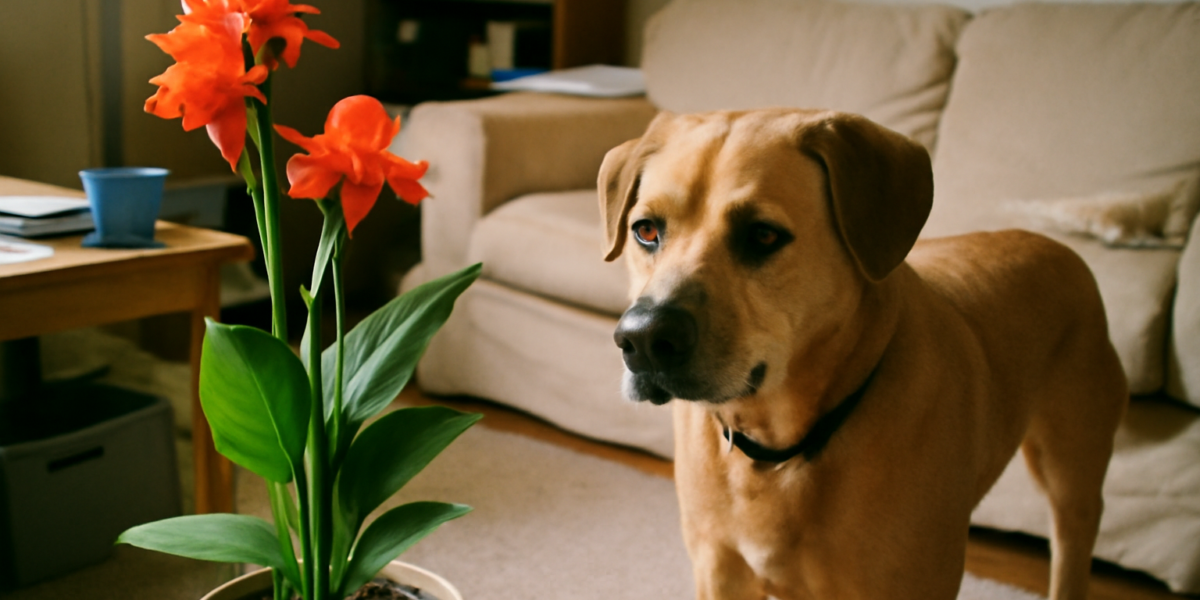
Canna lilies have very large, broad, banana-shaped leaves (often a foot or more long) arranged in upright clumps, with tall flower stalks rising above the foliage and clusters of dramatic tropical-looking flowers at the top. Colors range from solid reds and oranges to mottled yellows and pinks; some varieties have striking variegated or burgundy foliage. Plants reach two to six feet tall depending on variety, and they grow from rhizomes that spread slowly underground.
You will see canna lilies in summer flower beds, public landscaping (parks, hotel entrances, parking-lot dividers), and tropical-themed garden borders. They are also grown as patio container plants in cooler climates, where the rhizomes are dug up and stored indoors over winter. They aren’t typically used in cut-flower bouquets, so the most likely dog-exposure path is through outdoor or container plantings.
What to Expect If a Dog Eats Canna
Dogs who chew on canna leaves or flowers usually show no clinical signs at all, or at most a brief mild GI upset. Some dogs may drool a little, vomit once or twice if they ate a substantial amount, or pass a soft stool. Most are back to normal within a few hours, often without the owner noticing anything happened.
This is the typical mild-irritation picture from any non-food plant ingestion — a gut response to undigested plant fiber rather than a specific canna toxicity. There is no documented progression to kidney injury, liver injury, or cardiac problems from canna ingestion in dogs.
The exceptions where you should call the vet are the standard ones for any plant ingestion: persistent vomiting, refusal to eat for more than a day, lethargy beyond a brief slump, signs of pain, or a suspicion that your dog ate a very large amount of plant material. Very young, very small, very old, or chronically ill dogs may need quicker attention because they tolerate even mild GI upset less well.
Canna as a Dog-Safe Garden Choice
For dog owners who want a dramatic summer garden without worrying about plant toxicity, canna is one of the genuinely good choices. The flowers are showy, the foliage adds bold color and texture, and the safety profile is reassuring. If you are landscaping a dog-friendly yard, canna gives you visual impact without putting your dog at risk.
That said, “non-toxic” doesn’t mean “safe to eat in unlimited amounts.” Any dog who eats a large quantity of plant matter can develop GI upset and possibly an obstruction, and persistent plant-chewing should prompt a conversation about pica or boredom. Most dogs ignore canna once the novelty wears off, but if your dog is a chronic chewer, choose plant locations carefully.
How to Tell Canna from More Dangerous Plants
Canna’s banana-leaf foliage and tall flower spikes make it visually distinct from most truly toxic plants in the average garden. True lilies have narrow lance-shaped leaves along a single tall stem; canna has huge banana-shaped leaves growing in clumps. Sago palm, oleander, and yew — three of the most dangerous plants for dogs — look nothing like canna.
If you ever find yourself unsure about a plant in your yard, our roundup of pet-safe garden plants covers the safe options, and our broader plant-toxicity content covers the dangerous ones. When in doubt, take a clear photo and ask your vet or a poison control hotline for ID.
What to Do If You Aren’t Sure What Your Dog Ate
If you saw your dog chew on a “lily” in the yard but cannot confirm whether it was canna, day lily, or a true lily, lean cautious and call the vet. The visual differences are clear once you know them, but in the moment of “I don’t know what that was and now my dog has plant fragments in his mouth,” getting a professional opinion is worth a phone call.
Bring the plant or a clear photo to the vet, or call the ASPCA Animal Poison Control Center at (888) 426-4435 or the Pet Poison Helpline at (855) 764-7661 for species ID and guidance. Both charge a consultation fee and provide a case number the treating vet can use to coordinate care. For day lilies and true lilies, the dog risk is mostly mild GI upset, but ID matters for sorting out the cause.
Garden Planning for Dog Households
Canna lilies fit well into a dog-friendly summer garden. They tolerate full sun, perform well in most soils, and provide bold color from midsummer through frost. Pair them with other dog-safe perennials like coreopsis, gaillardia, rudbeckia (black-eyed Susan), echinacea (coneflower), and ornamental grasses for a full-sun bed that won’t worry you.
For comprehensive garden planning, our pet-safe garden plants roundup walks through dog-friendly options by growing condition. Avoid sago palms (severely toxic), oleander (severely toxic), yew (severely toxic), foxglove (cardiac), and azaleas/rhododendrons (grayanotoxin) — those are the heavy hitters dog owners should know to keep out of the yard.
Other “Lilies” Dog Owners Encounter
Several plants share the “lily” name without being true lilies, and they vary in dog risk. Peruvian lilies (Alstroemeria) cause mild GI upset. Peace lilies and calla lilies contain calcium oxalate raphides and cause oral irritation. Lily of the valley is a serious cardiac emergency from cardenolides — the most dangerous “lily” for dogs by far.
True lilies (Lilium) and day lilies (Hemerocallis) cause only mild GI upset in dogs. The deadly acute kidney injury they cause is unique to cats — not to dogs. So in a dog-only household, the urgency around true lilies is much lower than it would be in a household with cats. In a multi-pet household, the policy should always be written for the cat, because the cat is the more vulnerable species.
Container Cannas for Indoor or Patio Display
In cooler climates, canna lilies are commonly grown as container plants on patios and in sunrooms during the summer, then dug up and stored indoors over winter. This works well in dog households because the plant is non-toxic and the visual payoff is high. A few large pots of canna can transform a patio without putting your dog at risk.
If you want non-canna options for patio containers, the ASPCA’s non-toxic list also includes spider plants, Boston fern, areca palm, prayer plant, African violet, peperomia, and many others. The principle is straightforward: identify the plant, check the name against the toxic-plant list, and choose accordingly.
Why a Dog-Safe Yard Matters for Adopters
Most plant-related emergency vet visits are preventable with a brief yard and indoor plant audit. Canna lily landing on the safe side of that audit is a small win; the larger win is the habit of identifying every plant your dog might encounter.
If you are preparing to bring home a new dog — especially a curious puppy or a chronic chewer — a walk-through of your yard and indoor plants is some of the highest-value prep work you can do. Walk Me Home Rescue’s dog adoption hub can help you find your next family member, and our broader pet-care blog has more on dog-proofing the home.
Many dog-friendly households gravitate toward canna because it offers visual drama without the risk of more dangerous garden choices. Pair canna with a few signature non-toxic perennials, learn the names by sight, and you’ll find that maintaining a dog-safe yard is far less restrictive than it first appears. The dramatic-but-safe palette includes canna, ornamental grasses, coreopsis, blanket flower, and rudbeckia — collectively giving you the same summer color story as a less-safe border, with none of the worry about toxicity events.
Frequently Asked Questions
If my dog ate a canna leaf, do I need to call the vet?
If your dog seems clinically normal and ate only a small amount, calling your regular vet for guidance is reasonable but not always strictly necessary. If the dog develops more than brief mild GI signs, or if you can’t confirm the plant is canna, call the vet right away.
Will canna lily make my dog seriously sick?
Very unlikely. ASPCA lists canna as non-toxic to dogs, and there is no documented systemic toxicity. The worst common outcome is brief mild GI upset, similar to what you’d see from chewing any non-food plant.
How do I tell canna from a real lily in the garden?
Look at the leaves. Canna has huge banana-shaped leaves growing in upright clumps, often a foot or more long. True lilies have narrow lance-shaped leaves along a single tall stem. Day lilies have strap-shaped leaves rising in clumps from the ground. The leaf shape is the easiest tell at a glance.
Are canna rhizomes toxic if my dog digs them up?
No. Canna rhizomes are not toxic to dogs; the closely related species Canna edulis is grown as a food crop in some parts of South America. If your dog dug up and chewed a canna rhizome, mild GI upset is the realistic worst case.
Can I plant canna lilies along a fence where my dog runs?
Yes — canna is one of the more reliably dog-safe ornamental choices for sunny garden beds and fence-line plantings. If your dog is a chronic plant-chewer, you may see brief GI signs occasionally, but you won’t see a serious toxicity event from canna alone.


