
Last updated: May 16, 2026
In this article
- Grape Vine and Cats: Less Established but Still a Concern
- What We Know About the Toxin
- Why Cats Get Less Attention in Grape Toxicity Research
- Symptoms to Watch For
- What to Do Right Now
- Kidney Disease Risk and Long-Term Picture
- Garden and Indoor Layout for Cat Safety
- Look-Alike Climbing Plants
- How Vets Approach Suspected Grape Toxicity in Cats
- Adoption Note
- Frequently Asked Questions
Grape Vine and Cats: Less Established but Still a Concern
The honest answer to “is grape vine toxic to cats” is that the evidence is less clear-cut than for dogs, but the responsible default is to treat the plant as toxic and keep cats away from grapes, raisins, and the climbing vine itself. The most common landscape grape is Vitis vinifera (European wine grape), with Vitis labrusca (Concord-type American grape) close behind. Veterinary toxicologists have spent decades documenting acute kidney injury in dogs after grape or raisin ingestion. The corresponding case literature in cats is much thinner, partly because cats are less likely than dogs to chew on fruit and partly because the available studies are smaller.
That thin evidence base is exactly why caution is the right framing here. Most veterinary poison-control resources now treat grapes and grape products as potentially toxic to cats and recommend the same urgent response if a cat has eaten them. If you are searching grape vine toxic cats because your cat chewed leaves or licked at fallen fruit, call your veterinarian, the ASPCA Animal Poison Control Center at 888-426-4435, or the Pet Poison Helpline at 855-764-7661. The cost of overreacting is small. The cost of underreacting could be your cat’s kidney function.
What We Know About the Toxin
The compound in grapes most strongly implicated in dog kidney injury is tartaric acid and its salt potassium bitartrate. Tartaric acid is naturally abundant in grapes and gives them their tart edge. In dogs, it appears to interact with the kidney tubules in a way that triggers acute kidney injury in susceptible individuals, though sensitivity varies dramatically. Whether cats have the same vulnerability is still an open question. The cardiovascular and kidney physiology of cats differs from dogs in several ways, and a few species are genuinely less sensitive to tartaric acid. But “less sensitive” is not “immune,” and the published case reports in cats — though sparse — describe similar GI and kidney signs.
What the literature does establish is that whenever a cat is suspected of eating grapes or grape vine, treating the case the same way as a dog case is the conservative choice. The treatment protocol is straightforward, low-harm, and effective when started early. There is little to gain from waiting to see if a cat will be the first reported case of severe toxicity in your veterinarian’s career.
Why Cats Get Less Attention in Grape Toxicity Research
Cats are obligate carnivores and tend to be picky about plant matter. They are less likely than dogs to chew open a windfall grape or wander down to a vine to forage. That behavioral difference means fewer accidental exposures, fewer reported cases, and less data for researchers to analyze. It does not mean cats are physiologically protected. The kidneys of cats are arguably more sensitive to several other toxic insults (lily pollen, ethylene glycol, ibuprofen) than the kidneys of dogs, so a default assumption of equal-or-greater sensitivity is not unreasonable.
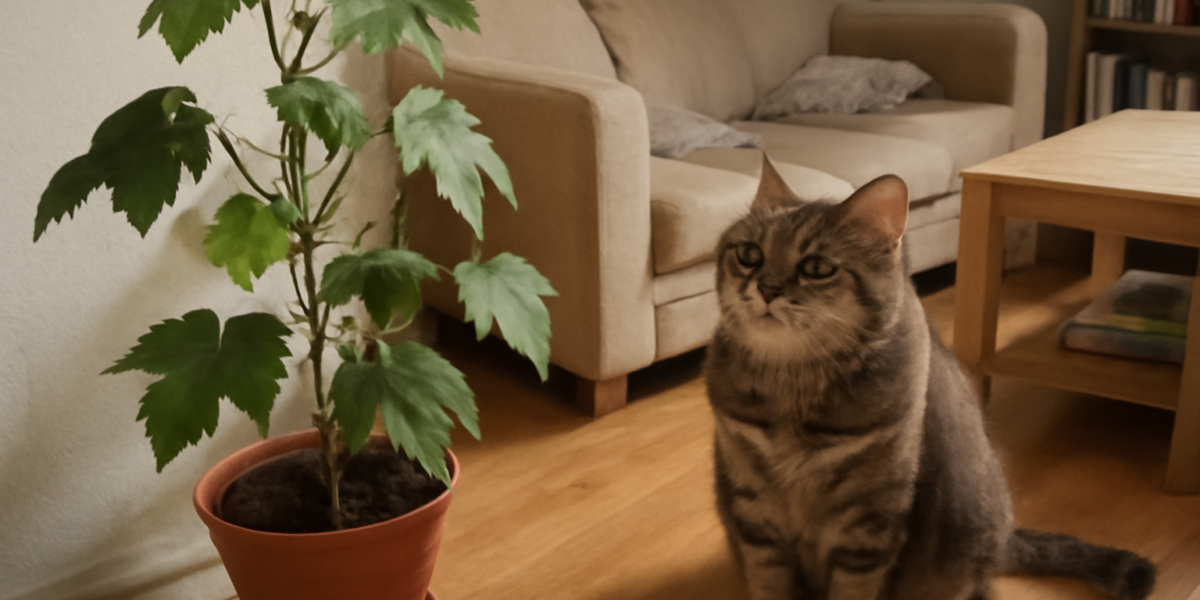
Curious or playful cats can still chew on grape vine leaves, especially indoor cats with reachable houseplants or outdoor cats who climb pergolas and arbors. Kittens are particularly likely to investigate dangling vines as toys. The risk surface for cats is real, even if the documented case count is small.
Symptoms to Watch For
If a cat has eaten grape or grape-vine material, the signs to watch for mirror those in dogs. Vomiting is the earliest and most common, often within six to twelve hours of ingestion. Other early signs include diarrhea, loss of appetite, and lethargy. Within twenty-four to seventy-two hours, kidney involvement may declare itself with increased thirst, changes in urination (more or less than usual), weakness, and hiding behavior. Severe cases progress to oliguria (very low urine output) or anuria (no urine), both of which are emergencies.
Cats are masters at masking illness. A cat who has just eaten grapes may look entirely normal for hours and then crash suddenly. That is why we encourage owners to call early rather than waiting for visible signs. Bloodwork at the time of exposure and again at twenty-four and seventy-two hours gives the most reliable picture of kidney function.
What to Do Right Now
Move quickly but stay calm. Note the time of ingestion, take a photo of the plant, and try to estimate how much your cat actually ate. Bring a sample of the plant and any vomit or stool to the vet visit if possible. Do not try to induce vomiting at home — at-home protocols that work for dogs (hydrogen peroxide) are not safe for cats and can cause severe harm. Veterinarians use specific medications to induce vomiting in cats, and the decision to do so depends on time elapsed and the cat’s overall condition.
Your vet will likely recommend an in-clinic visit for IV fluid therapy, anti-nausea medication, and serial bloodwork. Activated charcoal may be administered to limit further absorption. The earlier the intervention, the better the outcome. For more on poisoning response broadly, our piece on household items toxic to cats covers other common kitchen and pantry exposures cats stumble into.
Kidney Disease Risk and Long-Term Picture
Cats are already prone to kidney disease as they age. Chronic kidney disease in cats is one of the most common conditions in older indoor cats, and an acute injury early in life can leave residual damage that accelerates that progression. Even cats who appear to recover fully from an acute exposure may have reduced kidney reserve. This is one more reason to treat any grape exposure as a meaningful event, not a minor mishap.
Note that there is no dedicated “acute kidney injury in cats” pillar article on this site at the moment. The chronic kidney disease piece covers a lot of the same ground in terms of monitoring and supportive care, which is what most owners want to know after an acute event resolves. Diet, hydration, and regular bloodwork are the cornerstones of long-term kidney support.
Garden and Indoor Layout for Cat Safety
If you have a grape vine outdoors and an outdoor cat, the practical options are similar to those for dogs. Physical separation around the base of the vine, prompt cleanup of fallen fruit, and supervision during harvest season help reduce the exposure risk. For indoor cats, never bring grape-leaf cuttings indoors as decoration, do not leave grape products on counters or bowls where cats can reach them, and keep raisin-containing baked goods well secured.
If you are designing a cat-safe space, our roundup of cat-safe houseplants can help you choose climbing or trailing plants that do not pose the same risks. Spider plants, prayer plants, and many ferns offer the lush green aesthetic that cats enjoy lounging near without the kidney-injury concern. For a broader yard view, see pet-safe garden plants.
Look-Alike Climbing Plants
Grape vine has several climbing relatives that pet owners should know about. Virginia creeper (Parthenocissus quinquefolia) is often mistaken for young grape vine because of its lobed leaves and small dark berries; it is toxic via a different mechanism, calcium oxalate raphides plus cyanogenic compounds. We cover it fully in our Virginia creeper guide. Boston ivy is another Parthenocissus species commonly grown on building walls. English ivy is in a different family altogether but produces a similar climbing visual effect, and it is also toxic to cats.
The point of these comparisons is not to add to the worry list but to give you a clearer mental map. If a cat has chewed on a vine in your yard or garden, knowing exactly which species it is can help your veterinarian decide on the right response. Take a photo, snip a representative leaf and stem, and bring both to the appointment.
How Vets Approach Suspected Grape Toxicity in Cats
The treatment template borrows heavily from the dog protocol because the kidney-protective interventions are the same regardless of species. Decontamination if the ingestion is recent. Intravenous fluids at higher-than-maintenance rates for forty-eight to seventy-two hours to flush the kidneys. Anti-nausea medication. Activated charcoal in some cases. Serial bloodwork to track BUN, creatinine, phosphorus, and urine specific gravity. The decisions about each step are made case by case, factoring in the cat’s age, baseline health, and time elapsed since ingestion.
The earlier this protocol starts, the better the outcome. Cats brought in within the first six hours after ingestion typically do well. Cats whose treatment is delayed past twenty-four hours have a more guarded prognosis. The single best thing you can do is not wait — call as soon as you know or suspect ingestion has happened.
Adoption Note
If you are still preparing a home for a new cat, this is a good time to walk through the yard and indoor spaces with toxic-plant awareness. Cats explore differently than dogs (more vertical, more thorough, more selective) so the audit needs to include shelves, sunny windowsills, and any indoor pots or cuttings. Visit our adopt cats hub for guidance on prepping a new cat home. For ornamental ideas that look great without putting a cat at risk, the cat-safe flowers roundup is a useful starting point.
Cats already in your household benefit from the same audit. Grape vines are common in mature gardens, and many cat owners simply have not connected the food-side warning about raisins with the climbing plant on the back fence. The connection is real, and a small layout adjustment now can prevent a crisis later.
Frequently Asked Questions
Is grape vine confirmed toxic to cats?
The case literature is thinner for cats than for dogs, but veterinary poison-control authorities recommend treating grape products and grape vine as toxic to cats and responding the same way as for dog exposures. Lack of strong proof is not the same as proof of safety.
Are cats less likely to be poisoned than dogs?
Behaviorally, yes — cats are pickier about plant matter and less likely to forage. But cats are not physiologically immune. Their kidneys are sensitive to several other toxic insults, so the cautious assumption is equal-or-greater sensitivity, not less.
My cat licked a grape but did not chew it. Is that an emergency?
A small lick is unlikely to cause serious harm, but it is reasonable to call a poison helpline for guidance. The decision usually depends on the size of the cat, what was actually ingested, and how recent the exposure was.
What about grape juice or wine?
Anything grape-derived should be treated as a potential exposure source. Wine carries an additional alcohol risk on top of the grape concern. Juice contains concentrated grape compounds. Keep both out of reach of cats.
Are kittens at higher risk than adult cats?
Kittens are smaller, more curious, and more likely to chew or play with dangling vines, so the practical exposure risk is higher. They also have less metabolic reserve to absorb a toxic insult. If a kitten has eaten grape material, the urgency is somewhat higher than for an adult cat of the same exposure.


