Last updated: May 4, 2026
In this article
- Overview of the California Spangled Cat
- History and the Casey Project
- Appearance and Coat
- Temperament and Personality
- Care and Daily Routine
- Health and Lifespan
- Diet and Nutrition
- Common Behavioral Traits Documented in the Breed
- The Reality of Adopting a California Spangled
- Kitten Care for the Breed (When Available)
- Senior Care Considerations
- Why the Breed Almost Disappeared
- Is the California Spangled Right for You?
- Frequently Asked Questions
Overview of the California Spangled Cat
The California Spangled cat is one of the rarest breeds in the world today — a 1980s designer cat created by anthropologist and screenwriter Paul Casey with the explicit goal of producing a domestic cat that visually resembled wild spotted cats. The breed was conceived as a conservation awareness project, intended to celebrate big-cat aesthetics in a domestic companion and remind owners of what was being lost in the wild.
The breed had a brief moment of cultural prominence in the late 1980s, partly through a famous Neiman Marcus catalog Christmas listing that drew widespread media attention. It also coincided with the rise of the Bengal — another spotted designer breed — which ultimately captured most of the market interest. The California Spangled never developed the breeder base needed for sustained growth, and today it teeters near functional extinction.
This profile covers what is known about the breed and offers honest guidance for anyone considering one. Realistic expectation: finding a true California Spangled today is extraordinarily difficult.
History and the Casey Project
Paul Casey began the breeding program in the 1970s, motivated by witnessing the impact of leopard poaching during anthropological work in Africa. His goal was to create a domestic spotted cat that would prompt conversations about wild cat conservation. The breeding program drew on multiple foundation lines including British Shorthair, American Shorthair, Manx, Siamese, Abyssinian, and various other domestic and pedigreed cats — explicitly without using any wild cat species in the foundation.
This last point matters. Unlike Bengals (which incorporate Asian Leopard Cat ancestry) or Savannahs (Serval ancestry), the California Spangled has no wild blood. It is a fully domestic cat designed to look exotic, not a hybrid. That made it more domesticated in temperament than the contemporary hybrid breeds.
The breed’s introduction in 1986 generated significant publicity, but breeder networks never expanded substantially. By the 1990s and 2000s, the rise of the Bengal absorbed most adopter interest in spotted cats, and California Spangled breeding programs dwindled. Today, the breed is so rare that some cat fancy observers consider it functionally extinct as a viable breeding population — though a small number of dedicated enthusiasts may still maintain lines.
Appearance and Coat
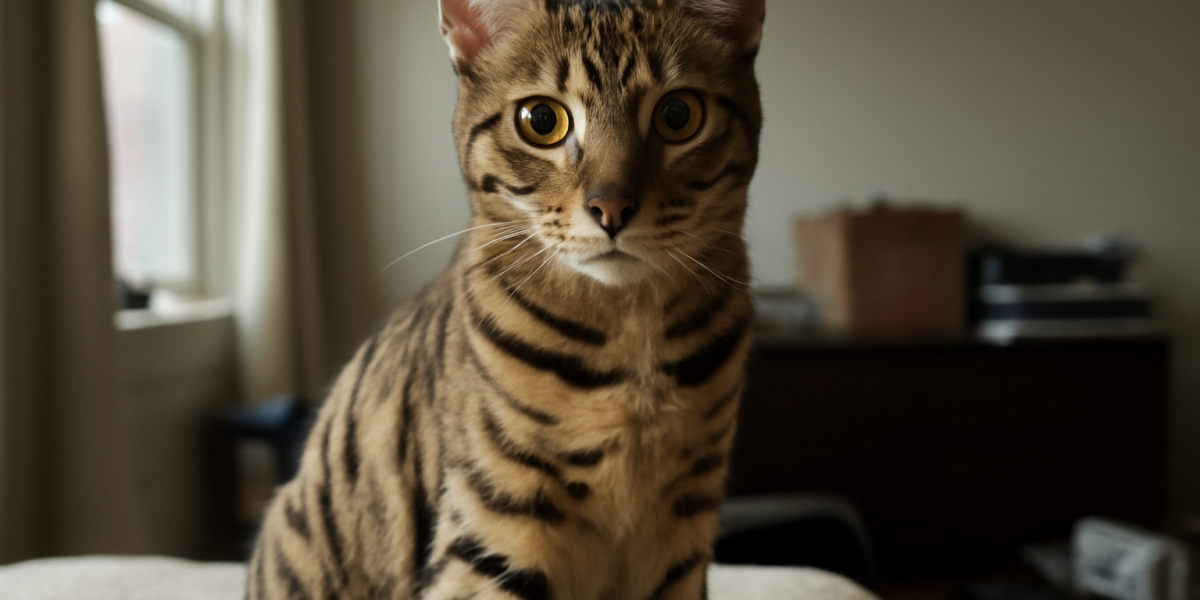
The California Spangled was bred to evoke the appearance of wild spotted cats — leopards, ocelots, margays — through purely domestic genetics. The body is medium to medium-large, lean and muscular, with a long line and an athletic stance suggestive of a stalking wildcat. The head is moderately wedge-shaped with high cheekbones, the ears are medium-sized and set at a slight angle, and the eyes are almond-shaped in colors complementing coat color.
The coat is short and lies close to the body, allowing the spotted pattern to display sharply. The breed standard called for clearly defined dark spots on a paler ground, with each spot separated and contrasting. Acceptable colors included silver, bronze, brown, gold, charcoal, blue, black, red, and white. The patterning was meant to be reminiscent of wild felines without strict mimicry of any single species.
Size and Build
Adult males typically weighed 9 to 15 pounds, females 7 to 12 pounds. The breed was substantial without being heavy, with visible muscle and clean athletic lines.
Temperament and Personality
Despite the wild appearance, California Spangleds were bred to be fully domestic in temperament. Casey emphasized this distinction repeatedly during the breed’s development: a cat that looked wild but behaved like a friendly domestic. By most accounts from the breed’s heyday, the result was successful — affectionate, sociable, intelligent cats that bonded closely with their family.
Owners during the breed’s active period described them as energetic and playful, with strong hunting and stalking play behaviors that suited their visual identity. Many were comfortable on harness walks. Vocalization tended toward conversational rather than constant.
Because the active breeding population today is so small, generalizations about temperament have to be made cautiously. Individual variation matters more than usual when working with a breed at very low population numbers.
Care and Daily Routine
Care needs are straightforward. The short, dense coat requires only weekly brushing, with no specialty grooming or coat products needed. Bathing is rarely necessary.
Standard cat care covers everything else. Routine veterinary visits, parasite prevention, vaccination, dental attention. The cat vaccination schedule applies to this breed as it does to any domestic cat.
Exercise and Mental Stimulation
The breed was bred to be active and athletic. Daily interactive play, climbing structures, and toys that mimic prey movement are essential. Many California Spangleds respond well to puzzle feeders and learning simple cues. The puzzle feeders for cats guide is a useful starting reference.
Health and Lifespan
The California Spangled’s diverse foundation lines theoretically provided good genetic diversity, which would have supported broad health. However, the very small modern breeding population creates the opposite risk — concentrated breeding among a few remaining lines can introduce inbreeding concerns. Anyone working with a true California Spangled today should ask detailed pedigree and health screening questions.
No specific condition is breed-defining in veterinary literature. Standard feline concerns apply: dental disease, kidney disease in seniors, hyperthyroidism, the common urinary and gastrointestinal range. Routine wellness care matters. The annual vet exam for cats and the annual bloodwork for cats guides cover the basics.
Lifespan estimates for the breed range from 9 to 16 years for healthy individuals, though robust population data is genuinely lacking given the small numbers.
Diet and Nutrition
A complete and balanced commercial diet appropriate for life stage is the foundation. The breed’s active build means many individuals are enthusiastic eaters; portion control supports a lean body condition. Wet food in the rotation supports hydration.
If your home includes other cats with different needs, the feeding multi-cat different diets guide covers practical setups.
Common Behavioral Traits Documented in the Breed
From accounts during the breed’s active period in the 1980s and 1990s, several behavioral traits were commonly observed. California Spangleds were described as confident, curious, and athletic, with strong stalking and pouncing play behaviors that suited their visual identity as wild-looking cats. Many were comfortable on harnesses and enjoyed supervised outdoor walks.
Vocalization tended toward conversational rather than constant. Owners described them as engaged and communicative without the relentless chatter of pure Siamese or Burmese lines. Many were notable jumpers and climbers, requiring tall cat trees and secure window screens to channel their athleticism safely.
Reports of trainability were generally positive. Many California Spangleds learned simple cues, fetch, and household routines quickly. The breed’s intelligence and engagement made them rewarding for owners who appreciated interactive cats. As with any rare breed today, individual variation matters more than usual when working with such a small active population.
The Reality of Adopting a California Spangled
This deserves honest treatment. The California Spangled is not a breed you can readily adopt today. The active breeding population is extremely small, and many cats advertised as California Spangled in the secondary market are mislabeled — often Bengals, Ocicats, or Domestic Shorthair tabbies with similar coloring.
If you encounter a listing claiming to be a California Spangled, ask for pedigree documentation traceable to the original Casey breeding lines. Be prepared for the possibility that no verifiable documentation exists. The finding a reputable rescue in your state guide includes red-flag indicators that apply here, and the cat-only rescues overview can help identify reputable channels.
If you love the California Spangled aesthetic but cannot verify availability, consider these alternatives. The Bengal offers similar wild-cat looks with established breeder networks. The Ocicat achieves the spotted look entirely from domestic genetics, similar to the California Spangled’s design philosophy. The Egyptian Mau is the only naturally spotted domestic cat breed. The cat breeds with spotted coats roundup compares them.
Kitten Care for the Breed (When Available)
If you do find a verified California Spangled kitten through a documented breeding line, standard kitten care principles apply with extra attention to socialization. The breed was developed for active, intelligent temperament; kittens benefit from rich early environments with handling by different people, household sounds, supervised interactions with other pets, and routine grooming and nail trims.
Establish a consistent feeding schedule and introduce litter box habits early. The kitten feeding schedule by age guide is a useful reference for the first year. Because the active breeding population is so small, any veterinary records or genetic testing the breeder provides should be retained carefully — they support both the cat’s individual care and the broader documentation of the line.
Senior Care Considerations
For the few California Spangleds in active homes today, senior care follows standard feline principles. Annual exams should become twice-yearly around age ten. Watch for age-related conditions including dental disease, kidney disease, and hyperthyroidism. The senior cat care checklist covers what to monitor as cats age.
Why the Breed Almost Disappeared
Several factors contributed. The Bengal’s rise drew most adopter interest in spotted cats, and Bengal breeders had stronger marketing and broader networks. Paul Casey’s breeding program was personally driven and did not transition smoothly to broader breeder support. Some registries did not grant championship status, limiting show-circuit exposure. And the conservation-awareness story that motivated the breed never quite landed as a mainstream message.
The breed’s fate is a useful case study for anyone interested in extinct cat breeds history and the fragility of small founding populations.
Is the California Spangled Right for You?
Realistically, the question is moot for most adopters because the breed is functionally unavailable. If you are determined to find one, expect intensive searching, possible disappointment, and the strong probability that an alternate spotted breed will end up being the better practical choice.
For comparable looks and traits with actual availability, consider Bengals, Ocicats, or Egyptian Maus. The rarest cat breeds roundup also discusses other extreme rarities that share the California Spangled’s challenge of vanishing breeder support.
Frequently Asked Questions
Is the California Spangled extinct?
Not formally extinct, but the active breeding population is so small that some observers consider the breed functionally unviable. A small number of dedicated enthusiasts may still maintain lines, but adoption availability is essentially absent.
Does the California Spangled have wild cat ancestry?
No. The breed was specifically created without wild cat species in the foundation. Casey wanted a fully domestic cat that visually resembled wild felines, not a hybrid. Bengals and Savannahs are the hybrid breeds; California Spangled is not.
What was the Neiman Marcus catalog connection?
The breed was famously listed in the 1986 Neiman Marcus Christmas Book, generating significant media attention. The publicity helped establish the breed’s name but did not translate into the breeder support needed for long-term sustainability.
If I cannot find one, what is the closest alternative?
The Ocicat is closest in concept — a fully domestic spotted breed designed to look wild. Bengals offer the strongest visual resemblance but include wild ancestry. Egyptian Maus are the only naturally spotted domestic cats.
Why did the breed never take off?
Multiple reasons: competition from Bengals, limited breeder network, registry recognition challenges, and difficulty translating the conservation-awareness origin story into mainstream adopter motivation.
Looking to adopt a California Spangled Cat Breed Profile?
Browse California Spangled Cat Breed Profile cats and mixes available for adoption from shelters and rescues near you.
Find California Spangled Cat Breed Profile Cats for Adoption