
Last updated: May 4, 2026
In this article
- The Short Answer on Cats and Rambutan
- What Is Rambutan?
- Why Cats Do Not Need Fruit
- Skin and Seed Hazards
- Sugar, Diabetes, and Obesity Concerns
- Safe Serving Size and Preparation
- How Rambutan Compares to Other Tropical Fruits for Cats
- Symptoms to Watch For After Rambutan
- What to Skip Entirely
- Storage, Choking, and Counter Safety
- Frequently Asked Questions
The Short Answer on Cats and Rambutan
Cats can eat a tiny piece of peeled, pitted rambutan flesh, but it is not a recommended treat. Rambutan is a sweet tropical fruit native to Southeast Asia with hairy red or yellow skin, juicy translucent flesh, and a single large seed in the middle. The flesh itself is non-toxic to cats, but it is high in sugar, low in protein, and offers nothing your obligate-carnivore cat actually needs. The hairy outer skin and the inner seed are both unsafe and must be removed completely before any small taste.
If your cat has shown curiosity about rambutan, a pea-sized piece of the peeled flesh once or twice a month is unlikely to cause harm in a healthy adult cat. Cats with diabetes, obesity, kidney disease, or sensitive stomachs should skip rambutan entirely. The answer to “can cats eat rambutan” is technically yes, in a very limited way, but practically speaking there are far better treats.
What Is Rambutan?
Rambutan (Nephelium lappaceum) is a relative of lychee and longan in the soapberry family. The name comes from the Malay word for “hair,” which describes the soft red or yellow spikes covering the outer rind. Inside, you find a sweet, slightly tart, grape-like flesh wrapped around a single oblong seed. It is grown commercially throughout Indonesia, Malaysia, Thailand, the Philippines, Vietnam, and parts of Central America.
Nutritionally, rambutan is mostly water and carbohydrate, with modest amounts of vitamin C, copper, manganese, and a small dose of fiber. Per 100 grams, raw rambutan flesh contains roughly 80 calories and around 18 to 20 grams of sugar. That sugar load is the main reason cats should only have tiny amounts — a cat’s daily caloric needs are typically 200 to 250 calories, and treats should not exceed 10 percent of total calories.
Why Cats Do Not Need Fruit
Cats are obligate carnivores. Their digestive enzymes, taste receptors, and nutritional requirements are built around animal protein. Cats cannot taste sweetness — they lack the functional Tas1r2 gene that codes for sweet taste receptors. So when a cat shows interest in rambutan, it is not because the fruit tastes sweet to them; it is the smell, texture, juiciness, or simple curiosity about what you are eating.
Their digestive tract is short and acidic, optimized for breaking down meat rather than fermenting plant fiber. Fruits high in sugar can cause loose stool, gas, or vomiting in cats that are not used to them. There are no nutrients in rambutan that cats cannot get more efficiently from a complete and balanced cat food. If you want to offer fruit as enrichment rather than nutrition, that is a fair reason — just keep portions tiny.
Skin and Seed Hazards
The hairy outer skin of rambutan is fibrous and indigestible. In small cats, even a finger-tip-sized piece could cause GI irritation, vomiting, or in worst cases a partial intestinal obstruction. The skin also contains saponins and tannins that are mildly toxic to most mammals if eaten in volume. Always peel rambutan completely before offering any to your cat — and do not leave peels accessible in trash where the cat can fish them out.
The seed is the bigger concern. Rambutan seeds contain saponins and trace alkaloids that are mildly toxic when raw. They are also a hard, oblong shape roughly the size of a peanut — exactly the shape and size that can lodge in a cat’s small intestine and create a foreign-body obstruction. Roasted rambutan seeds are eaten in some Southeast Asian cuisines for humans, but the cooking process and human GI anatomy do not translate to feline safety. Discard the seed every time.
Sugar, Diabetes, and Obesity Concerns
Diabetes mellitus is uncommon in cats but well-documented, with a prevalence of roughly 0.5 to 1 percent in the general cat population and higher rates in obese, indoor, and senior cats. Even healthy cats do not handle sugar loads efficiently because their pancreas is tuned for protein and fat metabolism rather than rapid carbohydrate processing. Repeated sugary treats contribute to weight gain and insulin resistance over time.
If your cat is already diagnosed with feline diabetes, rambutan is a hard no — even small amounts can disrupt blood sugar control. Our feline diabetes guide covers diet management and what to avoid. Overweight and indoor cats benefit from structured play and puzzle feeding rather than fruit treats. Senior cats with kidney disease — about 30 to 50 percent of cats over age 12 develop chronic kidney disease — should also skip sugary fruits and stick to vet-approved treats.
Safe Serving Size and Preparation
If you decide to offer a tiny taste of rambutan to a healthy adult cat with no medical conditions, here is the safest approach.
- Peel one ripe rambutan completely, removing all hairy skin
- Slice the flesh away from the seed and discard the seed
- Cut a pea-sized piece (no larger than a pencil eraser)
- Offer it plain on a clean dish — no syrup, no canned-fruit liquid, no added sugar
- Limit to once or twice a month maximum
- Watch for vomiting, diarrhea, or refusal of next meal over 12 to 24 hours
If your cat ignores it, that is the natural and correct response — cats simply do not need fruit. Do not coax. If your cat eats it and tolerates it well, you can repeat occasionally as enrichment. Never offer canned rambutan in syrup, dried rambutan with added sugar, or rambutan-flavored desserts.
How Rambutan Compares to Other Tropical Fruits for Cats
Rambutan sits in a similar safety tier as lychee and longan — all three are soapberry-family fruits with edible flesh, inedible skin, and a hard seed. Our cat lychee guide covers the same flesh-yes-skin-and-seed-no rules. Mango is somewhat safer because the flesh is large and easy to portion, though the pit and skin must still be removed. Watermelon has the highest water content and lowest sugar per gram of common tropical fruits and is generally the easiest fruit for cats to handle.
For comparison with other Southeast Asian fruits, see our guides on jackfruit, dragon fruit, and persimmon. The pattern is consistent: small amounts of plain peeled flesh are usually fine, sugary or canned versions are not, and seeds and skins should always be discarded. Berries like blueberries and strawberries have lower sugar per serving and are easier to portion in cat-sized amounts.
Symptoms to Watch For After Rambutan
If your cat eats a small amount of rambutan flesh and tolerates it, you may see no symptoms at all. If your cat ate the skin, the seed, or a large amount of flesh, watch for these warning signs over the next 24 to 72 hours.
- Vomiting, especially if it contains seed or peel fragments
- Diarrhea or unusually soft stool
- Refusal to eat the next regular meal
- Lethargy or hiding
- Repeated retching without producing anything (could indicate obstruction)
- Abdominal tenderness when picked up
A single mild GI upset usually resolves with bland food and water. Persistent vomiting, repeated retching, or any sign of abdominal pain warrants a vet call — foreign-body obstruction from a swallowed pit is a surgical emergency in cats. If you know the cat ate the seed, do not wait for symptoms; call your vet for advice.
What to Skip Entirely
Some rambutan-related products and preparations are never safe for cats and should be kept fully out of reach.
- Canned rambutan in heavy syrup — too much sugar, sometimes added preservatives
- Dried rambutan — concentrated sugar load
- Rambutan-flavored juice, smoothies, or yogurt drinks — added sugar and sometimes dairy
- Rambutan with chili-salt seasoning — sodium and capsaicin both irritate cats
- Whole unpeeled rambutan left within reach — choking and obstruction hazard
- Rambutan seeds, raw or roasted — saponin content plus obstruction shape
Treat rambutan the same way you would treat any human fruit dessert: assume it is not made for cats and only share a tiny portion of the plain peeled flesh if you choose to share at all.
Storage, Choking, and Counter Safety
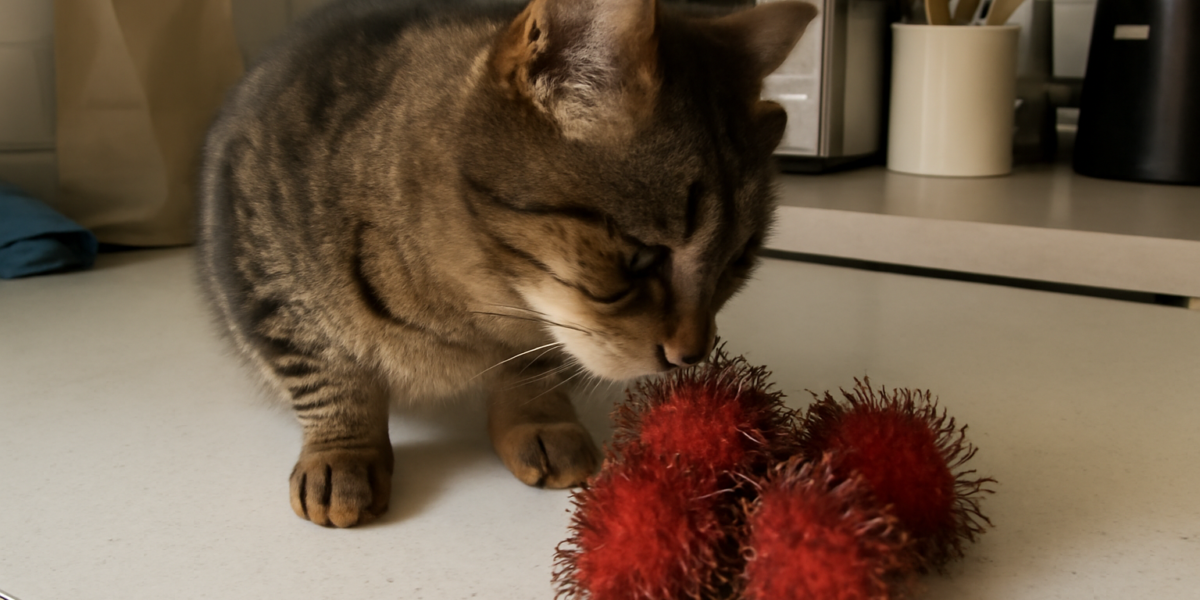
Whole rambutan with the spiky outer skin can look like a toy or curiosity to a cat, especially the bright red varieties. Cats sometimes bat fruit around the kitchen counter, and a determined cat can puncture the soft skin with their teeth and start chewing. The hairy spikes are not sharp, but they can irritate gums and tongue and trigger drooling or pawing at the mouth. The bigger risk is the seed: if a cat manages to break through the flesh and reach the pit, they may try to swallow it, with obstruction risk to follow.
Store rambutan in the refrigerator in a sealed container or produce drawer. Do not leave fruit bowls accessible on counters where cats roam. Discard peels and seeds in a covered trash bin — peels left on the cutting board are tempting to inquisitive cats. Wash cutting boards and knives that contacted the seed before using them for cat food preparation, since saponins can transfer in trace amounts.
If you serve rambutan to human family members, plate it and clear the plate when finished. Cats are persistent counter-surfers and will investigate any food left within their reach. The few seconds of food security pay off in fewer GI incidents and zero risk of seed ingestion.
Frequently Asked Questions
My cat swallowed a rambutan seed. Is it an emergency?
Call your vet for advice. The seed itself contains mild toxins, and the size and shape can cause obstruction in a cat’s intestine. Your vet may recommend monitoring at home, an X-ray, or induced vomiting depending on the cat’s size, the seed’s size, and how recently it was eaten.
Is rambutan flesh actually toxic to cats?
The flesh itself is not toxic. The concerns are sugar content, lack of nutritional value, and the skin and seed both being unsafe. Plain peeled flesh in a tiny portion is not a poisoning risk for healthy cats.
How is rambutan different from lychee for cats?
They are very similar — both are soapberry-family fruits with sweet flesh and a hard seed. Lychee skin is smoother, rambutan skin is hairy. Both have the same prep rules: peel, pit, tiny portion, occasional only.
Can kittens eat rambutan?
No. Kittens have small digestive tracts, immature gut microbiomes, and very specific nutritional needs. Stick to a complete kitten food and skip all fruit until adulthood. Our kitten feeding guide covers what to offer instead.
What if my cat steals rambutan from the counter?
If they ate only flesh, watch for mild GI upset and resume normal feeding. If they ate peel or seed, call your vet. Either way, store fruit out of reach — cats are persistent counter-surfers.


