
Last updated: April 10, 2026
In this article
Is Dieffenbachia Toxic to Cats?
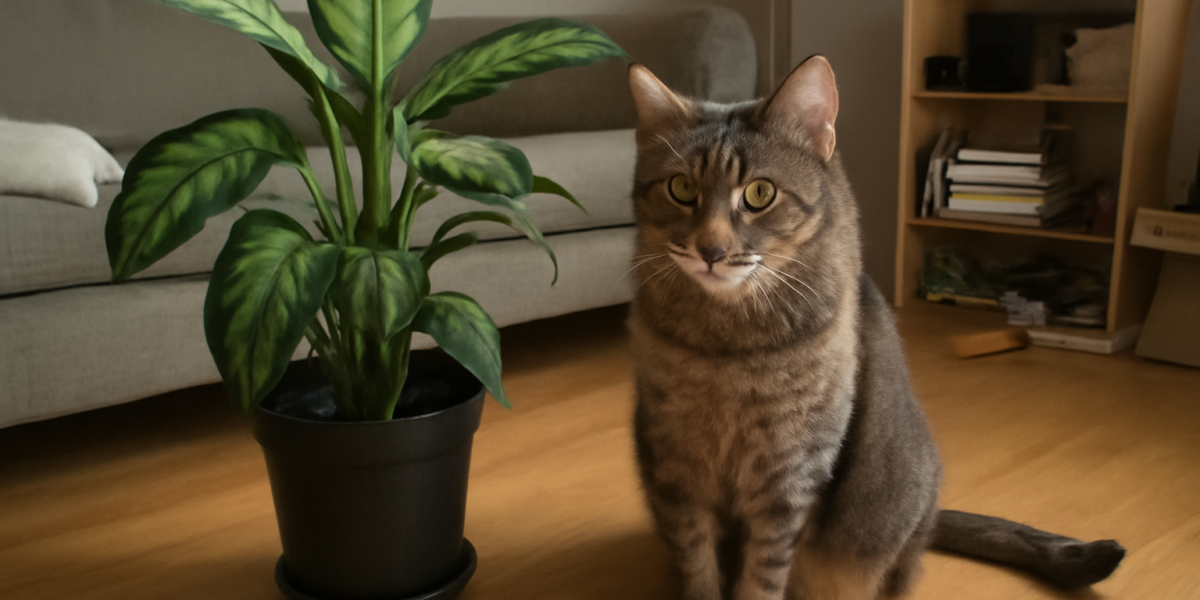
Dieffenbachia is one of the most popular leafy houseplants in the world, found in homes and offices alike for its bold, variegated foliage and easy care requirements. Its common name — dumb cane — comes from the temporary loss of speech that can occur in humans who chew the plant, caused by the same irritating crystals that harm cats. Despite its widespread appeal as a decorative plant, dieffenbachia is toxic to cats and poses a real hazard for curious felines who like to investigate — or chew on — household greenery.
Why Is Dieffenbachia Toxic to Cats?
The reason dieffenbachia is toxic to cats lies in a class of compounds called insoluble calcium oxalate crystals, specifically needle-like structures known as raphides. These crystals are packed into specialized plant cells called idioblasts throughout every part of the plant — leaves, stems, and roots. When a cat bites into any portion of the dieffenbachia plant, these cells rupture explosively, firing thousands of microscopic raphide needles directly into the soft mucous membranes of the mouth, tongue, and throat.
Unlike soluble oxalates, which are absorbed into the bloodstream and can damage the kidneys, insoluble calcium oxalate raphides cause intense localized irritation at the point of contact. The crystals act as tiny barbs, physically embedding themselves into soft tissue and triggering an immediate inflammatory response. This mechanism explains why symptoms appear almost instantly after a cat chews on dumb cane, and why even a small amount of plant material can produce a strong reaction. The same family of compounds is responsible for the toxicity of philodendron, pothos, and peace lily.
Symptoms of Dieffenbachia Poisoning in Cats
Because dieffenbachia is toxic to cats through direct physical irritation, most symptoms begin within minutes of ingestion. The severity depends on how much plant material was chewed and whether any was swallowed. Common signs to watch for include the following.
Pawing at the mouth is typically the first visible sign. The cat will rub its face against surfaces or paw at its mouth in an attempt to relieve the burning caused by the crystals.
Excessive drooling follows rapidly as the salivary glands respond to oral irritation and the body attempts to flush away the crystals.
Oral swelling and pain can make it difficult for the cat to eat, drink, or close its mouth comfortably. The lips, tongue, and gums may appear red and inflamed.
Vomiting is common if any plant material was swallowed, as calcium oxalate raphides irritate the esophagus and stomach lining in the same way they affect the mouth.
Loss of appetite accompanies the oral discomfort and may persist for a day or more while the inflammation resolves.
Difficulty swallowing or, in rare cases, labored breathing can occur when significant swelling develops in the throat or airway. This constitutes a veterinary emergency and requires immediate care.
What to Do If Your Cat Ate Dieffenbachia
Act quickly but stay calm. If you see your cat chewing on a dieffenbachia plant, or find evidence that leaves or stems have been bitten, follow these steps immediately.
- Remove your cat from the plant. Move the cat to a separate room and place the dieffenbachia well out of reach to prevent further ingestion.
- Rinse the mouth with water. If your cat will tolerate it, gently wipe the inside of the mouth with a damp cloth or offer small amounts of water to help flush out loose crystals. Do not force this if your cat resists.
- Do not induce vomiting. Unless a veterinarian explicitly instructs you to, do not attempt to make your cat vomit at home. Bringing calcium oxalate crystals back up through the esophagus can cause additional irritation to already-inflamed tissue.
- Call your vet or an animal poison control hotline right away. Contact your veterinarian, the ASPCA Animal Poison Control Center at (888) 426-4435, or the Pet Poison Helpline at (855) 764-7661. Have the plant name ready and be prepared to describe how much was consumed and what symptoms are present.
- Monitor your cat closely. Note the time of exposure, the symptoms you observe, and any changes so you can give your vet an accurate picture. Watch in particular for worsening swelling, breathing difficulty, or extreme lethargy.
Treatment for Dieffenbachia Toxicity in Cats
There is no specific antidote for dieffenbachia poisoning. Veterinary treatment is supportive and focused on managing symptoms and keeping the cat comfortable and hydrated. A veterinarian may flush your cat’s mouth and throat thoroughly with water to remove remaining crystals. Antihistamines or corticosteroids may be administered to reduce oral and airway swelling. Significant vomiting may be treated with anti-nausea medication, and intravenous fluids may be given to address dehydration. Pain relief medications can help your cat eat and drink while the inflammation resolves. Most cats recover fully within 12 to 24 hours when dieffenbachia toxic to cats exposure is treated promptly. Cases involving heavy ingestion or airway involvement may require hospitalization.
How to Keep Cats Safe Around Dieffenbachia
The most reliable strategy for protecting your cat is to eliminate access entirely rather than relying on deterrents.
Remove the plant or restrict access. Place dieffenbachia in a room your cat cannot enter, or rehome the plant altogether if reliable separation is not possible. Cats are skilled climbers and jumpers, so high shelves alone may not be sufficient.
Use hanging planters suspended from ceiling hooks well above your cat’s reach. This can allow you to display the plant safely if you have high ceilings and a confident anchor point.
Apply deterrents at the base of the plant. Textured mats, double-sided tape, or citrus-scented sprays around the pot can discourage curious cats from approaching. Cats generally dislike citrus scents.
Provide cat grass or catnip. Cats often chew on houseplants out of boredom or a desire for plant fiber. Offering a dedicated pot of cat grass or catnip can redirect this behavior toward a safe option. For more guidance on cat safety at home, visit our cat care articles.
Cat-Safe Alternatives to Dieffenbachia
If you love the lush, broad-leaved look that dieffenbachia provides but want to eliminate the hazard entirely, several houseplants offer a similar aesthetic and are classified as non-toxic to cats by the ASPCA.
- Calathea — dramatic patterned foliage in a wide range of colors, non-toxic and pet-friendly
- Areca Palm (Dypsis lutescens) — feathery tropical height with no toxic risk to cats
- Peperomia — compact, low-maintenance, and available in many leaf shapes and textures
- Boston Fern (Nephrolepis exaltata) — a lush, full alternative that is safe for cats
- Parlor Palm (Chamaedorea elegans) — elegant tropical presence without the toxicity
- Spider Plant (Chlorophytum comosum) — easy to grow, widely available, and non-toxic
Replacing dieffenbachia with one of these alternatives lets you maintain a plant-filled home without putting your cat at risk. Always verify any new plant against the ASPCA’s online poison plant database before bringing it indoors.
Frequently Asked Questions
Is dieffenbachia toxic to cats if they only lick the leaves?
A brief lick of an intact leaf surface is less likely to trigger severe symptoms than chewing, because the calcium oxalate raphides are released most forcefully when plant cells are ruptured. However, if a leaf is cut, torn, or otherwise damaged, the sap contains crystals that can irritate on contact. Even without chewing, you should monitor your cat for any drooling, pawing at the mouth, or other signs of discomfort, and contact your veterinarian if symptoms develop.
How much dieffenbachia is toxic to cats?
There is no established safe quantity. Individual cats vary in their sensitivity, and even a small bite can trigger a significant oral reaction. Severity generally increases with the amount ingested, but because the crystals cause immediate physical damage rather than a dose-dependent chemical effect, any ingestion — no matter how small it appears — should prompt a call to your vet or an animal poison control hotline.
Can a cat recover from eating dieffenbachia?
Yes. The vast majority of cats recover fully from dieffenbachia ingestion, particularly when care is sought promptly. Mild to moderate cases typically resolve within 12 to 24 hours with supportive veterinary treatment. Recovery is less predictable if a large amount was consumed or if treatment is delayed. This is why contacting a professional as soon as possible after any suspected dieffenbachia toxic to cats exposure is so important.
Is dumb cane the same as dieffenbachia?
Yes. Dumb cane is the common name for plants in the Dieffenbachia genus. The name comes from the temporary inability to speak that can result from chewing the plant — caused by the same calcium oxalate crystals that harm cats. All varieties of dieffenbachia, regardless of whether they are labeled by their scientific name or their common name, are toxic to cats and should be kept out of homes with feline companions or placed entirely out of reach.


