
Last updated: May 16, 2026
In this article
- Is Crassula Muscosa Toxic to Pets?
- What Is Crassula Muscosa?
- Why “Not ASPCA-Listed” Doesn’t Mean “Confirmed Safe”
- The Crassula Genus and the Jade Plant Connection
- Symptoms to Watch For After Ingestion
- First Aid After a Chewing Incident
- Why Watch Chain Is Mechanically Less Risky Than Some Plants
- Pet-Safe Placement
- How Watch Chain Compares to Other Crassulas
- Frequently Asked Questions
Is Crassula Muscosa Toxic to Pets?
Crassula muscosa — the small succulent commonly sold as Watch Chain, Princess Pine, Lizard’s Tail, or Zipper Plant — is not specifically listed by the ASPCA as toxic to cats or dogs. That means there is no confirmed toxicity record for this exact species. However, Crassula muscosa belongs to a genus that contains the well-known toxic jade plant (Crassula ovata), and many cautious keepers treat all Crassula species as low-risk-but-not-confirmed-safe.
The practical takeaway is that Crassula muscosa appears unlikely to cause serious harm in small ingestions, but the absence of a specific safety listing means it is not a confirmed pet-safe houseplant in the same way that, say, an air plant or a haworthia would be. If your pet has chewed a Watch Chain plant, monitor for mild GI signs (drooling, vomiting, soft stools) and call your vet if you see any concerning symptoms.
What Is Crassula Muscosa?
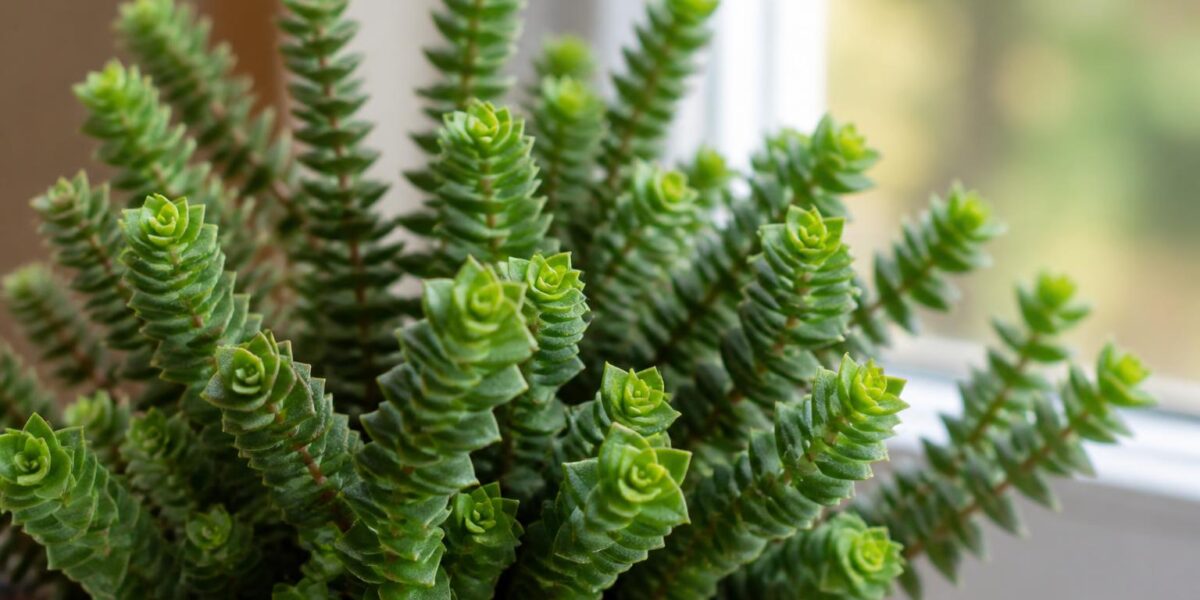
Crassula muscosa is a small succulent native to South Africa and Namibia. Its most distinctive feature is the leaves: tiny, scale-like, and tightly stacked along the stem so that the whole structure looks like a green chain or a watchband — hence the common names Watch Chain and Zipper Plant. Some cultivars look enough like a small evergreen sapling that the name “Princess Pine” stuck, even though the plant has no relationship to actual pines.
The plant grows to about six to twelve inches tall, often branching freely from the base, and is one of the easier Crassulas to keep indoors. It tolerates low light better than many succulents, propagates easily from stem fragments, and is widely sold in dish gardens and small terracotta pots. The flowers — when they appear, usually in spring — are tiny yellow-green clusters along the stems.
For comparison context, see our coverage of the related Crassula arborescens (silver jade), the columnar Crassula tetragona, the stacked Crassula perforata, and the small Crassula capitella. All share genus-level family resemblance with Watch Chain.
Why “Not ASPCA-Listed” Doesn’t Mean “Confirmed Safe”
The ASPCA Animal Poison Control Center maintains a database of plants with documented toxicity to pets. A plant on that list has been linked to clinical signs in real cases. A plant not on the list has either: (a) never been associated with toxicity in cases reported to the ASPCA, (b) not been studied or tested in any systematic way, or (c) been considered low-risk and never given a dedicated entry.
For Crassula muscosa, the most likely explanation is a combination of (b) and (c) — the plant has never been clinically tied to a published case in cats or dogs, but it also has not been positively confirmed as non-toxic. Some cautious sources note that Crassulaceae family plants in general can produce mild GI upset on ingestion, and the related jade plant (Crassula ovata) is confirmed toxic to cats and to dogs. That family-level relationship is the reason careful keepers do not treat unlabeled Crassulas as fully safe.
The Crassula Genus and the Jade Plant Connection
The genus Crassula contains around two hundred species, most native to southern Africa, Madagascar, and parts of the Mediterranean. The classic jade plant — Crassula ovata — is the only member of the genus with a fully established and ASPCA-listed toxicity profile. Its symptoms include vomiting, depression, ataxia, and in some cases bradycardia.
Whether the same toxic compound is present in Crassula muscosa is unknown. The botanical relationship is close enough that some keepers extrapolate caution from C. ovata to the rest of the genus, while others note that not all Crassula species share the same secondary chemistry. In practice, the conservative approach — treat as potentially mildly toxic, monitor after any ingestion, and prevent chewing where possible — is the safest stance for households with cats or dogs.
For the dog-side jade plant context, see our jade plants and dogs pillar.
Symptoms to Watch For After Ingestion
If your pet has chewed Watch Chain, the most likely outcome is no symptoms or mild GI upset. Watch for:
- Mild drooling, especially in the first hour after the bite
- Vomiting (one or two episodes is the most common scenario)
- Soft stools or mild diarrhea over the following day
- Reduced appetite for a meal or two
- Brief lethargy or “off” behavior
If you see more dramatic symptoms — repeated vomiting, severe lethargy, ataxia (uncoordinated walking), or any sign of breathing difficulty — treat the incident as a more serious exposure and call your vet promptly. These severe signs are not expected from Watch Chain ingestion based on what is currently known, but the absence of clinical data means surprises are possible.
First Aid After a Chewing Incident
If you catch your pet biting Crassula muscosa, calmly remove any visible plant fragments from the mouth using a damp washcloth or paper towel. Do not put your fingers deep into the mouth of a struggling animal. Do not induce vomiting at home unless directly instructed by a veterinarian.
Pick up any chewed leaves or fragments from the floor and put them in a sealed bag. Move the parent plant out of reach so the pet cannot return to it. Offer cool water and a normal small portion of food at the next regular mealtime — most pets will eat normally.
Then call your veterinarian, the ASPCA Animal Poison Control Center at 888-426-4435 (per-call consultation fee), or the Pet Poison Helpline at 855-764-7661 if you have any concerns. Have an estimate of how much plant material was eaten, the size and weight of your pet, and the time of the incident. For a small ingestion of Watch Chain in an otherwise healthy adult cat or dog, most professionals will recommend home monitoring rather than an in-clinic visit, but you should make that decision in consultation with your vet rather than alone.
Why Watch Chain Is Mechanically Less Risky Than Some Plants
One feature of Crassula muscosa that mildly reduces its risk profile is the small size and tightly stacked structure of its leaves. Unlike a broad-leafed plant where a single bite can deliver a large dose of plant material, a bite of Watch Chain typically captures only a few of the tiny scale-like leaves at a time. The plant also has no spines, no thorns, and no irritating sap that runs visibly when broken.
That said, mechanical low-risk does not equal chemical safety. A determined cat or dog can still chew through several inches of stem, and a teething puppy could conceivably consume a small whole plant. The mechanical advantage is helpful but should not be the basis for relaxed placement.
Pet-Safe Placement
If you want to keep a Crassula muscosa with pets in the household, the simplest precaution is elevated placement out of pet reach. Watch Chain tolerates a wide range of light conditions including bright indirect, which gives you flexibility about location.
For cats, the practical options are high shelves not adjacent to climbable furniture, glass-fronted plant cabinets, or rooms the cat does not access. For dogs, keep the plant on tables, plant stands, or shelves above nose height; never leave it on the floor where a curious puppy or food-motivated dog can reach it. The small pot size of most Watch Chain plants makes them easy to relocate to safer spots if you need to.
If you want a confirmed safe alternative, our dog-safe houseplant guide and cat-safe houseplant list include succulents that are positively listed as non-toxic by the ASPCA, including haworthia for cats, haworthia for dogs, echeveria, and sedum.
How Watch Chain Compares to Other Crassulas
Watch Chain is at the lower-risk end of the Crassula spectrum based on what is known. The confirmed-toxic jade plant (C. ovata) sits at the higher-risk end. The various stacked or columnar species (C. perforata, C. tetragona, C. capitella) are also not specifically ASPCA-listed but should be approached with the same cautious framing.
If you are building a cautious-keeper succulent collection in a pet household, the safest approach is to skip Crassulas entirely and stick to confirmed-safe genera like Haworthia, Echeveria, Sedum, and most Aeonium species. Several of those have confirmed coverage on our site, including Aeonium arboreum, Aeonium haworthii, and the popular Aeonium Kiwi cultivar.
Frequently Asked Questions
Is Crassula muscosa the same plant as Princess Pine?
Yes — Princess Pine is one of the common names for Crassula muscosa, used because the plant’s tiny stacked leaves on slim upright stems can resemble a miniature evergreen seedling. Other common names include Watch Chain, Lizard’s Tail, Rattail Crassula, and Zipper Plant. They all refer to the same species. (Note: there is also an unrelated club moss called Princess Pine in North American botanical references — that one is Lycopodium obscurum and has different toxicity considerations.)
My cat chewed a piece of Watch Chain and seems fine. Should I still call the vet?
If your cat is acting normally, eating, drinking, and showing no drooling, vomiting, or lethargy, you can usually monitor at home for the next twelve to twenty-four hours without an immediate vet visit. Make the decision in consultation with your vet’s advice line if you can. The ASPCA APCC at 888-426-4435 and the Pet Poison Helpline at 855-764-7661 can also advise. If any symptoms appear, schedule a same-day exam.
Can dogs eat Watch Chain plant?
No, dogs should not eat any part of Crassula muscosa. While the plant is not specifically ASPCA-listed as toxic, the genus contains the toxic jade plant, and there is no nutritional benefit to a dog from eating any succulent. Treat ingestion as an unwanted exposure and watch for mild GI signs.
Is the sap of Crassula muscosa irritating?
The sap of most Crassulas is not strongly irritating to skin in healthy humans, but some people with very sensitive skin develop mild contact reactions. There is no published evidence of significant skin or oral irritation in cats or dogs from Watch Chain sap specifically. The greater concern is the unidentified GI-active compound that may or may not be present.
Should I rehome my Watch Chain if I’m adopting a new pet?
Probably not — the small size and limited toxicity data for Crassula muscosa make it one of the more manageable Crassula species in a pet household. Keep it on a high shelf or in a closed cabinet, and you can usually keep it without rehoming. If you would prefer to swap to a confirmed safe alternative, our cat-safe houseplant list and dog-safe houseplant guide have many succulent options. If you are preparing for a homecoming through our cat adoption pages or our dog adoption pages, do a household plant audit before the new arrival.


