
Last updated: May 16, 2026
In this article
- Crassula Tetragona and Pet Safety at a Glance
- Is Crassula Tetragona Toxic to Cats and Dogs?
- The Pine Bonsai Look-Alike Problem
- Toxic Compounds in Crassula Tetragona
- Symptoms After Tetragona Ingestion
- First Aid Steps
- When to Head to the Clinic
- Why Crassula Tetragona Sneaks Into Pet Homes
- Living With Crassula Tetragona Safely
- Pet-Safe Alternatives
- Why the Pine Look-Alike Confusion Is Dangerous in Both Directions
- How Cats and Dogs Encounter Crassula Tetragona
- What to Tell Your Vet
- Long-Term Living With Crassula Tetragona and Pets
- Frequently Asked Questions
Crassula Tetragona and Pet Safety at a Glance
Crassula tetragona, commonly sold as Mini Pine Tree, Miniature Pine Tree, or Tetragona Succulent, is a Crassula species with needle-like leaves that fool plenty of pet owners into thinking they own a pine bonsai. They do not — and that mistake matters, because the answer to “is Crassula tetragona toxic to pets” is yes, while a true Pinus bonsai is only mildly GI-irritating. Get the identification right before you decide where to put the plant.
Tetragona shares the standard Crassula genus toxicity: saponins and likely small amounts of bufadienolide-like cardiac glycoside compounds. Exposures typically produce vomiting, lethargy, decreased appetite, and occasionally ataxia. Most cases are mild-to-moderate; severe cardiac signs are uncommon but possible in small, young, old, or already-fragile pets.
Is Crassula Tetragona Toxic to Cats and Dogs?
Yes. Crassula species are on the ASPCA toxic plant list for cats and dogs, and tetragona behaves the same way as its better-known relative Crassula ovata (jade plant). The toxic mechanism is not fully characterized, but the clinical signs are reproducible across the genus: vomiting, depression, ataxia, and occasionally a slow heart rate. Cats are slightly more sensitive than dogs.
For full-genus context, see are jade plants toxic to cats, are jade plants toxic to dogs, and the umbrella at are jade tree toxic to pets. The bonsai form is covered at jade tree bonsai toxic to pets — same chemistry as tetragona.
The Pine Bonsai Look-Alike Problem
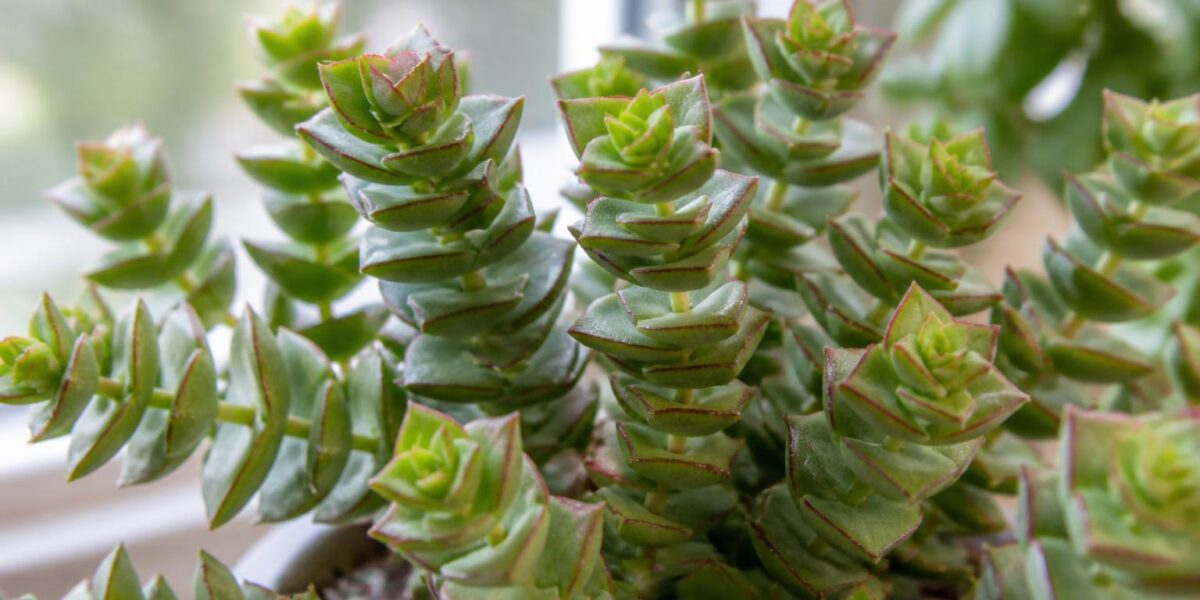
Crassula tetragona is sold under names like “Miniature Pine Tree” specifically because its slim, pointed, evergreen-needle leaves arranged on woody stems make it look like a tiny conifer. It is one of the most commonly mistaken houseplants in the pet community. The mistake matters in two directions:
- Pet owners who think they have a pine bonsai may be more relaxed about access — but tetragona is more toxic than pine.
- Pet owners who think they have tetragona may panic about a non-incident pine snack.
Compare your plant’s features against these distinguishing marks:
- Tetragona leaves are succulent — fleshy, soft, easily squashed between fingers. They are arranged in opposite pairs (decussate), not in fascicles.
- True pine needles are firm, slightly waxy, and grow in bundles (fascicles) of 2, 3, or 5 needles held by a small basal sheath.
- Tetragona stems are smooth, green-to-tan, and obviously succulent.
- Pine stems develop bark scales early and feel woody.
If your “pine” leaves squish like a sponge between your fingertips, you have a tetragona. See pine bonsai safe for pets for the actual conifer — note that pine is mildly GI-irritating but not classically toxic.
Toxic Compounds in Crassula Tetragona
Consistent with the genus profile, suspected toxins include:
- Saponins — irritate the GI tract by disrupting cell membranes.
- Bufadienolide-like cardiac glycosides — small amounts; far less concentrated than in Kalanchoe.
- Unidentified GI irritants — the ASPCA notes the toxic principle is not fully characterized.
The combination produces predictable mild-to-moderate GI illness with occasional cardiovascular involvement at higher doses.
Symptoms After Tetragona Ingestion
Watch for the following within 1–6 hours of suspected exposure:
- Vomiting
- Lethargy or depression
- Decreased appetite
- Ataxia or wobbly walking
- Drooling
- Mild diarrhea
- Slow heart rate (occasionally noted in cats)
Most pets recover within 24–48 hours with supportive care. Persistent vomiting, lethargy beyond a day, or any cardiac signs warrant immediate veterinary attention.
First Aid Steps
Remove the plant. Collect any chewed branches and dropped leaves. Tetragona’s slim leaves are easy to lose track of on a hardwood floor — sweep thoroughly. Photograph the plant for the vet.
Offer water but do not force it. Do not induce vomiting. Do not give milk, hydrogen peroxide, or salt-based home remedies.
Phone your veterinarian, the ASPCA Animal Poison Control Center at 888-426-4435, or the Pet Poison Helpline at 855-764-7661. Have the species name (Crassula tetragona, Mini Pine Tree), your pet’s weight, and the time and amount of exposure ready. A consultation fee may apply to the poison-control lines.
When to Head to the Clinic
Go to the emergency vet the same day if you see:
- Repeated vomiting
- Profound lethargy or collapse
- Severe ataxia or seizures
- Slow or irregular heartbeat
- Pale gums or signs of shock
Veterinary care typically includes anti-emetics, IV fluids, ECG monitoring if cardiac signs appear, and overnight observation in higher-risk patients.
Why Crassula Tetragona Sneaks Into Pet Homes
Tetragona is widely sold as a “miniature pine” or “starter bonsai” — labels that imply pet safety without actually delivering it. Three reasons it gets into homes that would otherwise avoid Crassula:
- Marketing names. “Mini Pine Tree” sounds like Pinus.
- Bonsai shaping. The plant trains beautifully into a tabletop tree, which puts it at cat-batting height.
- Easy propagation. Cuttings root in days, so a single plant becomes a windowsill collection.
If you keep multiple Crassula species, also see Crassula perforata toxic to pets (string of buttons) and Crassula arborescens toxic to pets (silver dollar plant). All three are part of the same toxicity category.
Living With Crassula Tetragona Safely
Place the plant on a tall stable shelf with no climb route. A hanging basket above pet jumping range is also reasonable. Avoid windowsills, coffee tables, and end tables.
Sweep dropped leaves daily. Tetragona leaves are small enough to scatter under furniture; do a thorough check after you handle the plant.
If you propagate from cuttings, keep the propagation tray separate from your living areas while roots establish. Keep tools, fertilizer, and pest sprays sealed and out of pet reach.
Pet-Safe Alternatives
If you want a similar miniature-tree aesthetic without the Crassula toxicity, consider:
- Pine bonsai (true Pinus species) — mildly GI-irritating but not classically toxic. See pine bonsai safe for pets.
- Chinese elm bonsai (Ulmus parvifolia) — ASPCA non-toxic; the gold-standard pet-safe bonsai. See Chinese elm bonsai safe for pets.
- Echeveria or Haworthia rosettes — non-toxic succulents that fill a similar tabletop role.
For broader options, see are succulents toxic to cats, are succulents toxic to dogs, and cat-safe houseplants. Meet adoptable companions at adopt cats and adopt dogs.
Why the Pine Look-Alike Confusion Is Dangerous in Both Directions
The “Mini Pine Tree” name confuses pet owners in two opposite ways, both with consequences:
- Direction one: The owner thinks they have a pine bonsai, relaxes about access, and is shocked when the cat starts vomiting after a leaf nibble. The reality — Crassula tetragona is more toxic than pine — comes too late.
- Direction two: The owner thinks they have Crassula tetragona, panics when the dog snacks on what is actually a pine bonsai, and rushes to the emergency clinic when home monitoring would have been adequate. Cost and stress are the consequences here.
Identification is the first step in any pet-safety plan. The squeeze test (succulent leaves squash; pine needles do not), the bundle test (pine needles grow in fascicled groups; tetragona leaves grow in opposite pairs along succulent stems), and the texture test (pine needles are firm and waxy; tetragona leaves are soft and powdery) all take seconds and resolve the question.
How Cats and Dogs Encounter Crassula Tetragona
Tetragona is a tabletop or windowsill succulent in most homes. Common exposure routes:
- Leaf nibbling. The slim leaves are easy to chew and easy to break off cleanly.
- Branch chewing. The succulent stems contain the same compounds as the leaves and snap off when batted.
- Floor pickup. Dropped leaves scatter on hard floors and are exactly the right size for a cat or small dog to mouth.
- Propagation tray investigation. Tetragona roots so easily that owners often have a propagation tray going somewhere — those rooting cuttings still contain the toxic compounds.
What to Tell Your Vet
Have ready: your pet’s species, breed, weight, age, and any pre-existing conditions or medications; the plant species (Crassula tetragona, mini pine tree, miniature pine); the time and approximate amount of exposure; and any signs observed. Photograph the plant. If you also keep a true pine bonsai, photograph that too — the comparison helps the vet confirm which species is involved.
Bring a leaf to the clinic. Squeezed between fingers, a fresh tetragona leaf will deform; that single observation lets the vet rule out pine without further analysis. See pine bonsai safe for pets for the look-alike conifer.
Long-Term Living With Crassula Tetragona and Pets
If you have decided to keep your mini pine tree, build a routine that prevents accidental contact. Daily and weekly habits that help:
- Display on a high stable shelf or hanging basket out of paw range. The slender form is easy to knock over from any low surface.
- Sweep the area around the pot daily — small leaves are easy to lose track of on hardwood floors.
- Use a wide flat tray under the pot to catch any debris.
- Cover the soil with larger pebbles to discourage cat digging and dog mouthing.
- Keep propagation trays in a separate room while cuttings root — tetragona roots so easily that owners often have multiple cuttings going at once.
- Store fertilizer, pest sprays, and tools sealed and out of pet reach.
If you also keep other Crassula species — perforata, arborescens, capitella, or the standard jade plant — apply the same supervision rules to all of them. The toxicity is genus-wide.
Some cats and dogs are persistent plant-eaters. They will find a way to a tetragona on a shelf you thought was safe. If your pet has a documented history of plant snacking — past vet visits for plant ingestion, repeat episodes despite environmental changes — the simplest long-term answer is to rehome the tetragona to a friend without pets. The risk-reward calculation rarely favors keeping a toxic plant in a household with a determined plant-eater.
Browse non-toxic alternatives at our cat-safe houseplants guide. Meet adoptable companions at adopt cats and adopt dogs.
Frequently Asked Questions
Is Crassula tetragona toxic to pets?
Yes. Mini Pine Tree (Crassula tetragona) shares the genus toxicity of jade plant. Ingestion causes vomiting, lethargy, decreased appetite, and occasionally ataxia or slow heart rate.
How do I tell Crassula tetragona from a real pine bonsai?
Squeeze a leaf. Tetragona leaves are succulent and squashy; pine needles are firm and waxy. Pine needles also grow in fascicled bundles, while tetragona leaves grow in opposite pairs along succulent stems.
What does Crassula tetragona poisoning look like?
Vomiting and lethargy within a few hours, often with decreased appetite. Severe cases may show ataxia or slow heart rate. Call your vet or ASPCA APCC at 888-426-4435 if signs persist.
Should I induce vomiting at home if my pet ate Crassula tetragona?
No. Call your vet or Pet Poison Helpline at 855-764-7661 for triage. Home emesis is not safe without veterinary direction.
Is there a non-toxic miniature pine alternative?
Yes. True pine bonsai (Pinus species) is non-toxic in the classical sense — only mildly GI-irritating. Chinese elm bonsai is the safest tabletop bonsai overall.


