
Last updated: May 16, 2026
In this article
- The Short Answer on Echeveria and Pets
- What Echeveria Actually Is
- What “ASPCA Non-Toxic” Means in Practice
- The Critical Confusion: Echeveria vs Jade Plant
- The Sempervivum Naming Overlap
- The Mechanical Caveats
- Cat-Specific Considerations
- Dog-Specific Considerations
- Other Succulents to Know About
- What to Do If Your Pet Eats Echeveria
- Echeveria in Pet-Safe Garden and Home Design
- When to Call the Vet
- Frequently Asked Questions
The Short Answer on Echeveria and Pets
Yes, echeveria is safe for pets. The popular rosette-forming succulent genus Echeveria is listed by the ASPCA as non-toxic to both cats and dogs. The echeveria safe for pets question lands solidly in the reassuring category. If your cat batted at one of those photogenic blue-green or pink-tipped rosettes on the windowsill, or your dog mouthed a rosette in the garden, you are not facing a poisoning emergency. This is one of the most genuinely pet-safe succulents in widespread cultivation, and the popularity of echeveria in modern interior styling means lots of pet households want this exact reassurance.
That said, “non-toxic” comes with the standard caveats and one critical caution about plant identification. Any plant matter eaten in large quantity can cause GI upset because pet GI tracts are not built for fibrous foliage. The fleshy leaves are also a choking or chewing concern in very young pets. The most important caveat is the common-name confusion: “hen-and-chicks” refers to both echeveria (safe) and sempervivum (also safe), but is sometimes loosely applied to other succulents in casual conversation, and the unrelated Crassula ovata (jade plant) — which IS toxic to pets — is sometimes mistaken for echeveria.
What Echeveria Actually Is
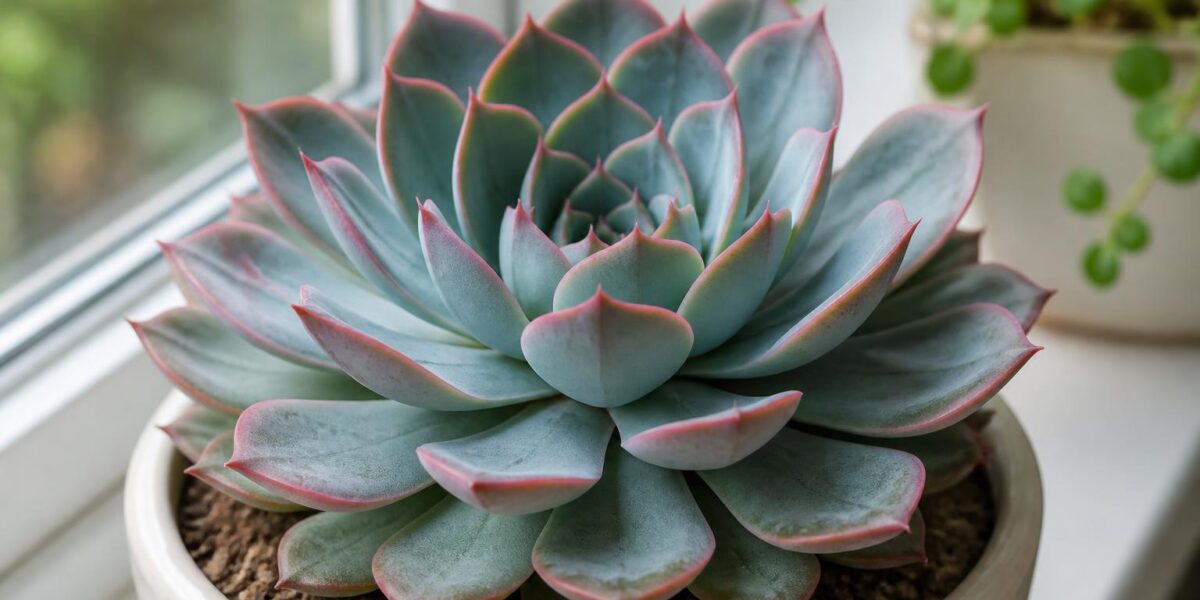
Echeveria is a genus of about 150 species of leaf succulents in the Crassulaceae family, native to semi-desert areas of Mexico and Central America. They form tight, photogenic rosettes of fleshy leaves in soft shades of blue-green, silver, lavender, peach, or red, often with pink or red leaf tips that intensify in bright sun and cool temperatures. They are among the most photographed succulents on social media for good reason — they are visually striking and easy to grow.
Common species and cultivars include Echeveria elegans (Mexican snowball, classic powder-blue rosettes), Echeveria ‘Black Prince’ (deep maroon), Echeveria ‘Lola’ (silvery lavender), Echeveria gibbiflora (large gibbous-leaved rosettes), Echeveria agavoides (pointed agave-like leaves), and many hybrid cultivars produced annually by succulent specialists. They are sold worldwide in garden centres, succulent specialty shops, and even general homewares stores.
Care is straightforward: bright light, well-drained gritty soil, modest watering. They tolerate the conditions of most homes and offices. Mature plants produce offsets (“chicks”) around the base of the original rosette (“hen”), giving rise to the “hen-and-chicks” common name. Many propagate readily from leaf cuttings, which is part of why they have become so widely shared and grown.
What “ASPCA Non-Toxic” Means in Practice
The ASPCA’s plant database lists Echeveria as non-toxic to cats, dogs, and horses. That listing means there is no documented systemic toxicity from typical exposures — the plant does not contain compounds known to cause clinical poisoning at the doses pets realistically encounter.
“Non-toxic” does not mean food. It means that occasional accidental ingestion does not require emergency intervention. Pets that eat large amounts of any plant matter can develop:
- Vomiting
- Diarrhea or loose stools
- Drooling or excessive lip-licking
- Reduced appetite for a day or two
- Pawing at the mouth
These signs are non-specific and self-limiting in most cases. They reflect the fact that pet GI tracts do not handle large fibrous plant servings well, not that echeveria is harmful. The same picture happens with grass, pothos foliage in dogs (mild cases), and many other plants pets occasionally chew.
For households where this is the realistic question — “my cat occasionally chews a leaf, do I need to worry” — the honest answer is no. Discourage the chewing for the cat’s comfort and the plant’s appearance, but do not panic.
The Critical Confusion: Echeveria vs Jade Plant
This is the single most important point in this article. Crassula ovata, the jade plant, is in the same plant family (Crassulaceae) and shares some superficial visual characteristics with echeveria — fleshy leaves, succulent habit, ease of propagation. Jade plants are extremely common houseplants worldwide.
Jade plant IS toxic to pets. The ASPCA lists Crassula ovata (also called jade tree, dollar plant, money tree, or Chinese rubber plant) as toxic to dogs and cats, with reported signs including vomiting, depression, and ataxia. The exact toxic compound has not been fully identified but the toxicity is consistent enough to warrant the listing. Cats and dogs have reportedly developed neurological signs (incoordination, lethargy) after chewing jade plant leaves.
Distinguishing the two:
- Echeveria: Tight rosette form. Leaves arranged spirally in a low symmetric rosette. Many leaves visible at once from above. Often blue-green, silver, or pastel-tinted.
- Jade plant (Crassula ovata): Tree-like or shrubby form. Thick woody central stem with paired oval leaves at branch tips. Leaves usually deep glossy green, sometimes with red leaf margins in bright sun. The plant looks like a small tree, not a flat rosette.
If you are reading this article because of a pet incident, identify which plant your pet actually encountered. The flat rosette of fleshy leaves is echeveria (safe). The miniature-tree habit with thick stems is jade plant (toxic). For the toxic side, see jade plants and cat toxicity and jade plants and dog toxicity.
The Sempervivum Naming Overlap
“Hen-and-chicks” is the common name applied to two unrelated genera:
Echeveria — Mexican origin, frost-tender, popular as a houseplant or in protected outdoor pots in cool climates. Non-toxic to pets.
Sempervivum — European origin, frost-hardy, popular in alpine rock gardens and outdoor planters in cold climates. Non-toxic to pets.
Both are reliably safe, so the naming overlap is not a safety risk. The visual difference: Sempervivum forms tighter, more compact rosettes with thinner pointed leaves, often with prominent leaf tips and hair-like marginal cilia. Echeveria leaves are typically broader, fleshier, and softer-looking. Both produce daughter rosettes around the base, hence the shared common name.
If your “hen-and-chicks” came from a frost-resistant outdoor planter that has survived winter, it is more likely Sempervivum. If it came as a houseplant from an indoor succulent display, it is more likely Echeveria. Either way, both are non-toxic.
The Mechanical Caveats
Beyond chemistry, three practical cautions are worth knowing:
Choking hazard for puppies and kittens. A young pet that gulps an entire fleshy leaf can have it lodged momentarily in the esophagus. The leaf is soft and usually passes, but worth watching young pets that grab whole leaves.
Soil and pesticide residues. Succulents from commercial growers may have been treated with systemic pesticides (neonicotinoids) that persist in plant tissue. New-purchase plants are best re-potted in fresh substrate before pet exposure. Pebble or grit top dressing also discourages cats from using pots as litter.
Pottery, lights, and accessories. Succulent displays often involve heavy pottery on shelves and edges. Pet activity around them risks knocked-over pots, broken pottery shards, and minor injury. Position displays so pets cannot reach them on impulse, or use unbreakable containers.
Cat-Specific Considerations
Cats are the species most likely to interact with houseplants, and the ASPCA non-toxic listing for echeveria matters most for cat households. Echeveria is one of the few visually striking succulents that can sit on a cat-accessible windowsill without anxiety.
For cats that nibble succulents repeatedly, consider:
- Providing dedicated cat grass (oat, wheat, or barley grass) as a designed outlet for the chewing instinct
- Reviewing the diet — some chewers are seeking missing fibre or moisture
- Repositioning the plant if the cat persistently knocks it over, more for the plant than the cat
- Replacing damaged rosettes with fresh ones; cats often lose interest once they have “tasted” a leaf
Our roundup of cat-safe houseplants covers a broader list of safe greenery. Pairing echeveria with non-toxic alternatives like calathea, areca palm, parlor palm, and spider plant gives a cat household a strong houseplant collection without toxicity worries.
Dog-Specific Considerations
Dogs interact with succulents differently. Most adult dogs ignore them. Puppies and bored adolescent dogs may chew on accessible plants, leading to mild GI upset (with echeveria) or worse (with jade plant or other Crassula species).
For dog households:
- Position echeveria pots out of nose-height for tall dogs
- Use heavy ceramic pots that resist tipping
- Pick up dropped leaves promptly to reduce chew temptation
- Avoid cocoa mulch in indoor or outdoor pots — cocoa is toxic to dogs from theobromine
For broader dog-and-succulent safety, haworthia is another reliably non-toxic succulent that pairs well with echeveria. Our roundup of succulent safety for dogs covers the full spectrum from confidently safe (echeveria, haworthia, sempervivum) to genuinely toxic (jade, kalanchoe, aloe). The cat side of the same roundup covers the parallel list for cat households.
Other Succulents to Know About
Pet-safe succulents (commonly available and ASPCA non-toxic):
- Echeveria (this article)
- Haworthia (zebra plant) — see haworthia and cat safety
- Sempervivum
- Sedum (most species)
- Lithops (living stones)
- Burro’s tail / donkey’s tail
- Ghost plant (Graptopetalum)
Toxic or concerning succulents to watch for:
- Jade plant (Crassula ovata) — moderate toxicity
- Aloe vera — see aloe and dog safety
- Euphorbia species (pencil cactus, crown of thorns) — irritant sap
- Kalanchoe — cardiac glycosides
- Sago palm (not a true succulent but often grouped with them) — severely toxic
- Yucca — saponins
The takeaway: the succulent category is a mixed bag. Picking species deliberately gives you a confident pet-safe collection. Random impulse buys at the supermarket succulent display land you with whatever is on sale, which may or may not be safe.
What to Do If Your Pet Eats Echeveria
For typical small-volume chewing of echeveria leaves:
- Stop further access. Move the plant or supervise more closely.
- Check the mouth gently. Remove visible plant fragments.
- Offer fresh water.
- Observe for vomiting or loose stools over the next 24 hours.
- Most pets are completely fine. No further intervention needed in most cases.
Call your vet if you see repeated vomiting, diarrhea lasting more than 24 hours, refusal to eat, or any unusual behavioural changes. Also call if you are unsure whether the plant your pet ate was actually echeveria or a similar-looking jade plant — the toxicity pictures are different and identification matters for treatment planning.
The ASPCA APCC at 888-426-4435 (consultation fee) and the Pet Poison Helpline at 855-764-7661 (consultation fee) are 24-hour resources if you cannot reach your usual vet. Both can help triage whether home monitoring is appropriate or whether you should visit a clinic.
Echeveria in Pet-Safe Garden and Home Design
If you are designing pet-safe plant displays, echeveria is one of the most reliable choices. Use it as the centerpiece of a windowsill grouping, in shallow display dishes, or as outdoor container subjects in mild climates. Pair with confidently safe partners like haworthia and sempervivum for textural variety, and with non-toxic foliage plants like areca palm, calathea, and spider plant for the larger living space.
For households considering a new pet, echeveria does not need to be removed. Walk through the rest of the plant collection alongside it — identify any genuinely toxic plants (jade, kalanchoe, aloe, sago palm, lilies in cat households, dieffenbachia, oleander, pothos) and decide whether to rehome them or restrict pet access. Our cat-safe houseplants guide and the broader cat adoption resources cover indoor pet-proofing in detail.
For dog households, similar thinking applies. Our dog adoption guide includes a checklist for both indoor and outdoor pet hazards.
When to Call the Vet
Call the clinic if you see any of the following after suspected echeveria ingestion:
- Repeated vomiting beyond one or two episodes
- Diarrhea lasting more than 24 hours
- Refusal to eat for more than a meal or two
- Lethargy, weakness, or unusual stumbling
- Any uncertainty about whether the plant was actually echeveria or a similar-looking jade plant
- Suspected swallowing of intact whole leaves in small puppies or kittens
- Pre-existing health conditions that warrant a lower threshold for vet contact
For after-hours questions, the ASPCA APCC at 888-426-4435 and the Pet Poison Helpline at 855-764-7661 are 24-hour services. Both charge consultation fees. Phone consultation is far cheaper than an unnecessary emergency visit and can help you triage the situation correctly.
Frequently Asked Questions
Are echeveria really completely safe for cats?
The ASPCA lists echeveria as non-toxic to cats. There is no documented systemic toxicity at typical exposures. Cats that eat large amounts of any plant matter can develop mild GI upset, but echeveria does not cause specific poisoning. It is one of the safer options for a cat-accessible succulent display.
What about my dog chewing on echeveria leaves?
The plant is non-toxic to dogs. Realistic concerns are mild GI upset from larger ingestions and choking on whole intact leaves in small puppies. Pick up dropped leaves, position pots out of easy reach, and call your vet if your dog shows persistent vomiting or stomach signs.
Is echeveria the same as jade plant?
No. Echeveria is a low rosette-forming succulent (non-toxic). Jade plant (Crassula ovata) is a tree-like or shrubby succulent with paired oval leaves on woody stems (toxic). Both are in the Crassulaceae family but they are different plants with different toxicity profiles.
Are sempervivum and echeveria both safe?
Yes, both. Both are sometimes called “hen-and-chicks.” Sempervivum is European, frost-hardy, and forms tight pointed-leaf rosettes. Echeveria is Mexican, frost-tender, and forms broader fleshy-leaved rosettes. Both are non-toxic to dogs and cats.
Can I propagate echeveria leaves where my pet can find them?
Yes, technically the leaf cuttings are not toxic. But scattered leaf cuttings on shelves or table surfaces invite pet investigation. Set up propagation in a tray on a high shelf or in a room the pet does not access, more for the propagation success than for safety reasons.


