
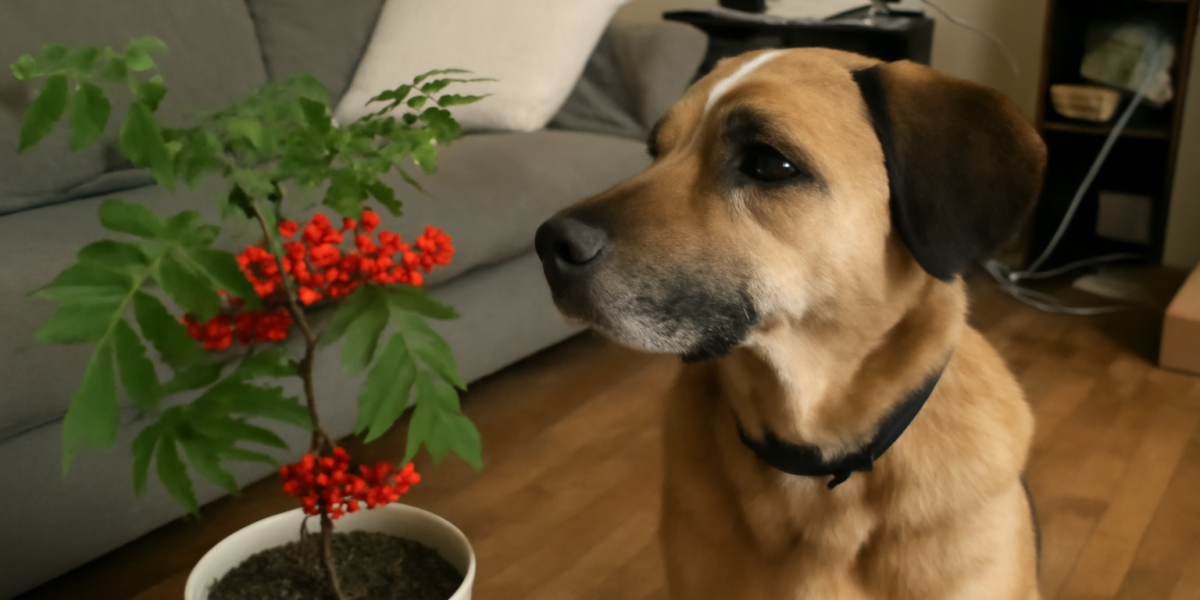
The Short Answer: Rowan Berries Are Mildly Toxic Raw, Safer Cooked
Rowan berries — the bright orange-red berries of the mountain ash tree (Sorbus aucuparia) — are mildly toxic to dogs, cats, and humans when eaten raw in larger quantities. The active irritant is parasorbic acid, a compound that causes gastrointestinal upset (vomiting, diarrhea, stomach pain) on ingestion. Severity tier is mild for small ingestions and moderate for larger ingestions, particularly in small pets. The same compound converts to the much safer sorbic acid when berries are cooked, frozen, or dried, which is why traditional rowan jelly and jam are perfectly fine for human consumption.
In this article
- The Short Answer: Rowan Berries Are Mildly Toxic Raw, Safer Cooked
- What Mountain Ash Is and Where You Find It
- The Parasorbic Acid Story
- Symptoms After Rowan Berry Ingestion
- What to Do If Your Pet Ate Rowan Berries
- Why Cooked Rowan Is Safer
- Distinguishing Rowan from Other Berry-Bearing Trees
- Realistic Yard Exposures
- Cooking Berries vs Garden Foraging
- Cat-Specific Considerations
- Rowan in Folklore and Tradition
- Other Berry and Tree Hazards in the Yard
- Building a Pet-Aware Berry Garden
- Frequently Asked Questions
If your pet snatched a few ripe berries off a low branch or ate berries off the ground, the most likely outcome is a brief bout of vomiting or soft stool followed by full recovery. Larger ingestions warrant a vet call. Rowan berries toxic pets searches usually end with reassurance plus monitoring rather than emergency intervention. The plant is not in the same severity tier as cardiac-glycoside or cyanogenic-glycoside ingestions.
What Mountain Ash Is and Where You Find It
Rowan, also called mountain ash, is a small to medium deciduous tree in the rose family (Rosaceae). Despite the “ash” common name, it is unrelated to true ash trees (Fraxinus). The tree is native across northern Europe, the British Isles, parts of Asia, and (in related species) the cooler regions of North America. It is widely planted as an ornamental for its compound feather-like leaves, white flower clusters in spring, and showy orange-red berries in autumn.
The most-encountered species is Sorbus aucuparia — the European rowan. American mountain ash (Sorbus americana) and showy mountain ash (S. decora) are similar species with comparable berry chemistry. Whitebeam, service tree, and several other Sorbus species share the genus. For pet-safety purposes, the same general guidance applies across the genus: raw berries are mild GI irritants, cooked berries are not.
The tree is common in UK gardens, Scandinavian forests, and urban plantings across northern climates. Mature trees produce dense clusters of berries that drop or are picked over by birds in late autumn. For pet households, the realistic exposure is to berries that fall onto the ground or branches that hang low enough for an investigating dog or cat.
The Parasorbic Acid Story
The mildly toxic principle in raw rowan berries is parasorbic acid, a lactone compound also found in some other Sorbus species. In its native form, parasorbic acid irritates the lining of the digestive tract, producing vomiting and diarrhea. The intensity scales with the amount eaten and the size of the pet.
Cooking, drying, freezing, or fermenting the berries converts parasorbic acid to sorbic acid — the same widely used food preservative found in many human foods. Sorbic acid is essentially non-toxic. This conversion is why traditional rowan jelly (a tart accompaniment to game meats in northern European cuisine) is safe for humans, and why frozen-then-thawed berries are less of a problem than fresh.
For pet exposure, the assumption should always be that the berries are raw. Pet ingestion typically happens with fresh berries on the tree or freshly fallen — not with carefully cooked rowan jelly. So treat the parasorbic acid as the operative concern.
Symptoms After Rowan Berry Ingestion
The clinical picture is fairly predictable. Within one to four hours of eating berries, expect to see vomiting (often with visible berry pieces), drooling, lip-licking, and possibly diarrhea. Some pets show abdominal discomfort — restlessness, the “praying” position with the front end down, or audible gut sounds.
Most cases self-limit within 12 to 24 hours. The pet vomits up the offending berries, the gut clears, and a return to normal eating happens by the following day. Dehydration from repeated vomiting is the main practical risk, particularly in small pets and very hot weather.
Severe cases — protracted vomiting, bloody diarrhea, lethargy that does not lift — warrant prompt veterinary care. These are unusual for rowan berries alone in healthy pets and may suggest concurrent issues (foreign body obstruction from a swallowed branch piece, a different plant ingested at the same time, or an unrelated illness).
What to Do If Your Pet Ate Rowan Berries
Stay calm and follow a sensible sequence. Move your pet to a quiet area and remove access to remaining berries — pick up fallen berries, leash the dog, or move the cat to a different part of the yard. Wipe any berry juice from the muzzle or paws with a damp cloth. Note the time, the approximate amount eaten, and any symptoms you have seen.
For a small ingestion in a healthy adult pet, home monitoring for 24 hours is usually appropriate. Offer fresh water in modest amounts to prevent rapid drinking-and-vomiting cycles. Withhold food for two to four hours after the most recent vomit, then offer a small amount of bland food (boiled chicken and rice, or a vet-approved bland diet).
Call the vet if your pet is small (under 5 kg or so), if vomiting persists beyond two episodes, if there is bloody vomit or diarrhea, if your pet refuses water, or if any unusual neurological signs appear. The ASPCA Animal Poison Control Center at (888) 426-4435 and the Pet Poison Helpline at (855) 764-7661 are both staffed around the clock by veterinary toxicologists. Both charge a consultation fee.
Do not induce vomiting at home. The bitter berries usually trigger natural mouth-clearing responses on their own, and home emesis can cause aspiration. Decontamination decisions belong to the vet.
Why Cooked Rowan Is Safer
Traditional human use of rowan berries — jelly, jam, schnapps in central Europe, syrups in Scandinavia — relies on the conversion of parasorbic acid to sorbic acid through heat. The cooking process essentially eliminates the irritant principle. This is well established in food chemistry and is the reason rowan jelly has been a staple of game-meat cooking for centuries.
What this means for pets: a cat or dog who licked rowan jelly off a kitchen counter is not in the same risk tier as a cat or dog who ate fresh berries off the tree. The cooking has done most of the safety work. Sugar load (in jam or jelly) and any other ingredients (alcohol in schnapps, spices, citric acid) become more relevant than the rowan itself.
For practical advice, do not deliberately offer rowan jelly to pets — the sugar content and the lack of nutritional benefit argue against it — but do not panic if a pet stole a small taste. The historical safety record of cooked rowan in human cuisine is reassuring.
Distinguishing Rowan from Other Berry-Bearing Trees
Rowan trees are sometimes confused with several other landscape trees that have showy autumn berries. The pet-safety conversation differs across species.
Hawthorn (Crataegus) has small red berries in dense clusters, simple leaves, and notable thorns. Generally low-toxicity for pets — covered in our companion piece on hawthorn berries and pets.
Holly berries are red, glossy, and on a different tree (Ilex) with spiky evergreen leaves. Toxic to pets, with GI upset as the typical picture.
Juniper berries are blue-black, on coniferous shrubs, with needle-like leaves. Generally low-toxicity but warrant a call for large ingestions.
Mistletoe berries are pearly white, on parasitic plants growing on host trees. Toxic to dogs and cats with GI and rare cardiac effects. Dogwood berries are mildly toxic — a different family of small landscape trees.
Photograph the tree if you are unsure which berry your pet ate. Branch shape, leaf shape, and berry color and arrangement together usually allow identification. The vet appointment goes faster with confident ID.
Realistic Yard Exposures
Rowan trees are common in temperate-climate gardens, particularly in the UK, Ireland, Scandinavia, and the cooler parts of the northern US and Canada. Berries ripen in late summer to autumn and can stay on the tree through early winter, making bird food and (for some pets) accidental snack opportunities.
For pet households with rowan trees, the realistic exposure points are: fallen berries on the ground after autumn drops, low-hanging branches that small dogs or cats can reach, and pruning piles after garden cleanup. Picking up dropped berries during peak ripening reduces ground-level exposure substantially.
Bird-loving households often appreciate rowan precisely because of the berry attraction. Songbirds eat rowan berries readily, and the tree is a wildlife garden classic. Coexistence with pets is straightforward: pick up drops, prune low branches, supervise the dog during berry season.
Cooking Berries vs Garden Foraging
Some plant-curious pet owners ask whether they can feed pets a “safe” amount of cooked rowan as part of a varied diet. The answer is essentially no — there is no nutritional benefit to rowan that cannot be obtained from safer foods, and the sugar content of rowan jelly is its own concern for dogs.
For dogs and cats specifically, fruits that are known safe in moderation include blueberries, watermelon (seedless), and small amounts of plain apple (no seeds). Skip rowan from any deliberate offering list. If you make rowan jelly at home, store it where pets cannot reach the jar — the sugar content is more of a concern than the fruit residue.
Cat-Specific Considerations
Cats are less likely than dogs to eat rowan berries, partly because cats are obligate carnivores with little interest in fruit, and partly because berry size and texture do not appeal to most cats. A curious kitten might investigate a fallen berry, but mature cats almost always ignore them.
The realistic cat exposure is typically a small kitten playing with a berry as a toy and possibly licking it, or a cat that brought a chewed branch indoors as part of normal carrying behavior. Symptoms (if any) are usually mild and self-limiting. Vet contact is reasonable for any persistent vomiting, lethargy, or refusal to eat.
For broader cat plant audits, our roundup of cat-safe flowers and cat-safe houseplants walks through verified-safe options. Walk Me Home Rescue’s adopt a cat hub covers home prep alongside breed and temperament guidance for new families.
Rowan in Folklore and Tradition
This is a brief detour worth knowing about because pet owners sometimes encounter rowan in unexpected contexts. The tree has a long history in northern European folklore as a protective species — rowan was traditionally planted near houses to ward off evil spirits, and rowan wood is used in some Scottish, Norse, and Celtic traditions for amulets and tools.
In some folk-medicine traditions, rowan berries are used in cooked preparations as a digestive aid. These uses are for humans only and have no veterinary application. If you encounter “rowan tincture” or “mountain ash extract” in a herbal cabinet, store it where pets cannot access it — the alcohol content and concentrated active compounds make it more dangerous than fresh berries.
Rowan-flavored schnapps is popular in central Europe and contains both alcohol (toxic to pets) and concentrated berry compounds. Same storage advice applies.
Other Berry and Tree Hazards in the Yard
Rowan tends to be planted alongside other berry-bearing or fruiting trees. Knowing the cast of characters in your yard helps with quick triage.
If you have rowan, you may also have hawthorn, holly, juniper, dogwood, or various berried shrubs nearby. Each has its own profile. Hawthorn berries are low-toxicity. Holly berries are toxic to cats and dogs. Juniper berries are generally low concern. Mistletoe berries to cats warrant care.
For broader pet-safe garden ideas, our overview of pet-safe garden plants covers plants verified safe across categories. Trading out one toxic shrub at a time as gardens are renovated is often more practical than a wholesale yard overhaul.
Building a Pet-Aware Berry Garden
Mountain ash and other berry-bearing trees are wonderful for wildlife and beautiful in autumn. Coexistence with pets is straightforward in most cases. The headline practices are: identify what you have, pick up drops during peak season, supervise pets during ripe-fruit windows, and respond promptly to suspected ingestions.
For households where the dog or cat is a known forager, a more cautious approach might mean fencing off the rowan during autumn or moving the tree to a less-accessible part of the yard. Smaller yards may benefit from choosing pet-safer ornamental trees instead — magnolia, dogwood (selected non-fruiting cultivars), serviceberry. Walk Me Home Rescue’s hubs at adopt a cat and adopt a dog include yard-prep guidance alongside breed and temperament considerations for new families building or renovating outdoor space.
Frequently Asked Questions
Are rowan berries dangerous to dogs?
Mildly. Raw rowan berries contain parasorbic acid, which causes vomiting and diarrhea. Small ingestions usually self-limit within 24 hours. Larger ingestions in small dogs warrant a vet call.
What about rowan jelly or jam?
Cooking converts parasorbic acid to safer sorbic acid, so cooked rowan products are less of a toxicity concern. Sugar content and any added ingredients become more relevant than the fruit itself. Do not deliberately offer to pets.
How many berries does it take to cause a problem?
This depends on the size of the pet. A few berries in a 30-kg dog may produce no symptoms. The same handful in a 3-kg cat or small dog may cause noticeable vomiting. Smaller pets warrant lower thresholds for vet contact.
Are mountain ash leaves and bark also toxic?
The bark, leaves, and seeds contain cyanogenic glycosides in small amounts (typical of the rose family). Ingestion is uncommon and reports of meaningful poisoning from leaves alone are rare. The berries are the main pet-exposure concern.
How long does rowan-berry GI upset last?
Most cases resolve within 12 to 24 hours. Persistent vomiting, bloody stool, lethargy, or refusal to eat beyond a day warrants veterinary attention.


