
Last updated: May 16, 2026
In this article
- The Short Answer on Syngonium and Cats
- What Syngonium Actually Is
- The Calcium Oxalate Raphide Mechanism
- Symptoms to Watch For
- Why the Severity Stays Mild for Most Cats
- What to Do If Your Cat Chewed Syngonium
- What the Vet Will Likely Do
- Look-Alike and Name Confusion
- Cat-Safer Houseplant Alternatives
- Keeping Your Existing Syngonium and Your Cat
- When to Skip the Wait-and-See
- The Bigger Picture for Cat Households
- Frequently Asked Questions
The Short Answer on Syngonium and Cats
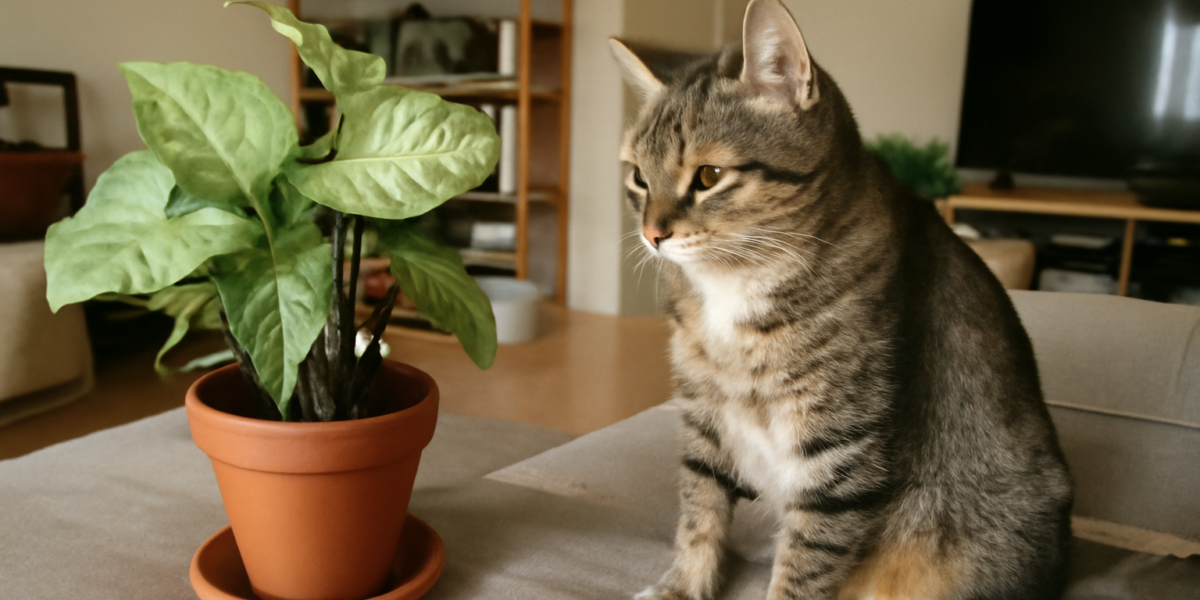
Syngonium is toxic to cats. The ASPCA lists Syngonium podophyllum, the plant most pet owners know as the arrowhead vine or arrowhead plant, on its toxic-to-cats register. The trouble is mechanical and chemical at the same time, and it shows up within minutes of a curious cat sampling a leaf. Severity sits in the mild-to-moderate range for most exposures, but the discomfort is genuine and the drooling can be dramatic enough to scare any owner.
If your cat just chewed a syngonium leaf and is now pawing at her mouth, drooling ropes of saliva, or refusing food, that is a textbook calcium oxalate reaction. Move the plant out of reach, rinse her mouth gently with cool water if she will tolerate it, and call your veterinarian or the ASPCA Animal Poison Control Center at 888-426-4435. Most cases resolve within a few hours with supportive care, but a vet visit is wise the first time it happens because swelling can occasionally tighten the airway.
What Syngonium Actually Is
Syngonium podophyllum is a climbing aroid native to Central and South America, sold under a confusing pile of common names. You will see it labeled arrowhead plant, arrowhead vine, goosefoot plant, American evergreen, nephthytis, and African evergreen, all referring to the same species. Younger leaves are arrow-shaped, which is where most of the names come from. As the plant matures and climbs, the leaves develop deep lobes that look almost hand-shaped.
It is one of the most popular beginner houseplants in the world because it tolerates low light, neglectful watering, and small pots. Garden centers sell pink, cream, white, and lime-green cultivars. The variegated forms are especially Instagram-friendly and especially common in homes with cats, which is part of why this article exists.
Syngonium belongs to the Araceae family, the aroid family. That single fact tells you almost everything you need to know about its toxicity. If you already know that monstera, pothos, philodendron, dieffenbachia, and peace lily are all bad news for cats, you already know the general shape of the syngonium problem. They share a chemical defense.
The Calcium Oxalate Raphide Mechanism
Aroids defend themselves with insoluble calcium oxalate raphides. Raphides are microscopic, needle-shaped crystals packed inside specialized cells called idioblasts. When a cat chews a leaf, the idioblasts rupture and fire the crystals like tiny biological darts into the soft tissue of the tongue, gums, and palate. The crystals are insoluble in water, which means the body cannot quickly dissolve or wash them away.
The crystals also carry proteolytic enzymes on their surfaces, which dial up the inflammation. The result is immediate burning pain, swelling, drooling, and sometimes vomiting if the cat manages to swallow plant material. This is the same chemistry you read about in articles on monstera toxicity in cats, pothos toxicity in cats, and dieffenbachia toxicity in cats. Different leaf, same defensive system.
The reason most aroid exposures stay in the mild-to-moderate band rather than escalating is that the pain itself stops the cat from eating much. A single bite is often enough to convince a sensible cat to walk away. Kittens, food-motivated cats, and bored indoor cats with nothing else to chew are the higher-risk patients because they may push past the initial sting.
Symptoms to Watch For
The classic signs of syngonium ingestion in a cat appear within five to thirty minutes of chewing.
- Sudden, heavy drooling, sometimes with foamy saliva at the corners of the mouth
- Pawing at the face or mouth, head shaking, repeated swallowing
- Visible redness or swelling of the gums, tongue, or lips
- Vocalizing, hiding, or restless pacing from the discomfort
- Vomiting, sometimes with shredded green plant fragments
- Refusal to eat or drink for several hours
- Mildly raspy or hoarse meowing if the throat is irritated
Less commonly, you may see watery eyes if the sap touched the face, or pawing combined with sneezing if the cat got sap on her whiskers and then groomed it onto her nose. Severe airway swelling that compromises breathing is rare but possible, particularly in kittens or in cats with pre-existing upper respiratory disease, and it is the single reason this is not a wait-and-see situation.
Why the Severity Stays Mild for Most Cats
The good news inside the bad news is that syngonium does not contain a true systemic toxin. The calcium oxalate raphides cause local pain and inflammation, but they do not cross into the bloodstream and damage the kidneys or liver the way true lilies do. Once the swelling settles and the cat rinses her mouth with water and grooming, the episode is essentially over.
That said, a small percentage of cats develop more dramatic reactions. Tongue or pharyngeal swelling that interferes with swallowing is the most worrying outcome. Cats with this presentation may drool continuously, refuse to drink, and lose body weight quickly because they are too sore to eat. These cats need a vet exam and sometimes a short course of anti-inflammatory medication, fluids under the skin, and a soft food diet for a few days.
Severity tends to be slightly worse with the variegated and white-leaf cultivars, which some growers anecdotally report as being more sap-rich. There is no rigorous study on this. What we do know is that any syngonium leaf or stem fragment carries the raphides, and the freshly cut sap is the most irritating part of the plant.
What to Do If Your Cat Chewed Syngonium
Stay calm and act in this order.
- Move the plant out of reach so the cat cannot take a second bite while you are dealing with the first.
- Gently wipe any visible plant material out of the mouth with a soft, damp cloth. Do not stick your fingers deep into a frightened cat’s throat.
- Offer cool water, a small amount of plain milk, or a lick of plain yogurt. The fat and protein bind some of the irritant chemistry and the cool temperature soothes the burn.
- Call your veterinarian or the ASPCA Animal Poison Control Center at 888-426-4435 (consultation fee applies). The Pet Poison Helpline at 855-764-7661 is a second option.
- Watch breathing carefully for the first two hours. If you see open-mouth breathing, blue-tinged gums, or a swollen tongue protruding from the mouth, drive to the nearest emergency vet immediately.
Do not induce vomiting at home. Hydrogen peroxide, salt water, and finger-down-the-throat techniques are all unsafe for cats and can make the irritation worse by re-exposing the esophagus to more raphides on the way back up. Decontamination decisions belong to a veterinarian.
What the Vet Will Likely Do
For most syngonium cases, treatment is supportive and the prognosis is excellent. Your veterinarian will examine the mouth and throat, check that swelling is not affecting breathing, and assess hydration. From there, treatment can include rinsing the mouth, prescribing an anti-inflammatory medication, providing fluids under the skin if the cat is reluctant to drink, and recommending soft, bland food for two to three days.
Bloodwork is rarely needed for a straightforward syngonium ingestion because the toxin does not damage organs. Your vet will reach for it only if symptoms do not match the history (suggesting another exposure happened too) or if the cat has an underlying condition that complicates recovery. Most cats are back to normal within twenty-four hours.
Look-Alike and Name Confusion
The biggest source of confusion with syngonium is its bouquet of common names. If a friend tells you they have an arrowhead plant or a goosefoot plant, that is syngonium and it is toxic. If they say they have a nephthytis, that is also syngonium. Some older houseplant books use Nephthytis as a separate genus, but the species sold today are almost all Syngonium podophyllum.
Do not confuse syngonium with arrowhead vine of the marsh (Sagittaria), which is an unrelated aquatic plant. And do not assume the pink variegated cultivars are somehow safer than the green ones. The cultivar name on the tag has nothing to do with the calcium oxalate content. Pink Syngonium, Confetti, Neon Robusta, Berry Allusion, and the rest all share the same toxicity profile.
Cat-Safer Houseplant Alternatives
If you love the trailing-vine look that draws people to syngonium, several non-toxic plants give you the same effect without the calcium oxalate problem. Spider plants are reliable cascading houseplants that the ASPCA lists as non-toxic to cats and dogs. Prayer plants (Maranta and Ctenanthe) give you the patterned-leaf drama with none of the toxicity. Calatheas are another excellent swap.
For climbing or trailing texture specifically, look at peperomia varieties, parlor palms, or hoya kerrii. Our full cat-safe houseplants guide goes into the trade-offs of each, including light needs and how easily kittens can knock them off shelves. The bromeliad family is another good shelf-friendly group.
Keeping Your Existing Syngonium and Your Cat
You do not necessarily have to throw out your arrowhead plant. Plenty of households share space with both a curious cat and a syngonium without incident, but it takes some thought. Hang the plant from a ceiling hook in a room the cat does not haunt. Use a closed terrarium for smaller specimens. Keep the soil covered with smooth river stones so the cat is not drawn to dig. And place the pot somewhere that does not let her launch from a nearby surface.
For households with kittens, senior cats, or cats with a history of plant chewing, rehoming the syngonium to a friend’s place is usually the kinder choice. Cats who chew houseplants tend to do so because they are bored, deficient in fiber, or under-stimulated. Offering a tray of cat grass or oat grass redirects the chewing instinct onto something safe and digestible.
When to Skip the Wait-and-See
Most syngonium exposures resolve on their own. Take the cat to a vet immediately, not in the morning, if you see any of the following: difficulty breathing, a tongue that looks visibly swollen and protruding, persistent vomiting, weakness or collapse, or refusal to drink water for more than twelve hours. These are uncommon but real complications, and a same-day exam costs less than a hospital stay for dehydration.
Kittens deserve a lower threshold for vet evaluation across the board. Their small body mass, narrow airways, and tendency to keep eating despite the pain make them the highest-risk patients in this category. If you have an eight-week-old kitten and a syngonium in the same room and you find chew marks on a leaf, call the vet even if the kitten currently looks fine.
The Bigger Picture for Cat Households
Plant toxicity is one of those slow-burn worries that owners often do not think about until something happens. The simple act of walking through every room of your home, noting what is on the windowsills and floors, and cross-referencing those plants against the ASPCA database can prevent a midnight emergency vet visit. Syngonium, monstera, pothos, philodendron, peace lily, dieffenbachia, dumb cane, calla lily, and elephant ear all share the same calcium oxalate chemistry and all should be considered hazards for cats.
If you are setting up a home for a cat you are about to bring home, our cat adoption hub includes a household-prep guide that walks you through plants, foods, cords, and chemicals that need to be moved or removed before the cat arrives. The afternoon you spend cat-proofing is a fair trade for years of relaxed, plant-filled evenings.
Frequently Asked Questions
Is the pink syngonium safer than the green one for my cat?
No. The variegation is purely cosmetic. Pink, white, neon, and confetti cultivars all contain the same calcium oxalate raphides as the standard green Syngonium podophyllum. The toxicity profile is identical across cultivars.
My cat licked a syngonium leaf but did not chew it. Should I worry?
A lick that does not break the leaf surface releases very few raphides, so most cats are fine. Watch for drooling, pawing at the mouth, or vomiting in the first hour. If your cat seems comfortable and is eating normally that evening, the exposure was minimal.
How long do syngonium symptoms last in cats?
Mild oral irritation typically resolves within two to twelve hours. Drooling and reluctance to eat can persist for a day in cats that took a bigger bite. Symptoms beyond forty-eight hours are unusual and warrant a vet exam.
Can I make my syngonium safe by spraying it with bitter apple?
Bitter apple sprays deter some cats but not all, and they wash off with watering and humidity. Relying on a deterrent spray as the only barrier between a cat and a toxic plant is risky. Physical separation, hanging baskets, or rehoming the plant are more reliable.
Will my cat learn to avoid syngonium after one bad experience?
Often, yes. Cats are quick associative learners and most will not return to a plant that hurt them. But not every cat learns the lesson, and even the cats that do may chew a different aroid in the same room. Removing access is the safer long-term plan.


