
Last updated: May 16, 2026
In this article
- Vinca Major Is Toxic to Dogs and Cats
- Identifying Greater Periwinkle in Your Garden
- How Vinca Alkaloids Affect Dogs and Cats
- Symptoms After Greater Periwinkle Ingestion
- What To Do If Your Pet Eats Vinca Major
- Vinca Major Versus Vinca Minor and Other Periwinkles
- Why Greater Periwinkle Is Common in Pet-Accessible Spaces
- Pet-Safer Trailing and Ground-Cover Alternatives
- Removing Vinca Major Safely With Pets in the Yard
- Frequently Asked Questions
Vinca Major Is Toxic to Dogs and Cats
Vinca major — greater periwinkle, big-leaf periwinkle, the larger-leaved cousin of the lesser periwinkle that shows up in trailing pots and as a vigorous shade ground cover — is classified as toxic to dogs, cats, and horses by the ASPCA. The active compounds are vinca alkaloids, the same indole-alkaloid family that includes vincristine and vinblastine, two chemotherapy drugs that bind tubulin and disrupt cell division. Greater periwinkle contains vincamine and a suite of related alkaloids in every part of the plant: leaves, stems, the milky sap that bleeds when a stem is broken, and the roots.
The clinical reality is moderate-to-severe toxicity. Most pet ingestions cause GI upset within hours — drooling, vomiting, diarrhea, lethargy. Larger or chronic exposures can move into tremors, weakness, low blood pressure, low body temperature, and theoretical bone-marrow suppression at very high doses. If you watched your dog or cat chew Vinca major, do not wait to see whether symptoms appear. Call your veterinarian, the ASPCA Animal Poison Control Center at 888-426-4435 (per-call fee), or Pet Poison Helpline at 855-764-7661 right away.
Identifying Greater Periwinkle in Your Garden
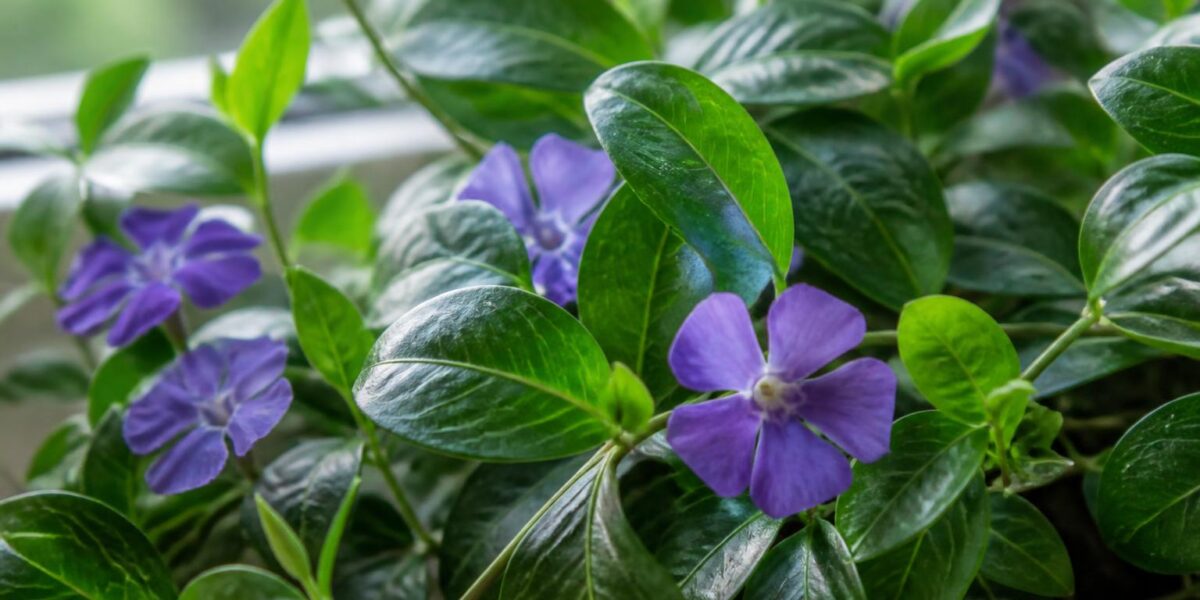
Vinca major looks like Vinca minor’s larger sibling. The leaves are dark glossy green, oval to slightly heart-shaped at the base, with a faint crinkle along the edge — typically two to three inches long, roughly twice the size of V. minor leaves. Stems trail along the ground, root where they touch soil, and produce upright flowering shoots in spring. The flowers are five-petaled, pinwheel-shaped, blue-violet to lavender, about an inch and a half across — significantly larger and showier than V. minor’s bloom.
The most common variegated cultivar, Vinca major ‘Variegata’, has cream-edged leaves and is sold as a trailing accent plant for hanging baskets, window boxes, and mixed container plantings. That cultivar deserves special attention from pet owners because its decorative use means it lands inside houses and on porches where pets routinely roam — not just on a remote slope. The variegation does not change the toxicity. The cream-and-green plant in your spring annual basket from the garden center contains the same vinca alkaloids as the wild species.
How Vinca Alkaloids Affect Dogs and Cats
The vinca alkaloid family works at the cellular level by binding tubulin, the protein that builds the spindle fibers used in cell division. When the spindle can’t form, dividing cells get stuck and die. That mechanism is why the purified pharmaceuticals vincristine and vinblastine are used as cancer chemotherapy — they preferentially kill the rapidly dividing cells that make up tumors. The downside, in oncology and in accidental plant ingestion alike, is that healthy rapidly dividing tissues take collateral damage: bone marrow, the lining of the gut, and hair follicles.
For a pet who eats greater periwinkle, the practical consequences depend on the amount swallowed and the pet’s body weight. A small lick or single chewed leaf usually produces nothing more dramatic than mild GI upset. A meaningful mouthful — a dog dragging a hanging basket down off a porch railing, a cat shredding a Vinca major variegata pot — can produce vomiting and diarrhea (sometimes bloody), depression, ataxia (wobbling gait), tremors, and slowed cardiovascular and respiratory signs over the next several hours. Bone-marrow effects (low white-cell counts, low platelets) are theoretical with extreme or chronic exposure but rare with single garden ingestions.
Symptoms After Greater Periwinkle Ingestion
Symptoms typically begin within one to four hours of ingestion, depending on stomach contents and how thoroughly the plant material was chewed. The earliest signs are usually oral irritation and GI upset, followed by neurological signs in more serious cases. Watch carefully for the first 12 to 24 hours after a known ingestion and document anything you see for the veterinary team.
Early signs (typically within hours):
- Drooling, lip-smacking, or pawing at the mouth
- Reluctance to eat or drink
- Vomiting, sometimes containing leaf material
- Diarrhea, occasionally with blood
- Lethargy, hiding, or unusual quietness
Concerning signs that need urgent veterinary care:
- Tremors, muscle twitching, or seizure activity
- Difficulty walking, collapse, or hind-limb weakness
- Pale or muddy gum color
- Cool body temperature (cold ears, paws)
- Heart rate that seems unusually slow or fast
- Labored or rapid breathing
What To Do If Your Pet Eats Vinca Major
Move the pet away from the plant and quickly check the mouth. Use a finger to sweep out any leaf fragments or sap residue, and offer a sip of water to rinse the mouth. Do not induce vomiting at home. Hydrogen peroxide is sometimes recommended for emergency emesis but the indication and dose are situational, and the wrong call (giving peroxide to a cat, or to a dog already showing neurological signs) creates additional problems.
Call for guidance immediately. Your owner’s veterinarian if they’re reachable; an emergency veterinary hospital after hours; the ASPCA Animal Poison Control Center at 888-426-4435 or Pet Poison Helpline at 855-764-7661 for 24/7 specialist toxicology support. Both poison-control hotlines charge a per-call fee but assign your treating veterinarian a case number that lets them coordinate the treatment plan with a board-certified veterinary toxicologist.
Bring three pieces of information to the call: a clear photograph or fresh sample of the plant in a plastic bag, the best estimate of how much was eaten, and your pet’s body weight. If you have any nursery tag or receipt that confirms it was Vinca major (versus Catharanthus or one of the more potent relatives), bring that too — species confirmation makes a real difference to the treatment plan.
Vinca Major Versus Vinca Minor and Other Periwinkles
Walk Me Home Rescue covers Vinca minor as a separate article because owners often have both species in the same yard or as the same hanging-basket impulse buy. The two share chemistry — both contain vinca alkaloids and both are on the ASPCA toxic list — but V. major leaves are roughly twice the size and the flowers are noticeably larger and showier. The clinical response to ingestion is the same: don’t wait, call poison control, document what was eaten.
Catharanthus roseus, the Madagascar periwinkle, is a different genus entirely despite sharing the common name. It contains the same alkaloid family at much higher concentration and is the species most often referenced in older toxicology literature when “periwinkle” is listed as severely toxic. If you bought a “periwinkle” at a southern garden center and the plant is an upright bedding annual with pink, white, or rosy single flowers — that’s Catharanthus, not Vinca, and the precautionary level is even higher.
Why Greater Periwinkle Is Common in Pet-Accessible Spaces
The horticultural reasons for Vinca major’s popularity in pet-occupied spaces are worth understanding because they explain why this plant keeps showing up where dogs and cats run into it. Vinca major is sold as a “spiller” in spring annual containers — the trailing element that softens the edges of mixed pots on porches, decks, balconies, and patios. It tolerates partial shade. It looks lush and full quickly. It overwinters as an evergreen perennial in milder climates so it returns reliably year after year. Garden centers stock it heavily every spring.
That use pattern means greater periwinkle frequently lives at pet level on porches, in patio containers within reach of curious dogs and cats, and in pots placed on the floor for trailing display. It is much more likely to be at nose height in a household than the typical ground-cover species. Pet owners who buy mixed annual containers in spring should specifically ask whether the trailing plant is Vinca major / Vinca major ‘Variegata’ and skip those pots in favor of trailing alternatives like trailing lobelia (also caution — different toxicity), bacopa, or annual sweet potato vine (also note nightshade-family caution depending on cultivar).
Pet-Safer Trailing and Ground-Cover Alternatives
If you are removing Vinca major from your garden or your container plantings, several non-toxic trailing or ground-cover alternatives serve the same horticultural role:
- Carex (sedge) species — dense grass-like ground cover with excellent shade tolerance and ASPCA-non-toxic status
- Foamflower (Tiarella) — native woodland ground cover with airy white spring blooms
- Woodland strawberry (Fragaria vesca) — small edible fruits, dog and cat friendly
- Bacopa (Sutera) — popular trailing annual for hanging baskets, not on the ASPCA toxic list
- Calibrachoa (million bells) — trailing flowering annual; not specifically listed as toxic but always verify with current ASPCA guidance for individual cultivars
For ground-covering perennials that share the dry-shade niche periwinkle thrives in, mint-family options like catmint and the broader mint group — including spearmint and lemon balm — provide a different aesthetic but a much more pet-friendly safety profile. Note these are technically herbs and not strict ground covers, and large-volume grazing can still cause GI upset, but they are not on the ASPCA toxic list.
Removing Vinca Major Safely With Pets in the Yard
Vinca major is shallow-rooted and forms a dense mat that can be peeled up by hand or with a stiff garden rake after a soaking rain softens the soil. Wear gloves — the milky sap can be a contact irritant on human skin and certainly does not need to land in a pet’s coat. Bag pulled material in heavy-duty contractor bags rather than composting on site, because Vinca major’s stem fragments root readily and uncomposted clippings can re-establish a colony in your compost area.
Restrict pet access to the work area while you remove and for at least 48 hours afterward, so any sap residue or scattered leaf fragments have time to dry out or be cleaned up. Replant the area with a non-toxic alternative quickly — bare soil under trees attracts dogs to dig and cats to use as a bathroom, neither of which improves the situation. A thick layer of natural mulch followed by spring planting of carex, foamflower, or the ground-cover alternatives above is the cleanest sequence.
Avoid the temptation to spray the periwinkle with herbicide and walk away. Wilted herbicide-treated foliage often becomes more attractive to a curious pet, not less, and adds glyphosate toxicity to whatever vinca alkaloid risk was already in play. Mechanical removal followed by replanting is the safer sequence for households with pets.
Frequently Asked Questions
Is Vinca major toxic to dogs and cats?
Yes. Vinca major (greater periwinkle) is on the ASPCA toxic list for dogs, cats, and horses. The toxic compounds are vinca alkaloids, the same chemical family as vincristine and vinblastine chemotherapy drugs. Severity is moderate-to-severe depending on the amount eaten.
What does Vinca major do to a pet?
Vinca alkaloids bind tubulin and disrupt cell division, with the main effects on rapidly dividing tissues — gut lining, bone marrow. In a pet, that translates to GI upset (drooling, vomiting, diarrhea), neurological signs (lethargy, tremors, weakness), and in severe cases low blood pressure, low body temperature, and bone-marrow effects. Most garden ingestions are at the milder end of the spectrum but every exposure deserves a poison-control call.
What should I do if my dog ate greater periwinkle?
Remove your dog from the plant, check and clear the mouth of leaf fragments, take a sample of the plant in a plastic bag, and call your veterinarian or the ASPCA APCC at 888-426-4435 or Pet Poison Helpline at 855-764-7661. Do not induce vomiting at home without veterinary instruction.
Is the variegated Vinca major in my hanging basket toxic too?
Yes. The variegated cultivar (Vinca major ‘Variegata’) has cream-edged green leaves but the chemistry is the same as the all-green species. Variegated periwinkle is widely sold as a trailing element in spring annual containers, which puts it within easy reach of porch and patio pets. Treat it the same way you would the wild species.
Are Vinca major and Madagascar periwinkle the same plant?
No. Vinca major is a temperate trailing perennial. Madagascar periwinkle is Catharanthus roseus, a tropical bedding annual with much higher alkaloid concentrations. Both are on the ASPCA toxic list but Catharanthus is more potent. If a nursery tag just says “periwinkle,” confirm the species before assuming it’s the milder one.


