
Last updated: May 16, 2026
In this article
- The Short Answer on Audrey Ficus and Pets
- What Audrey Ficus Actually Is
- The Ficin Sap Chemistry
- Symptoms to Watch For
- Why Severity Usually Stays Mild to Moderate
- What to Do If Your Pet Chewed Audrey Ficus
- Where Audrey Ficus Causes the Most Trouble
- Distinguishing Audrey Ficus From Other Banyans and Indoor Figs
- Pet-Safer Alternatives for the Same Look
- Living With Audrey Ficus When You Already Have It
- When a Vet Visit Is Warranted
- Pesticide and Soil Considerations
- Building a Pet-Aware Plant Collection
- Frequently Asked Questions
The Short Answer on Audrey Ficus and Pets
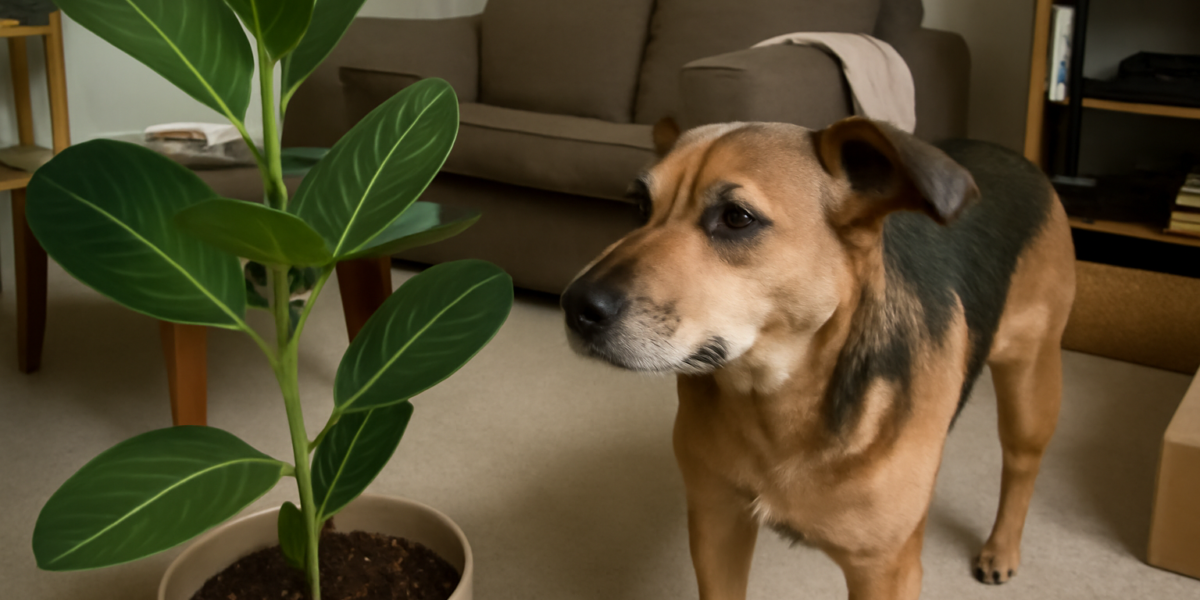
Audrey ficus is toxic to pets. Ficus benghalensis ‘Audrey’, the trendy houseplant with fuzzy oval leaves and prominent pale veins, has only become a fixture in the indoor-plant world in the last several years, but the chemistry behind it is identical to the rest of the Ficus genus. Searches for audrey ficus toxic pets all land on the same answer: yes, the milky sap can irritate dogs and cats, and that sap is present in every leaf, stem, and branch of the plant. The severity for an average exposure is mild to moderate rather than life-threatening, but the discomfort is real and the reaction can be dramatic enough to scare any owner.
If your dog or cat has just chewed on an Audrey ficus leaf or rubbed against a freshly broken stem, the most likely outcome is a sore mouth, drooling, possibly a few episodes of vomiting, and a patch of skin redness wherever the sap landed. Most pets recover within hours once the plant is moved out of reach. Call your veterinarian or the ASPCA Animal Poison Control Center at 888-426-4435 if symptoms are intense, prolonged, if any swelling appears around the lips or under the jaw, or if a young kitten or puppy ingested a meaningful amount.
What Audrey Ficus Actually Is
Ficus benghalensis is the banyan fig, native to the Indian subcontinent, where the wild form grows into the massive trees that dominate village squares and temple grounds. The species is famous for sending aerial roots down from horizontal branches, and a single mature banyan can spread over many acres because each aerial root that reaches the ground turns into a new trunk. The plant is the national tree of India and has cultural and religious significance across South and Southeast Asia.
The ‘Audrey’ cultivar is a selection of Ficus benghalensis chosen for indoor cultivation. The leaves are slightly fuzzy on the upper surface, with prominent cream-colored veins that contrast against a deep matte green. The growth habit is upright and tree-like, with a single woody stem and a structured canopy. Mature indoor specimens can reach two to three meters and look remarkably like a small banyan tree, which is the visual appeal that made the cultivar a houseplant fashion item starting around the late 2010s.
The plant is sometimes labeled simply “ficus Audrey” or “banyan tree” in nurseries. It is closely related to the rest of the popular indoor figs: the fiddle-leaf fig (Ficus lyrata), the weeping fig (Ficus benjamina), the rubber tree (Ficus elastica), and the mistletoe fig (Ficus deltoidea). All five share the milky sap chemistry that makes the genus mildly to moderately toxic to pets.
The Ficin Sap Chemistry
Every Ficus species defends itself with a white latex that bleeds from any cut surface. The latex contains ficin, a protein-digesting enzyme in the same broad family as papain (from papaya) and bromelain (from pineapple). When that latex contacts the soft tissue of a pet’s mouth, gums, or skin, the enzyme begins to break down surface proteins and triggers an inflammatory response. The result is local swelling, redness, and the burning sensation that prompts a cat to paw at her face or a dog to lip-lick repeatedly.
The latex also contains psoralen-like furanocoumarins, which amplify the inflammation and can occasionally produce a phototoxic skin reaction in animals exposed to both the sap and bright sunlight. The chemistry is essentially identical to what you would read about in fiddle-leaf fig toxicity in cats, rubber tree and cats, and rubber plants and dogs. Different leaf shape, same family, same defensive sap.
Some plant-care references describe pure wild Ficus benghalensis sap as more concentrated than other indoor Ficus saps, on the basis that the wild species produces the latex for both defense and for healing the constant aerial-root wounds. The ‘Audrey’ cultivar appears to follow the same general profile. There is no rigorous comparative toxicology data among Ficus cultivars in pets, so the practical advice is to treat every Ficus as a meaningful sap-irritant and manage accordingly.
Symptoms to Watch For
Most Audrey ficus exposures show up within fifteen to forty-five minutes of contact. The classic picture in a cat or dog includes:
- Sudden drooling, sometimes heavy, with white sap residue around the muzzle
- Pawing at the face, lip-licking, head shaking, repeated swallowing
- Red, inflamed gums or tongue; occasional small ulcers from prolonged chewing
- Vomiting with chewed plant fragments
- Mild diarrhea over the following twelve to twenty-four hours
- Patchy skin redness where sap landed on the muzzle, paw, or chest
- Watery eyes, sneezing, or rubbing the face on furniture
- Temporary refusal to eat or drink for several hours
Severe systemic effects are uncommon. The reaction is almost always confined to the surfaces that physically contacted the sap, which keeps Audrey ficus exposures generally less dangerous than calcium-oxalate aroid exposures, where airway swelling can occasionally compromise breathing. The exception is any pet with pre-existing oral disease, a history of severe contact dermatitis, or unusually persistent chewing that delivered a much larger sap dose than a single bite.
Why Severity Usually Stays Mild to Moderate
The natural ceiling on Audrey ficus exposure is the pain itself. The first chew or two delivers enough enzyme contact to make the leaf unpleasant, and most pets walk away. The cats and dogs who push past that point are usually kittens, puppies, food-motivated chewers, or bored indoor animals with nothing else interesting to do. Even those harder cases typically peak at moderate GI upset rather than progressing to anything systemic.
Compare this with the truly dangerous toxic plants in a typical home: true lilies for cats, sago palm for dogs, oleander for both. Those plants damage cells in the kidney, liver, or heart. Ficus benghalensis ‘Audrey’ does not have that systemic reach. The damage is local, the recovery is usually rapid, and supportive care at home or at a vet clinic resolves nearly every case within a day or two.
That said, “mild for most” is not the same as “safe for all.” Tiny puppies, kittens, brachycephalic breeds with crowded airways, and pets with pre-existing dental or oral disease can have outsize reactions. The classic example is a senior cat with chronic gingivitis who chews an Audrey ficus leaf — the underlying inflamed gums respond more forcefully than a healthy mouth would. Treat each exposure on its own merits and call your vet if anything looks worse than mild.
What to Do If Your Pet Chewed Audrey Ficus
The first move is mechanical. Gently wipe any visible sap from the mouth, muzzle, paws, or chest with a damp cloth. If your pet will tolerate it, offer a small amount of cool water or low-sodium broth to help rinse the mouth. Move the plant out of reach to prevent a second round. Do not induce vomiting at home — for ficin-based irritation, vomiting can re-expose the throat to sap on the way back up and worsen the picture.
Call your veterinarian if drooling persists past an hour, if pawing at the mouth continues, if vomiting recurs more than two or three times, or if any swelling appears around the lips, jaw, or throat. The ASPCA Animal Poison Control Center at 888-426-4435 and the Pet Poison Helpline at 855-764-7661 are both available around the clock and will tell you whether home observation is appropriate or whether your pet should be examined in person. There is a small consultation fee for either hotline.
For a healthy adult dog or cat with a small exposure and rapidly settling symptoms, observation at home is reasonable. Offer soft food for the next twenty-four hours, avoid kibble that demands a lot of chewing, and watch for delayed signs like reduced appetite, ongoing lethargy, or new skin reactions where you missed wiping sap off the coat.
Where Audrey Ficus Causes the Most Trouble
Audrey ficus is sold and grown as a tree-form houseplant, which keeps the foliage at standing height and out of immediate floor-level dog range. The trouble starts when the plant is small enough to sit on a side table, or when a tall specimen drops a leaf to floor level after natural shedding. Cats are the more frequent investigators because they jump up to surfaces that put the canopy at face level. Dogs are usually only at risk when they encounter trimmings, dropped leaves, or a juvenile plant that lives at floor height.
Pruning sessions are the highest-risk moments for any household with this plant. Fresh cuts bleed heavily, and the white latex can drip onto the floor, the work surface, the pruner’s hands, and any surface a pet investigates afterward. Wipe up the drips immediately, wash the pruning shears before putting them down, and keep pets out of the room until the cut surfaces have dried.
The plant also occasionally drops mature leaves spontaneously when light, water, or temperature change. Those dropped leaves still contain sap on any torn edge, and a curious dog can mouth a fallen leaf as a chew toy. Sweeping up around the base of the plant once or twice a week handles this category of risk.
Distinguishing Audrey Ficus From Other Banyans and Indoor Figs
The Ficus genus has a confusing common-name vocabulary. Ficus benghalensis ‘Audrey’ is sometimes sold as “banyan tree,” which is also the common name for the wild species the cultivar comes from. The wild species and the ‘Audrey’ cultivar share the same toxicity profile. The ‘Krishna’ cultivar of Ficus benghalensis, with cup-shaped leaves, is the same chemistry as well.
Audrey ficus is also sometimes confused with the fiddle-leaf fig (Ficus lyrata), which has larger, violin-shaped leaves and a more pronounced sculptural look. Both are sap-irritant Ficus species. The other indoor figs to know are weeping fig and cats, weeping fig and dogs, the trailing creeping fig, and the small bushy mistletoe fig. Each of those articles describes the same general chemistry expressed in a different growth habit.
Pet-Safer Alternatives for the Same Look
If Audrey ficus was on your shortlist for the tree-like form, large leaves, and sculptural canopy, several genuinely non-toxic plants offer a similar look. Areca palm brings a tall, feathery, tree-like presence and is ASPCA non-toxic. Ponytail palm gives a sculptural single-stem tree silhouette with a non-toxic profile. Parlor palm works as a floor-level foliage plant with a similar architectural feel.
The full cat-safe houseplants guide covers light, watering, and pet-friendliness for each. The pet-safe garden plants roundup is the outdoor counterpart. Building a collection around non-toxic anchors and treating the toxic plants as managed exceptions is the pattern most pet households settle into over time.
Living With Audrey Ficus When You Already Have It
If you love your Audrey ficus and do not want to part with it, the practical answer is height, distance, and pruning hygiene. Place the plant in a corner that is not a regular pet patrol route. Keep the lower trunk free of foliage so the canopy starts above pet face height. Use heavy ceramic pots so a dog tail or a leaping cat does not knock the plant over.
For pruning, plan ahead. Time cuts for moments when pets are out of the room or in another part of the house. Wipe each cut with a damp paper towel until the bleeding stops. Wash the pruners before putting them down. Keep the trimmings in a sealed bag for disposal rather than tossing them in an open bin where a curious pet can dig them out.
When a Vet Visit Is Warranted
Most Audrey ficus exposures do not need a clinic visit, but several scenarios do. Visible swelling of the lips, tongue, or throat warrants an immediate call. Persistent vomiting beyond three or four episodes, blood in vomit or stool, refusal to drink water for more than twelve hours, or any breathing difficulty all earn a clinic visit. Skin reactions that progress to weeping sores or that the pet keeps rubbing or licking obsessively need professional care because secondary bacterial infection is the next concern.
Brand-new puppies and kittens with any Audrey ficus exposure should get at least a phone call to the vet, even if they look fine. Their smaller body mass means a smaller dose of ficin can produce a bigger effect, and early supportive care is much easier than late rescue. Pregnant or nursing pets and pets with chronic kidney, liver, or dental disease also warrant a lower threshold for clinical attention.
Pesticide and Soil Considerations
Like every shop-bought houseplant, a new Audrey ficus often arrives with systemic insecticide residue on the leaves and possibly granular insecticide mixed into the nursery soil. That residue is a separate concern from the ficin sap and adds another layer of caution to the first few weeks of ownership. Quarantine the plant on a high shelf for one to two weeks. Wipe the leaves with a damp cloth on day one and again a week later. If you have a dog or cat that eats potting soil, repot into your own soil mix before placing the plant in its permanent spot.
The sap concern persists indefinitely because the latex is part of the plant itself, but the pesticide residue concern fades over the first few weeks as the chemicals degrade and the leaves are wiped clean. Setting up the right routine in the early days makes long-term coexistence much easier.
Building a Pet-Aware Plant Collection
Most pet households do not need to remove every toxic plant. The goal is to know what you have, where the high-risk plants are placed, and what to do if exposure happens. Audrey ficus is manageable in a pet household when the canopy is above pet reach and the household has the vet hotline numbers saved. It is a poor choice for a household with a determined plant-chewer who has already shown a taste for foliage.
If you are bringing a new pet into a home with an established Audrey ficus or any Ficus collection, our cat adoption hub and dog adoption hub include household-prep guidance on plants, foods, cords, and chemicals to address before the pet arrives.
Frequently Asked Questions
Is Audrey ficus toxic to cats only or also to dogs?
Both. The ficin sap chemistry affects mammals broadly. Cats tend to show the reaction more dramatically because they paw at their faces and groom sap into the mouth, but dogs who chew leaves get the same oral irritation and skin reaction.
How does Audrey ficus toxicity compare with fiddle-leaf fig toxicity?
Both are Ficus species and both produce ficin-bearing milky sap with essentially the same defensive chemistry. The severity of any single exposure depends more on the dose chewed and the individual pet’s sensitivity than on the species. Treat both as moderate sap-irritant houseplants.
My cat just chewed a leaf and is drooling but seems otherwise fine. Do I need the vet?
Mild drooling alone with no swelling, no breathing difficulty, and no persistent vomiting can usually be observed at home for an hour or two. If symptoms intensify, swelling appears, or anything looks worse than mild, call your vet or the ASPCA Animal Poison Control Center at 888-426-4435.
Is the fuzzy texture of the Audrey ficus leaves a separate hazard?
The fine surface fuzz is a horticultural feature of the cultivar, not a toxin. It does not contain stinging hairs and does not cause the kind of mechanical irritation that some unrelated fuzzy-leaf plants do. The sap inside the leaf is the relevant concern.
Will my Audrey ficus survive a chewing pet?
Usually yes. Ficus benghalensis ‘Audrey’ regrows from the central trunk and produces new leaves over weeks. As long as the woody stem is intact, the plant typically recovers fully even from significant leaf loss.


