
Last updated: May 16, 2026
In this article
- The Short Answer: Rubber Trees Are Mildly Toxic to Cats
- Naming the Plant Correctly: Why “Rubber Tree” Confuses Everyone
- The Toxic Compounds in Ficus Elastica Sap
- Symptoms of Rubber Tree Poisoning in Cats
- What to Do If Your Cat Chewed a Rubber Tree
- How Veterinarians Treat Mild Plant Sap Exposure
- Distinguishing Rubber Tree from Other “Rubber” Plants
- Comparing Rubber Tree Toxicity in Cats vs Dogs
- Other Sap-Irritant Houseplants Cat Owners Should Know
- Preventing Future Rubber Tree Encounters
- When a Plant-Free Living Room Just Makes Sense
- Frequently Asked Questions
The Short Answer: Rubber Trees Are Mildly Toxic to Cats
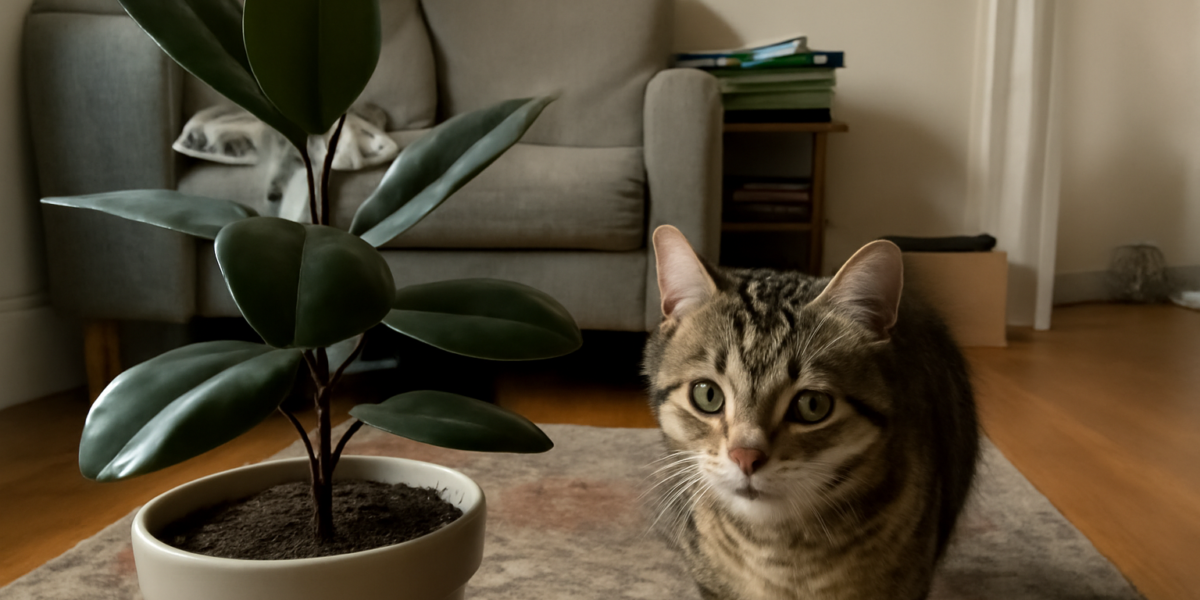
Yes, the rubber tree is toxic to cats, but the severity sits in the mild gastrointestinal tier rather than the life-threatening tier. The plant in question is Ficus elastica — the broad-leaved indoor tree sometimes sold as the Indian rubber bush, rubber fig, or simply “rubber plant.” Like all Ficus species, it produces a milky white latex sap that contains psoralens, ficin (a proteolytic enzyme), and other irritant compounds. When a cat chews a leaf, that sap contacts the lips, tongue, and stomach lining and triggers drooling, oral pain, vomiting, and sometimes mild dermatitis around the mouth.
If you walked into the living room and found chewed leaves on the floor or a sticky milky residue on your cat’s whiskers, this is a “call the vet, but not a 911 emergency” situation in most cases. Cats almost always self-limit their nibbling because the sap tastes terrible and stings on contact. Rubber tree toxic cats searches usually end with cats who vomited once or twice and recovered fine — but you still want a professional in the loop because dehydration from repeated vomiting can become its own problem in small cats.
Naming the Plant Correctly: Why “Rubber Tree” Confuses Everyone
Before we go further, it is worth untangling the names. The “rubber tree” most pet owners picture is Ficus elastica, a glossy-leaved tropical from Southeast Asia that has been a houseplant staple for over a century. Florists also call this plant the rubber plant, rubber bush, or rubber fig — and there is a separate Walk Me Home Rescue article on the umbrella term rubber plants and cats that covers nursery-trade naming in more depth.
That is not the same plant as the commercial latex-rubber tree (Hevea brasiliensis), which is a tall outdoor tree grown on plantations to make industrial rubber. Pet cats almost never encounter Hevea; toxicity data for it is limited and most exposure literature is occupational, not veterinary.
It is also not the same as the pencil cactus (Euphorbia tirucalli), which is sometimes labeled “milkbush” or “rubber euphorbia” in garden centers. Pencil cactus is in a completely different family (Euphorbiaceae) and produces a far more caustic latex than Ficus. If your cat chewed a thin pencil-like green stem with milky sap, see our piece on pencil cactus and cats — that exposure is significantly more serious than a Ficus elastica nibble.
The Toxic Compounds in Ficus Elastica Sap
The milky white latex that oozes from a broken rubber tree leaf or stem is the part that does the damage. It contains several documented irritants. Psoralens are furocoumarins that can cause photosensitive dermatitis — basically a mild chemical burn that gets worse with sun exposure. Ficin, an enzyme similar to bromelain in pineapple, breaks down proteins and can irritate the lining of the mouth, throat, and stomach. The sap also contains caoutchouc (the natural-rubber polymer that gives the plant its name) and various phenolic compounds that taste bitter and astringent.
The good news is that these compounds are concentrated in the latex, not in the wood, roots, or dried leaves. Most of the bitterness hits a cat the moment she bites in, which is why the typical exposure is a single chewed leaf and a quick “ugh” reaction rather than a full meal of foliage. Cats are also famously sensitive to bitter tastes — most stop after one nibble of a rubber tree.
Symptoms of Rubber Tree Poisoning in Cats
The symptom picture for a cat that chewed a Ficus elastica leaf is fairly predictable. Within minutes you may see drooling, lip-licking, head-shaking, or pawing at the mouth — all signs of oral irritation. The cat may shake her head as if she has tasted something foul, because she has.
Within an hour or two, you may see one or more episodes of vomiting. The vomit may contain visible plant fragments, and that is actually useful information for your vet. Some cats develop diarrhea over the following six to twelve hours; others have no lower-GI symptoms at all. A small number of cats develop a mild facial rash or red patches around the lips where the sap touched skin — this is the psoralen-related dermatitis, and it usually fades on its own within a day.
What you should not see is collapse, breathing difficulty, severe weakness, swollen tongue/throat, seizures, or unstoppable vomiting. Those signs would suggest either a much larger ingestion than typical, an allergic reaction, or — more likely — that your cat actually ate something else. If symptoms escalate beyond mild GI upset, treat it as an emergency and head to the clinic.
What to Do If Your Cat Chewed a Rubber Tree
Stay calm and follow a sensible sequence. Move your cat to a quiet area and remove the rubber tree (or move the cat to a room without it) so the exposure stops. Wipe any visible sap off her muzzle, paws, or fur with a damp cloth — gentle wiping, not vigorous scrubbing. If sap is sticky, a tiny amount of pet-safe shampoo and warm water will lift it.
Call your veterinarian and describe what happened: the plant species (a photo helps), roughly how much she ate, when it happened, and what symptoms you have seen. For most rubber tree exposures, the vet will either recommend home monitoring with a follow-up call if symptoms worsen, or suggest a same-day visit for fluids and an anti-nausea injection if the cat is small or already vomiting hard.
If your regular vet is closed, the ASPCA Animal Poison Control Center at (888) 426-4435 and the Pet Poison Helpline at (855) 764-7661 are both staffed by veterinary toxicologists around the clock. Both charge a consultation fee and both will give your treating vet a case number that simplifies follow-up care.
Do not induce vomiting at home. Hydrogen peroxide is not safe in cats and the bitter Ficus sap usually triggers vomiting on its own anyway. Decontamination decisions belong to the vet.
How Veterinarians Treat Mild Plant Sap Exposure
If a vet visit is warranted, treatment for rubber tree exposure is straightforward and supportive. The clinical team will examine the cat’s mouth for any sap residue, check for tongue or gum redness, and listen for a normal swallow reflex. Most cats look bright and alert by the time they arrive — they have already vomited up the offending leaf in the carrier.
Common treatments include subcutaneous fluids to counteract any dehydration from vomiting, an anti-nausea injection (maropitant or ondansetron is typical), and sometimes a single dose of activated charcoal if the ingestion was very recent and substantial. A small bland-diet plan for 24 to 48 hours — easily digestible canned food in small frequent meals — usually rounds out the treatment. Most cats are fully recovered within a day or two with no lasting effects.
Distinguishing Rubber Tree from Other “Rubber” Plants
Houseplant labels are a mess. The “rubber tree” you bought at the home-improvement store could be any of several species, and toxicity profiles differ. Beyond Ficus elastica, the most common confusables are:
- Pencil cactus / Euphorbia tirucalli — pencil-thin succulent stems, very caustic latex, much more serious if ingested or contacts the eye.
- Rubber tree fig / Ficus benghalensis (Indian banyan) — large outdoor tree, not a typical houseplant, similar mild-irritant sap to F. elastica.
- Rubber vine / Cryptostegia grandiflora — climbing vine with cardiac glycosides, far more dangerous, mostly a pasture-weed concern in subtropical regions.
- Baby rubber plant / Peperomia obtusifolia — confusingly named because it is not a Ficus; it is in the pepper family and is listed as non-toxic by the ASPCA.
Bring the plant or a clear photo with you to the vet appointment. Identification matters because pencil cactus exposure (for example) is treated with eye-flushing protocols and longer observation, while a Ficus elastica nibble usually needs only a couple of hours of supportive care.
Comparing Rubber Tree Toxicity in Cats vs Dogs
The rubber tree is on the ASPCA toxic list for both cats and dogs, with the same general mild-GI severity profile. Dogs tend to be the bigger gamblers — their indiscriminate chewing means they can ingest more leaf material in one sitting than a cat would tolerate, so dog exposures occasionally produce harder vomiting and longer recovery times. The dog-specific picture, including dose context and what to expect on a vet visit, is covered in our companion piece on rubber tree toxic to dogs.
For households where the broader “rubber plant” naming is a question, the rubber plants and dogs overview adds a second angle. Cats specifically tend to nibble out of curiosity rather than appetite, and their smaller body size means a teaspoon of sap can produce more visible drooling than a much larger ingestion would in a dog.
Other Sap-Irritant Houseplants Cat Owners Should Know
If a curious cat reached the rubber tree, she will probably reach for other sappy houseplants too. Several common indoor plants share the “milky-irritant-sap” or “calcium-oxalate-crystal” tier of toxicity — uncomfortable but rarely fatal. Worth knowing about:
- Pothos and cats — calcium oxalate raphides cause the same drooling/oral pain picture, no latex.
- Monstera and cats — large-leaf aroid with the same oxalate mechanism.
- Dieffenbachia and cats — “dumb cane,” more painful oral reaction than rubber tree.
- Philodendron and cats — extremely common, calcium oxalate again.
If you are auditing your home for cat-safe alternatives, our roundup of cat-safe houseplants walks through indoor plants the ASPCA does not flag — including spider plants, Boston ferns, areca palms, prayer plants, and several true non-toxic ficus relatives.
Preventing Future Rubber Tree Encounters
A few practical changes go a long way. Move the rubber tree to a room your cat cannot access, ideally one with a closed door. Cats are vertical climbers, so “high shelf” alone is rarely enough — they will jump. If rehoming the plant to a cat-free space is not an option, consider gifting it to a cat-free friend; rubber trees are forgiving and almost always survive a move.
Provide your cat with safe greens to graze on. Cat grass (oat, barley, or wheatgrass kits) and fresh catnip satisfy the urge to chew on green plant matter and reduce the likelihood she will go hunting for leaves on your shelves. Some cat owners find that a single tray of cat grass cuts houseplant nibbling by a remarkable margin.
Block sap pathways. Even the cleanest pruning of a Ficus elastica leaves a sticky white drop where the leaf meets the stem. Wipe drops up immediately and keep clippings out of compost bins your cat can access.
When a Plant-Free Living Room Just Makes Sense
For multi-cat households or homes with kittens, the easiest answer is sometimes the simplest: keep big-leaf Ficus plants out entirely and stick to ASPCA-cleared species. The rubber tree is beautiful, but it is not the only handsome glossy houseplant in the world, and the peace of mind from a fully cat-safe collection is worth the swap.
Adopting a new cat is also a great moment to plant-audit your home. Walk Me Home Rescue has a comprehensive cat adoption hub, and incoming cats will appreciate a household that has already been checked for the most common plant pitfalls. Our cat-safe flowers guide covers cut-flower swaps that pair with non-toxic foliage.
Frequently Asked Questions
How much rubber tree does it take to make a cat sick?
Even a single chewed leaf can produce drooling and a vomit episode in many cats — the sap is bitter and irritating in very small amounts. There is no documented life-threatening dose for typical household exposure, but more leaf material generally means harder vomiting, more dehydration risk, and a higher chance you will end up at the vet. Treat any chewed leaf as worth a phone call.
Will the sap blind my cat if it gets in her eye?
Permanent blindness from Ficus elastica is not documented, but the latex is irritating and can cause painful conjunctivitis. If sap touches your cat’s eye, flush gently with saline solution or lukewarm water for at least five minutes and call the vet. Pencil cactus latex is a different story — that one is a true ophthalmologic emergency.
Is the dropped sap on the floor still dangerous after it dries?
Dried sap is far less irritating than fresh sap because the active enzymes degrade and the latex polymer hardens. Still, a curious cat can still pick up enough residue to cause mild drooling. Wipe up drops as they happen and dispose of pruning waste in a sealed bin.
My cat ate a rubber tree leaf and seems totally fine. Should I still call the vet?
A quick call is always reasonable. Many cats genuinely do shake off a small nibble with no symptoms, but a vet check by phone establishes a record and lets you ask whether home monitoring is appropriate or whether a visit is needed. If your cat is older, has chronic kidney disease, or is on medication that could interact with vomiting, lean toward bringing her in.
Can my cat develop a rubber-latex allergy?
True latex allergy in cats is poorly documented in the veterinary literature; most reactions to Ficus sap are direct chemical irritation, not immune-mediated allergy. That said, if your cat has had a bigger-than-expected reaction (severe facial swelling, hives, breathing trouble) on past contact with rubber tree or other latex-producing plants, treat the next exposure as a higher risk and avoid that genus entirely.


