
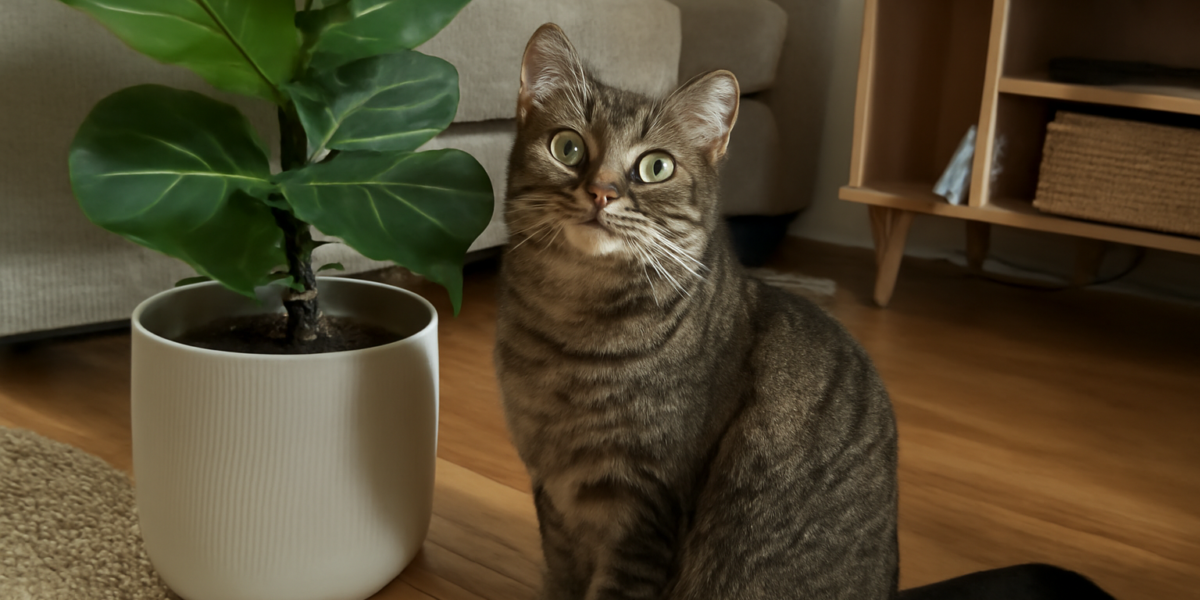
Last updated: April 10, 2026
In this article
- What Makes Fiddle Leaf Figs Toxic to Cats?
- Symptoms of Fiddle Leaf Fig Exposure in Cats
- What to Do If Your Cat Eats Fiddle Leaf Fig
- Veterinary Treatment for Fiddle Leaf Fig Ingestion
- Living with Both Fiddle Leaf Figs and Cats
- Safer Alternatives to Fiddle Leaf Figs for Cat Households
- Frequently Asked Questions
Are Fiddle Leaf Figs Toxic to Cats? A Practical Guide for Plant-Loving Cat Parents
The fiddle leaf fig (Ficus lyrata) has become one of the most popular houseplants in recent years, gracing living rooms, office spaces, and social media feeds with its large, sculptural leaves and elegant tree-like form. But if you have a cat at home, you may have heard conflicting information about whether this Instagram darling is safe to have around your feline companion.
The short answer is that fiddle leaf figs are considered mildly toxic to cats. They will not cause the kind of acute, life-threatening emergency that some other toxic plants can, but they can certainly cause discomfort and illness if your cat decides to take a bite. Understanding the specific risks — and knowing the difference between mild and serious toxicity — will help you make informed decisions about whether a fiddle leaf fig can coexist with your cat.
What Makes Fiddle Leaf Figs Toxic to Cats?
Fiddle leaf figs belong to the Ficus genus, which includes hundreds of species that share certain characteristics, including the production of an irritating milky sap called latex. This sap is the primary source of toxicity in fiddle leaf figs and other ficus plants.
The sap contains several compounds that can irritate tissues on contact. The most significant are ficin, a proteolytic enzyme that breaks down proteins and can irritate and damage mucous membranes, and ficusin (psoralen), a furocoumarin compound that can cause photosensitivity and skin irritation. The sap also contains insoluble calcium oxalate crystals, similar to those found in plants like philodendrons and elephant ears, though generally in lower concentrations.
When a cat bites into a fiddle leaf fig leaf or stem, the sap is released and contacts the tissues of the mouth, tongue, and throat. The combination of the enzymatic irritation from ficin and the mechanical irritation from calcium oxalate crystals causes pain, inflammation, and swelling. If the cat swallows the sap or plant material, gastrointestinal irritation can follow.
It is important to put this in context. The toxicity of fiddle leaf figs is categorized as mild to moderate by most veterinary toxicology resources, including the ASPCA. This is meaningfully different from plants like lilies, oleander, or yew, which can cause organ failure or death. With fiddle leaf figs, you are primarily dealing with irritation and discomfort rather than systemic poisoning. That said, “mild” does not mean “no big deal” — your cat can still experience genuine suffering, and certain complications can arise that warrant veterinary attention.
The sap can also cause skin irritation on contact. If your cat rubs against a broken leaf or gets sap on its paws or face, it may develop localized redness, itching, or a rash. This dermal reaction is usually mild and self-limiting but can be uncomfortable for your cat.
Symptoms of Fiddle Leaf Fig Exposure in Cats
The symptoms your cat may experience after biting or chewing on a fiddle leaf fig depend on how much contact occurred and whether any plant material or sap was swallowed. In most cases, symptoms are mild and self-limiting, but it is good to know the full range of what might occur.
Oral irritation is the most common symptom. Your cat may drool excessively, paw at its mouth, shake its head, or lip-smack repeatedly. The mouth, tongue, and gums may appear red and inflamed. Some cats will vocalize in discomfort. These oral symptoms are usually the first to appear and often develop within minutes of the cat biting the plant.
If your cat swallowed sap or plant material, gastrointestinal symptoms may follow. These can include nausea, vomiting, decreased appetite, and diarrhea. The vomiting may contain visible plant material. These GI symptoms typically develop within a few hours of ingestion and usually resolve on their own within 12 to 24 hours.
Skin irritation is possible if sap came in contact with your cat’s skin, particularly on the face, muzzle, or paws. You might notice redness, mild swelling, or your cat excessively grooming or scratching the affected area. In rare cases, the psoralen compounds in the sap can cause photosensitive reactions — meaning the skin becomes more sensitive to sunlight, potentially leading to sunburn-like lesions on exposed areas.
More concerning symptoms, while uncommon, can include significant swelling of the mouth or throat that makes breathing or swallowing difficult, persistent vomiting or diarrhea that leads to dehydration, and loss of appetite lasting more than a day. Eye irritation can also occur if the cat transfers sap from its paws to its eyes during grooming.
Most cats who bite a fiddle leaf fig once will experience immediate unpleasant sensations and will not return for a second taste. The bad taste and oral irritation serve as effective deterrents for the majority of cats. However, kittens and particularly curious or persistent cats may require more proactive management.
What to Do If Your Cat Eats Fiddle Leaf Fig
If you discover your cat has been chewing on your fiddle leaf fig, here is a calm, step-by-step approach:
Assess the situation. Look at the plant to estimate how much damage was done — a single tooth mark on a leaf is very different from a cat who has been chewing and swallowing multiple leaves. Check your cat’s mouth gently for any remaining plant material and remove it if possible.
Rinse the mouth if your cat will allow it. Offer fresh water or gently rinse the mouth with cool water using a syringe. Some cats will appreciate a small amount of tuna water or low-sodium broth to encourage drinking and help flush irritants from the mouth. Do not force fluids if your cat is resisting.
Clean any sap from the skin. If you can see sap on your cat’s face, paws, or fur, gently wipe it away with a damp cloth. This prevents further irritation and reduces the chance of the cat spreading the sap to its eyes during grooming.
Monitor for symptoms. In most cases of minor fiddle leaf fig exposure, home monitoring is sufficient. Watch for persistent drooling, vomiting, diarrhea, refusal to eat or drink, or any signs of breathing difficulty over the next 12 to 24 hours.
Call your veterinarian if you observe persistent vomiting (more than two to three episodes), diarrhea lasting more than 24 hours, complete refusal to eat or drink for more than 12 hours, signs of mouth or throat swelling that affects breathing, eye redness, squinting, or pawing at the eyes, or if your cat seems lethargic or in significant pain. For related guidance, you might also find our article on monstera toxicity in cats helpful, as monsteras share some of the same irritating compounds.
Veterinary Treatment for Fiddle Leaf Fig Ingestion
When veterinary care is sought for fiddle leaf fig exposure, treatment is typically straightforward and supportive. Most cases are managed on an outpatient basis without the need for hospitalization.
Your veterinarian will examine your cat’s mouth and throat to assess the degree of irritation and swelling. They will also evaluate your cat’s hydration status and overall condition. In most cases, the physical exam findings will be reassuring — mild oral redness and perhaps some drooling, but nothing life-threatening.
Treatment may include pain management with cat-safe analgesics if your cat appears to be in significant oral discomfort. Anti-nausea medications such as maropitant (Cerenia) may be given if vomiting is persistent. Subcutaneous fluids may be administered if your cat is mildly dehydrated from vomiting or reduced drinking.
For skin reactions, your vet may prescribe a topical treatment or recommend gentle cleaning of the affected area. If the eyes were exposed to sap, the vet will flush the eyes with sterile saline and check for corneal damage. An ophthalmic ointment or drops may be prescribed for eye irritation.
GI protectants such as famotidine or sucralfate may be recommended if there is concern about stomach or esophageal irritation from swallowed sap. A bland diet (boiled chicken and rice, or a veterinary gastrointestinal diet) may be suggested for a day or two to give the digestive tract time to recover.
The vast majority of cats recover fully from fiddle leaf fig exposure within 24 to 48 hours with no lasting effects. Serious complications are rare, and long-term health effects from a single exposure are essentially unheard of. This is a plant where the discomfort is real but the danger is low.
Living with Both Fiddle Leaf Figs and Cats
Given that fiddle leaf fig toxicity is mild, some cat owners choose to keep their plants while taking precautions, rather than giving them up entirely. This is a reasonable approach for many households, provided you understand the risks and take appropriate steps to minimize them. Here are strategies that many plant-and-cat households have found effective.
Placement matters. Fiddle leaf figs are large plants that are usually kept on the floor, which makes them easily accessible to cats. If possible, place your fiddle leaf fig in a room your cat does not frequent, or use plant stands that elevate the pot. However, be realistic — most cats can reach just about anywhere they want to go, so elevation alone may not be sufficient for a truly determined cat.
Deterrent strategies can help. Citrus peels placed around the base of the plant, bitter apple spray applied to the lower leaves, or double-sided tape on the pot rim can discourage many cats from investigating. Some owners have success with motion-activated air sprays placed near the plant. None of these methods are foolproof, but they can reduce casual nibbling.
Provide alternative greens. Cats who chew on houseplants are often seeking fiber or greenery in their diet. Growing cat grass (wheat grass or oat grass) and offering it as a dedicated “cat plant” can redirect your cat’s botanical interests to something safe and appropriate. Catnip and silver vine plants are also safe options that give cats an outlet for their plant-chewing instincts.
Know your cat. Some cats have zero interest in plants and will never so much as sniff your fiddle leaf fig. Others are chronic plant chewers who will seek out and munch on every green thing in the house. If your cat is in the latter category, keeping a mildly toxic plant in the home may not be worth the ongoing stress and risk, no matter how beautiful the plant is. For cat households with persistent plant chewers, see our guide to cat-safe houseplants for alternatives.
Another related plant to be aware of is the rubber plant (Ficus elastica), which is also in the Ficus genus and shares similar mild toxicity characteristics. If you have multiple ficus plants, the same precautions apply to all of them.
Safer Alternatives to Fiddle Leaf Figs for Cat Households
If you decide that the safest course of action is to replace your fiddle leaf fig with a non-toxic alternative, you are in luck. There are several stunning houseplants that can provide similar visual impact without any risk to your cat.
The cast iron plant (Aspidistra elatior) is an excellent option for cat households. It has large, glossy, dark green leaves, tolerates low light, and is virtually indestructible. While the leaves are not quite as dramatically large as a fiddle leaf fig’s, the overall effect is similar, and the plant is completely non-toxic to cats.
Parlor palms (Chamaedorea elegans) and areca palms (Dypsis lutescens) are both cat-safe and can grow quite large, providing the kind of statement-plant presence that a fiddle leaf fig offers. They have a more tropical, feathery look rather than the broad-leafed silhouette of a ficus, but many plant lovers find them equally appealing.
Calathea species are among the most beautiful non-toxic houseplants available. Varieties like Calathea orbifolia have large, round leaves with striking patterns, while Calathea lancifolia (rattlesnake plant) offers long, wavy, dramatically patterned foliage. All calatheas are safe for cats.
Money trees (Pachira aquatica) are another popular, cat-safe option that can grow into small indoor trees with braided trunks and lush, palmate leaves. They provide a tree-like form similar to a fiddle leaf fig and are easy to care for in average household conditions.
Bird’s nest ferns (Asplenium nidus), Boston ferns, and staghorn ferns are all non-toxic and offer lush green foliage that can brighten any room. They tend to be smaller than fiddle leaf figs but can be displayed in hanging baskets or on plant stands for maximum visual impact.
Frequently Asked Questions
How toxic are fiddle leaf figs compared to other common houseplants?
Fiddle leaf figs are on the lower end of the plant toxicity spectrum. They are significantly less dangerous than plants like lilies (which can cause fatal kidney failure in cats), dieffenbachia (which has much higher concentrations of calcium oxalate crystals), or sago palms (which can cause liver failure). Fiddle leaf fig toxicity is comparable to that of other Ficus species and is primarily limited to local irritation rather than systemic poisoning. While any toxic plant exposure warrants attention, fiddle leaf fig ingestion rarely requires intensive veterinary care.
Will my cat definitely get sick if it bites a fiddle leaf fig?
Not necessarily. The severity of reaction depends on how much sap was released and how much the cat actually consumed. A tentative nibble on a leaf tip might produce little or no reaction, while vigorous chewing that releases significant sap could cause noticeable oral irritation and gastrointestinal upset. Individual cat sensitivity also varies — some cats seem to react more strongly to the same irritants than others. In general, the more plant material consumed, the more likely and more severe the symptoms will be.
Can fiddle leaf fig sap hurt my cat’s skin?
Yes, the sap from fiddle leaf figs can cause contact dermatitis in cats (and in humans as well). If sap gets on your cat’s skin, it may cause redness, irritation, itching, or mild swelling at the contact site. The psoralen compounds in ficus sap can also cause photosensitivity, meaning the affected skin area may become more susceptible to sunburn. If you notice sap on your cat’s fur or skin, gently clean it with a damp cloth and monitor for irritation. If significant skin reaction develops, consult your veterinarian.
Is the soil or fertilizer in my fiddle leaf fig pot dangerous to my cat?
While the soil itself is generally not toxic, some potting mixes contain additives like perlite, vermiculite, or slow-release fertilizer granules that could potentially cause gastrointestinal upset if consumed. More concerning, some cat owners use cocoa mulch as a decorative topping, which contains theobromine and is genuinely toxic to cats (and dogs). Moldy soil can also harbor harmful fungi. If your cat likes to dig in or eat potting soil, cover the soil surface with decorative rocks too large for your cat to move, or use a physical barrier around the pot base.
My cat keeps going back to my fiddle leaf fig despite getting sick. Why?
Some cats are simply more persistent in their plant-chewing behavior than others. Cats may be attracted to fiddle leaf figs because they enjoy the texture of the leaves, are seeking fiber or plant matter in their diet, are bored and using the plant as entertainment, or are attracted to the movement of the leaves in a breeze. If your cat repeatedly targets your fiddle leaf fig despite negative experiences, the safest approach is to remove the plant from the cat’s environment. Repeated exposure, even to a mildly toxic plant, is not good for your cat’s health and well-being. Provide cat grass as a safe alternative and ensure your cat has adequate enrichment and stimulation.


